Mastaba of Mereruka: Exploring Saqqara’s Finest Tomb
What Is the Mastaba of Mereruka?
While the pyramids of Saqqara attract most visitors, some of the site’s greatest treasures lie hidden beneath low, rectangular limestone structures known as mastabas. Among them, none is more impressive than the Mastaba of Mereruka.
Built more than 4,300 years ago during Egypt’s Sixth Dynasty, this remarkable tomb belonged to Mereruka, the powerful vizier of Pharaoh Teti. Today, it is celebrated as the largest and most richly decorated private tomb in Saqqara, offering an extraordinary glimpse into the daily life, beliefs, and artistic achievements of the Old Kingdom.
Unlike royal pyramids, which emphasize the divine status of the king, Mereruka’s tomb tells a more personal story. Its walls are covered with beautifully carved reliefs showing farming, fishing, hunting, craftsmanship, family life, religious ceremonies, and administrative duties. These scenes preserve details of ancient Egyptian society that have survived for more than four millennia.
For travelers interested in archaeology, history, or art, the Mastaba of Mereruka is one of the highlights of any visit to Saqqara.
Quick Facts About the Mastaba of Mereruka
| Fact | Information |
|---|---|
| Owner | Mereruka |
| Period | Sixth Dynasty (c. 2345–2333 BC) |
| Pharaoh Served | King Teti |
| Location | Saqqara Necropolis |
| Type | Mastaba (Private Tomb) |
| Number of Rooms | 33 |
| Famous For | Largest private tomb in Saqqara and exceptional relief carvings |
| Nearby Monuments | Pyramid of Teti, Step Pyramid of Djoser, Serapeum, Pyramid of Unas |
What Is a Mastaba?
Before pyramids became the standard royal tombs, mastabas were the most common burial monuments for Egypt’s elite.
The word mastaba comes from the Arabic word for “bench,” describing the structure’s flat roof and sloping sides.
A typical mastaba consisted of:
- A rectangular limestone superstructure.
- One or more decorated chapels.
- Offering rooms for funerary rituals.
- A vertical burial shaft leading to an underground chamber.
- A false door through which the deceased’s spirit was believed to receive offerings.
While kings were buried in pyramids during the Old Kingdom, high-ranking officials such as Mereruka were honored with elaborate mastabas that reflected their wealth, influence, and close relationship with the royal court.
Who Was Mereruka?
Mereruka was one of the most influential officials of Egypt’s Sixth Dynasty.
He served as Vizier, the highest-ranking position in the kingdom after the pharaoh himself. As chief administrator under King Teti, Mereruka oversaw many aspects of government, including taxation, justice, agriculture, public works, and royal construction projects.
His exceptional status is reflected in the scale of his tomb.
Mereruka also strengthened his position through marriage to Princess Seshseshet Waatetkhethor, a daughter of Pharaoh Teti. This royal connection elevated his standing within the court and explains why his burial monument rivals many royal structures in size and artistic quality.
The combination of political authority and royal family ties made Mereruka one of the most powerful men of his time.
Why Is Mereruka’s Tomb So Famous?
The Mastaba of Mereruka is renowned not only for its size but also for the extraordinary quality of its decoration.
Its walls preserve hundreds of finely carved scenes depicting both ceremonial and everyday activities. Rather than focusing exclusively on religious symbolism, the reliefs document the lives of farmers, fishermen, craftsmen, musicians, dancers, scribes, and servants.
These scenes provide invaluable evidence for historians studying life in ancient Egypt.
The tomb is especially admired for:
- Remarkably preserved relief carvings.
- The largest floor plan of any private mastaba in Saqqara.
- Detailed depictions of Old Kingdom daily life.
- Elegant hieroglyphic inscriptions.
- Exceptional artistic craftsmanship.
- Its close association with King Teti and the royal cemetery.
For many Egyptologists, Mereruka’s mastaba is one of the finest examples of private funerary architecture ever built.
A Palace for Eternity
The Mastaba of Mereruka was never intended simply as a burial place.
Ancient Egyptians believed that life continued after death, provided the deceased received food offerings, prayers, and proper rituals.
To support this eternal existence, Mereruka’s tomb was designed as a symbolic residence where his spirit—or ka—could continue to enjoy the comforts and status he had held during his lifetime.
The numerous chambers, offering rooms, and decorated halls recreated an idealized version of his earthly world, ensuring that he would never lack food, wealth, servants, or companionship in the afterlife.
This concept explains why the tomb is filled with vivid scenes of daily activities rather than images of death.
Why Every Visitor Should Include It
Many visitors spend most of their time exploring the Step Pyramid or the Serapeum, unaware that one of Saqqara’s greatest masterpieces lies only a short walk away.
The Mastaba of Mereruka offers something entirely different from Egypt’s pyramids.
Instead of monumental architecture, it presents a remarkably intimate portrait of life during the Old Kingdom. Visitors can stand before reliefs carved over four thousand years ago and observe scenes that remain instantly recognizable today—farmers harvesting crops, fishermen casting nets, craftsmen at work, and families gathered together.
These moments bridge the gap between the modern world and ancient Egypt in a way few monuments can.
For anyone seeking to understand not only how ancient Egyptians built their monuments but also how they lived, worked, and celebrated life, the Mastaba of Mereruka is an essential stop in Saqqara.
Architecture of the Mastaba of Mereruka
The Mastaba of Mereruka is not simply the largest private tomb in Saqqara—it is one of the finest examples of Old Kingdom funerary architecture ever discovered.
Unlike the royal pyramids, which were designed to glorify the pharaoh, Mereruka’s mastaba reflects the life, responsibilities, and achievements of one of Egypt’s most powerful officials. Every room, corridor, and carved relief served both a practical and symbolic purpose, ensuring that Mereruka would continue to enjoy status, prosperity, and comfort in the afterlife.
With 33 decorated rooms, multiple chapels, offering chambers, and an underground burial complex, the tomb resembles a carefully planned residence rather than a simple place of burial.
A Monument Built for Eternity
Constructed from fine limestone, the mastaba measures approximately 32 meters (105 feet) long and 23 meters (75 feet) wide, making it the largest private tomb in the Saqqara Necropolis.
Rather than concentrating all decoration in a single chamber, the architects distributed reliefs throughout the monument, allowing every section of the tomb to tell part of Mereruka’s story.
The superstructure was designed to withstand the passage of time while protecting the burial chamber deep below the desert surface.
More than 4,300 years later, much of that design remains remarkably intact.
The Layout of the Tomb
The Mastaba of Mereruka follows a carefully organized plan centered around ceremonial spaces rather than living quarters.
The tomb includes:
- A spacious entrance hall.
- Multiple offering chapels.
- Reception rooms.
- Family chambers.
- Storerooms.
- Serdab chambers.
- A burial shaft.
- Underground burial chamber.
- Corridors connecting the various sections.
The monument was divided into separate areas dedicated to Mereruka, his wife Princess Seshseshet Waatetkhethor, and his son Meri-Teti, reflecting the importance of family within ancient Egyptian funerary beliefs.
The Entrance Hall
Visitors enter through a modest limestone doorway before stepping into a surprisingly spacious interior.
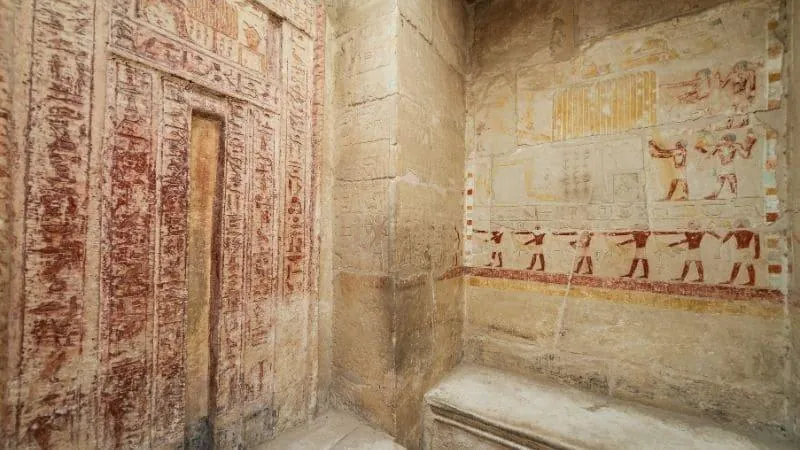
Immediately, the walls come alive with beautifully carved reliefs depicting servants bringing offerings, priests performing rituals, and attendants preparing food for the afterlife.
The entrance served more than a decorative function.
It symbolized the transition between the world of the living and the eternal realm where Mereruka’s spirit would continue to receive offerings from his descendants.
Even today, the craftsmanship displayed in the first rooms sets the tone for the remarkable experience that follows.
The Offering Chapels
At the heart of the mastaba are several offering chapels.
These sacred spaces were where family members and priests presented food, drink, incense, flowers, and prayers to sustain Mereruka’s ka, or life force.
Typical offerings included:
- Bread.
- Beer.
- Meat.
- Poultry.
- Fruits.
- Vegetables.
- Wine.
- Perfumed oils.
Ancient Egyptians believed these symbolic offerings became spiritually available to the deceased, ensuring eternal nourishment.
Many of the beautifully carved offering scenes visible today depict long processions of servants carrying baskets overflowing with provisions.
The False Door
One of the most significant architectural elements within the mastaba is the false door.
Although it resembles an ordinary doorway, it was never intended to open.
Instead, ancient Egyptians believed it served as a magical portal through which the spirit of the deceased could travel between the worlds of the living and the dead.
The false door was typically positioned at the focal point of the offering chapel.
Priests placed food and offerings before it while reciting prayers asking the gods to sustain Mereruka for eternity.
The finely carved inscriptions surrounding the doorway invoke blessings from the gods and identify the tomb owner by his many official titles.
The Serdab Chamber
Hidden within the mastaba is one of its most mysterious features—the serdab.
This small, sealed chamber housed a statue of Mereruka.
Tiny openings in the wall allowed the statue to “observe” ceremonies taking place in the offering chapel while also enabling the deceased’s spirit to receive offerings and prayers.
Should the mummy become damaged, the statue provided an alternative physical form through which the ka could continue to exist.
The concept reflects the ancient Egyptian belief that preserving one’s identity was essential for eternal life.
The Burial Shaft
Like most elite Old Kingdom tombs, the burial chamber itself was located deep beneath the mastaba.
A vertical shaft descends from the superstructure to the underground burial chamber, helping protect the tomb from robbers while symbolically separating the sacred burial space from the world above.
The shaft originally would have been sealed after the burial ceremony.
Although many valuable grave goods disappeared during ancient times, the surviving architecture continues to reveal how carefully these monuments were planned.
The Underground Burial Chamber
At the bottom of the shaft lies the burial chamber where Mereruka was laid to rest.
Compared with the richly decorated upper rooms, the burial chamber is relatively simple.
Its primary purpose was to protect the sarcophagus and ensure the safe preservation of the body.
The contrast between the elaborate chapels above and the plain burial chamber below reflects an important aspect of Old Kingdom funerary design.
Daily rituals and symbolic offerings occurred in the accessible upper chambers, while the actual burial remained hidden and protected beneath the desert.
Built for Three Generations
One feature that makes the Mastaba of Mereruka unique is its family-oriented design.
Rather than honoring only a single individual, the monument contains separate sections dedicated to:
- Mereruka himself.
- His wife, Princess Seshseshet Waatetkhethor, daughter of King Teti.
- His son, Meri-Teti.
Each section includes its own decorated spaces, inscriptions, and symbolic imagery.
This arrangement highlights the importance of family continuity and demonstrates how elite tombs could evolve into dynastic monuments preserving the memory of multiple generations.
The Symbolism Behind the Architecture
Every architectural feature inside the mastaba served a religious purpose.
Nothing was accidental.
The ancient Egyptians believed that architecture itself could help guarantee eternal life.
For example:
| Architectural Feature | Symbolic Meaning |
|---|---|
| Entrance | Transition from the living world to eternity |
| Offering Chapel | Eternal nourishment for the ka |
| False Door | Spiritual gateway between worlds |
| Serdab | Home of the owner’s statue and spirit |
| Burial Shaft | Protection of the deceased |
| Burial Chamber | Eternal resting place |
| Relief Decorations | Ensuring prosperity in the afterlife |
Together, these elements created a carefully designed spiritual environment intended to sustain Mereruka forever.
Engineering Excellence
Although the mastaba lacks the towering height of nearby pyramids, its construction required remarkable precision.
The limestone blocks were carefully cut and fitted together with tight joints, ensuring both structural stability and smooth surfaces suitable for carving detailed reliefs.
The builders also had to consider:
- Weight distribution.
- Roof support.
- Ventilation during construction.
- Drainage.
- Long-term durability.
These engineering solutions demonstrate the high level of technical knowledge achieved during Egypt’s Sixth Dynasty.
The quality of workmanship seen throughout the tomb reflects the expertise of the craftsmen who worked under the royal administration.
Why Architects Admire the Mastaba of Mereruka
While visitors are often captivated by the relief carvings, architects appreciate the mastaba for different reasons.
It represents one of the finest surviving examples of how private funerary architecture evolved alongside royal monuments.
Rather than imitating the pyramids, Mereruka’s tomb developed its own sophisticated architectural language—combining ceremonial spaces, symbolic design, and practical engineering into a harmonious whole.
Its thoughtful layout, careful proportions, and integration of sculpture with architecture make it a masterpiece of Old Kingdom design.
For this reason, the Mastaba of Mereruka is considered essential not only for understanding ancient Egyptian art but also for tracing the evolution of architecture itself.
The Incredible Reliefs of the Mastaba of Mereruka
If the architecture of the Mastaba of Mereruka is impressive, its relief carvings are what truly make it one of the greatest artistic masterpieces of ancient Egypt.
Unlike royal pyramids, where decoration often focuses on religious texts and funerary symbolism, the walls of Mereruka’s tomb celebrate life itself.
Every room tells a different story.
Farmers harvest grain beneath the Egyptian sun. Fishermen cast their nets into the Nile. Hunters pursue wild animals through the marshes. Craftsmen carve statues and build furniture. Musicians perform during celebrations, while priests prepare sacred offerings for eternity.
Together, these scenes create one of the most complete visual records of daily life during Egypt’s Old Kingdom.
For historians, archaeologists, and visitors alike, the Mastaba of Mereruka offers something extraordinary: the chance to observe ancient Egyptian society almost exactly as its people wished to remember it.
Art with a Purpose
The reliefs inside the mastaba were never intended as simple decoration.
Ancient Egyptians believed that images possessed magical power.
Anything carefully carved into the walls could become reality in the afterlife.
By depicting food, servants, animals, boats, and daily activities, Mereruka ensured that these blessings would continue forever.
Each scene was therefore both a work of art and a sacred guarantee of eternal prosperity.
This belief explains why nearly every wall inside the tomb is filled with beautifully organized carvings.
Scenes of Agriculture
Some of the tomb’s finest reliefs portray agricultural life.
Ancient Egypt depended entirely on the annual flooding of the Nile, and successful farming was essential to both the kingdom and the afterlife.
Visitors can observe detailed scenes showing:
- Farmers plowing fields.
- Sowing grain.
- Harvesting wheat and barley.
- Carrying baskets of crops.
- Herding cattle.
- Feeding livestock.
These reliefs demonstrate the remarkable attention Egyptian artists paid to everyday activities.
Individual workers are shown bending, lifting, pulling, and harvesting with astonishing realism.
Even after more than four thousand years, their movements remain immediately recognizable.
Fishing Along the Nile
Fishing scenes are among the most beautiful decorations inside the mastaba.
The Nile provided food, transportation, and economic prosperity, making it one of the most important elements of Egyptian civilization.
Artists portrayed fishermen using:
- Casting nets.
- Harpoons.
- Fishing lines.
- Reed boats.
- Traps.
The surrounding marshes are filled with:
- Tilapia.
- Catfish.
- Water birds.
- Papyrus plants.
- Lotus flowers.
These compositions are admired not only for their artistic quality but also because they provide valuable evidence about the ecology of ancient Egypt.
Hunting in the Marshes
One of the most dynamic themes throughout the mastaba is hunting.
Mereruka is frequently shown as a commanding figure, standing larger than everyone around him while overseeing hunting expeditions through the Nile marshes.
The reliefs include remarkably detailed depictions of:
- Wild birds taking flight.
- Hunters throwing sticks.
- Servants collecting game.
- Dogs assisting during hunts.
- Papyrus thickets filled with wildlife.
These scenes symbolized more than recreation.
For ancient Egyptians, controlling nature represented the triumph of order over chaos—a central theme in Egyptian religion.
Life Inside an Old Kingdom Estate
Perhaps the greatest strength of Mereruka’s tomb is its extraordinary portrayal of ordinary people.
Rather than focusing solely on nobles and priests, the artists filled the walls with scenes of everyday work.
Visitors can see:
- Bakers preparing bread.
- Brewers making beer.
- Butchers processing meat.
- Potters shaping clay vessels.
- Carpenters building furniture.
- Metalworkers crafting tools.
- Textile workers weaving linen.
Each occupation is shown with remarkable precision.
Historians frequently use these reliefs to study ancient Egyptian technology because they preserve details that written records often omit.
Boats on the Nile
Several reliefs illustrate boats traveling along the Nile.
The scenes include:
- Cargo vessels.
- Fishing boats.
- Reed boats.
- Rowers.
- Sailors.
- River transport.
The Nile served as Egypt’s primary highway.
These carvings reveal how goods, people, and building materials moved throughout the kingdom.
They also remind visitors that Mereruka’s wealth depended upon a well-organized administrative system connecting every region of Egypt.
Family Life
Unlike royal monuments, private tombs often emphasize family relationships.
Mereruka appears alongside his wife, Princess Seshseshet Waatetkhethor, and members of his household.
These scenes portray:
- Family gatherings.
- Children.
- Servants.
- Household attendants.
- Domestic activities.
- Banquets.
The warmth expressed through these carvings reminds us that ancient Egyptians valued family life as deeply as modern societies do.
For Mereruka, preserving these relationships in stone ensured they would continue throughout eternity.
Religious Ceremonies
Interwoven with scenes of daily life are numerous religious rituals.
Priests appear performing ceremonies while attendants prepare offerings destined for Mereruka’s spirit.
The reliefs depict:
- Incense burning.
- Libations.
- Offerings of bread.
- Offerings of beer.
- Sacrificial animals.
- Ritual purification.
These scenes reinforced the belief that the deceased required continual spiritual support after death.
They also demonstrate the close relationship between religion and everyday life in ancient Egypt.
Wildlife and Nature
One of the most fascinating aspects of the mastaba is the extraordinary variety of animals carved into its walls.
Visitors can identify:
- Gazelles.
- Cattle.
- Donkeys.
- Monkeys.
- Dogs.
- Birds.
- Geese.
- Ducks.
- Fish.
- Crocodiles.
The artists captured each animal with remarkable accuracy.
Many Egyptologists regard these carvings as some of the finest examples of natural observation produced anywhere in the ancient world.
Artistic Style
The reliefs of Mereruka’s tomb represent the height of Old Kingdom artistic achievement.
Several characteristics distinguish this style:
Balanced Composition
Figures are arranged in carefully organized horizontal registers, creating orderly narratives that guide the viewer through each scene.
Hierarchical Scale
Important individuals appear significantly larger than servants and laborers.
Mereruka dominates almost every composition, visually reinforcing his authority.
Precision
Every tool, plant, bird, and animal was carved with extraordinary attention to detail.
These reliefs serve not only as artistic masterpieces but also as historical documents.
Elegant Hieroglyphs
The inscriptions accompanying each scene identify individuals, describe activities, and invoke blessings for the deceased.
Their clarity reflects the exceptional craftsmanship of Old Kingdom scribes and stone carvers.
A Window into Ancient Egyptian Society
For archaeologists, the Mastaba of Mereruka is invaluable because it documents aspects of daily life rarely preserved elsewhere.
Through its reliefs, researchers gain insight into:
- Agriculture.
- Food production.
- Animal husbandry.
- River transportation.
- Construction methods.
- Clothing.
- Hairstyles.
- Jewelry.
- Furniture.
- Music.
- Religious ceremonies.
- Government administration.
Few monuments provide such a broad picture of Egyptian civilization during the Sixth Dynasty.
This is why Mereruka’s tomb is studied not only by Egyptologists but also by historians, anthropologists, artists, and architects.
Why Visitors Spend So Long Here
Many travelers expect to spend only a few minutes inside the mastaba.
Instead, they often remain far longer.
Every room reveals new details that reward careful observation.
The reliefs are so rich and varied that visitors frequently notice something different each time they look—a hidden animal, a craftsman’s tool, a musician’s instrument, or a beautifully carved hieroglyph.
Unlike the grandeur of the pyramids, the Mastaba of Mereruka offers an intimate connection with the people behind ancient Egypt’s civilization.
Rather than focusing solely on kings, it tells the story of administrators, craftsmen, laborers, families, and communities whose lives helped build one of history’s greatest cultures.
For many visitors, these beautifully preserved scenes become the most memorable part of their visit to Saqqara.
Visiting the Mastaba of Mereruka Today
The Mastaba of Mereruka is one of the highlights of the Saqqara Necropolis, yet many visitors walk past it without realizing they are about to enter one of the finest private tombs ever built in ancient Egypt.
Unlike the pyramids, which impress through their monumental scale, Mereruka’s tomb captivates visitors through its remarkable detail. Every chamber reveals beautifully preserved reliefs that offer a vivid picture of daily life more than 4,300 years ago.
If you’re planning a visit to Saqqara, the Mastaba of Mereruka deserves a place near the top of your itinerary.
Can You Enter the Mastaba of Mereruka?
Yes.
The Mastaba of Mereruka is generally open to visitors as part of the Saqqara archaeological site, allowing travelers to explore its decorated chambers and admire some of the best-preserved Old Kingdom reliefs in Egypt.
Unlike many ancient tombs where only a single room is accessible, Mereruka’s mastaba contains multiple interconnected chambers that visitors can walk through, creating a much more immersive experience.
Because access may occasionally be limited due to conservation work or archaeological projects, it’s always advisable to check current site conditions before visiting.
What You’ll See Inside
Walking through the mastaba feels like stepping into a stone history book.
Every room presents a different aspect of ancient Egyptian life.
Highlights include:
- Massive limestone pillars.
- Beautifully carved offering chapels.
- The famous false door.
- Hunting scenes.
- Fishing scenes.
- Agricultural activities.
- Family portraits.
- Workshops and craftsmen.
- Religious ceremonies.
- Hieroglyphic inscriptions.
Unlike many monuments where decoration is concentrated in a single chamber, Mereruka’s tomb rewards visitors throughout the entire journey.
Almost every room offers something worth studying.
How Long Should You Spend Here?
The ideal visit depends on your interest in history and archaeology.
Quick Visit
20–30 minutes
Perfect for travelers with a packed itinerary who want to see the most famous reliefs.
Recommended Visit
45–60 minutes
This allows enough time to:
- Explore the decorated chambers.
- Examine the relief carvings.
- Read inscriptions with your guide.
- Appreciate the architecture.
- Take photographs where permitted.
History Enthusiasts
60–90 minutes
Egyptology enthusiasts often spend well over an hour inside the mastaba, studying the artistic details and comparing scenes across different rooms.
Opening Hours
The Mastaba of Mereruka follows the operating hours of the Saqqara archaeological site: 8:00 AM to 4:00 PM daily, all year, as listed on the official Egyptian Ministry of Tourism and Antiquities site in October 2026.
Opening hours may occasionally change because of restoration work, archaeological excavations, or public holidays.
Tickets
The Mastaba of Mereruka is located within the Saqqara archaeological complex. The tomb has its own ticket: EGP 200 for foreign adults (EGP 100 for students). The general Saqqara site ticket is EGP 600 (students EGP 300), and an inclusive Saqqara ticket costs EGP 1,400 (students EGP 700). These prices are as listed on the official Egyptian Ministry of Tourism and Antiquities site in October 2026; prices change, so check before you go.
Many visitors choose a guided tour that includes transportation, entrance arrangements, and expert interpretation, making it easier to appreciate the tomb’s historical significance without worrying about logistics.
Best Time to Visit
Saqqara can be visited throughout the year, but the experience is most enjoyable during Egypt’s cooler months.
October to April
This is the ideal season for visiting.
Benefits include:
- Comfortable temperatures.
- Better lighting for photography.
- Pleasant walking conditions.
- More time to explore surrounding monuments.
May to September
Summer afternoons can become extremely hot.
To make the most of your visit:
- Arrive when the site opens.
- Wear lightweight clothing.
- Carry drinking water.
- Bring a hat and sunscreen.
Fortunately, the thick limestone walls of the mastaba help keep many of the interior chambers cooler than the surrounding desert.
Photography Tips
The Mastaba of Mereruka offers exceptional opportunities for photography, especially for visitors interested in archaeology and ancient art.
Exterior Photography
The best time to photograph the mastaba is during the early morning when soft sunlight highlights the texture of the limestone.
Recommended compositions include:
- The entrance façade.
- Wide-angle views showing the mastaba beside the Pyramid of Teti.
- Architectural details around the doorway.
Interior Photography
Inside the tomb:
- Use available light whenever possible.
- Avoid flash photography if restricted.
- Focus on relief details rather than trying to photograph entire rooms.
- Capture close-ups of hieroglyphs, craftsmen, and agricultural scenes.
- Include visitors in a few photographs to illustrate the scale of the chambers.
Always follow the site’s current photography regulations and respect any areas where photography is prohibited.
Accessibility
Because the mastaba is an ancient monument, visitors should expect:
- Uneven limestone floors.
- Narrow passageways.
- Low ceilings in some rooms.
- Stone thresholds.
- Limited accessibility for wheelchairs.
Comfortable walking shoes are strongly recommended.
Visitors with reduced mobility should consult their guide before entering, as some sections may require extra care.
Nearby Attractions
The Mastaba of Mereruka is ideally located within walking distance of many of Saqqara’s most important monuments.
Pyramid of Teti
Just a short walk away, the Pyramid of Teti features beautifully preserved Pyramid Texts and one of the most accessible royal burial chambers in Egypt.
Recommended visit: 30–45 minutes.
Step Pyramid of Djoser
The world’s first pyramid and the masterpiece of Imhotep.
Its vast ceremonial complex marks the beginning of monumental stone architecture.
Recommended visit: 60–90 minutes.
Serapeum of Saqqara
Explore the underground galleries where the sacred Apis Bulls were buried inside enormous stone sarcophagi.
Recommended visit: 45–60 minutes.
Pyramid of Unas
Known for containing the earliest surviving Pyramid Texts, the Pyramid of Unas is one of the most historically significant monuments in Saqqara.
Recommended visit: 30–40 minutes.
Imhotep Museum
Located near the entrance to the archaeological site, the museum displays statues, artifacts, and discoveries that provide valuable context before exploring the necropolis.
Recommended visit: 30–45 minutes.
Suggested Half-Day Saqqara Route
| Time | Attraction |
|---|---|
| 09:00 | Step Pyramid of Djoser |
| 10:15 | Heb-Sed Court |
| 10:45 | Serapeum |
| 11:45 | Pyramid of Unas |
| 12:15 | Pyramid of Teti |
| 01:00 | Mastaba of Mereruka |
Suggested Full-Day Itinerary
| Time | Attraction |
|---|---|
| 08:00 | Depart Cairo |
| 09:00 | Imhotep Museum |
| 09:45 | Step Pyramid |
| 11:00 | Serapeum |
| 12:00 | Pyramid of Unas |
| 12:30 | Pyramid of Teti |
| 01:15 | Mastaba of Mereruka |
| 02:15 | Lunch |
| 03:15 | Memphis |
| 04:30 | Dahshur |
| 06:00 | Return to Cairo |
This route allows visitors to experience the evolution of ancient Egyptian architecture while also discovering the daily life and artistry that flourished alongside the royal monuments.
The Mastaba of Mereruka can be added to a tailor-made day at Saqqara; our private Giza, Saqqara and Dahshur tour covers the Step Pyramid there; see our Cairo day tours for other ways to combine Saqqara with Giza.
Frequently Asked Questions
Why is the Mastaba of Mereruka famous?
It is famous for being the largest and one of the best-preserved private tombs in Saqqara, featuring exceptional reliefs that depict daily life, religious rituals, agriculture, hunting, and craftsmanship during the Old Kingdom.
Who was Mereruka?
Mereruka was the vizier of Pharaoh Teti, the highest-ranking official after the king. He also married Princess Seshseshet Waatetkhethor, a daughter of Teti, strengthening his position within the royal court.
Can visitors enter the tomb?
Yes. Visitors can generally explore many of the decorated chambers, making it one of the most rewarding tombs to visit in Saqqara.
Is the Mastaba of Mereruka worth visiting?
Absolutely. If you want to understand how ancient Egyptians lived—not just how they buried their kings—this tomb provides one of the richest and most detailed windows into Old Kingdom society.
Why the Mastaba of Mereruka Shouldn't Be Missed
While the pyramids showcase the ambition of Egypt's pharaohs, the Mastaba of Mereruka reveals the people who helped govern one of the world's greatest civilizations. Its beautifully carved reliefs, sophisticated architecture, and remarkably preserved scenes of everyday life create an experience unlike any other in Saqqara. For travelers who wish to go beyond Egypt's most famous monuments, this extraordinary tomb offers a deeper appreciation of the artistry, culture, and human stories that defined the Old Kingdom.
Why is the Mastaba of Mereruka famous?
It is famous for being the largest and one of the best-preserved private tombs in Saqqara, featuring exceptional reliefs that depict daily life, religious rituals, agriculture, hunting, and craftsmanship during the Old Kingdom.
Who was Mereruka?
Mereruka was the vizier of Pharaoh Teti, the highest-ranking official after the king. He also married Princess Seshseshet Waatetkhethor, a daughter of Teti, strengthening his position within the royal court.
Can visitors enter the tomb?
Yes. Visitors can generally explore many of the decorated chambers, making it one of the most rewarding tombs to visit in Saqqara.
Is the Mastaba of Mereruka worth visiting?
Absolutely. If you want to understand how ancient Egyptians lived—not just how they buried their kings—this tomb provides one of the richest and most detailed windows into Old Kingdom society.
Why the Mastaba of Mereruka Shouldn't Be Missed
While the pyramids showcase the ambition of Egypt's pharaohs, the Mastaba of Mereruka reveals the people who helped govern one of the world's greatest civilizations. Its beautifully carved reliefs, sophisticated architecture, and remarkably preserved scenes of everyday life create an experience unlike any other in Saqqara. For travelers who wish to go beyond Egypt's most famous monuments, this extraordinary tomb offers a deeper appreciation of the artistry, culture, and human stories that defined the Old Kingdom.
It is famous for being the largest and one of the best-preserved private tombs in Saqqara, featuring exceptional reliefs that depict daily life, religious rituals, agriculture, hunting, and craftsmanship during the Old Kingdom.
Who was Mereruka?
Mereruka was the vizier of Pharaoh Teti, the highest-ranking official after the king. He also married Princess Seshseshet Waatetkhethor, a daughter of Teti, strengthening his position within the royal court.
Can visitors enter the tomb?
Yes. Visitors can generally explore many of the decorated chambers, making it one of the most rewarding tombs to visit in Saqqara.
How long should I spend at the Mastaba of Mereruka?
Most visitors spend 45–60 minutes, while history enthusiasts may wish to allow up to 90 minutes to fully appreciate the artwork and inscriptions.
Is the Mastaba of Mereruka worth visiting?
Absolutely. If you want to understand how ancient Egyptians lived—not just how they buried their kings—this tomb provides one of the richest and most detailed windows into Old Kingdom society.
Why the Mastaba of Mereruka Shouldn’t Be Missed
While the pyramids showcase the ambition of Egypt’s pharaohs, the Mastaba of Mereruka reveals the people who helped govern one of the world’s greatest civilizations.
Its beautifully carved reliefs, sophisticated architecture, and remarkably preserved scenes of everyday life create an experience unlike any other in Saqqara.
For travelers who wish to go beyond Egypt’s most famous monuments, this extraordinary tomb offers a deeper appreciation of the artistry, culture, and human stories that defined the Old Kingdom.
Plan Your Visit with Delta Tours Egypt
The Mastaba of Mereruka is far more than an ancient tomb—it is one of the best-preserved windows into everyday life during Egypt’s Old Kingdom. While the nearby pyramids showcase the ambition of kings, Mereruka’s tomb reveals the people who governed the kingdom, managed its economy, and shaped one of history’s greatest civilizations.
Its remarkable architecture, beautifully carved reliefs, and peaceful atmosphere make it one of Saqqara’s most rewarding monuments, especially for travelers who want to experience Egypt beyond its most famous landmarks.
At Delta Tours Egypt, we believe the true magic of Saqqara lies in understanding the stories behind its monuments. Our private Egyptologist guides bring these reliefs to life, explaining the symbolism, history, and fascinating details that many visitors would otherwise miss.
Whether you’re exploring Saqqara as part of a day trip from Cairo or a longer journey through Egypt, we’ll help you experience this extraordinary UNESCO World Heritage Site in comfort and at your own pace.
If you’re planning your journey, explore our Luxury Egypt Tours, where Saqqara is combined with iconic destinations such as the Pyramids of Giza, the Grand Egyptian Museum, Luxor, Aswan, and a luxury Nile cruise.
Recommended Saqqara Itinerary
For the best experience, we recommend visiting the monuments in the following order:
- Imhotep Museum
- Step Pyramid of Djoser
- Heb-Sed Court
- Pyramid of Unas
- Serapeum of Saqqara
- Pyramid of Teti
- Mastaba of Mereruka
- Memphis
- Dahshur
This route follows the historical development of ancient Egyptian architecture while minimizing walking and transportation time.
Related Articles
Continue exploring the Saqqara Necropolis with our detailed guides:
- Saqqara Travel Guide – Everything you need to know before visiting Egypt’s oldest royal necropolis.
- Step Pyramid of Djoser – Discover the world’s first pyramid and Imhotep’s architectural masterpiece.
- Who Was Imhotep? – Learn about the genius who revolutionized architecture and became one of ancient Egypt’s most celebrated figures.
- Serapeum of Saqqara – Explore the underground galleries of the sacred Apis bulls.
- Pyramid of Unas – Discover the earliest surviving Pyramid Texts.
- Pyramid of Teti – Visit one of Egypt’s most fascinating royal tombs.