The Serapeum of Saqqara: History, Sacred Apis Bulls & Complete Visitor Guide (2026)
Beneath the quiet desert plateau of Saqqara lies one of ancient Egypt’s most mysterious and awe-inspiring monuments.
Hidden below the sand is the Serapeum of Saqqara, a vast underground complex of tunnels and chambers that served for centuries as the burial place of the sacred Apis Bulls. Unlike the towering pyramids above ground, the Serapeum offers visitors a completely different experience—descending into cool limestone galleries lined with enormous stone sarcophagi that continue to puzzle archaeologists and engineers alike.
Each Apis Bull was believed to be the living manifestation of Ptah, the creator god of ancient Memphis. When one of these sacred animals died, it was honored with elaborate funerary ceremonies; from the 26th Dynasty onward, the bulls were placed inside colossal stone sarcophagi weighing roughly 40 tons each, with lids of about 24 tons. Cut from several hard stones (granite, some of it brought hundreds of kilometers from Aswan, as well as basalt, greywacke and diorite) and carved with remarkable precision, these coffins remain among the greatest engineering achievements of the ancient world.
Rediscovered in 1850 by the French archaeologist Auguste Mariette, the Serapeum transformed our understanding of ancient Egyptian religion, animal worship, and funerary traditions. Today, it is considered one of the highlights of Saqqara and an essential stop for travelers interested in archaeology, mythology, and ancient engineering.
Whether you are visiting Saqqara for the first time or returning to explore beyond the famous Step Pyramid, the Serapeum promises one of the most unforgettable experiences in Egypt.
Quick Facts About the Serapeum
| Feature | Details |
|---|---|
| Location | Saqqara Necropolis, Egypt |
| Purpose | Burial place of the sacred Apis Bulls |
| Discovered By | Auguste Mariette |
| Discovery Year | 1850 |
| Period of Use | New Kingdom to the Ptolemaic Period; the giant stone coffers date from the 26th Dynasty (Amasis II, c. 550 BC) onward |
| Sarcophagus Weight | About 40 tons per box, lids about 24 tons; heaviest box and lid up to about 62 tons |
| Material | Granite, basalt/greywacke and diorite |
| Recommended Visit | 45–60 minutes |
| UNESCO Status | Part of the Memphis and its Necropolis World Heritage Site |
What Is the Serapeum of Saqqara?
The Serapeum is one of the most remarkable religious monuments in ancient Egypt.
Rather than serving as the tomb of a king, queen, or nobleman, it was created as the final resting place of the Apis Bulls, animals regarded as living incarnations of the god Ptah.
In ancient Egyptian religion, the Apis Bull was not an ordinary animal. Priests carefully selected each bull based on specific physical markings that were believed to identify it as divine. Once chosen, the animal lived within the temple precincts at Memphis, where it was cared for by priests and honored through daily rituals.
Upon its death, the bull underwent an elaborate mummification process comparable to that of a pharaoh. After weeks of preparation, the sacred remains were transported to Saqqara for burial; from the 26th Dynasty onward, they were placed within the enormous stone sarcophagi that still line the underground galleries today.
This extraordinary tradition continued for more than a thousand years, demonstrating the immense religious importance of the Apis cult in ancient Egyptian society.
Unlike many monuments built for human rulers, the Serapeum reflects the unique relationship between religion, kingship, and the natural world in ancient Egypt.
Why Was the Apis Bull Sacred?
To understand the Serapeum, it is first necessary to understand the importance of the Apis Bull itself.
The Apis Bull was believed to be the earthly manifestation of Ptah, the patron god of craftsmen, architects, and the ancient capital of Memphis.
According to Egyptian belief, Ptah communicated his divine will through the living bull. The animal therefore became an intermediary between the gods and humanity, receiving reverence from priests, kings, and ordinary Egyptians alike.
Each Apis Bull was identified by a series of sacred markings, including:
- A white triangular marking on the forehead.
- Distinctive patterns across the body.
- A unique shape beneath the tongue.
- Special markings on the tail.
When an Apis Bull died, priests searched throughout Egypt for its successor, ensuring that the divine presence of Ptah continued uninterrupted.
Over time, the cult of the Apis Bull became so influential that later Greek rulers associated the bull with Osiris, creating the combined deity Serapis, from which the name Serapeum is derived.
The Discovery of the Serapeum
For centuries, the location of the Serapeum was forgotten beneath the desert sands.
Everything changed in 1850, when French archaeologist Auguste Mariette noticed a partially buried avenue of sphinxes while exploring Saqqara.
Believing the sphinxes must have led to an important monument, he began excavating the area.
His work eventually revealed one of the greatest archaeological discoveries of the nineteenth century.
Hidden beneath the desert was an extensive underground necropolis containing dozens of enormous stone sarcophagi, each weighing roughly 40 tons.
Although many burial chambers had been looted in antiquity, Mariette’s discovery fundamentally changed historians’ understanding of Egyptian religion and established the Serapeum as one of Saqqara’s most important monuments.
Today, visitors still enter the site through the same underground galleries first revealed by Mariette more than 170 years ago.
Why the Serapeum Fascinates Engineers
The Serapeum is famous not only for its religious significance but also for the extraordinary engineering required to construct it.
Each sarcophagus was carved from a single block of hard stone: granite, some of it quarried in Aswan approximately 900 kilometers (560 miles) south of Saqqara, as well as basalt, greywacke and diorite.
Transporting these massive blocks across the Nile Valley and lowering them into underground chambers represented one of the greatest logistical achievements of the ancient world.
Even with modern technology, moving objects of this size through narrow underground passages would be a challenging operation.
The precision of the polished stone surfaces has also attracted attention from engineers and archaeologists, demonstrating the exceptional craftsmanship of ancient Egyptian stonemasons.
For many visitors, standing beside one of these colossal sarcophagi is the moment they truly appreciate the remarkable skill of the civilization that created them.
Inside the Serapeum: Exploring Egypt’s Underground Wonder
Descending into the Serapeum is unlike entering any other archaeological monument in Egypt.
Unlike the towering pyramids that dominate the skyline of Saqqara, the Serapeum remains almost invisible from the surface. Only after walking through its entrance passage do visitors begin to understand the extraordinary scale of what lies beneath the desert.
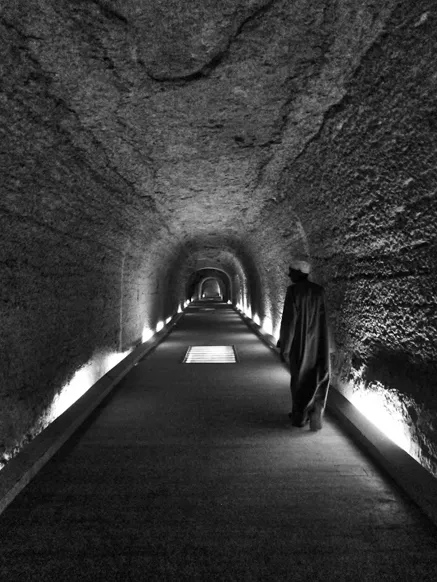
The temperature drops noticeably, natural light fades away, and a network of long limestone galleries stretches into the darkness. Massive stone sarcophagi stand silently inside side chambers, creating an atmosphere that is both mysterious and awe-inspiring.
For many travelers, this becomes the most memorable part of their visit to Saqqara.
The Underground Galleries
The Serapeum consists of two principal burial systems developed over many centuries.
The earliest burials took place in individual tombs connected by passages. As the cult of the Apis Bull grew in importance, Egyptian architects expanded the complex by constructing the famous Great Vault, a long underground corridor with enormous burial chambers on either side, whose giant stone coffers date from the 26th Dynasty (Amasis II, c. 550 BC) into the Ptolemaic period.
Walking through these galleries today allows visitors to appreciate both the engineering skills of ancient Egypt and the religious significance of the monument.
Unlike royal pyramids, which focused on a single king, the Serapeum remained in continuous use for centuries as successive sacred bulls were honored and buried.
This gradual expansion explains why different architectural styles can be observed throughout the monument.
The Giant Sarcophagi
The first sight of one of these sarcophagi leaves almost every visitor speechless.
Each coffin is carved from a single block of hard stone. Some are granite, including granite from the quarries of Aswan, nearly 900 kilometers (560 miles) from Saqqara; others are basalt, greywacke or diorite.
Some of these sarcophagi measure more than 4 meters in length, nearly 2.5 meters in width, and weigh roughly 40 tons.
The lids alone weigh about 24 tons, so the heaviest box and lid together reach about 62 tons.
Even more astonishing is the precision of their construction.
The interior surfaces are remarkably smooth, the corners are carefully squared, and the lids fit with extraordinary accuracy despite their immense weight.
These achievements continue to inspire discussions among engineers studying ancient construction techniques.
How Were These Massive Coffins Moved?
One of the greatest mysteries surrounding the Serapeum concerns transportation.
How did ancient Egyptians move such enormous blocks of hard stone from distant quarries to Saqqara?
Although no written record provides a complete answer, archaeologists believe the process involved several stages.
Quarrying
Workers extracted the hard stone using dolerite pounding stones, copper tools, and wooden wedges.
The blocks were shaped directly at the quarry before transportation began.
River Transport
Once prepared, the stone was loaded onto large barges during the annual Nile flood.
The river acted as Egypt’s primary transportation network, allowing heavy stone to move efficiently toward Memphis.
Overland Transport
From the Nile, workers dragged the sarcophagi across prepared roads using wooden sledges.
Recent experimental archaeology suggests that wetting the sand significantly reduced friction, making transportation far more efficient.
Lowering into the Chambers
The greatest mystery remains the final stage.
How these enormous sarcophagi were lowered into underground chambers and accurately positioned continues to be debated.
Some researchers suggest carefully engineered ramps and counterweight systems, while others believe temporary earthen embankments were constructed and later removed.
Although no definitive explanation exists, the precision of the finished monument demonstrates the remarkable abilities of ancient Egyptian engineers.
Were the Sarcophagi Empty?
Visitors often notice something surprising.
Many of the stone sarcophagi appear empty today.
This has led to countless myths and sensational theories.
The historical explanation is much simpler.
Over thousands of years, many chambers were entered by tomb robbers searching for precious metals, jewelry, and valuable funerary objects.
Organic materials—including the mummified remains of the Apis Bulls—deteriorated naturally or disappeared during these ancient robberies.
Archaeological evidence nevertheless confirms that the Serapeum functioned as the burial place of the sacred bulls for centuries.
The absence of complete burials today does not diminish the monument’s historical importance.
Ancient Rituals at the Serapeum
The burial of an Apis Bull was one of the most important religious ceremonies in ancient Egypt.
When a sacred bull died, priests observed a period of national mourning.
The animal underwent an elaborate mummification process lasting approximately seventy days, similar to the treatment given to Egyptian kings.
Following preparation, a magnificent funeral procession transported the bull from Memphis to Saqqara.
Priests, officials, musicians, and worshippers accompanied the sacred procession before the animal was placed inside its stone sarcophagus.
Offerings of food, incense, oils, flowers, and prayers were presented to ensure the continued protection of Egypt by the divine spirit of Ptah.
These ceremonies demonstrate the extraordinary reverence ancient Egyptians held for the Apis Bull.
The Connection Between Memphis and the Serapeum
The Serapeum cannot be understood without understanding Memphis.
Located only a few kilometers north of Saqqara, Memphis served as the political and religious capital of Egypt for much of the Old Kingdom.
The Temple of Ptah in Memphis housed the living Apis Bull.
Pilgrims traveled from across Egypt to seek blessings from the sacred animal.
After the bull’s death, the ceremonial journey from Memphis to Saqqara symbolized its passage from the world of the living into eternity.
For this reason, many visitors choose to combine both sites during the same excursion.
Together they tell the complete story of one of Egypt’s most important religious traditions.
Visiting the Serapeum Today: Everything You Need to Know
For many travelers, the Serapeum becomes the highlight of their visit to Saqqara.
Unlike the bright open spaces surrounding the Step Pyramid, the Serapeum offers a completely different atmosphere. As you descend below the desert surface, the noise of the outside world fades away, replaced by cool air, dim lighting, and the silent presence of one of Egypt’s most mysterious monuments.
Whether you are fascinated by archaeology, ancient engineering, or Egyptian religion, exploring the Serapeum is an unforgettable experience that adds a new dimension to any visit to Saqqara.
What to Expect During Your Visit
Your visit begins at the entrance to the underground galleries.
After descending a short passageway, visitors enter the famous Great Vault, where enormous burial chambers branch off from the main corridor.
Each chamber houses a colossal stone sarcophagus that once contained the mummified remains of an Apis Bull.
Unlike many Egyptian monuments, the Serapeum does not impress through towering architecture.
Instead, it captivates visitors through:
- The immense size of the stone sarcophagi.
- The silence of the underground galleries.
- The precision of ancient stonework.
- The mysterious atmosphere created by centuries of history.
- The realization that these chambers were once among the holiest places in ancient Egypt.
Most visitors spend much of their time simply standing beside the enormous sarcophagi, trying to comprehend how ancient engineers accomplished such an extraordinary feat.
How Long Should You Spend at the Serapeum?
The ideal visit depends on your level of interest.
Quick Visit
30–40 minutes
Suitable for travelers combining several monuments within Saqqara.
Recommended Visit
45–60 minutes
This allows enough time to explore the galleries, admire the sarcophagi, take photographs where permitted, and appreciate the historical significance of the monument.
Archaeology Enthusiasts
60–90 minutes
History lovers often spend longer examining the engineering, inscriptions, and architectural layout of the underground chambers.
Opening Hours
The Serapeum follows the opening hours of the Saqqara archaeological site: 8:00 AM to 4:00 PM daily, all year, as listed on the official Egyptian Ministry of Tourism and Antiquities site in October 2026.
Opening hours may occasionally change because of archaeological work, restoration projects, or public holidays.
Tickets
The Serapeum has its own ticket, sold separately from the general Saqqara site ticket: EGP 340 for foreign adults (EGP 170 for students), while the site ticket is EGP 600 (students EGP 300), as listed on the official Egyptian Ministry of Tourism and Antiquities site in October 2026; prices change, so check before you go. Ticket policies also occasionally change as new conservation measures are introduced.
For the most convenient experience, many visitors choose a private guided tour where transportation, entrance arrangements, and expert explanations are handled in advance.
Best Time to Visit
Although the Serapeum is underground, the timing of your visit still matters.
Early Morning
8:30 AM – 10:30 AM
Advantages:
- Cooler temperatures before exploring the rest of Saqqara.
- Fewer visitors.
- Better opportunity to enjoy the galleries in relative silence.
Late Morning
Ideal if you’re following the typical Saqqara route:
- Step Pyramid
- Heb-Sed Court
- South Tomb
- Serapeum
This sequence follows the natural layout of the archaeological site.
Photography Tips
Photography inside the Serapeum creates unique opportunities, but the underground environment presents certain challenges.
To achieve the best results:
- Increase ISO rather than using flash.
- Keep your camera steady or use image stabilization.
- Capture the full scale of each sarcophagus by including a person for perspective.
- Photograph along the length of the galleries to emphasize their dramatic symmetry.
Outside the Serapeum, the surrounding desert landscape also offers beautiful opportunities to photograph the entrance and nearby monuments.
Always follow current photography regulations, as rules may change.
Accessibility
Because the Serapeum is located underground, visitors should be aware of several practical considerations.
The monument includes:
- Descending ramps or steps.
- Uneven stone floors.
- Limited natural lighting.
- Narrow passages in certain areas.
Visitors with mobility limitations should consult their guide before entering.
Although the galleries are spacious once inside, access may be difficult for wheelchairs or anyone unable to negotiate stairs.
Tips for Visiting the Serapeum
To make the most of your experience:
✔ Visit early in the day.
✔ Wear comfortable walking shoes.
✔ Bring water for the rest of your Saqqara visit.
✔ Allow time to explore nearby monuments.
✔ Take a guided tour if you want to understand the religious significance of the site.
✔ Don’t rush—many visitors spend several minutes simply appreciating the incredible engineering.
Combine the Serapeum with Other Attractions
The Serapeum is ideally located within the Saqqara Necropolis, making it easy to combine with several other remarkable monuments.
Step Pyramid of Djoser
Only a short walk away, the world’s first pyramid provides the perfect introduction to Saqqara.
Recommended time:
60–90 minutes
Mastaba of Mereruka
One of Egypt’s finest decorated private tombs.
Recommended time:
30 minutes
Mastaba of Ti
Beautiful relief carvings depicting everyday life in ancient Egypt.
Recommended time:
25 minutes
Pyramid of Unas
Home to the oldest known Pyramid Texts.
Recommended time:
20 minutes
Imhotep Museum
Excellent for understanding the discoveries made throughout Saqqara.
Recommended time:
30–45 minutes
Suggested Half-Day Route
| Time | Attraction |
|---|---|
| 09:00 | Step Pyramid |
| 10:00 | Heb-Sed Court |
| 10:30 | South Tomb |
| 11:00 | Serapeum |
| 12:00 | Mastaba of Mereruka |
| 12:30 | Mastaba of Ti |
| 01:15 | Imhotep Museum |
Why the Serapeum Is Often Missed
Surprisingly, many group tours spend only a short time at the Serapeum—or skip it altogether.
There are several reasons:
- Tight itineraries focused on the Step Pyramid.
- Visitors unaware of its significance.
- Limited time during half-day excursions.
However, travelers who include the Serapeum often describe it as one of the most fascinating monuments they visited in Egypt. Its combination of mystery, engineering, and religious history offers a completely different perspective from the country’s more famous temples and pyramids.
For anyone interested in understanding the spiritual beliefs of ancient Egypt, the Serapeum is an essential stop.
Legacy, Religion & Why the Serapeum Matters Today
Standing inside the silent galleries of the Serapeum, it is impossible not to wonder what this place meant to the ancient Egyptians.
To modern visitors, the giant sarcophagi are extraordinary engineering achievements. To the priests of ancient Memphis, however, they represented something far greater. Each chamber was considered a sacred space where a divine being prepared for eternal life.
The Serapeum was not simply a cemetery.
It was one of the holiest religious sites in Egypt for more than a thousand years.
The Cult of the Apis Bull
The religious importance of the Serapeum revolved around one extraordinary animal—the Apis Bull.
Unlike ordinary cattle, each Apis Bull was believed to embody the living spirit of Ptah, the creator god and patron deity of Memphis.
Priests searched throughout Egypt for a calf displaying a unique combination of sacred markings described in religious tradition. Once identified, the animal was transported to Memphis, where it lived within the temple precinct under constant care and protection.
The bull became a national symbol.
Kings sought its blessing before major events, pilgrims traveled great distances to witness it, and priests interpreted its behavior as messages from the gods.
When the Apis Bull died, Egypt entered a period of mourning. The elaborate funeral that followed reflected the belief that the divine spirit had not disappeared—it had simply completed one earthly existence before returning to the gods.
This explains why each burial within the Serapeum was treated with the same respect normally reserved for a pharaoh.
From Apis to Serapis
The history of the Serapeum did not end with the ancient Egyptian pharaohs.
Following Alexander the Great’s conquest of Egypt in 332 BC, the country entered the Ptolemaic Period, during which Greek and Egyptian religious traditions began to merge.
The Ptolemies sought a deity who could unite both cultures.
The result was Serapis, a new god combining characteristics of:
- Osiris, god of the afterlife.
- Apis, the sacred bull of Memphis.
- Greek divine imagery and philosophy.
It is from this fusion that the name Serapeum originates.
Although the monument itself was much older, the Greek name became widely adopted and remains in use today.
The evolution from Apis to Serapis demonstrates how Egyptian religious traditions adapted while continuing to influence Mediterranean civilizations for centuries.
Why the Serapeum Is Unique
Egypt is filled with magnificent temples, pyramids, and tombs, but no other monument offers an experience quite like the Serapeum.
Its uniqueness lies in several remarkable characteristics.
It Honors Animals Rather Than Kings
Most Egyptian monuments celebrate the lives and achievements of pharaohs.
The Serapeum instead reflects the worship of sacred animals believed to embody divine power.
It Is Entirely Underground
Unlike Karnak Temple or the Pyramids of Giza, the Serapeum reveals its grandeur beneath the surface.
Its dramatic atmosphere is created not by towering architecture but by darkness, silence, and immense subterranean chambers.
It Demonstrates Extraordinary Engineering
The giant stone sarcophagi remain among the largest stone coffins ever produced in antiquity.
Their transportation, carving, and installation continue to inspire engineers today.
It Represents More Than a Thousand Years of Continuous Use
Very few archaeological sites in Egypt remained active for such an extended period.
Generation after generation, priests expanded the underground galleries as new Apis Bulls were buried, making the Serapeum one of Egypt’s longest-serving sacred monuments.
Common Myths About the Serapeum
Because of its mysterious appearance, the Serapeum has become the focus of many sensational claims.
Let’s separate fact from fiction.
Myth 1: The Sarcophagi Were Built by an Unknown Civilization
Reality:
Archaeological evidence clearly attributes the construction and expansion of the Serapeum to ancient Egyptian builders over several historical periods. Inscriptions, historical records, and excavation findings support this conclusion.
Myth 2: The Giant Stone Boxes Were Impossible to Build
Reality:
Although the sarcophagi are extraordinary, they reflect the exceptional skill of Egyptian stonemasons rather than impossible technology.
Ancient Egyptians had centuries of experience quarrying, transporting, and shaping granite, as demonstrated by obelisks, temple columns, statues, and royal sarcophagi throughout Egypt.
Myth 3: The Sarcophagi Were Never Used
Reality:
Historical records, inscriptions, and archaeological discoveries confirm that the chambers served as burial places for successive Apis Bulls.
The absence of complete mummies today is primarily the result of ancient tomb robbery and natural deterioration over thousands of years.
Rather than diminishing the monument, this makes it even more impressive.
The Serapeum stands as a testament to the ingenuity, organization, and technical expertise of one of history’s greatest civilizations.
Why Every Visitor Should Include the Serapeum
Many visitors arrive at Saqqara intending only to see the Step Pyramid.
While the Step Pyramid tells the story of architectural innovation, the Serapeum reveals another equally fascinating aspect of ancient Egypt—its religion.
Together these monuments provide a far more complete understanding of Egyptian civilization.
The Step Pyramid explains how Egyptians built.
The Serapeum explains what Egyptians believed.
Visiting both allows travelers to appreciate the remarkable relationship between engineering, spirituality, and kingship that shaped one of history’s greatest civilizations.
The Serapeum can be added to a day at Saqqara when you plan a tailor-made trip; our private Giza, Saqqara and Dahshur tour covers the Step Pyramid at Saqqara; our Cairo tours and excursions list other combinations.
Frequently Asked Questions
What is the Serapeum of Saqqara?
The Serapeum is an underground burial complex within the Saqqara Necropolis where the sacred Apis Bulls were buried after elaborate religious ceremonies.
Why were the Apis Bulls important?
The Apis Bulls were believed to be the living manifestations of the god Ptah and later became associated with Osiris. They played a central role in the religious life of ancient Memphis.
Who discovered the Serapeum?
French archaeologist Auguste Mariette rediscovered the Serapeum in 1850 after following a partially buried avenue of sphinxes at Saqqara.
Can visitors enter the Serapeum?
Yes. When open to the public, visitors can walk through the underground galleries and see several of the enormous stone sarcophagi.
How long does a visit take?
Most travelers spend 45 to 60 minutes exploring the monument, though archaeology enthusiasts often stay longer.
Is the Serapeum suitable for children?
Yes, although younger children should be supervised because of the underground passages and low-light conditions. Older children interested in history and archaeology usually find the monument particularly fascinating.
Continue Exploring Saqqara
If you’re interested in learning more about the remarkable monuments surrounding the Serapeum, continue with these guides:
- Saqqara, Egypt: Complete Visitor Guide
- Step Pyramid of Djoser
- Pyramid of Unas
- Pyramid of Teti
- Mastaba of Mereruka
- Who Was Imhotep?
Why Visit the Serapeum with Delta Tours Egypt?
The Serapeum is a monument that rewards explanation.
Without understanding the story of the Apis Bull, the religious importance of Memphis, or the extraordinary engineering behind the giant sarcophagi, many visitors leave without fully appreciating what they have seen.
At Delta Tours Egypt, our private Saqqara tours are designed to bring these stories to life.
Our licensed Egyptologists explain not only the history of the monument but also the beliefs, rituals, and engineering achievements that make the Serapeum one of Egypt’s most fascinating archaeological discoveries.
Our private tours include:
- Hotel pickup and drop-off in Cairo or Giza.
- Comfortable private transportation.
- Licensed Egyptologist guide.
- Flexible itinerary.
- Visits to the Step Pyramid, the Bent and Red Pyramids at Dahshur and the Giza pyramids, with other Saqqara sites on request.
- Plenty of time for photography and exploration.
- Personalized recommendations throughout the day.
Whether you are an archaeology enthusiast or simply looking to experience a quieter side of ancient Egypt, we’ll help you discover the remarkable history hidden beneath the sands of Saqqara.
Recommended One-Day Itinerary
The Serapeum is best explored as part of a full-day journey through the ancient necropolis.
| Time | Activity |
|---|---|
| 08:00 | Depart Cairo |
| 09:00 | Step Pyramid of Djoser |
| 10:15 | Heb-Sed Court & Entrance Colonnade |
| 11:00 | Explore the Serapeum |
| 12:00 | Mastaba of Mereruka |
| 12:40 | Mastaba of Ti |
| 01:30 | Lunch |
| 02:30 | Memphis |
| 03:30 | Dahshur |
| 06:00 | Return to Cairo |
This route allows visitors to experience the evolution of pyramid construction while also discovering one of the most sacred underground monuments in ancient Egypt.
Serapeum vs. Other Underground Monuments in Egypt
| Monument | Why Visit |
|---|---|
| Serapeum of Saqqara | Massive stone sarcophagi and the burial place of the sacred Apis Bulls |
| Great Pyramid of Giza | Royal burial chambers and the Grand Gallery |
| Bent Pyramid | Rare opportunity to explore two internal chamber systems |
| Red Pyramid | The first successful true pyramid with one of Egypt’s best-preserved interiors |
| Catacombs of Kom El Shoqafa | Roman-Egyptian underground cemetery in Alexandria |
Each monument offers a unique perspective on ancient burial traditions, but the Serapeum stands apart because it was created for sacred animals rather than royalty.