Grand Egyptian Museum Guide
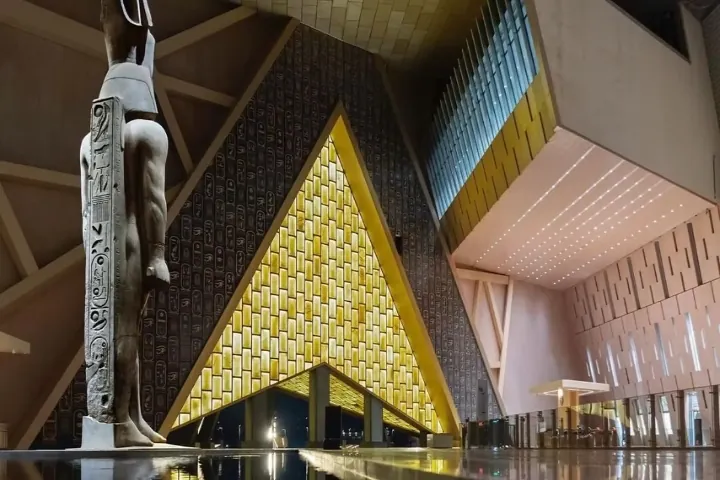
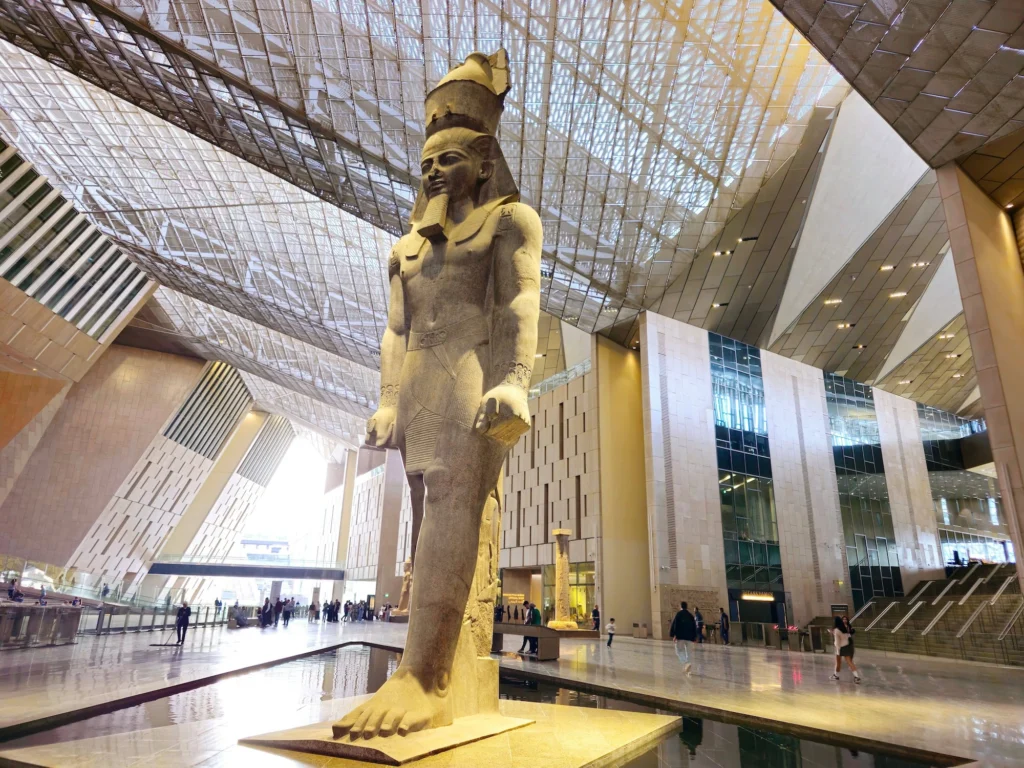
The first sight that stops many visitors inside the Grand Egyptian Museum is not a golden mask. It is the colossal figure of Ramesses II, standing beneath a vast contemporary roof as though ancient Egypt has stepped into the architecture of the twenty-first century. Beyond him, the Grand Stairs rise past kings, gods, temples, and funerary monuments toward a view that reconnects the museum with the pyramids of Giza.
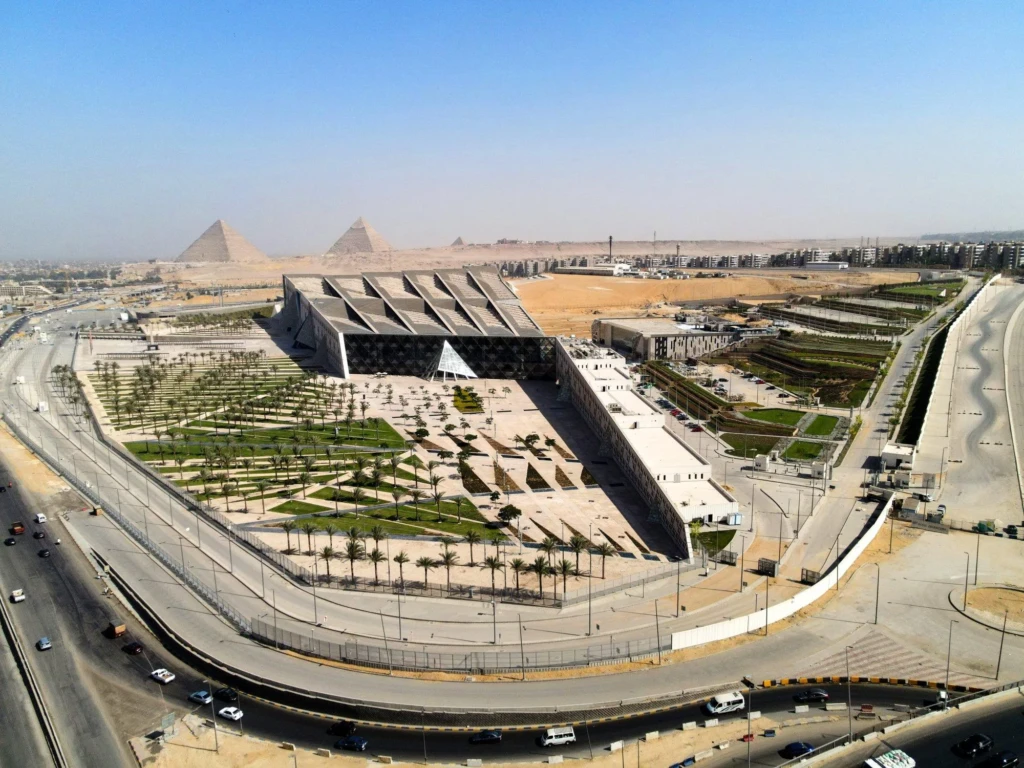
That relationship defines the experience. The Grand Egyptian Museum—widely known as GEM—is not simply a larger replacement for the Egyptian Museum in Tahrir Square. It is a purpose-built archaeological museum on the edge of the Giza Plateau, designed to tell the story of ancient Egyptian civilization through monumental objects, historical themes, conservation, landscape, and modern interpretation.
After years of anticipation and phased trial operations, GEM’s official inauguration took place on November 1, 2025, and the museum opened to the public on November 4. As of October 10, 2026, visitors can access the Tutankhamun Galleries, Main Galleries, Grand Hall, Grand Stairs, Khufu’s Boats Museum, exterior gardens, and commercial areas with the appropriate admission ticket.
For travelers asking whether the Grand Egyptian Museum GEM is worth including in a Cairo itinerary, the short answer is yes—especially if this is your first journey to Egypt. Yet its enormous scale rewards preparation. The right route, enough time, an advance ticket, and an Egyptologist who can connect objects to the places you will visit can transform a beautiful museum into the intellectual center of your trip.
The Grand Egyptian Museum at a Glance
| Essential fact | Current visitor information |
|---|---|
| Location | Giza, close to the Giza Pyramids Plateau and west of central Cairo |
| Official opening | Inaugurated November 1, 2025; public opening November 4, 2025 |
| Main experiences | Grand Hall, Grand Stairs, Main Galleries, Tutankhamun Galleries, Khufu’s Boats Museum, gardens, dining, and shopping |
| Recommended visit | 4–5 hours for highlights; most of a day for a deeper visit |
| Best pairing | Giza Pyramids on a carefully paced full day, or the museum on a separate day |
| Tickets | Date- and time-specific tickets through the official GEM ticketing website |
| Evening hours | Extended gallery hours on Wednesday and Saturday, subject to change |
| Best for | First-time visitors, families, history enthusiasts, photographers, and travelers seeking a modern, accessible museum experience |
Is the Grand Egyptian Museum Fully Open?
Yes. This is important because many older articles still describe partial access, trial openings, unavailable Tutankhamun galleries, or a future grand opening. Those details are now outdated.
The museum’s official ticketing platform currently states that general visits include:
- The Tutankhamun Galleries
- The Main Galleries
- The Grand Hall
- The Grand Stairs
- Khufu’s Boats Museum
- The commercial area
- The exterior gardens
Temporary exhibitions, children’s programs, guided experiences, mixed-reality activities, and special events may have their own schedules, capacity limits, or additional booking requirements. Check the exact inclusions displayed for your selected ticket rather than assuming that every event or add-on is part of general admission.
A correction to a common misunderstanding
GEM displays Tutankhamun’s funerary collection; it does not contain his archaeological tomb. The tomb known as KV62 remains in the Valley of the Kings near Luxor. Museum galleries can recreate context and reunite objects, but the excavated burial place and the displayed collection are different experiences.
This distinction matters when comparing a museum visit in Giza with a future journey through Luxor. One reveals the craftsmanship, symbolism, and material world of the young king in extraordinary depth. The other places you inside the royal necropolis where the burial was discovered.
Why Was the Grand Egyptian Museum Built?
Egypt needed more than additional display space. It needed a museum capable of presenting monumental objects at the scale for which they were created, conserving a vast national collection, supporting research, welcoming large international audiences, and telling ancient Egyptian history through a modern interpretive plan.
The historic Egyptian Museum of Antiquities in Tahrir opened in 1902 and remains an essential institution. Its densely layered galleries and neoclassical building belong to the history of Egyptology itself. Yet the building was never designed for the visitor numbers, conservation systems, monumental installations, or interpretive technologies expected of a major twenty-first-century museum.
GEM answers a different brief. Its position between metropolitan Cairo and the desert edge at Giza creates a physical and intellectual bridge: artifacts excavated from temples, settlements, tombs, and royal complexes are displayed within sight of the pyramid landscape that produced some of them.
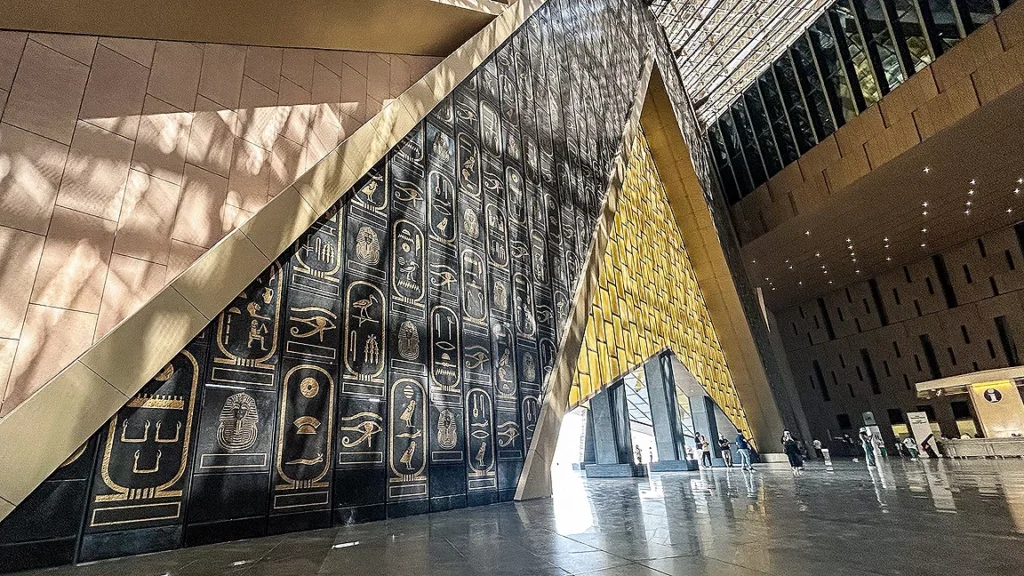
The project developed through an international architectural competition won by Heneghan Peng Architects. The architects describe a site shaped by a roughly 50-meter difference in level where Cairo meets the desert plateau. Rather than competing visually with the pyramids, the museum’s geometry, long lines, layered stone surfaces, and controlled views establish a dialogue with them.
This is why the building should not be treated merely as a container. The approach, entrance sequence, great interior spaces, framed landscape, and ascent through the museum are part of the story.
How to Understand the Museum’s Layout
The GEM Grand Egyptian Museum is easier to navigate when you imagine it as a sequence rather than a collection of disconnected rooms.
1. The Grand Hall: a monumental welcome
The colossus of Ramesses II establishes the scale immediately. The statue is not placed in a conventional room with a low ceiling; it occupies an immense public space where visitors can walk around it and observe the changing relationship between sculpture and architecture.
Pause before rushing upstairs. Look at how a royal image communicates authority through size, stance, idealized features, inscriptions, and placement. This visual language will reappear throughout the museum.
2. The Grand Stairs: kingship in motion
The monumental staircase functions as an exhibition route as well as a transition between levels. The museum organizes its display around four themes: Royal Image, Divine Houses, Gods and Kings, and Journey to Eternity.
Large statues, architectural elements, and funerary objects introduce ideas that shaped Egyptian monuments for thousands of years. The ascent gradually changes your viewpoint, and the upper perspective reconnects the interior with the Giza pyramids outside.
Allow time for this area. Visitors who climb only to reach the galleries miss one of GEM’s most carefully composed experiences.
3. The Main Galleries: society, kingship, and belief
The Main Galleries move beyond a simple procession of famous pharaohs. Their three interpretive themes—Society, Kingship, and Beliefs—allow visitors to examine ancient Egypt from different directions.
Society explores the people, professions, family life, materials, technologies, and social structures that sustained Egyptian civilization. Royal monuments may dominate popular images of Egypt, but farmers, scribes, artisans, administrators, priests, and laborers made the state function.
Kingship examines how rulers represented authority, maintained cosmic and political order, built monuments, interacted with deities, and prepared royal identities for eternity. The ideal image of the king was not a portrait in the modern sense; it was a visual argument about power and legitimacy.
Beliefs introduces the divine world, temple ritual, burial practices, transformation after death, protective symbols, and the relationship between humans and the gods. The objects become easier to understand when death is treated not as ancient Egypt’s only concern, but as one part of a larger religious system focused on order, renewal, and continued existence.
A chronological structure helps visitors follow change across long spans of history while the themes encourage comparison. Egyptian art can appear visually consistent, but political systems, religious emphasis, language, foreign relations, artistic choices, and burial practices evolved repeatedly.
4. The Tutankhamun Galleries: a collection reunited
For many travelers, the Tutankhamun Galleries are the emotional high point. The discovery of KV62 by Howard Carter’s team in 1922 preserved an unusually rich royal burial assemblage: furniture, jewelry, ritual equipment, vehicles, statues, containers, weapons, clothing, and the objects created for the king’s afterlife.
GEM’s achievement is not simply displaying the most famous pieces. It is bringing the collection together so visitors can understand how thousands of individual objects formed a coherent burial world.
The golden burial mask remains the icon, but do not let it consume the entire visit. Tutankhamun’s golden throne, ceremonial objects, guardian figures, jewelry, footwear, vessels, and daily-life possessions reveal craftsmanship and personal detail that a single masterpiece cannot convey.
The displays also help correct the idea that Tutankhamun was historically Egypt’s most powerful ruler. His fame rests largely on the survival and discovery of his tomb. He ruled briefly late in the Eighteenth Dynasty, during a period shaped by the religious changes associated with Akhenaten and the subsequent restoration of traditional cults.
5. Khufu’s Boats Museum: ancient engineering beside Giza
The royal boats associated with Khufu’s pyramid complex offer a different kind of wonder. Discovered in sealed pits beside the Great Pyramid, the surviving timbers demonstrate sophisticated woodworking, joining, rope systems, planning, and ritual meaning.
Scholars have debated whether such vessels should be understood primarily as funerary boats, solar vessels, functioning royal craft, or objects carrying overlapping meanings. The safest interpretation recognizes that their archaeological context beside Khufu’s pyramid was deliberate and that boats held powerful practical and symbolic roles in Egyptian life and religion.
Seeing the reconstructed vessel near the pyramid landscape makes this section especially effective after—or before—a Giza Plateau visit. An Egyptologist can help you recognize how the boat relates to royal burial, the sun god’s journey, Nile transport, and the logistics of the pyramid age without presenting debated details as certainty.
6. Gardens, dining, shopping, and public spaces
GEM is designed as a cultural complex rather than a sequence of galleries alone. Exterior gardens, restaurants, cafés, retail spaces, educational facilities, and family experiences allow visitors to pause during a long day.
Dining and commercial opening hours can differ from gallery hours, while individual venues may change. If a particular restaurant or activity matters to your itinerary, confirm it separately before arrival.
The Best Things to See at the Grand Egyptian Museum
The word “best” depends on your interests, but first-time visitors should build their route around a manageable set of anchors.
The colossus of Ramesses II
This is the museum’s defining arrival image and a lesson in royal monumentality. Walk around the statue and examine it from more than one level if the visitor route permits.
The Grand Stairs collection
Focus on how royal statues, divine imagery, temple architecture, and funerary monuments change as you ascend. The value lies in their relationships, not just individual labels.
The view toward the Giza Pyramids
The museum’s dialogue with the plateau becomes clearest where the architecture frames Giza. Visibility depends on haze and weather, so the view cannot be guaranteed every day.
Tutankhamun’s golden burial mask
The mask combines royal portraiture, divine symbolism, precious materials, and protective funerary text. View it as part of a wider burial program rather than an isolated treasure.
Tutankhamun’s golden throne
The throne’s intimate scene of the king and queen beneath the rays of the Aten opens a window onto art, affection, religion, and political transition after the Amarna period.
The guardian statues and funerary equipment
These objects communicate how the burial chamber and surrounding rooms were protected, supplied, and ritually activated. They also reveal the labor of many highly specialized workshops.
Khufu’s reconstructed boat
Its scale and technical sophistication challenge simplistic assumptions about Old Kingdom technology. Examine the hull, joinery, and graceful form before considering its ritual context.
Objects from ordinary and elite life
Do not skip the tools, writing equipment, domestic objects, personal adornment, and administrative evidence in favor of gold alone. These displays explain how ancient Egypt worked.
Grand Egyptian Museum Opening Hours
The following schedule was checked against the official GEM ticketing website on October 10, 2026.
| Day | GEM complex | Galleries |
|---|---|---|
| Sunday, Monday, Tuesday, Thursday, Friday | 8:30 a.m.–7:00 p.m. | 9:00 a.m.–6:00 p.m. |
| Wednesday and Saturday | 8:30 a.m.–10:00 p.m. | 9:00 a.m.–9:00 p.m. |
Last entry is one hour before gallery closing time. The complex hours cover more than the exhibition galleries, so arriving while the complex is open does not necessarily mean all galleries are admitting visitors.
Schedules may change for Ramadan, public holidays, official events, maintenance, or operational reasons. Recheck the official Grand Egyptian Museum ticketing website immediately before your visit.
Grand Egyptian Museum Tickets
Book through GEM’s official ticketing platform. The museum states that this is its only official online ticket source and does not accept responsibility for tickets purchased elsewhere.
Prices vary by nationality, visitor category, age, and selected experience. Because the booking platform displays the current amount after you choose a date and ticket type, a static price copied into a travel article can become misleading. Use the live official total as the authority.
Important ticket rules
- Select the correct date, entry time, nationality, and age category.
- Bring valid identification for discounted or free admission.
- Tickets are non-transferable and normally non-refundable.
- A ticket allows single entry; re-entry is not permitted after leaving.
- The entry time is the period in which you must enter and does not necessarily limit how long you may remain before closing.
- Children under six, visitors with disabilities, and ICOM members are among the categories the official platform currently lists for free admission, subject to proof and the displayed conditions.
- Foreign spouses of Egyptian citizens and their children may purchase Egyptian admission with the specified proof of relationship.
Guided-tour tickets and optional experiences may be available separately. If you book a private Egyptologist through a tour company, confirm whether your museum admission is already included so you do not purchase it twice.
How Long Do You Need at GEM?
Two to three hours: essential highlights only
Choose the Grand Hall, Grand Stairs, a focused selection from the Main Galleries, and the Tutankhamun highlights. This route is possible but compressed. It is best for travelers combining GEM with another major site on a tight schedule.
Four to five hours: the best first visit
This allows time for the main arrival sequence, thematic galleries, Tutankhamun collection, Khufu’s Boats Museum, and at least one rest. For most first-time visitors, this is the best balance between depth and fatigue.
Six hours or more: history-focused visit
Serious archaeology enthusiasts can spend most of the day comparing periods, reading interpretation, studying materials, and returning to key objects. Schedule food and seated breaks before museum fatigue erases your concentration.
More than one visit
Travelers with a strong interest in Egyptology should consider returning. GEM is too large to absorb completely in a single pass, and a second visit can focus on themes you rushed the first time.
A Smart First-Time Route Through GEM
An effective route is selective. Trying to examine every label from the entrance onward usually leads to exhaustion before the Tutankhamun Galleries.
- Start in the Grand Hall. Spend 15–20 minutes with Ramesses II and the scale of the building.
- Climb the Grand Stairs slowly. Select representative objects from each theme rather than stopping equally at everything.
- Use the pyramid view as an orientation point. Connect the museum to the landscape you have seen or will visit.
- Enter the Main Galleries with one question in mind. Follow Society for daily life, Kingship for political power, or Beliefs for religion and the afterlife before widening your route.
- Take a short break before Tutankhamun. The collection deserves your attention, not the last remains of your energy.
- Explore Tutankhamun as a story. Follow discovery, royal life, ritual preparation, burial, and afterlife rather than racing directly to gold.
- Finish with Khufu’s Boats Museum. This creates a strong bridge back to the Giza Plateau.
If your entry time, crowd flow, or guide recommends a different sequence, adapt. A private guide’s greatest value in a museum this large is not reciting every label; it is editing the experience intelligently.
Should You Visit GEM and the Giza Pyramids on the Same Day?
You can, and their proximity makes the combination logical. Whether you should depends on your pace and priorities.
Same-day visit: best for limited time
Begin at the Giza Plateau when outdoor conditions are cooler, then move to GEM for an afternoon inside. A private vehicle reduces logistical friction, while an Egyptologist can connect Khufu’s pyramid complex to the boat display and place objects within their original archaeological landscape.
The risk is fatigue. The pyramids require walking, sun exposure, and transport between viewpoints; GEM requires sustained concentration across enormous galleries. Keep lunch efficient and avoid adding distant Cairo attractions to the same day.
Separate days: best for depth
Dedicate one day to the Giza Pyramids and Sphinx and another to GEM. This is the stronger choice for history enthusiasts, families who need breaks, older travelers, photographers, and anyone planning four or more hours in the museum.
Use the Cairo Travel Guide to place GEM within a wider city itinerary.
A balanced full-day plan
- Early morning: Giza Pyramids Plateau
- Late morning: Great Sphinx and valley-temple area
- Lunch and transfer
- Mid-afternoon: Grand Hall and Grand Stairs
- Later afternoon: selected Main Galleries and Tutankhamun highlights
This plan provides breadth but cannot cover every gallery. On Wednesday or Saturday, extended evening hours may make the combination more comfortable, provided the current schedule remains unchanged.
How to Get to the Grand Egyptian Museum
GEM is in Giza near the pyramids, not in downtown Cairo. Travel time varies dramatically with your hotel, departure hour, road conditions, security procedures, and Cairo traffic.
Private car and driver
For international visitors, a prearranged private vehicle is usually the simplest option. It is especially valuable when combining GEM with the Giza Plateau, traveling with children, carrying mobility equipment, or returning to a hotel across Cairo.
Taxi or ride-hailing service
Ride-hailing apps and taxis can be practical, but confirm that the driver is using the official museum entrance and pickup area. Meeting a return car at a large complex can take longer than expected, so allow extra time.
Public transport
Cairo’s transport network continues to evolve, and routes or nearby station connections may change. Consult a current navigation service and official local guidance for your travel date rather than relying on an old blog’s directions.
Airport transfer combinations
GEM can sometimes fit an arrival or departure day, but only with a generous margin. Cairo traffic, museum entry times, baggage rules, and international airport procedures make tight combinations risky. Large luggage should remain securely in your vehicle or hotel storage; bags exceeding the museum’s permitted dimensions cannot enter the galleries.
Visitor Rules, Photography, and What to Bring
Bags and security
The official visitor rules prohibit large bags, backpacks, luggage, or parcels exceeding 40 × 40 centimeters inside the museum. These must be placed in designated storage areas. All belongings may be inspected by security.
Carry only what you need: identification, ticket confirmation, phone or camera, a small water bottle, necessary medication, and a light layer for air-conditioned spaces.
Photography
Personal photography and video are generally allowed on phones and cameras, with restrictions in designated areas of the Tutankhamun Galleries. Flash, tripods, monopods, selfie sticks, drones, external lighting, and live streaming are prohibited.
Commercial photography, television, documentary, advertising, and professional filming require prior written approval and applicable fees. Museum staff and posted gallery instructions take precedence over general rules.
Food and drink
Outside food and beverages are not permitted on the museum premises under the current general policy. Inside galleries, food and drinks are prohibited except for small water bottles. Use designated dining areas and never place liquids near displays.
Clothing and comfort
There is no need for formal dress. Wear comfortable shoes because the museum involves extensive walking and standing. Bring a layer if you are sensitive to air conditioning. Respectful clothing is practical for continuing to other Cairo or Giza sites.
Accessibility
GEM’s modern design makes it generally easier to navigate than many archaeological sites, and the official website publishes dedicated accessibility information. Travelers with specific mobility, sensory, or medical requirements should contact the museum or tour planner before visiting to confirm entrances, wheelchairs, rest areas, lifts, accessible toilets, and assistance for the selected galleries.
Free admission for visitors with disabilities does not automatically answer every access need, so plan the route rather than relying on the ticket category alone.
Visiting GEM with Children
The museum can be excellent for families if adults resist the urge to “finish” it. Select a handful of vivid themes: boats, animals, crowns, writing, jewelry, games, food, and the objects prepared for Tutankhamun’s afterlife.
The Children’s Museum and educational programs may require separate registration, fixed age groups, or specific time slots. Check the museum calendar and ticket options before promising an activity to a child.
For a successful family visit:
- Keep the main gallery route to two or three themes.
- Take a break before the Tutankhamun Galleries.
- Let children choose an object to sketch or describe.
- Avoid combining a full pyramid morning with an exhaustive museum afternoon.
- Use a private Egyptologist who can turn labels into stories and questions.
- Confirm stroller and storage arrangements in advance.
The best family museum visit ends while curiosity is still alive.
GEM vs. the Egyptian Museum vs. NMEC
Searches for Egyptian museum Cairo, the museum of Cairo, or museum of Egyptian antiquities often produce three different institutions. They are not interchangeable.
| Museum | Location | Strongest reason to visit | Best for |
|---|---|---|---|
| Grand Egyptian Museum (GEM) | Giza, near the pyramids | Tutankhamun Galleries, monumental sculpture, thematic Main Galleries, Grand Stairs, and Khufu’s boats in a modern complex | First-time visitors, families, architecture lovers, and travelers combining a museum with Giza |
| Egyptian Museum in Cairo (EMC) | Tahrir Square, downtown Cairo | A historic 1902 museum with a vast collection and the atmosphere of early museum archaeology | Repeat visitors, specialists, downtown itineraries, and those who enjoy dense traditional displays |
| National Museum of Egyptian Civilization (NMEC) | Fustat, Old Cairo | Royal Mummies Gallery and a chronological story extending from prehistory through Pharaonic, Greco-Roman, Coptic, Islamic, modern, and popular heritage | Travelers interested in Egypt across all eras, royal mummies, and Old Cairo combinations |
Does GEM replace the Egyptian Museum in Tahrir?
No. Important objects were transferred, but the Tahrir museum remains open with an enormous collection and its own institutional significance. Its official website describes more than 170,000 artifacts spanning the Predynastic to Graeco-Roman periods.
GEM offers more space, clearer contemporary interpretation, major Tutankhamun displays, and strong proximity to the pyramids. Tahrir offers the character of a landmark museum opened in 1902 and access to collections that remain there.
Where are the royal mummies?
The principal Royal Mummies Gallery is at NMEC in Fustat, not GEM. The official NMEC page lists the mummies of 17 kings and three queens in a gallery designed to evoke the Valley of the Kings.
Which museum should a first-time visitor choose?
Choose GEM if you have time for only one Egypt museum and your priority is ancient Egyptian art, Tutankhamun, modern interpretation, and Giza. Choose NMEC if royal mummies and Egypt’s complete civilizational timeline matter most. Add the Egyptian Museum in Tahrir if you love traditional collections, have another half day, or are returning to Cairo.
Suggested GEM Itineraries
Half-day Grand Egyptian Museum tour
Allow four to five hours door to door from a nearby Giza hotel, depending on traffic. Focus on the Grand Hall, Grand Stairs, selected Main Galleries, and Tutankhamun. Include Khufu’s boat if Old Kingdom archaeology is a priority.
Full-day Pyramids and GEM tour
Visit Giza outdoors first, then continue to the museum after lunch. Keep the museum route curated. This pairing works particularly well with a private Egyptologist because the day moves from archaeological landscape to excavated objects.
GEM and Saqqara on separate days
Use GEM to understand broad themes and artifacts, then visit Saqqara with that visual vocabulary fresh in your mind. The Step Pyramid complex, tomb reliefs, and changing burial architecture become more legible after the museum. Read the Saqqara Egypt Guide before planning the archaeological day.
Three-museum Cairo itinerary
Spread GEM, the Egyptian Museum in Tahrir, and NMEC across at least two days. Pair Tahrir with downtown Cairo, NMEC with Coptic Cairo or Islamic-era sites, and GEM with Giza. Attempting all three in one day turns extraordinary collections into a checklist.
Is a Private Egyptologist Worth It at GEM?
GEM can be visited independently, and its contemporary displays offer far more context than many older museums. A private Egyptologist becomes valuable when you want selection, comparison, and connection.
The guide can:
- Build a route around your interests instead of following every gallery equally
- Explain hieroglyphic captions, royal titles, materials, and archaeological context
- Connect museum objects to Giza, Saqqara, Luxor, Aswan, and other sites on your itinerary
- Separate established evidence from attractive speculation
- Adapt explanations for children, specialists, or first-time visitors
- Coordinate transport, entry timing, breaks, and a same-day Giza visit
The purpose is not to fill every minute with commentary. A strong guide knows when to interpret, when to compare, and when to let an object command the room.
Travelers building a private itinerary can explore Egypt tours that connect Cairo’s museums with the Nile Valley. Those seeking five-star hotels, private transport, and a more flexible pace can review Egypt luxury tours, while the Egypt classic tours collection suits travelers who want a balanced route through the country’s essential sites.
Common Myths and Outdated Claims About GEM
“The Grand Egyptian Museum is not fully open.”
Outdated. The museum opened fully to the public in November 2025, and the official ticket currently includes the Tutankhamun Galleries, Main Galleries, Grand Hall, Grand Stairs, and Khufu’s Boats Museum.
“GEM contains Tutankhamun’s tomb.”
Incorrect. It contains the museum galleries for his funerary collection. His excavated tomb, KV62, is in the Valley of the Kings.
“GEM replaced every other Egyptian museum.”
Incorrect. The Egyptian Museum in Tahrir and NMEC remain open and serve different curatorial purposes.
“Every artifact in GEM is Pharaonic gold.”
Incorrect. Gold attracts attention, but the collection includes stone, wood, ceramic, metal, textile, papyrus, organic materials, tools, domestic objects, and architectural elements that reveal many levels of Egyptian life.
“You can see the whole museum in two hours.”
You can see selected highlights. You cannot meaningfully absorb the full collection, architecture, Tutankhamun Galleries, and boat museum at that pace.
“Any website selling GEM tickets is official.”
Incorrect. GEM identifies tickets.gem.eg as its only official ticketing website. Third-party tours may legally bundle admission with guiding and transport, but the service should be described clearly.
Our private Grand Egyptian Museum and Pyramids tour pairs the museum with Giza in one day, and the museum is included in packages such as Timeless Egypt. See all our Cairo day tours.
Frequently Asked Questions
What is the Grand Egyptian Museum?
The Grand Egyptian Museum is a purpose-built archaeological museum and cultural complex in Giza. It presents ancient Egyptian objects through the Grand Hall, Grand Stairs, Main Galleries, Tutankhamun Galleries, and Khufu’s Boats Museum.
Where is the Grand Egyptian Museum?
It stands in Giza near the Giza Pyramids Plateau, west of central Cairo. It should not be confused with the Egyptian Museum in Tahrir Square.
Is the Grand Egyptian Museum open now?
Yes. It officially opened to the public on November 4, 2025. Current areas and schedules should still be checked on the official ticket site before visiting.
What are the Grand Egyptian Museum opening hours?
As checked September 3, 2026, galleries operate from 9:00 a.m. to 6:00 p.m. on Sunday, Monday, Tuesday, Thursday, and Friday, and from 9:00 a.m. to 9:00 p.m. on Wednesday and Saturday. Last entry is one hour before gallery closing.
How much are Grand Egyptian Museum tickets?
Prices depend on nationality, age, and ticket or experience type. Select your date and category on the official ticketing platform to see the current amount.
Should I book GEM tickets in advance?
Yes, especially for weekends, holidays, peak travel periods, evening visits, and carefully timed Giza combinations. Tickets are date- and time-specific.
How long does a GEM visit take?
Allow four to five hours for a strong first visit. Two to three hours covers selected highlights, while serious history enthusiasts can spend most of a day.
Is the Tutankhamun collection open?
Yes. The official general-visit description includes the Tutankhamun Galleries.
Is Tutankhamun’s golden mask at GEM?
Yes. The museum’s official collection website lists the Golden Burial Mask among its Tutankhamun highlights.
Is Tutankhamun’s tomb inside the museum?
No. The original tomb, KV62, remains in the Valley of the Kings near Luxor. GEM displays the funerary collection in museum galleries.
Are the royal mummies at the Grand Egyptian Museum?
The principal Royal Mummies Gallery is at the National Museum of Egyptian Civilization in Fustat.
Is the old Egyptian Museum still open?
Yes. The Egyptian Museum in Cairo at Tahrir Square remains open and continues to display a vast collection of Egyptian antiquities.
Can I visit GEM and the pyramids in one day?
Yes. The combination is practical with an early start, private transport, a sensible lunch break, and a selective museum route. Separate days provide a deeper and less tiring experience.
Can I take photographs inside GEM?
Personal photography is generally permitted, with restrictions in designated Tutankhamun areas. Flash, tripods, monopods, selfie sticks, drones, external lighting, and live streaming are prohibited under current rules.
Can I bring luggage into GEM?
Large bags, luggage, or parcels exceeding 40 × 40 centimeters are not allowed inside and must be stored in designated areas. Avoid arriving directly from the airport with unsecured luggage plans.
Is GEM suitable for wheelchair users?
The modern museum provides accessibility information and facilities, but visitors should confirm arrangements for their specific needs in advance. An accessible ticket category does not replace route planning.
Is the Grand Egyptian Museum good for children?
Yes, when the visit is selective and includes breaks. Check the Children’s Museum and education-program schedule because activities may require separate registration or age-specific booking.
What is the best day to visit GEM?
There is no guaranteed quiet day. Wednesday and Saturday currently offer longer gallery hours, while mornings can provide more time to explore. Weekends, holidays, and peak seasons may be busier.
Plan a Better Grand Egyptian Museum Visit
The Grand Egyptian Museum succeeds because it changes how ancient Egypt is encountered. A colossus is allowed to feel colossal. A royal burial becomes more than one golden object. A boat from Khufu’s pyramid complex can be understood within sight of Giza. Daily life, kingship, religion, craftsmanship, and archaeology are brought together in a museum designed around scale and connection.
Delta Tours Egypt has created tailor-made journeys since 1974. A private GEM visit can be arranged around your interests, preferred pace, hotel location, and wider Cairo plan, with an Egyptologist who connects the collection to the monuments you will see across Egypt. Museum admission, transport, guiding, and any optional experiences should be stated clearly in your proposal.
Whether GEM is your introduction to Egypt or the place where a long journey finally comes together, give it the one thing its scale demands: enough time.
Planning both museums? Our guide to the Egyptian Museum in Tahrir explains what is still on display there and how it compares with the GEM.