The Great Sphinx: History, Mysteries, Meaning & Visitor Tips
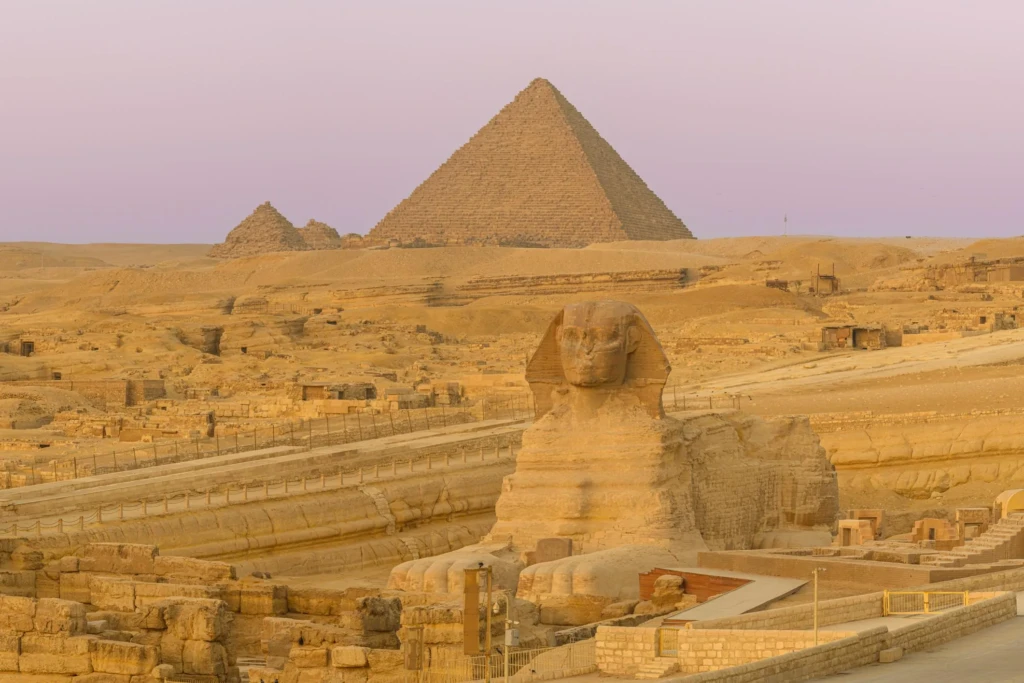
At the eastern edge of the Giza Plateau, a colossal lion rests with its head raised toward the sunrise. Behind it rise the pyramids of Giza; before it, modern Cairo stretches toward the Nile. This is the Great Sphinx of Giza, one of ancient Egypt’s most recognizable creations and one of archaeology’s most frequently misunderstood monuments.
The Sphinx is not simply a giant statue placed beside the pyramids. Its core was carved directly from the plateau’s natural limestone while quarry workers cut a deep enclosure around it. Stone removed during that process was used in the temple immediately in front of the monument. Its position beside Khafre’s valley temple and causeway links it to a wider royal building program in which architecture, landscape, kingship, and solar religion were closely connected.
More than 4,500 years after its creation, fundamental questions still attract debate. Which pharaoh commissioned it? Whose face does it show? Why was its temple left unfinished? Who removed its nose? Was the monument always called a sphinx? Archaeology answers some of these questions strongly, leaves others open, and rejects many sensational claims that have grown around the statue.
This detailed guide examines what the Great Sphinx is, how and when it was carved, why most evidence points to Pharaoh Khafre, what happened to its nose and beard, how the Dream Stela transformed its later history, and how to experience the monument as part of a modern visit to Giza.
Great Sphinx of Giza at a Glance
| Essential fact | Details |
|---|---|
| Location | Eastern side of the Giza Plateau, beside Khafre’s valley temple and causeway |
| Probable builder | Pharaoh Khafre, although no surviving contemporary inscription names him directly |
| Probable date | Fourth Dynasty, around 2500 BCE |
| Material | Natural limestone bedrock with extensive ancient and modern masonry repairs |
| Form | Reclining lion’s body with the head of a king wearing the nemes headdress |
| Approximate length | 73–73.5 meters / about 240 feet |
| Approximate height | 20 meters / about 66 feet |
| Approximate width | 19 meters / about 62 feet across the haunches |
| Direction | Faces east toward the rising sun |
| Later Egyptian name | Horemakhet, meaning “Horus in the Horizon” |
| Famous later monument | The Dream Stela of Thutmose IV between the front paws |
| UNESCO context | Part of the World Heritage property “Memphis and its Necropolis – the Pyramid Fields from Giza to Dahshur” |
What Is the Great Sphinx?
The Great Sphinx of Giza is a monumental royal image with the body of a reclining lion and the head of a human king. It was cut from a projecting mass of limestone left behind as quarry workers excavated the surrounding ditch. Although people often describe it as being carved from a single rock, that phrase needs qualification: the original core is living bedrock, but generations of repairs added limestone blocks to weakened and eroded parts of the body.
In ancient Egyptian art, the lion communicated physical strength, dominance, and association with the sun. Combining that body with a royal head transformed the king into a being of superhuman power. The image was therefore not a fantasy creature in the modern sense. It was a political and religious statement in stone: the pharaoh as guardian, ruler, and divine intermediary.
The Great Sphinx is the earliest surviving colossal Egyptian sculpture of its kind. Smaller royal sphinx images may have existed earlier, but nothing preserved approaches its scale. Its success established a visual formula that Egyptian artists would reuse for nearly two thousand years in temple avenues, royal sculpture, and images of gods and rulers.
The monument belongs to the broader Giza Pyramids Complex, but it should be understood as part of Khafre’s architectural zone rather than as a guardian built directly for the Great Pyramid of Khufu. Its enclosure, temple, neighboring valley temple, and the lower portion of Khafre’s causeway form a connected archaeological landscape.
Where Is the Great Sphinx Located?
The Sphinx sits on the eastern, lower side of the Giza Plateau on the west bank of the Nile in Greater Cairo. It faces almost directly east. Khafre’s pyramid rises behind it to the west, while Khafre’s valley temple stands immediately south of the Sphinx Temple.
This position was not chosen merely to create a dramatic view. In the Old Kingdom, a royal pyramid complex extended from the edge of the floodplain upward toward the desert plateau. A valley temple formed the ceremonial entrance, a causeway climbed toward the mortuary temple, and the pyramid dominated the western end of the route. The Sphinx occupied a powerful threshold between the cultivated Nile Valley and the royal necropolis.
Because modern photography compresses distance, the Sphinx often appears to sit directly in front of all three Egyptian pyramids at Giza. In reality, it is most closely integrated with Khafre’s complex. Khufu’s Great Pyramid lies farther north, and Menkaure’s pyramid stands to the southwest.
Travelers can use the Great Sphinx location on Google Maps as a general reference, but should follow the entrance and transport instructions attached to their official Giza Plateau ticket. The site’s visitor circulation has changed, and older guides that direct travelers to the former Mena House entrance may be outdated.
When Was the Great Sphinx Built?
Most archaeologists date the Great Sphinx to Egypt’s Fourth Dynasty, approximately 2613–2494 BCE, with the strongest case placing its construction during the reign of Khafre around 2558–2532 BCE. In practical terms, the statue is roughly 4,500 years old.
There is no surviving Old Kingdom inscription saying, “Khafre built the Sphinx.” That absence is the foundation of the attribution debate. Yet archaeology rarely depends on a single written statement. Researchers compare construction sequences, quarry layers, temple plans, causeways, masonry, artifacts, and the relationship between one structure and another.
The result is a strong cumulative case: Khafre is the most probable builder, even though the attribution cannot be called absolutely proven.
Why the Fourth-Dynasty Date Matters
Placing the Sphinx in the Fourth Dynasty connects it with a known period of colossal royal construction. Khufu commissioned the Great Pyramid; Khafre created the second pyramid, its temples, and causeway; Menkaure built the third major pyramid. The quarrying, stone transport, surveying, and labor organization visible across Giza provide a clear technological and cultural context for carving a monumental lion from the plateau.
Claims that the Sphinx comes from 7000, 10,500, or even 12,000 BCE would require a completely different archaeological context. No settlement, tool tradition, inscriptional record, associated temple culture, or dated construction sequence from those periods has been found at the Sphinx enclosure. Weathering alone cannot overturn the much broader archaeological setting.
Who Built the Great Sphinx of Giza?
Pharaoh Khafre remains the leading candidate. He was a son of Khufu and the ruler associated with the second-largest pyramid at Giza. Archaeological work by the Egyptian Ministry of Tourism and Antiquities and researchers including Mark Lehner connects the Sphinx to Khafre’s building program through location, construction order, temple architecture, and geology.
The Archaeological Case for Khafre
The most important evidence is not a supposed facial resemblance. It is the relationship among the Sphinx, the Sphinx Temple, Khafre’s valley temple, and his causeway.
Researchers mapped the geological beds running through the Sphinx’s body and matched them to the enormous limestone core blocks used in the Sphinx Temple. Some of those blocks include several distinct geological layers and weigh many tons. Their “geological fingerprints” show that they were quarried from the ditch created around the Sphinx.
This means that carving the enclosure and constructing the Sphinx Temple were stages of the same operation. Architectural and stratigraphic evidence then places that operation after Khafre’s valley temple and within the sequence of Khafre’s monuments.
The temple plans reinforce the connection. Khafre’s pyramid temple and the Sphinx Temple share important design features, including courts associated with colossal royal statues. The two lower temples occupy the same prepared terrace. The Sphinx quarry also interacts directly with the foundation and drainage of Khafre’s causeway.
Together, these relationships make Khafre the most convincing owner.
Could Khufu Have Started the Sphinx?
Some Egyptologists have argued for Khufu, builder of the Great Pyramid of Giza. Stylistic interpretations of the royal head, solar associations, and quarry activity north of the Sphinx have been used to support this possibility. AERA’s research allows that Khufu might have initiated or inspired part of the concept, but concludes that the stronger physical evidence links most of the monument and its temple to Khafre.
What About Djedefre?
Another theory proposes that Djedefre, Khufu’s son and Khafre’s predecessor, carved the Sphinx in honor of Khufu. This offers a possible dynastic explanation for the face, but Djedefre built his own pyramid complex at Abu Rawash, north of Giza, and no archaeological construction sequence ties him to the Sphinx as strongly as the evidence for Khafre.
Does the Face Look Like Khafre?
The royal head has features that some researchers compare with surviving statues of Khafre, particularly sculptures found in his valley temple. Such comparisons can support the attribution, but portrait resemblance in Egyptian royal art is difficult to use as decisive proof. Pharaohs were depicted through idealized conventions as well as individual features, and thousands of years of erosion and restoration have changed the Sphinx’s face.
The responsible conclusion is simple: Khafre is highly probable, but the lack of a contemporary dedicatory inscription should remain visible in any accurate explanation.
How Was the Great Sphinx Built?
The Sphinx was created through subtraction rather than assembly. Ancient workers quarried a U-shaped trench into the plateau and left a central mass of limestone standing. Sculptors then shaped that mass into the lion’s body and royal head.
Geological mapping supports a reconstruction in which the landscape was transformed through several coordinated stages:
- Quarry workers removed the harder upper limestone from around the future head.
- They cut deeper into alternating hard and soft beds to create the enclosure and expose the body.
- Large blocks removed from the quarry were dragged a short distance east and placed in the Sphinx Temple.
- Sculptors refined the retained bedrock mass into the head, headdress, shoulders, back, flanks, tail, chest, and extended forepaws.
- Builders added masonry where the natural rock required adjustment or protection.
The work may have progressed at the same time as the neighboring temple construction. Geological mapping suggests blocks from different levels of the Sphinx’s body were used in different parts of the Sphinx Temple, almost preserving the quarrying sequence in the temple walls.
Why the Head Survived Better Than the Body
The Giza Plateau formed from ancient marine sediments laid down tens of millions of years before the pharaohs. These deposits hardened into limestone beds of unequal strength.
The Sphinx’s head occupies a harder, more durable layer. The body passes through a sequence of stronger and weaker beds. Softer bands recede more quickly under wind, moisture, salt, temperature change, and other weathering processes, while harder beds project outward. This natural variation explains much of the deeply layered appearance of the body and the repeated need for masonry repairs.
The difference is geological, not evidence that one civilization carved the body and another later recut the head. The proportions are also influenced by the size and shape of the original bedrock mass available to the sculptors.
How Big Is the Great Sphinx?
Modern surveys place the monument at approximately 73 to 73.5 meters long from the front paws to the tail, about 20 meters high from the base to the top of the head, and roughly 19 meters wide across the rear haunches.
To understand that scale, imagine a sculpture nearly as long as a Boeing 747-8’s fuselage and approximately as tall as a six-story building. Yet the monument can seem smaller in photographs because the pyramids behind it are so immense.
| Feature | Approximate measurement |
|---|---|
| Total length | 73–73.5 m / about 240 ft |
| Total height | 20 m / about 66 ft |
| Width across haunches | 19 m / about 62 ft |
| Head height | About 10 m / 33 ft |
| Face width | About 4 m / 13 ft |
Measurements vary slightly depending on survey points, restoration masonry, and whether a source rounds the figures. Claims that the Sphinx is only 57 meters long significantly understate the accepted surveyed length.
What Did the Great Sphinx Originally Look Like?
Today the monument appears as pale, weathered limestone, but the ancient image was more complete and more colorful.
The Royal Headdress and Uraeus
The head wears the nemes, the striped cloth headdress associated with Egyptian kings. A royal cobra, or uraeus, originally rose from the forehead. The headdress framed the face and extended behind the ears toward the shoulders, visually separating the human head from the lion’s body.
Was the Sphinx Painted?
Surviving traces of pigment show that parts of the Sphinx were painted. Red color has been recorded on the face, and evidence of other colors has been reported around the headdress and body. Ancient Egyptian monumental sculpture was rarely intended to remain as bare stone; color completed the image and increased its symbolic force.
Any full-color reconstruction remains partly interpretive because only fragments survive. It is nevertheless safe to say that the original experience was not the monochrome, sand-colored monument familiar today.
Did the Sphinx Have a Beard?
The Sphinx possessed a ceremonial beard at some stage. A substantial limestone fragment is held by the British Museum. Importantly, the museum dates that fragment to the Eighteenth Dynasty—more than a thousand years after Khafre.
This raises a valuable nuance. The beard may have been added or substantially remade during New Kingdom restoration rather than belonging to the original Fourth-Dynasty sculpture. Its form and weight also make scholars question how it was supported. It should not automatically be treated as part of the monument’s first appearance.
Why Is the Head Small Compared with the Body?
The Sphinx’s head can look disproportionately small, which has inspired theories that an earlier lion, jackal, or other animal head was later recarved. There is no convincing archaeological proof for those reconstructions.
More practical explanations exist. The head was limited by the harder upper bedrock left after quarrying, while the body extended through a much larger natural formation. Erosion of the body, repeated masonry cladding, and the loss of the headdress, beard, nose, and uraeus also altered the monument’s visual balance.
What Did the Great Sphinx Mean?
The Sphinx joined the physical power of the lion with the authority and intelligence of the king. It expressed the pharaoh as a dominant protector positioned at the ceremonial approach to his eternal monument.
Its eastward gaze introduced a solar dimension. The statue faced the rising sun, while the pyramid complex extended westward toward the desert and sunset. In Egyptian belief, sunrise, sunset, burial, and renewal formed parts of a continuing cosmic cycle rather than separate ideas.
The original Old Kingdom name and precise cult title have not survived. More than a thousand years later, New Kingdom Egyptians worshiped the monument as Horemakhet—“Horus in the Horizon”—and understood it as a manifestation of the sun god. This later interpretation may preserve older solar ideas, but it should not be projected backward without qualification.
The Sphinx Temple and Khafre’s Valley Temple
Two major temples stand immediately east and southeast of the Sphinx enclosure. Their relationship is one of the keys to understanding the monument.
The Sphinx Temple
The Sphinx Temple was built with enormous limestone core blocks removed while carving the Sphinx ditch. Its plan included a central open court, colonnaded spaces, and positions for colossal statues. The temple’s east-facing arrangement and the monument behind it have encouraged interpretations involving solar movement and royal regeneration.
Archaeological evidence suggests the temple was never fully completed. Exterior granite casing was left unfinished, blocks remained abandoned, and construction debris may not have been cleared. The absence of known Old Kingdom priestly titles connected to a Sphinx cult also suggests that the intended ritual program may never have become fully active.
This unfinished state is one of Giza’s most interesting clues. Even royal construction could stop because of a king’s death, political transition, changing priorities, or pressure to complete more essential funerary elements.
Khafre’s Valley Temple
Khafre’s valley temple stands directly beside the Sphinx Temple and was completed earlier in the construction sequence. Massive limestone blocks were faced with granite, and the interior contained monolithic granite pillars and statues of the king.
The most famous surviving image from this building shows Khafre seated with the falcon god Horus protecting the back of his head. That sculpture helps explain the ideological world in which the Great Sphinx was created: the king was not merely a political ruler but a figure embedded in divine order.
The Dream Stela of Thutmose IV
Between the Sphinx’s forepaws stands a tall granite monument known as the Dream Stela. Pharaoh Thutmose IV erected it around 1400 BCE, more than a thousand years after the Sphinx was carved.
The inscription tells a carefully constructed royal story. Before becoming king, the young prince hunted on the Giza Plateau and rested in the shadow of the sand-covered Sphinx. He fell asleep at midday and dreamed that the monument, speaking as Horemakhet, promised him kingship if he cleared away the sand choking its body.
Thutmose later became pharaoh, excavated and restored the Sphinx, and placed the stela between its paws. The account can be read as a sacred encounter, a record of conservation, and a statement legitimizing his claim to the throne.
The Dream Stela is also evidence that ancient Egyptians themselves confronted the same environmental problem visible today. Wind-blown sand repeatedly filled the enclosure, burying the lion’s body while leaving its head exposed. The Sphinx has spent long periods of history partly covered, which both concealed and protected sections of it.
What Was the Sphinx Called in Ancient Egypt?
The name “Great Sphinx” is not the monument’s original Egyptian name. Whatever Old Kingdom builders called it has not survived in a secure contemporary inscription.
By the New Kingdom, the monument was known as Horemakhet, or Hor-em-Akhet, meaning “Horus in the Horizon.” Greek speakers later associated it with their own sphinx, a mythological creature famous for posing a fatal riddle. The Arabic name Abu al-Hawl is often translated as “Father of Terror” or “Father of Dread.”
These changing names reveal how each era reinterpreted the monument. Fourth-Dynasty builders may have understood it as a royal lion within Khafre’s complex. New Kingdom rulers saw a solar deity. Greek and Roman visitors connected it to classical mythology. Medieval writers placed it within their own histories, while modern culture made it a symbol of mystery itself.
Egyptian Sphinx vs. Greek Sphinx
The Great Sphinx of Giza did not pose the famous riddle of Greek mythology. That story belongs to the Greek Sphinx encountered by Oedipus at Thebes in Greece.
| Egyptian royal sphinx | Greek mythological sphinx |
|---|---|
| Usually male | Usually female |
| Human royal head and lion’s body | Woman’s head, lion’s body, and typically wings |
| Symbol of royal or divine power and protection | Dangerous monster associated with a riddle |
| Placed in temples, avenues, and royal settings | Appears mainly in mythology and later art |
| Great example: the Sphinx of Giza | Famous story: Oedipus and the Sphinx |
Confusing the traditions is understandable because the modern word is Greek, but their symbolism and cultural roles are different.
Who Broke the Great Sphinx’s Nose?
The honest answer is that the exact person responsible cannot be established with certainty. The damage was deliberate: marks on the face indicate that tools were driven into the nose before it was pried away. Natural erosion alone did not produce the present break.
One historical account attributes the damage to Muhammad Sa’im al-Dahr in 1378 CE. The medieval Egyptian historian al-Maqrizi wrote that the man was angered by local people making offerings to the Sphinx and attacked it as an act of iconoclasm. This is an important historical source, but it was recorded later and should not be treated as courtroom-level proof.
Did Napoleon Destroy the Sphinx’s Nose?
No. Napoleon’s soldiers did not shoot off the nose.
Danish explorer Frederic Louis Norden drew the Sphinx without its nose during his visit in 1737, more than sixty years before Napoleon’s Egyptian campaign began in 1798. The drawing makes the popular cannon story chronologically impossible.
This myth survives because Napoleon, artillery, and an already damaged monument create a memorable story. Evidence is less theatrical but much clearer: the nose was gone before the French expedition arrived.
Where Is the Sphinx’s Nose Today?
No securely identified complete nose survives in a museum. Claims that visitors can see it in London, Paris, or Cairo are misleading. Small stone fragments have been associated with damage around the monument, but the missing feature has not been reconstructed from a confirmed set of pieces.
Excavation and Restoration Through History
The biography of the Sphinx did not end when its sculptors put down their tools. Sand burial, religious renewal, excavation, tourism, and conservation repeatedly changed its appearance.
| Period | Major development |
|---|---|
| Fourth Dynasty, c. 2500 BCE | Sphinx and temple most probably carved and built within Khafre’s program |
| Eighteenth Dynasty, c. 15th–14th centuries BCE | New Kingdom rulers renewed worship; Amenhotep II built a nearby temple |
| Reign of Thutmose IV, c. 1400 BCE | Sphinx cleared, restored, and commemorated with the Dream Stela |
| Greco-Roman periods | Monument visited, cleared, restored, and incorporated into later religious interpretations |
| 1817 | Giovanni Battista Caviglia carried out a major modern clearance around the chest and paws |
| 19th century | Additional excavation and documentation by figures including Auguste Mariette and Gaston Maspero |
| 1920s–1930s | Émile Baraize and later Selim Hassan conducted extensive excavation and clearance |
| Late 20th century onward | Detailed mapping, geological study, masonry conservation, groundwater monitoring, and repeated restoration |
Not every restoration improved the monument. Earlier repairs sometimes used stone or mortar that behaved differently from the original limestone. Incompatible materials could trap moisture, add weight, or accelerate deterioration. Modern conservation therefore requires careful analysis rather than simply covering every worn surface with new blocks.
Why Is the Great Sphinx Eroding?
The monument’s preservation challenges come from several interacting forces:
- Alternating hard and soft limestone beds weather at different rates.
- Salt crystallization can expand within pores and break the stone surface.
- Moisture can move through the rock from rainfall, condensation, and subsurface conditions.
- Daily and seasonal temperature changes stress exposed surfaces.
- Wind and airborne particles contribute to abrasion.
- Pollution and the modern urban environment affect the plateau.
- Poorly matched restoration materials can cause additional damage.
Sand burial was not purely destructive. While sand placed pressure on the monument and obscured it, deep coverage also shielded parts of the body from wind and direct temperature changes. Full exposure created a different set of conservation problems.
Preserving the Sphinx means managing an ancient geological formation as well as an artwork. There is no single treatment that can make the monument permanently maintenance-free.
Mysteries, Hidden Chambers, and Unsupported Claims
The Sphinx attracts speculation because its original dedication is missing, its body is surrounded by a cut enclosure, and many ancient structures at Giza contain shafts, tombs, or subsurface features. Scientific surveys have detected cracks, cavities, and geological irregularities around the monument. These findings do not prove that a constructed archive or secret chamber lies beneath its paws.
Is There a Hall of Records Under the Sphinx?
No Hall of Records has been found. The idea was popularized in modern times through psychic claims that an archive from Atlantis would be discovered beneath the Sphinx. Archaeological and geophysical work has not verified such a chamber or civilization.
Is the Sphinx 10,500 Years Old?
The proposed date of 10,500 BCE is associated with theories connecting the lion shape to the constellation Leo and the Giza pyramids to Orion. These ideas are not supported by contemporary Egyptian texts, an associated archaeological culture, or the construction sequence of the Sphinx Temple and Khafre complex.
Does Water Erosion Prove a Prehistoric Date?
Some researchers argue that patterns in the enclosure were caused by heavy rainfall and therefore require a date thousands of years earlier than the Fourth Dynasty. Other geologists and archaeologists explain the weathering through the plateau’s layered limestone, rainfall runoff, salt activity, groundwater, wind, and long exposure history.
The erosion debate can raise useful geological questions, but it does not outweigh the archaeological links among the quarry, Sphinx Temple, valley temple, and Khafre causeway.
Was the Head Recarved from a Lion or Anubis?
Theories propose that the present royal head replaced a larger lion, jackal, or Anubis head. No confirmed carving sequence or surviving physical evidence establishes this transformation. Differences in proportion can be explained more economically by the original rock mass, unequal geological beds, lost features, and later repair.
Evidence vs. Legend
| Popular claim | Evidence-based assessment |
|---|---|
| Khafre definitely built the Sphinx | Khafre is the strongest and most probable attribution, but no contemporary dedicatory inscription survives. |
| Napoleon’s cannon destroyed the nose | False; the nose was documented as missing decades before Napoleon arrived. |
| The Sphinx is only 57 meters long | Incorrect; modern surveys place it at roughly 73–73.5 meters. |
| The Great Sphinx asked Oedipus a riddle | False; that story belongs to Greek mythology, not the Egyptian monument. |
| A Hall of Records has been found below it | False; no such archive has been verified. |
| The Sphinx was built in 10,500 BCE | Unsupported by the site’s archaeological context and construction sequence. |
| The monument was always bare limestone | Unlikely; surviving pigment shows that at least parts were painted. |
| The beard must be an Old Kingdom original | Uncertain; the British Museum fragment is dated to the Eighteenth Dynasty and may represent a later addition or restoration. |
Visiting the Great Sphinx
The standard public view of the Great Sphinx is part of a general Giza Plateau visit. Visitors normally approach the viewing area near Khafre’s valley temple and look across the enclosure toward the statue. The monument itself and the area between its paws are not open for ordinary unrestricted access.
Special access inside the enclosure is a separate private arrangement requiring official authorization and additional site-opening fees. It should never be represented as included with a normal Giza ticket.
Great Sphinx Tickets
As checked on 1 September 2026, the Egyptian Ministry of Tourism and Antiquities listed general Giza Plateau admission for foreign visitors at:
| Ticket | Adult | Student |
|---|---|---|
| Giza Plateau general entry | EGP 700 | EGP 350 |
The general ticket covers the public archaeological area and standard Sphinx viewing, but not the separately ticketed interiors of the principal pyramids or certain tombs. The Ministry’s individual Sphinx page states that private visits require additional site-opening fees.
Prices and access procedures can change, so confirm them on the official Egyptian monuments ticket platform shortly before visiting. Students should carry an accepted physical student ID and check current eligibility conditions.
Opening Hours
Official sources are not fully synchronized. The Ministry’s Giza Plateau page displays 8:00 AM–4:00 PM, while the official booking platform lists a 7:00 AM opening with last entry at 4:00 PM. Check the exact date before departure, especially during Ramadan, public holidays, special events, or conservation work.
The Current Entrance and Transport System
The active visitor entrance operates through the Great Gate area on Al-Fayoum Desert Road, with organized internal transportation between major stops. Older instructions pointing to the historic entrance near Mena House may no longer reflect normal operations.
Private vehicles do not provide unrestricted movement among the monuments. Build flexibility into the visit because shuttle circulation, queues, and temporary access controls can affect the order of stops.
Best Time to See the Sphinx
Early morning usually offers the best combination of cooler weather, manageable crowds, and softer light. Because the Sphinx faces east, direct morning light reveals the face and chest differently from the stronger side-light and back-light later in the day.
October through April generally provides more comfortable temperatures. Summer visits require stronger heat planning: carry water, wear a hat and breathable clothing, use sun protection, and avoid spending all available time walking on exposed ground.
Air quality, haze, wind, and dust can change visibility. A perfectly clear pyramid skyline is never guaranteed, so focus on understanding the monument as well as photographing it.
How Long Should You Spend at the Sphinx?
Allow 30–45 minutes for the Sphinx viewing area and valley temple during a standard visit. A knowledgeable guide may need longer to explain the temple sequence, Dream Stela, geology, restoration, and relationship with Khafre’s pyramid.
The Sphinx should not consume an entire separate day for most travelers. It works best as the concluding or connecting element of a three-to-four-hour Giza Plateau visit. Visitors combining Giza with the Grand Egyptian Museum should reserve a full day rather than trying to compress both into a short morning.
Best Photography Tips
- Photograph the face and extended paws from the principal viewing area.
- Use Khafre’s pyramid behind the head to show the archaeological relationship, but avoid making the perspective imply that every pyramid belongs to the Sphinx complex.
- A slightly wider composition reveals the enclosure and temples, which tell more of the story than a tight facial portrait.
- Morning light generally illuminates the east-facing monument more evenly.
- Do not cross barriers or climb structures for a photograph.
- Ask before photographing local workers, guides, or other visitors.
Personal photography is generally permitted outdoors for non-commercial use. Drones, commercial shoots, tripods, large professional setups, and special access are governed by separate permissions.
Accessibility and Family Advice
The public viewing area involves uneven stone, slopes, crowds, and limited shade. Visitors with reduced mobility should confirm the current shuttle stop, accessible route, and walking distance before arrival. The closest permitted viewing point may still require assistance.
For families, the Sphinx is a useful storytelling stop. Children can quickly understand the combination of a lion’s body and a king’s head, the missing nose mystery, the Dream Stela, and the difference between Egyptian and Greek sphinxes. Keep explanations short outdoors and save technical detail for shaded breaks or the museum.
Entering a pyramid is not required to enjoy Giza. Seniors, young children, and travelers who dislike enclosed passages can build an excellent visit around the Sphinx, valley temple, exterior pyramids, panoramic viewpoint, and Grand Egyptian Museum.
A Practical Giza Route Including the Sphinx
For most first-time visitors, the following sequence works well, subject to the active shuttle route:
- Begin near the Great Pyramid of Khufu and examine its scale, casing remains, and eastern complex.
- Continue toward Khafre’s pyramid and identify the surviving casing near its summit.
- Stop at the panoramic viewpoint for the wider alignment of the Giza pyramids.
- Visit Menkaure’s zone if time and mobility allow.
- Finish at Khafre’s valley temple and the Great Sphinx, where the route from pyramid to causeway to temple becomes visible.
Ending at the Sphinx gives the visit a logical architectural conclusion. You move from the royal tombs on the plateau down toward the ceremonial entrance once connected with the Nile Valley.
Travelers planning several days in the capital can use our Cairo Travel Guide to connect Giza with the Grand Egyptian Museum, Islamic Cairo, Coptic Cairo, and the Egyptian Museum. Those interested in the evolution of pyramid building should continue south with the Saqqara Egypt Guide.
Is a Guided Sphinx Visit Worth It?
The Sphinx appears simple from a distance: lion body, human head, missing nose. Without context, many visitors photograph it and leave within minutes. A qualified Egyptologist reveals that the monument is also a quarry, a geological section, a royal image, a temple complex, a restoration record, and a case study in how archaeologists build an argument without a definitive inscription.
A private guide is particularly useful for explaining why the evidence favors Khafre, identifying the Sphinx Temple and valley temple, placing the Dream Stela in its later New Kingdom context, and separating popular legends from what the site actually shows.
Delta Tours Egypt has planned journeys through Egypt since 1974. Travelers can include a privately guided Giza visit within broader Egypt tours or choose a tailored experience through our luxury Egypt tours, with timing, transport, museum visits, and guiding adapted to their interests and pace.
The Sphinx is part of our private Pyramids Day Tour and the Grand Egyptian Museum and Pyramids tour; for an evening view, see the Pyramids Sound and Light Show. All options are on our Cairo tours page.
Frequently Asked Questions About the Great Sphinx
What is the Great Sphinx of Giza?
It is a colossal ancient Egyptian royal sculpture carved from the natural limestone of the Giza Plateau. It combines a reclining lion’s body with the head of a king wearing the nemes headdress.
Who built the Great Sphinx?
Most archaeological evidence points to Pharaoh Khafre of the Fourth Dynasty. The monument’s quarry, temple, nearby valley temple, and causeway form a construction sequence strongly associated with his pyramid complex. No surviving contemporary inscription makes the attribution absolutely certain.
When was the Great Sphinx built?
It was most probably carved around 2500 BCE during the Fourth Dynasty, making it roughly 4,500 years old.
How tall is the Great Sphinx?
The monument is approximately 20 meters, or 66 feet, high from its base to the top of the head.
How long is the Great Sphinx?
Modern surveys place it at approximately 73–73.5 meters, or about 240 feet, from its forepaws to its tail.
Whose face is on the Sphinx?
The face most probably represents Khafre, although Khufu and Djedefre have also been proposed. Erosion, restoration, and the idealized nature of Egyptian royal art make facial comparison alone inconclusive.
Why does the Sphinx have a lion’s body?
The lion represented strength, dominance, guardianship, and solar power. Combining it with a royal head expressed the pharaoh as a superhuman protector and divine ruler.
Who destroyed the Sphinx’s nose?
The exact culprit is uncertain. Medieval historian al-Maqrizi attributed the damage to Muhammad Sa’im al-Dahr in 1378 CE, but this remains a historical account rather than proven forensic fact.
Did Napoleon shoot the Sphinx’s nose off?
No. A drawing made by Frederic Louis Norden in 1737 shows the nose already missing, decades before Napoleon arrived in Egypt.
Where is the Sphinx’s beard?
A major fragment of a ceremonial beard is held by the British Museum. It is dated to the Eighteenth Dynasty and may have been a later addition or restoration rather than an original Fourth-Dynasty feature.
Was the Great Sphinx originally painted?
Yes, at least in part. Surviving pigment traces demonstrate that color was applied to the monument, including red on the face.
Is there a secret chamber beneath the Sphinx?
No constructed secret archive has been verified. Surveys have identified geological irregularities and possible cavities, but they do not prove the existence of a Hall of Records or lost-civilization library.
Can visitors walk between the Sphinx’s paws?
Not with standard admission. Ordinary visitors view the Sphinx from the designated public area. Entering the enclosure requires special official authorization and additional private-opening arrangements.
Is the Sphinx ticket separate from the Giza Pyramids ticket?
Standard public viewing is included within general Giza Plateau admission. Special private enclosure access is separate, and pyramid interiors require their own tickets.
How long do you need at the Great Sphinx?
Allow around 30–45 minutes for the Sphinx and Khafre’s valley temple during a standard guided visit. The complete Giza Plateau normally requires at least three to four hours.
Is the Great Sphinx close to the Great Pyramid?
Yes, both are within the Giza Plateau archaeological area. However, the Sphinx is more directly connected to Khafre’s second pyramid complex than to Khufu’s Great Pyramid.
Why the Great Sphinx Still Matters
The Great Sphinx survives because ancient Egyptian builders understood how to turn the plateau itself into royal architecture. They did not transport a finished statue to Giza. They carved the living rock, transformed the removed stone into a temple, and placed the resulting lion at the ceremonial threshold of a pyramid complex.
Its damaged face and weathered body are not failures of the monument’s story. They are records of geology, changing religion, sand burial, political memory, excavation, restoration, and more than four millennia of human attention.
The Sphinx is often marketed as an unsolved mystery, but its evidence is more compelling than fantasy. We can trace stone from its enclosure into temple walls. We can see how it fits Khafre’s causeway. We can read the dream of a New Kingdom prince between its paws. We can disprove Napoleon’s supposed attack with an 18th-century drawing. And where certainty ends, we can explain exactly why.
Standing before the Great Sphinx of Giza, with the Egyptian pyramids rising behind it and Cairo spreading beyond the plateau, means looking at several histories at once: the ambition of the Old Kingdom, the religious imagination of later pharaohs, the curiosity of travelers, and the continuing work of archaeologists and conservators. That layered history—not invented secrets—is what makes the monument endlessly worth seeing.