Imhotep Museum at Saqqara: What to See Before the Pyramids
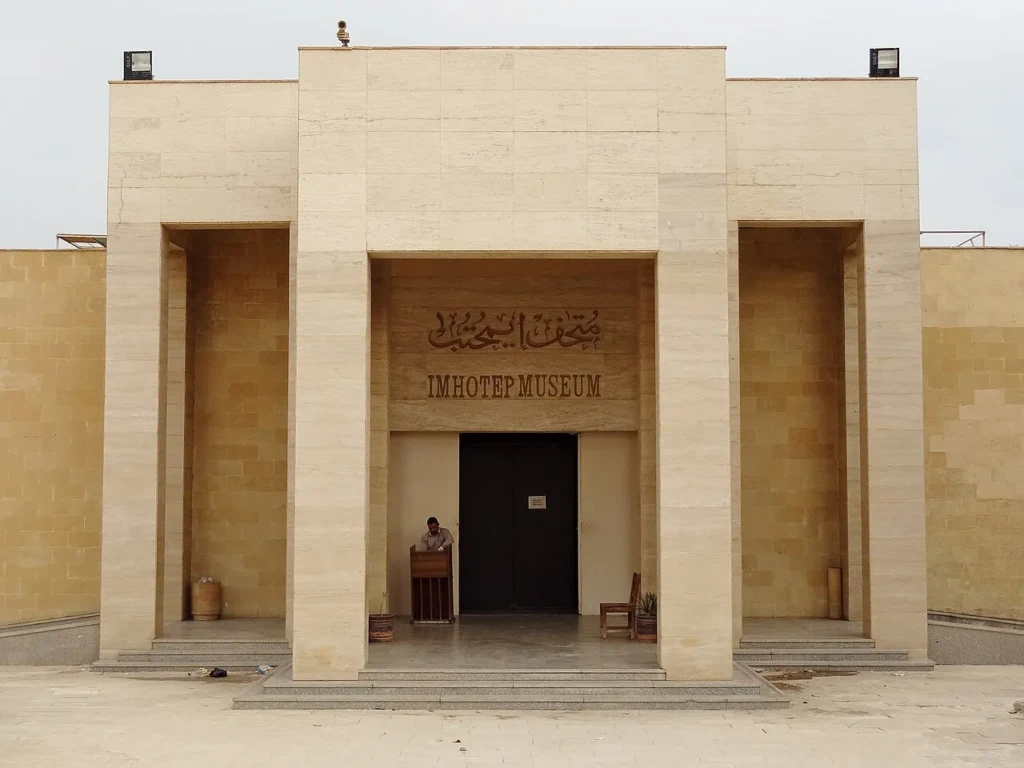
Visit the Imhotep Museum first when you arrive at Saqqara. It stands at the entrance to the necropolis, and the same Saqqara area ticket covers it, so there is no extra fee. In about an hour, its six halls give you the background you need for the Step Pyramid and the tombs: who built them, how, and what was found inside.
This guide covers what the museum is and why it was built, the objects worth finding in each part of the building, opening hours and the foreigner ticket price, and how to fit a museum stop into a day at Saqqara, Memphis and Dahshur.
| Quick facts | Details |
|---|---|
| Location | Entrance of the Saqqara necropolis, Giza Governorate |
| Distance | About 20 km from the Giza plateau (museum brochure); Saqqara lies about 40 km southwest of Cairo (official site listing) |
| Opened | 2006; the project was launched in 1997 |
| Named after | Imhotep, the official of King Djoser credited with designing the Step Pyramid |
| Size | One floor, six halls, more than 280 objects, about 12,000 square meters |
| Last renovated | 2023, by the Ministry of Tourism and Antiquities |
| Opening hours | 8:00 AM to 5:00 PM daily; 9:00 AM to 3:00 PM in Ramadan (official listing, October 2026) |
| Foreigner ticket | Included in the Saqqara area ticket: EGP 600 adult, EGP 300 student (official listing, October 2026) |
| Time needed | Our planning suggestion: 45 to 75 minutes |
What is the Imhotep Museum?
The Imhotep Museum is the site museum of Saqqara, the vast burial ground of the ancient capital Memphis. Everything on display was excavated at Saqqara itself. That makes it different from the big national museums in Cairo and Giza, where objects from all over Egypt sit side by side.
According to the Ministry of Tourism and Antiquities brochure, the project began in 1997 and the museum officially opened in 2006. Wikipedia gives the opening date as April 26, 2006. The building was placed at the foot of the plateau so that it would not dominate the desert landscape around the pyramids.
The museum had a practical purpose as well. Objects stored in traditional site magazines are harder to protect. A modern, air-conditioned building near the excavations offers climate control and better security for finds that come out of the ground every season.
Why it is named after Imhotep
Imhotep served King Djoser of the Third Dynasty. He is credited with the king’s funerary complex, the Step Pyramid, the first large building in Egypt made entirely of cut stone. The official brochure lists some of his titles, including seal-bearer of the king of Lower Egypt and high priest of Heliopolis.
He was remembered for more than architecture. Later generations credited him with medical knowledge, and long after his death he was worshipped as a god of healing, linked by the Greeks with Asclepius. For the full story of the man and his legacy, read our guide Who Was Imhotep?. This article stays with the museum.
The 2023 renovation
The Ministry renovated the museum in 2023. Its brochure says the halls were upgraded and step-free paths were added for older visitors and people with disabilities. The cafeteria, the shops and an audiovisual room that screens films about the Saqqara site were also redesigned.
What to see inside, in visiting order
The museum is on one level, and the route runs through six halls. Exhibits can rotate, especially in the hall for recent discoveries, so treat the list below as a guide rather than a guarantee.
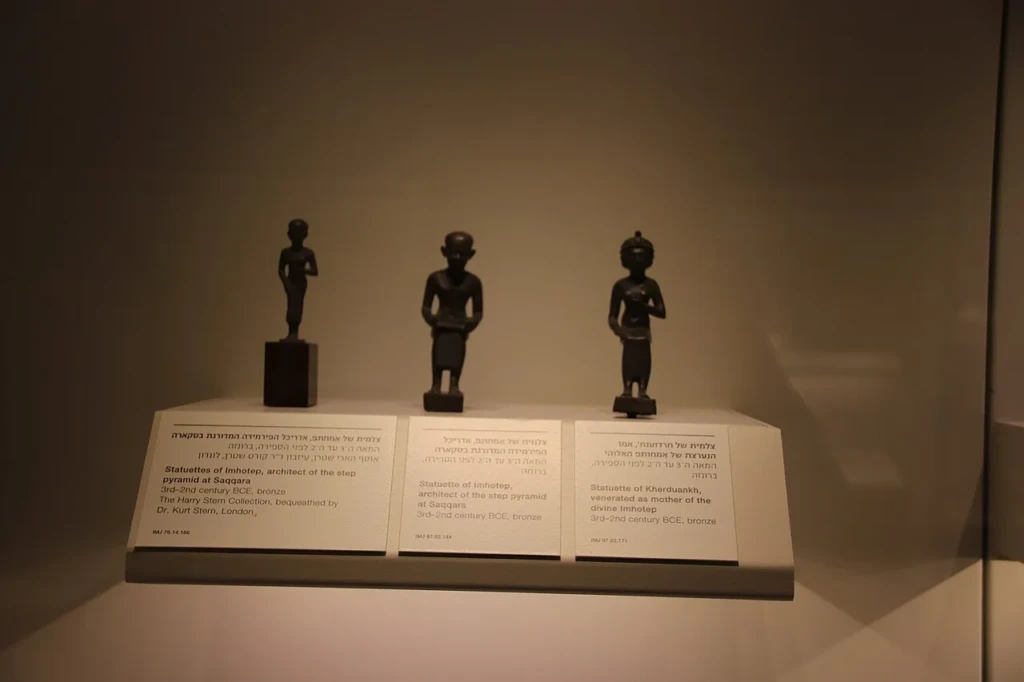
1. The entrance hall and Djoser’s statue base
The first hall introduces the king and his architect. The key object connected with this space is a statue base of Djoser. The king’s feet rest on the “Nine Bows,” the traditional symbol for Egypt’s enemies. The base also carries an inscription naming Imhotep with his titles.
That inscription matters. Very few ancient Egyptian architects are named on royal monuments. This is the closest you will get to a signature on the world’s first great stone building. Wikipedia notes that the original statue fragment was lent by the Egyptian Museum in Cairo during the museum’s opening months, so ask your guide what is on display when you visit.
2. Recent finds from Saqqara
Saqqara is still one of the most active excavation zones in Egypt, and the second hall shows finds from different missions on the plateau. Because new discoveries arrive often, this is the hall most likely to change between visits. It is also the best place to see what archaeologists are finding today.
3. The craft of building: cubits, ostraca and tools
One section explains how the pyramids were planned and measured. Look for two measuring rods, one of schist and one of wood. The brochure explains that the cubit used by Egyptian builders measured about 52 cm, roughly the length of a forearm.
Nearby are limestone ostraca. These are flakes of stone that scribes used as notepads, drawing plans and notes in red or black ink. Seen together, the rods and the sketches show that the Step Pyramid began as careful drawings and measurements, not guesswork.
The same theme includes a set of bronze medical instruments. The brochure links them to Egyptian surgery, an echo of Imhotep’s later fame as a healer.
4. Architecture from the Step Pyramid complex
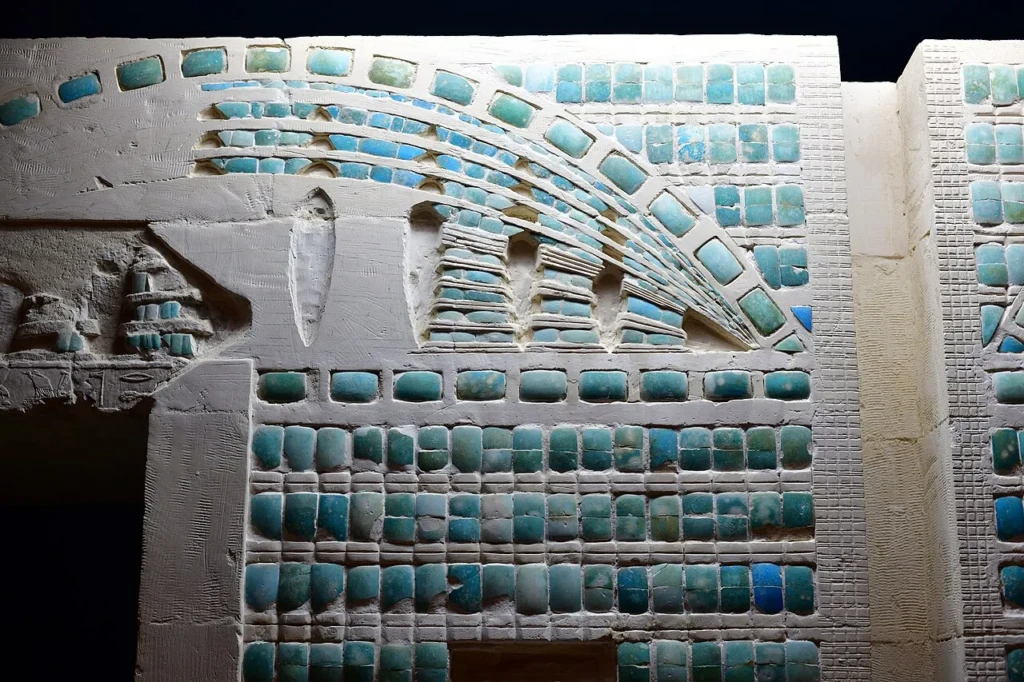
This is the highlight for most visitors. The hall displays architectural elements from Djoser’s complex. The star is a reconstructed wall of blue-green faience tiles set around a false door. Tiles like these lined chambers beneath the complex, imitating reed matting in a material meant to last forever.
False doors were the point where the spirit of the dead could pass between worlds and receive offerings. The brochure notes that one false door in Djoser’s Southern Tomb records the king performing the Heb Sed, a royal renewal ritual.
A small statue of Imhotep is shown in this part of the museum as well. If you plan to enter the Step Pyramid later, this hall is the best preparation. Our Step Pyramid of Djoser guide covers the monument itself.
5. Burial and belief
The next section covers burial customs from the Sixth Dynasty to the New Kingdom. You will see coffins, funerary equipment and offerings meant to supply the dead forever. One surprising object is a pottery vessel holding the remains of cheese left as an offering.
A mummy is shown here that the museum describes as “perhaps” belonging to King Merenre of the Sixth Dynasty. The brochure is careful about this. It says some of the wrappings and ornaments look later, which could point to a different date and identity. Read the label with that caution in mind.
The museum also presents a reconstructed tomb with a mummy, a wooden coffin and burial furniture, so you can see how a burial chamber was arranged.
6. The Pyramid Texts
Saqqara is where the Pyramid Texts first appear. These spells and hymns were carved inside royal burial chambers to protect the king on his journey to the afterlife. The museum shows inscribed fragments of colored limestone covered in hieroglyphs.
Once you have seen them in a glass case, you can see the full texts in place. Our guides to the Pyramid of Unas and the Pyramid of Teti explain where to find them.
7. The Jean-Philippe Lauer gallery and library
The last space honors Jean-Philippe Lauer, the French architect and Egyptologist who spent most of his life restoring Djoser’s complex. The brochure says he was born in Paris in 1902 and came to Egypt in 1926 to work for the Antiquities Service. Wikipedia describes a career of some 75 years at Saqqara.
His library has been recreated with his books, periodicals and handwritten notes. Personal belongings such as his compass and camera are on display, along with photographs of him at work. When you later walk through the rebuilt colonnade and enclosure wall at the Step Pyramid, you are looking at the result of his work.
Other objects to ask about
Wikipedia mentions two more pieces linked to the museum: a Ptolemaic mummy found during excavations near the Pyramid of Teti, and a large pair statue of Amenemopet, a High Priest of Mut in the 19th Dynasty, with his wife, found near the causeway of Unas. Displays change, so ask at the desk or let your Egyptologist guide confirm what is on show.
Opening hours and ticket prices
As listed on the official Ministry of Tourism and Antiquities site in October 2026, the Imhotep Museum opens every day from 8:00 AM to 5:00 PM. During Ramadan the hours are 9:00 AM to 3:00 PM, and the ticket window closes at 2:00 PM. Check before you go, because hours can change.
Plan to arrive well before closing. The museum page gives the regular last-ticket time as 4:00. Separately, the official Saqqara site page lists the archaeological area as open from 8:00 AM to 4:00 PM. Because the outdoor monuments may close earlier than the museum, it makes sense to see the museum at the start of your visit.
There is no separate museum ticket. As listed on the official Ministry of Tourism and Antiquities site in October 2026, foreign visitors pay EGP 600 per adult and EGP 300 per student for the Saqqara area ticket, which the Ministry describes as an inclusive ticket for the Saqqara area and the Imhotep Museum. Some monuments inside the site, such as the interior of Djoser’s pyramid and certain tombs, require their own tickets. Check before you go.
Rules and services
- Photography: phone photography is free. Flash, tripods and monopods are not allowed without a commercial permit.
- Bags: bags and parcels larger than 40 x 40 cm must go to the cloakroom, as must umbrellas and sharp objects.
- Food: food and drinks are not allowed in the galleries, except small water bottles.
- Children: children must stay with an adult. Children under six are on the official free-entry list.
- Dress: the museum asks for appropriate clothing. Light layers that cover the shoulders work well for both the museum and the site.
- Services: the official page lists a café and a library.
How to get there and how long it takes
The museum is at the entrance to Saqqara, so your car stops near it before you continue into the site. The official brochure puts it about 20 km from the Giza plateau. The Ministry’s Saqqara page places the site about 40 km southwest of Cairo.
Driving time depends heavily on Cairo traffic and on where you start. Your driver or guide will confirm timing on the day. There is no practical public transport for a combined visit, so most travelers come by private car or on a guided day tour.
Best time to visit
Go in the morning. The museum is indoors, but the rest of Saqqara is open desert with little shade. A good plan is to arrive at opening time, spend under an hour in the museum, and then move outside before the midday heat.
The cooler months are the most comfortable for a full day at Saqqara and Dahshur. Our month-by-month guide to the best time to visit Egypt explains what to expect in each season.
How to combine the museum with nearby sites
The museum works best as the opening chapter of a Saqqara day. Here is a route that flows well:
- Imhotep Museum. Get the background on Djoser, Imhotep and the Pyramid Texts.
- Step Pyramid complex. Walk the entrance colonnade and the great court that Lauer helped restore.
- Pyramid of Unas or Teti. See the Pyramid Texts in their original setting.
- A noble tomb. The Mastaba of Mereruka has some of the finest daily-life reliefs at Saqqara.
- The Serapeum. If time allows, visit the underground galleries of the Apis bulls, covered in our Serapeum of Saqqara guide.
For a broader overview of the site, read our Saqqara visitor guide or the longer list of things to do in Saqqara. Many travelers add the open-air museum at Memphis (Mit Rahina) and the two great pyramids of Dahshur on the same day.
Is the Imhotep Museum worth it?
Yes, especially because it costs nothing extra. Saqqara can feel confusing on a first visit, with monuments spread across a wide plateau and burials from the first dynasties to the Coptic era. The museum puts that history in order. It also shows things you cannot see outdoors: the faience tiles from inside the Step Pyramid complex, the builders’ measuring rods, and the life’s work of the man who rebuilt Djoser’s walls.
If you are short on time, focus on three things: the Djoser statue base with Imhotep’s name, the faience wall, and the Lauer library. That takes about 30 minutes.
Visit with Delta Tours Egypt
The easiest way to see the museum and the main Saqqara monuments in one day is our Giza, Saqqara and Dahshur pyramids day tour, from $105 per person. If you would rather focus on the Giza side, the Grand Egyptian Museum and Giza Pyramids private tour starts from $95 per person. For a short Cairo stay, the 4-day Taste of Egypt Cairo tour starts from $535 per person; ask us if you would like a Saqqara day added.
Browse all our private Cairo day tours, or see how a private Egyptologist guide and driver can shape the day around your interests.
Frequently Asked Questions
Do I need a separate ticket for the Imhotep Museum?
No. The official listing describes the Saqqara area ticket as covering both the site and the Imhotep Museum. As listed in October 2026, foreign adults pay EGP 600 and students EGP 300.
How long should I spend in the Imhotep Museum?
Our planning suggestion is 45 to 75 minutes. If you are pressed for time, 30 minutes covers the Djoser statue base, the faience wall and the Lauer gallery.
Should I visit the museum before or after the Step Pyramid?
Before. The museum explains the Step Pyramid’s design and shows objects from inside the complex. The official site also lists the outdoor Saqqara area as closing earlier than the museum.
Can I take photos inside the Imhotep Museum?
Yes. The official policy allows free phone photography. Flash, tripods and monopods are not allowed, and you should avoid photographing other visitors or staff.
Is the museum accessible for visitors with limited mobility?
The museum is on one floor. The Ministry says the 2023 renovation added special paths for older visitors and people with disabilities. The wider Saqqara site is uneven desert, so plan the outdoor part with your guide.
Is there a café at the Imhotep Museum?
Yes. The official museum page lists a café among its services, along with a library. It is a useful place to rest before heading out to the monuments.
Saqqara rewards travelers who arrive prepared, and an hour in the Imhotep Museum is the simplest way to do that. Read our full Saqqara Egypt guide to plan the rest of your day, or contact us to arrange a private visit with an Egyptologist.
Featured image: Imhotep Museum at Saqqara. Photo: Olaf Tausch / Wikimedia Commons, CC BY 3.0