Dahshur Pyramids: Bent Pyramid, Red Pyramid & Visitor Guide
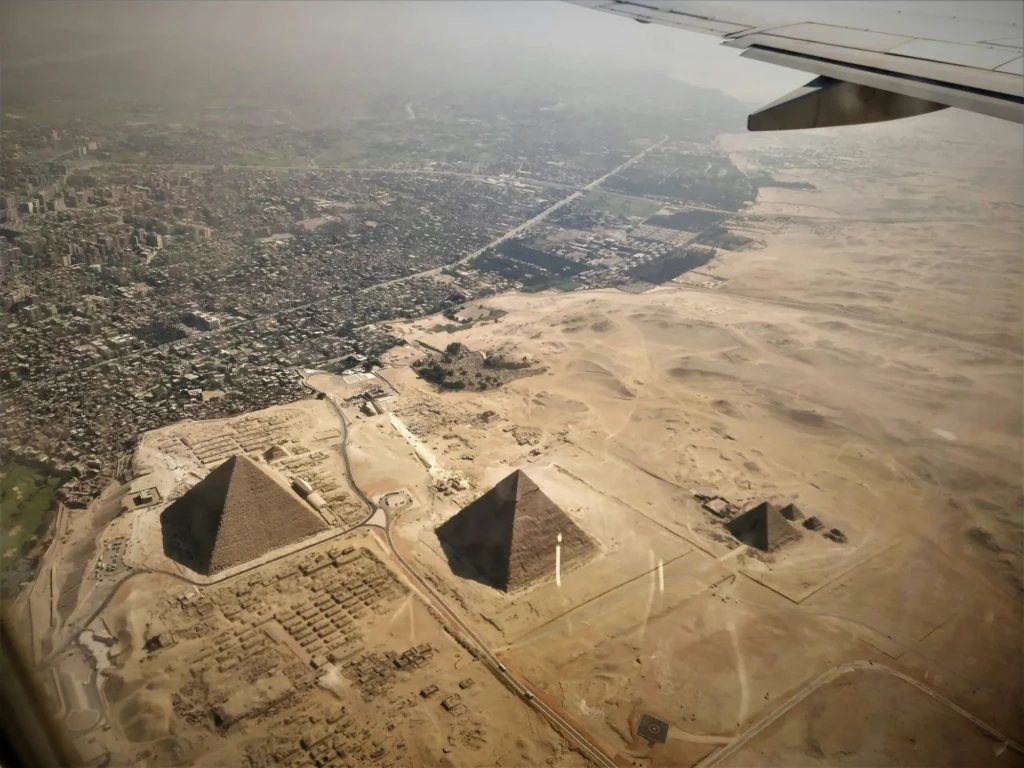
The Dahshur pyramids are two giant 4th Dynasty pyramids built by King Sneferu about 28 km (17 miles) south of central Cairo: the Bent Pyramid, whose slope changes partway up, and the Red Pyramid, Egypt’s first successful smooth-sided pyramid. You can go inside the Red Pyramid through a long, low passage. As listed on the official Ministry of Tourism and Antiquities site in October 2026, the site opens daily from 8:00 a.m. to 5:00 p.m., and the foreign adult ticket is EGP 200.
This guide explains why these two pyramids matter, what going inside the Red Pyramid really involves, the Bent Pyramid’s history and access, and how to combine Dahshur with Saqqara, Memphis and Giza in one day.
| Quick facts | Details |
|---|---|
| Location | About 28 km (17 miles) south of central Cairo, at the southern end of the Memphis necropolis |
| Built by | King Sneferu, first king of the 4th Dynasty and father of Khufu |
| Main monuments | Red Pyramid, Bent Pyramid; Middle Kingdom pyramids including the Black Pyramid of Amenemhat III |
| Opening hours | Daily, 8:00 a.m. to 5:00 p.m. (Ministry of Tourism and Antiquities, October 2026) |
| Foreigner ticket | Adult EGP 200; student EGP 100 (Ministry of Tourism and Antiquities, October 2026) |
| Red Pyramid height | 105 m (344 ft); the third-largest Egyptian pyramid after Khufu’s and Khafre’s at Giza |
| Red Pyramid passage | About 61 m (200 ft) long, sloping down at 27°, about 0.9 m (3 ft) high |
| UNESCO status | Part of the Memphis and its Necropolis World Heritage Site, inscribed in 1979 |
What is Dahshur and why does it matter?
Dahshur was the southern part of the cemetery of Memphis, ancient Egypt’s capital. Kings of the Old and Middle Kingdoms built pyramids on its desert plateau. North of it lie the other great pyramid fields of Memphis: Saqqara, Abusir and Giza.
Dahshur matters because it shows the moment the Egyptians learned to build a true pyramid. The Ministry of Tourism and Antiquities says Sneferu chose this plateau to rival Djoser’s Step Pyramid at Saqqara. His first attempt here changed shape partway through. He then built a complete pyramid nearby: the Red Pyramid.
In 2019, AFP reported that the site drew only a trickle of visitors and lacked the touts and bustle of Giza. That calm is still a big part of the appeal for many travelers. You stand in open desert with two pyramids that are almost as large as those at Giza.
From Meidum to Giza: how Sneferu’s pyramids changed history
Sneferu built at least three major pyramids during his long reign. Each one reflects lessons learned from the last. His son Khufu then built the Great Pyramid at Giza. Following the sequence helps you see Dahshur as a turning point rather than a side trip.
- Djoser’s Step Pyramid, Saqqara. The starting point, built roughly a century earlier as a stack of stepped layers. Read more in our guide to the Step Pyramid of Djoser.
- Meidum. About 72 km (45 miles) south of Cairo. Begun as a step pyramid, possibly under Sneferu’s predecessor Huni, then filled in to make straight sides. It partly collapsed, likely during construction. Locals call it the “false pyramid.”
- The Bent Pyramid, Dahshur. Started steep at about 54 degrees. Builders cut the angle to about 43 degrees for the upper part, which created the bend.
- The Red Pyramid, Dahshur. Built from the start at the safer 43-degree angle. It is considered Egypt’s first successful smooth-sided pyramid.
- The Great Pyramid, Giza. Built by Khufu, Sneferu’s son, using the lessons of Dahshur at a much larger scale. See our Giza Pyramids Complex guide.
Scholars still debate exactly why the Bent Pyramid’s angle changed. One view links it to signs of instability, possibly connected to problems at Meidum. Another points to the practical difficulty of building ramps near the top of a steep pyramid. Either way, the change is visible in the stone, and you can see it with your own eyes.
What to see at Dahshur, in visiting order
The two Sneferu pyramids stand about 1 km (0.6 miles) apart. The Red Pyramid is the northern one, and most visits begin there because it is the one people want to enter.
1. The Red Pyramid
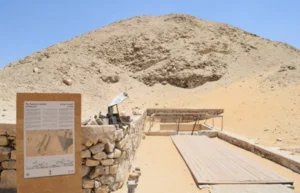
The Red Pyramid takes its name from the reddish tone of its limestone blocks. It was once covered in fine white limestone from Tura, south of modern Cairo. Like most pyramid casings, that limestone was later taken for reuse. The pyramid rises 105 m (344 ft) on a base about 220 m (720 ft) wide. Its gentle 43-degree slope makes it look low and wide compared with the pyramids at Giza.
Near the pyramid, look for the reconstructed fragments of a pyramidion, or capstone. Experts are not sure it actually belonged to this pyramid, since its angle does not match.
2. The Bent Pyramid
About 1 km south, the Bent Pyramid is the most distinctive shape in Egypt. The lower section rises at a steep angle for about 49 m (160 ft), then the slope eases to the top. It also keeps much of its original polished limestone casing, which is rare. This gives you a good sense of how all pyramids once looked.
The Bent Pyramid has two entrances, one on the north side and one high on the west face. Each leads to its own chamber with a corbelled roof. A small satellite pyramid stands just south of it.
3. The Middle Kingdom pyramids
Dahshur was used again about 700 years later. Kings of the 12th Dynasty built pyramids here, including Amenemhat II’s White Pyramid, the pyramid of Senusret III with tombs of royal women around it, and the Black Pyramid of Amenemhat III. They are in poor condition today. The Black Pyramid’s polished granite capstone is now displayed at the Egyptian Museum in Cairo, covered in our Egyptian Museum Tahrir guide.
The Middle Kingdom area is not the focus of most visits. Ask your guide on the day which parts are accessible.
Can you go inside the Red Pyramid?
Yes. Entry to the Red Pyramid’s interior is part of a standard Dahshur visit, and it is one of the best pyramid interiors you can see in Egypt. It is also physically demanding, so it helps to know exactly what to expect.
The climb to the entrance
The entrance is high on the north face. You climb steps cut into or built over the pyramid’s stones to reach it, in full sun.
The descending passage
From the entrance, a passage slopes down at about 27 degrees for roughly 61 m (200 ft). It is only about 0.9 m (3 ft) high and 1.2 m (4 ft) wide. That means you go down bent almost double the whole way. Most adults cannot stand up at any point in the passage.
The climb back up is harder than the descent. Your thighs and lower back do most of the work. The passage is narrow, so people heading in and out sometimes need to squeeze past each other. A ventilation system pipes fresh air down the shaft to the chambers.
The chambers
At the bottom, a short level passage opens into the first chamber. Its corbelled roof rises in eleven stepped layers to about 12 m (40 ft). A second, similar chamber lies directly beneath the pyramid’s peak. A wooden staircase then takes you up to a third chamber with a corbelled roof about 15 m (50 ft) high. This is thought to be the burial chamber. Its floor is rough and dug out, and its walls are blackened, signs believed to come from tomb robbers.
Who should skip it
Think carefully if you have back or knee problems, heart or breathing conditions, or a fear of tight spaces. Pregnant travelers should also consider skipping it. There is no shame in staying outside. The view of the Bent Pyramid from the Red Pyramid’s steps is worth the climb on its own.
Can you go inside the Bent Pyramid?
The Bent Pyramid was closed to visitors for decades. In July 2019, Egypt reopened it to tourists for the first time since 1965. At the reopening, AFP reported that visitors could climb down a 79 m (259 ft) narrow tunnel from the northern entrance to reach two chambers. The small satellite pyramid nearby was also opened for the first time since its excavation in 1956.
Interior access at Egyptian sites can change with conservation work. The Ministry’s Dahshur page does not say which interiors are open on a given day. Ask your guide or check locally before you go if entering the Bent Pyramid is important to you.
How to get to Dahshur, and how long to spend
Dahshur lies about 28 km (17 miles) south of central Cairo, on the edge of the desert beyond the farmland of the Nile valley. Saqqara, by comparison, is about 40 km southwest of Cairo, according to the Ministry of Tourism and Antiquities. Most visitors come by private car with a driver, usually as part of a guided day.
Driving time depends heavily on Cairo traffic and where you start, so build in a buffer. Once there, allow around two hours to see both Sneferu pyramids at a comfortable pace, including the Red Pyramid interior. Add time if you want to enter the Bent Pyramid or linger for photos.
Dahshur tickets and opening hours
As listed on the official Ministry of Tourism and Antiquities site in October 2026, Dahshur opens every day from 8:00 a.m. to 5:00 p.m. The foreign adult ticket is EGP 200, and the foreign student ticket is EGP 100. Check before you go, since Egyptian site prices change regularly.
Bring some Egyptian pounds in cash as a backup for tickets, tips and restrooms.
Best time to visit Dahshur
The site is open desert with almost no shade, so timing matters. Arrive close to the 8:00 a.m. opening for the coolest air and the softest light on the pyramids. Early arrival also means a quieter Red Pyramid passage.
For season, the cooler months from roughly October to April are the most comfortable for a full pyramid day. If you travel in summer, start as early as possible and plan indoor stops, such as the Imhotep Museum at Saqqara, for midday. Our guide to the best season to visit Egypt covers weather month by month.
Practical tips for visiting Dahshur
- Wear shoes with grip. The steps to the Red Pyramid entrance and the sloping passage can be dusty.
- Dress for crouching. Loose trousers or long shorts work better than a skirt or tight jeans in the passage.
- Bring water and a hat. There is little shade or shelter on the plateau.
- Leave the large bag in the car. You will want both hands free inside the passage.
- Carry a small light. A phone flashlight helps you look up into the corbelled roofs.
- Go slowly on the way up. Take breaks in the passage if you need them. Let faster climbers pass.
- Carry small notes. Useful for tips, restrooms and any guardian who shows you something extra.
How to combine Dahshur with Saqqara, Memphis and Giza
The ancient cemeteries of Memphis run in a line from north to south: Abu Rawash, Giza, Zawyet al-Aryan, Abu Ghurab, Abusir, Saqqara, Mit Rahina (the site of the city of Memphis itself) and Dahshur. That geography makes a south-of-Cairo day easy to plan.
Dahshur, Memphis and Saqqara in one day
This is the most popular combination. Start at Dahshur when it opens, then head north to Mit Rahina to see the remains of Memphis. Finish at Saqqara with the Step Pyramid, the Pyramid Texts and the noble tombs. Our Saqqara visitor guide and our list of things to do in Saqqara help you choose what to see there.
Seeing the pyramids in this order also tells the story well. You see the Step Pyramid that Sneferu tried to outdo, then the Red Pyramid where he finally succeeded. Some travelers prefer to start at Saqqara for that reason, and either order works.
Adding Giza
Giza sits at the northern end of the same line. Fitting Giza, Saqqara and Dahshur into one day is possible but long. It works best for travelers who want to see the whole evolution of the pyramid in a single sweep and do not mind a full day on the road. If you have more time, give Giza its own day with the Great Sphinx and the Grand Egyptian Museum.
Visit with Delta Tours Egypt
Delta Tours Egypt is a family-run operator founded in 1974, holding Ministry of Tourism licence No. 121. Our one-day Giza, Saqqara and Dahshur pyramids day tour starts from $105 per person and covers all three pyramid fields in one day from Cairo. If you would rather focus on Giza, the private Giza Pyramids tour with guide and car starts from $55 per person. The Grand Egyptian Museum and Giza Pyramids private tour starts from $95 per person. For a short stay, the 4-day Cairo tour with the pyramids, GEM and Old Cairo starts from $535 per person. See every option on our private Cairo day tours page.
Frequently Asked Questions
Are the Dahshur pyramids worth visiting?
Yes, especially if you are interested in how the pyramids developed. Dahshur has two of Egypt’s largest pyramids, a calmer setting than Giza and a pyramid interior you can enter. It pairs naturally with Saqqara on the same day.
Can you go inside the Red Pyramid?
Yes. You climb to an entrance high on the north side, then go down a passage about 61 m long and only about 0.9 m high. It is tiring, especially coming back up, but the corbelled chambers inside are impressive.
How much is the Dahshur ticket?
As listed on the official Ministry of Tourism and Antiquities site in October 2026, the foreign adult ticket is EGP 200 and the foreign student ticket is EGP 100. Check before you go, as prices change.
Why is the Bent Pyramid bent?
Its builders started at a steep angle of about 54 degrees, then reduced it to about 43 degrees partway up. Scholars still debate the reason, with instability and construction ramps among the main explanations.
How far is Dahshur from Cairo and Giza?
Dahshur is about 28 km south of central Cairo. It lies at the southern end of the pyramid fields that start at Giza, with Saqqara and Memphis in between.
Which came first, the Red Pyramid or the Great Pyramid?
The Red Pyramid came first. It was built by Sneferu, and his son Khufu built the Great Pyramid at Giza afterward, using what had been learned at Dahshur.
Ready to plan a pyramid day south of Cairo? Explore our private Cairo day tours and we will shape the route around what you most want to see.