Avenue of Sphinxes: Walking from Karnak to Luxor Temple
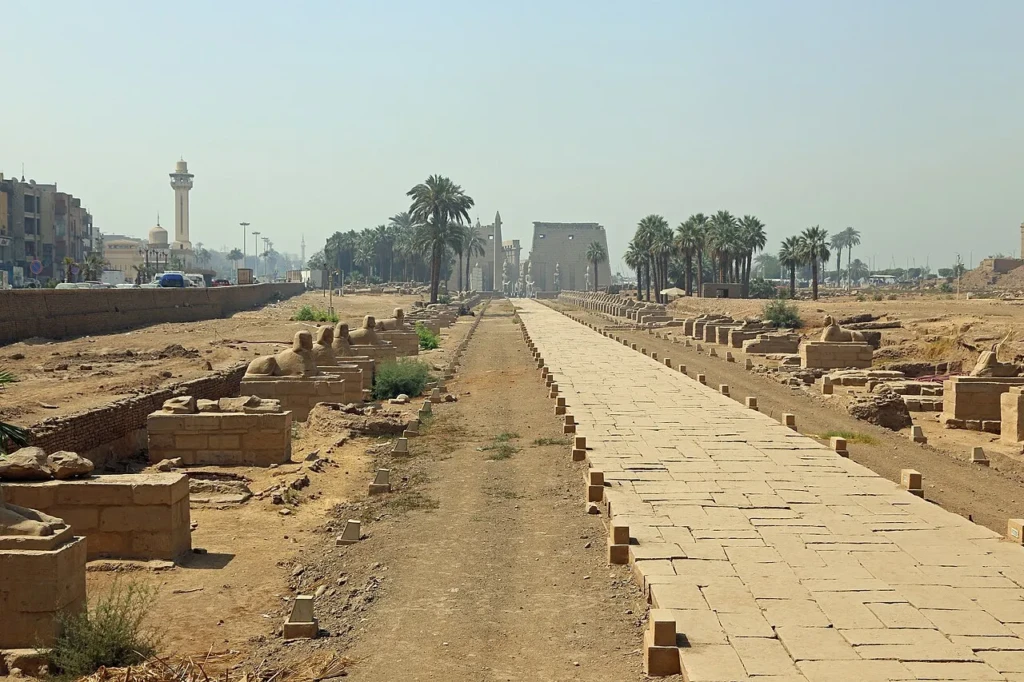
The Avenue of Sphinxes is a 2.7-kilometer processional road in Luxor that links Karnak Temple with Luxor Temple, lined on both sides by sphinx and ram statues. It was completed under the pharaoh Nectanebo I in the 4th century BC, after being begun in the New Kingdom. Buried for centuries, it was excavated over about seven decades and officially reopened on November 25, 2021.
This guide covers the avenue itself: its history, what survives, and how to see it alongside the two temples at either end. For the temples in depth, read our guides to Karnak Temple and Luxor Temple.
Avenue of Sphinxes Quick Facts
| Fact | Details |
|---|---|
| Location | East Bank of Luxor, between Karnak Temple (north) and Luxor Temple (south) |
| Length | 2,700 m (2.7 km) |
| Date | Begun in the New Kingdom; completed under Nectanebo I (380–362 BC), 30th Dynasty |
| Purpose | Route for the annual Opet Festival procession of Amun, Mut and Khonsu |
| Statues | 1,057 recorded: 807 human-headed sphinxes and 250 ram-headed statues |
| Rediscovered | 1949, when the first eight sphinxes were found near Luxor Temple |
| Reopened | November 25, 2021, with a public ceremony |
| Time needed | Our planning suggestion: 30 to 45 minutes at the Luxor Temple end; up to 1.5 hours to walk a long stretch |
What Was the Avenue of Sphinxes For?
The avenue was built for one festival. Karnak was the great home of the god Amun, and Luxor Temple lay to the south. According to the Ministry of Tourism and Antiquities, Luxor Temple is unusual because it faces Karnak instead of following the normal east-west axis of Egyptian temples.

Once a year, during the Opet Festival, priests carried the sacred images of Amun, his wife Mut and their son Khonsu out of Karnak. The procession moved south to Luxor Temple, where they visited the god who resided there, Amenemopet. The avenue gave this yearly procession a monumental stage.
Why sphinxes and rams?
Sphinxes combine a lion’s body with a human head. The ram was an animal of Amun, so ram-headed statues tied the road directly to Karnak’s god. The avenue includes three types: lion-bodied statues with ram heads, full rams, and human-headed sphinxes. Most of the statues along the main road are human-headed sphinxes.
Who Built the Avenue?
No single king built it. The route took shape over more than a thousand years.

- Hatshepsut (18th Dynasty) recorded on her Red Chapel at Karnak that she built six chapels for Amun-Re along the route.
- Amenhotep III set up full ram statues, which were later moved to Karnak.
- Tutankhamun is linked to the first statue type, on the branch between Karnak and the Precinct of Mut.
- Nectanebo I (380–362 BC), of the 30th Dynasty, completed the avenue in the form most of it takes today.
Later periods left their mark too. Excavators found Roman buildings, workshops for pottery and statues, and a relief bearing the cartouche of Cleopatra VII along the route.
How the Avenue Was Lost and Found
After the temples fell out of use, sand covered the road. Over the centuries, houses and streets were built on top of the stretches farthest from the two temples. For a long time only the ends near the temples were known.
- 1949: The Egyptian archaeologist Zakaria Ghoneim found the first eight sphinxes in front of Luxor Temple.
- 1958–1961: Seventeen more statues were uncovered.
- 1961–1964: Another 55 came to light, all within about 250 meters.
- 1984–2000: The full course of the road was traced.
- 2005–2011: A major excavation and restoration push, halted by the 2011 uprising.
- November 25, 2021: The restored avenue was reopened with a televised parade through Luxor.
The 2021 ceremony, announced on the Ministry’s event page, celebrated the completion of restoration on the road and on both temples. It recreated a festival procession, with models of sacred boats for Amun, Mut and Khonsu carried along the route. Not every statue survived. Some sphinxes were destroyed over the centuries, which is the honest state of a road that spent so long under a city.
What to See, From South to North
Most visitors meet the avenue at Luxor Temple first, since it sits in the city center close to hotels and cruise moorings. This order follows the route of the ancient procession in reverse.
1. The Luxor Temple end
The stretch in front of Luxor Temple is where the first sphinxes were found in 1949. Rows of sphinxes on their pedestals line the approach to the temple. It is the classic view, and the one most worth your time if you only have a few minutes.
Luxor Temple is lit after dark, and the sphinxes near the pylon look very different in the evening. If you visit late in the day, walk this stretch once in daylight and once after sunset.
2. The central section
Between the two temples, the route passes through modern Luxor. Houses and streets once covered these stretches, so what survives here is more fragmentary than at the ends. This part shows the scale of the project more than its beauty, and it helps you grasp how long the procession was.
3. The Karnak end and the Mut branch
At the northern end, the avenue approaches the Karnak complex. A branch runs toward the Precinct of Mut, the temple of Amun’s wife, south of the main Amun Precinct. Karnak’s own courts and gates contain more ram statues, so the theme continues once you are inside.
Opening Hours, Tickets and Access
We could not find an official ticket price or set opening hours for the avenue itself on the Ministry’s site. The sections at each end are best seen as part of your visits to the two temples. Ask your guide how much of the central route is open to walk on the date of your visit.
For the temples at either end, the figures below are as listed on the official Ministry of Tourism and Antiquities site in October 2026; check before you go.
| Site | Hours | Foreign adult | Foreign student |
|---|---|---|---|
| Luxor Temple | Daily 6:00 am–8:00 pm | EGP 500 | EGP 250 |
| Karnak Temple (with the Open Air Museum) | Daily 6:00 am–5:00 pm | EGP 600 | EGP 300 |
| Mut Temple at Karnak | Separate ticket | EGP 200 | EGP 100 |
The Karnak figures come from the Ministry’s Karnak page, which notes that the main ticket covers both Karnak Temple and the Open Air Museum.
Walking From Karnak to Luxor Temple
The idea of walking the full 2.7 kilometers in the footsteps of the procession is appealing. In practice, think carefully before committing to it.
- Heat: For much of the year, a long walk in full sun is tiring, especially after a morning at Karnak. Early morning or late afternoon is far better.
- Access: How much of the route you can walk may vary. Your guide will confirm what is open.
- Pace: At an easy pace with stops, our planning suggestion is up to 1.5 hours for a long stretch.
- Logistics: Arrange for your driver to meet you at the far end, so you are not walking back.
For most travelers, the best plan is simple. See Karnak in the morning, drive to Luxor Temple, and walk the southern stretch of the avenue there. This gives you the strongest section without the fatigue.
Best Time to Visit
Luxor gets very hot from late spring to early autumn. The cooler months are the most comfortable for walking outdoors. Our guide to the best season to visit Egypt covers the weather month by month.
Within the day, two windows work best. Early morning at Karnak, when it opens at 6:00 am, avoids both heat and crowds. Late afternoon into evening at Luxor Temple, which stays open until 8:00 pm, lets you see the sphinxes in daylight and under lights.
How to Get There
Both ends of the avenue are on Luxor’s East Bank, in or near the city center. The Ministry describes Luxor Temple as about three kilometers south of Karnak. Most hotels and Nile cruise moorings are a short drive from either temple. Your driver or guide will confirm timing on the day.
If you are coming from Cairo, Luxor can be visited on a long day trip by air or as part of a longer stay. Our Luxor travel guide explains how to plan your time there.
Combining the Avenue With Other Luxor Sites
The avenue is not a separate outing. It is the thread that ties two East Bank temples together. Plan it this way:
- Morning: Karnak Temple, including the Great Hypostyle Hall and, if you have time, the Mut Temple.
- Midday: Rest, lunch or the Luxor Museum.
- Late afternoon: Luxor Temple and the southern stretch of the avenue as the light softens.
Save the West Bank for another day. The Valley of the Kings and the Temple of Hatshepsut need a full morning on their own. If you are on a Nile cruise between Luxor and Aswan, the East Bank temples are usually part of the Luxor program.
Visit With Delta Tours Egypt
We do not sell a dedicated Avenue of Sphinxes tour. Our Luxor & Karnak Temples tour, from $70 per person, visits the two temples at either end of the avenue with a private Egyptologist. The Luxor East And West Banks day, from $128 per person, adds the royal tombs. For an evening at Karnak, see the Sound & Light Show Luxor, from $80 per person.
If you want time to walk a longer stretch of the avenue, we can arrange a private visit on request through our tailor-made tours service, timed for the cooler hours. You can also browse all our Luxor tours and excursions.
Frequently Asked Questions
How long is the Avenue of Sphinxes?
It runs 2,700 meters, or 2.7 kilometers, between Karnak Temple and Luxor Temple. That figure comes from the Ministry of Tourism and Antiquities.
How many sphinxes are on the Avenue of Sphinxes?
Published counts list 1,057 statues: 807 human-headed sphinxes and 250 ram-headed statues. Many are damaged, and some survive only as bases.
When did the Avenue of Sphinxes reopen?
It officially reopened on November 25, 2021, with a large ceremony in Luxor. The event marked the end of decades of excavation and restoration.
Do I need a ticket for the Avenue of Sphinxes?
We found no official separate ticket listed for the avenue. The stretches at each end are seen with your Luxor Temple and Karnak visits, which have their own tickets. Ask your guide about access to the central section on your date.
Can you walk from Karnak to Luxor Temple along the avenue?
The route links the two temples, but how much you can walk may vary. In hot weather, most travelers see the Luxor Temple end on foot and drive between the temples.
What was the Opet Festival?
It was an annual festival in which the images of Amun, Mut and Khonsu were carried from Karnak to Luxor Temple. The avenue was built as the stage for that procession.
The Avenue of Sphinxes turns two famous temples into one connected story. To plan your East Bank day with a private Egyptologist, start with our Luxor tours and excursions.
Featured image: Avenue of Sphinxes leading to Luxor Temple. Photo: Marc Ryckaert / Wikimedia Commons, CC BY-SA 4.0