Karnak Temple: History, Highlights & Visitor Guide
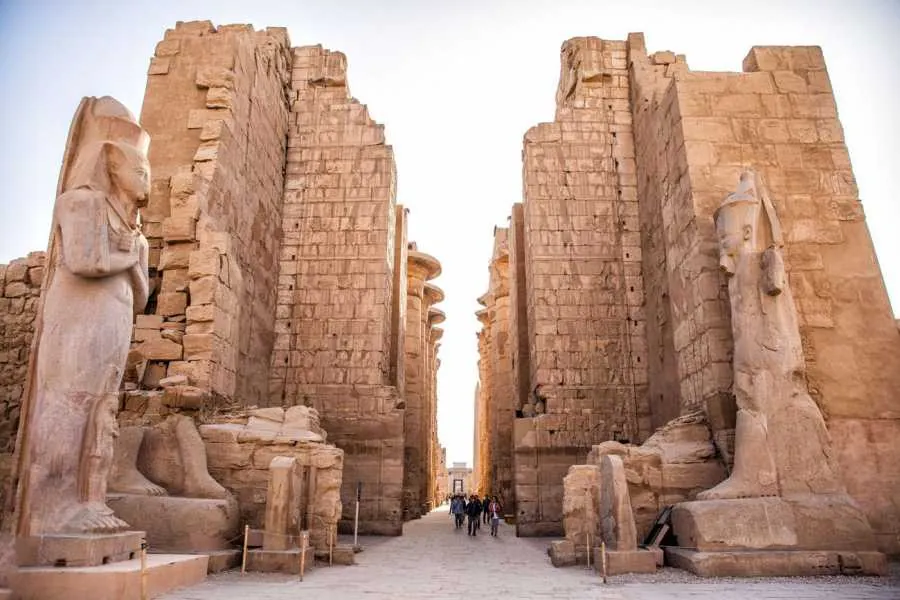
Karnak Temple in Egypt is the kind of place that changes scale every few steps. First comes an avenue guarded by ram-headed sphinxes. Then an immense gateway opens into a court large enough to absorb the crowds. Beyond it rises the Great Hypostyle Hall, where 134 stone columns create a forest of carved papyrus stalks. Continue farther and obelisks, sanctuaries, festival halls, chapels, and a sacred lake reveal a site that is far more complex than its familiar name suggests.
Karnak is not one temple built by one ruler. It is a vast religious complex developed, dismantled, enlarged, and rededicated over many centuries. Its surviving monuments preserve the ambitions of pharaohs from the Middle Kingdom through the Greco-Roman era, although the New Kingdom left the most imposing mark. For travelers, that long history creates both Karnak’s fascination and its main challenge: without a plan, it is easy to admire the size while missing the story.
This guide explains what Karnak was, who built it, how the complex is arranged, what deserves your time, and how to plan a comfortable visit. It also clarifies the relationship between Karnak and Luxor Temple, offers routes for visits of different lengths, and answers the practical questions travelers ask before arriving.
What Is Karnak Temple?
The name “Karnak Temple” is convenient, but “Karnak Temple complex” is more accurate. Within its ancient enclosure walls stood multiple temples and subsidiary monuments dedicated to different deities. The largest and most visited area is the Precinct of Amun-Re. Other major sacred zones include the Precinct of Mut to the south and the Precinct of Montu to the north. The remains of temples associated with Aten worship also show how the complex changed during the religious upheaval of Akhenaten’s reign.
Ancient Egyptians knew the principal sanctuary as Ipet-sut, usually translated as “the Most Select of Places.” It became the foremost cult center of Amun-Re, a god whose rise was closely connected to the political success of Thebes. Mut, Amun’s consort, and Khonsu, their son, completed the Theban Triad. Their temples, sacred images, and festival journeys made Karnak a living ritual landscape rather than a static collection of monuments.
Only parts of the wider complex follow the standard visitor route today. Most travelers enter the Amun-Re precinct and move west to east through the main sequence of pylons, courts, halls, and sanctuaries. Even this accessible core is enormous. That is why an understanding of the Karnak Temple plan makes the difference between a series of impressive photographs and a coherent encounter with ancient Egyptian religion and kingship.
Why Karnak Temple Mattered in Ancient Egypt
Karnak’s importance was religious, political, and economic at once. Amun-Re was not simply a local god receiving private prayers. During the New Kingdom, his cult was closely tied to royal authority and Egypt’s imperial wealth. Pharaohs presented themselves as chosen by the god, celebrated victories in his presence, and used temple building to demonstrate legitimate rule.
The temple institution also controlled estates, workshops, granaries, livestock, and personnel. Priests conducted daily rites inside restricted sanctuaries, while administrators managed a major economic organization. Ordinary people did not wander freely through the inner courts as modern visitors do. Access became more exclusive toward the sacred core: monumental outer spaces displayed royal and divine power, but only designated priests and the king could approach the most restricted areas.
Festivals opened another kind of relationship between temple and city. During the Opet Festival, the sacred images of Amun, Mut, and Khonsu traveled from Karnak toward Luxor Temple in ceremonial barques. The journey connected the two sanctuaries, placed divine power before the wider community, and renewed the relationship among Amun, the king, and the ordered world. Karnak therefore functioned both as a secluded divine residence and as the starting point for one of Thebes’ most important public celebrations.
Karnak Temple History: A Sacred Complex Built Over Centuries
Karnak did not grow according to one master plan. Each period inherited structures from earlier rulers and responded with additions, replacements, restorations, or deliberate erasures. Some monuments were taken apart and reused as filling inside later pylons. Others were enclosed by new construction. This layered development explains why the site can feel like an architectural puzzle—and why reconstructed chapels in the Open-Air Museum are so valuable.
Middle Kingdom beginnings
There may have been earlier sacred activity at Karnak, but the clearest early monumental phase belongs to the Middle Kingdom. Senusret I of the Twelfth Dynasty built extensively in the area. His beautifully carved White Chapel, now reconstructed in Karnak’s Open-Air Museum, was originally a barque station used in festival processions. Its reliefs and geographical lists make it one of the most informative early monuments associated with the site.
The political setting matters. The rulers who reunited Egypt at the beginning of the Middle Kingdom came from Thebes, helping elevate the city and its gods. Amun’s sanctuary grew as Thebes developed from a regional center into a place of national importance.
The early New Kingdom and the rise of Amun
After Theban rulers helped drive the Hyksos from northern Egypt and established the New Kingdom, Amun became central to royal ideology. Wealth from military campaigns and international exchange flowed into his temple. Successive rulers expanded Karnak on an unprecedented scale.
Thutmose I constructed pylons and courts and erected obelisks on the temple’s east–west axis. Hatshepsut inserted chapels and obelisks into the sacred landscape, using architecture and inscriptions to affirm her devotion to Amun and the legitimacy of her kingship. Her Red Chapel, originally created as a shrine for Amun’s portable barque, has been reconstructed from surviving blocks in the Open-Air Museum.
Thutmose III made extensive changes of his own. His contributions included the Akh-menu, commonly called the Festival Hall, at the eastern end of the central temple. The building includes unusual columns often compared to tent poles and a group of reliefs known as the Botanical Garden, representing plants and animals associated with regions reached during his campaigns.
Amenhotep III and the monumental axes
Amenhotep III continued reshaping the complex. His Third Pylon once formed an imposing entrance, and its construction reused blocks from older monuments. Many of those dismantled pieces later allowed archaeologists to reconstruct chapels in the Open-Air Museum. Amenhotep III also developed the temple’s north–south relationship with other sacred zones and made major contributions throughout Thebes, including at Luxor Temple.
Akhenaten, religious change, and restoration
Before adopting the name Akhenaten and moving his court to Akhetaten, Amenhotep IV built temples to the Aten at or near Karnak. These structures used relatively small stone blocks, often called talatat, that could be assembled quickly. Later rulers dismantled much of this Aten complex, and the blocks were reused within new construction.
After Akhenaten’s religious reforms were rejected, Tutankhamun and his successors restored traditional cults. Horemheb undertook major work at Karnak and reused Aten blocks in his pylons. The site therefore preserves religious conflict not as a single dramatic ruin but as material embedded within later architecture.
Seti I, Ramesses II, and the Great Hypostyle Hall
The Great Hypostyle Hall reached its celebrated form under the early Nineteenth Dynasty. Seti I was responsible for much of its decoration, particularly in the northern half, while Ramesses II completed and inscribed extensive areas. The result is one of the most ambitious columned spaces in ancient architecture.
The reliefs are not interchangeable decoration. Interior scenes emphasize ritual encounters between king and gods, while the outer walls include military imagery. Differences in carving technique also help attentive visitors distinguish phases: Seti I is strongly associated with refined raised relief in key areas, while much of Ramesses II’s work uses sunk relief suited to strong exterior light and faster execution.
Later additions: Ramesses III to the Ptolemies
Ramesses III built a temple for Amun’s barque beside the Great Court, creating one of the best-preserved smaller temple sequences along the main route. Centuries later, the Kushite king Taharqa added a monumental kiosk to the court; one enormous column remains standing.
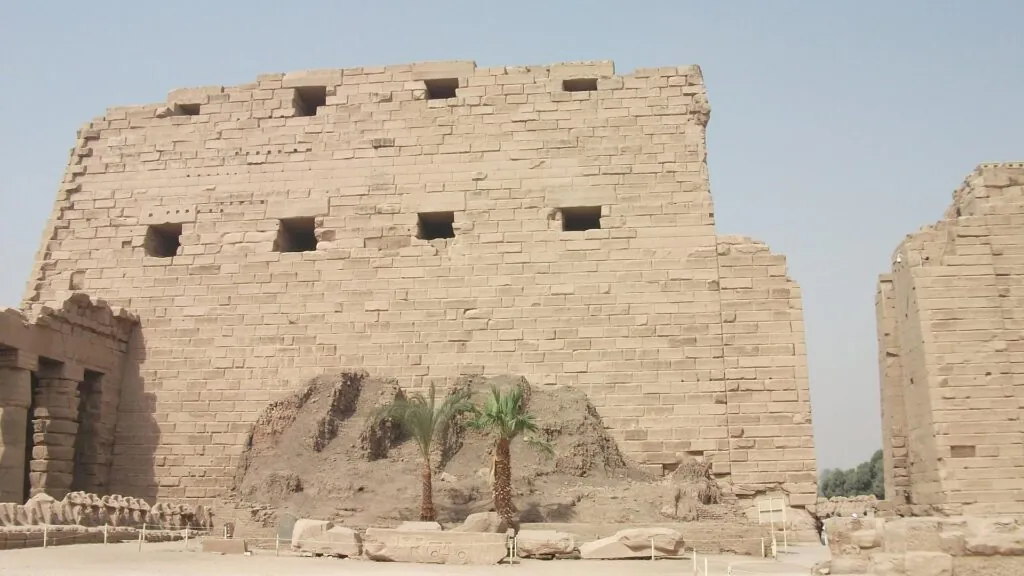
The outer First Pylon, now the principal Karnak Temple entrance, was among the last monumental gateways added to the Amun precinct. It is generally associated with the Thirtieth Dynasty, probably the reign of Nectanebo I, and was left unfinished. Evidence of the building process remains visible, including traces of mudbrick construction ramps.
Ptolemaic rulers continued building and decorating throughout Karnak, and Roman emperors also left inscriptions and interventions. The site was never the creation of a single “golden age.” It was an active sacred landscape that rulers repeatedly reinterpreted.
Who Built Karnak Temple?
No single pharaoh built the temple of Karnak. Its history spans too many reigns for one answer, and the often-repeated claim that “about 30 pharaohs built Karnak” should be treated as a simplified summary rather than a complete count. Some rulers created entire buildings; others added gates, inscriptions, statues, obelisks, restorations, or reused blocks.
| Ruler or period | Selected contribution or significance |
|---|---|
| Senusret I | Major Middle Kingdom building; the reconstructed White Chapel is associated with his reign |
| Thutmose I | Expanded the Amun temple and erected obelisks along the central axis |
| Hatshepsut | Added obelisks and the Red Chapel for Amun’s processional barque |
| Thutmose III | Built the Akh-menu Festival Hall and made extensive additions across the complex |
| Amenhotep III | Built the Third Pylon and contributed to Karnak’s monumental development |
| Amenhotep IV/Akhenaten | Constructed Aten temples later dismantled after the restoration of Amun’s cult |
| Horemheb | Added pylons and reused large quantities of dismantled Aten temple blocks |
| Seti I | Developed and decorated much of the Great Hypostyle Hall |
| Ramesses II | Completed major decoration in the Hypostyle Hall and added inscriptions elsewhere |
| Ramesses III | Built the well-preserved barque temple within the Great Court |
| Taharqa | Added a colossal kiosk in the Great Court |
| Nectanebo I | Commonly associated with the vast enclosure wall and unfinished First Pylon |
| Ptolemaic and Roman rulers | Continued construction, restoration, and inscription at the complex |
This succession is the essence of Karnak Temple history. Pharaohs did not simply preserve the past. They positioned themselves within it—sometimes honoring predecessors, sometimes appropriating their work, and sometimes trying to erase them.
Understanding the Karnak Temple Plan
The most helpful way to read the main Amun-Re precinct is through two monumental axes.
The east–west axis forms the standard visitor route. It begins near the ancient quay and Avenue of Rams, passes through the First Pylon and Great Court, enters the Great Hypostyle Hall, and continues through older pylons toward the central sanctuary and eastern temples. Moving inward roughly parallels increasing ritual exclusivity.
The north–south axis branches from the central complex through a succession of pylons toward the Precinct of Mut and, ultimately, the route to Luxor Temple. This axis was important for processions, especially those associated with the Theban Triad.
The present route does not reproduce ancient access exactly. Gateways changed over time, monuments were enclosed, and modern conservation needs determine which spaces visitors can enter. Treat a map as an orientation tool rather than a snapshot of one historical moment.
A simple mental map for first-time visitors
- Arrival and Avenue of Rams: the processional approach to the First Pylon.
- First Pylon and Great Court: a vast, relatively late outer entrance containing earlier and later monuments.
- Second Pylon and Great Hypostyle Hall: Karnak’s most celebrated architectural space.
- Third to Sixth Pylons: a denser sequence containing obelisks, courts, and the route toward the sanctuary.
- Central sanctuary: the sacred heart, altered and rebuilt across periods.
- Akh-menu: Thutmose III’s Festival Hall east of the central core.
- Sacred Lake and southern zone: a quieter area with ritual associations and broad views.
- Open-Air Museum: reconstructed chapels northwest of the Great Court; allow separate time and check access arrangements.
What to See at Karnak Temple
1. The Avenue of Ram-Headed Sphinxes
The approach to the First Pylon is lined with statues combining lions’ bodies and rams’ heads. The ram was associated with Amun, and small royal figures appear protected beneath the chins of the animals. This is distinct from the longer Avenue of Sphinxes connecting Karnak and Luxor Temple, where different phases and statue forms reflect a complex building history.
Pause here before rushing to the gateway. The avenue establishes the processional character of the site: Karnak was designed to be approached ceremonially, with architecture controlling what appeared and disappeared from view.
2. The Unfinished First Pylon
The First Pylon looks ancient even by Karnak’s standards, yet it is a relatively late addition to the Amun precinct. Its undecorated masonry and unfinished condition make it unusually revealing. Rather than presenting a polished royal façade, it exposes the scale of labor required to build one.
The pylon’s massive towers frame the current entrance into the Great Court. Look for remnants of mudbrick ramps behind the masonry. Such evidence helps archaeologists study construction methods, although many popular claims about exactly how every stone was raised remain reconstructions rather than documented step-by-step instructions from ancient builders.
3. The Great Court
The Great Court is not empty space. It contains monuments from different periods arranged within a late enclosure. On the right stands the barque temple of Ramesses III, with a small pylon, an open court lined by Osiride figures, a columned hall, and sanctuary rooms. Because its spaces follow a clear sequence, it is an excellent introduction to how an Egyptian temple became more enclosed and sacred toward its rear.
Near the center of the court, one surviving column marks the kiosk of Taharqa. Imagine it as part of a much larger open structure built by a Kushite king who ruled Egypt during the Twenty-fifth Dynasty. The court also preserves evidence of older processional monuments and the changing arrangement of the main entrance.
4. The Great Hypostyle Hall
For many visitors, the Great Hypostyle Hall is the defining experience of Karnak Temple Egypt. The hall covers roughly 5,000 square meters and contains 134 sandstone columns. Twelve enormous columns form the elevated central nave; their open papyrus capitals rise to about 20–21 meters. The lower side aisles use closed-bud papyrus forms.
This difference in height allowed clerestory windows to admit light above the lower roofs. The effect would once have been far more controlled than the open sky seen today: shafts of light entered a roofed, painted interior filled with ritual images and hieroglyphs. Traces of ancient color survive high on columns and sheltered surfaces, giving a glimpse of a space that was never intended to look uniformly beige.
Do more than photograph the central aisle. Walk toward the northern section to study Seti I’s exceptionally fine reliefs, then compare them with inscriptions from the reign of Ramesses II. On the exterior walls, military scenes communicate the king’s role as defender of divine order. These are ideological monuments, not neutral battle reports, even when they preserve valuable names, places, and historical details.
5. The Obelisks of Thutmose I and Hatshepsut
Obelisks transformed sunlight into royal theology. Their granite shafts were quarried far to the south at Aswan, transported to Thebes, raised in pairs, and dedicated to the solar aspects of Amun-Re. Their pyramid-shaped tops may originally have been covered with a reflective metal such as electrum, catching the sun above the temple roofs.
The standing obelisk of Hatshepsut is among Karnak’s most powerful monuments. Its inscriptions praise Amun and emphasize the queen’s devotion and legitimacy. Thutmose III later enclosed part of it within masonry, probably as part of changes to the temple rather than a simple attempt to destroy it. The protected lower sections retained surfaces that help visitors imagine the original finish.
A standing obelisk of Thutmose I also survives. Seeing the two in relation to pylons and courts makes their achievement more striking than any isolated height statistic: each was a single piece of hard granite placed within an already crowded sacred core.
6. The Central Sanctuary
Beyond the forest of columns, the route narrows toward Karnak’s sacred center. The surviving granite barque sanctuary dates to the reign of the Macedonian ruler Philip Arrhidaeus, although it occupies a ritual location shaped by earlier structures. Here the portable shrine of Amun could rest during ceremonies.
The fragmentary rooms around it are harder to understand than the Great Court, but this is where a guide adds the most value. Walls, thresholds, reused blocks, and changes in masonry reveal repeated rebuilding. The sacred core was not frozen in the New Kingdom; later kings renewed it while claiming continuity with ancient tradition.
7. Thutmose III’s Festival Hall, the Akh-menu
East of the central temple lies the Akh-menu, or Festival Hall of Thutmose III. Its distinctive columns are often described as evoking the poles of a campaign tent, a fitting association for a king who celebrated military success. The complex served royal and divine ritual purposes, including ceremonies connected with renewal.
Seek out the reliefs known as the Botanical Garden. They show plants and animals linked in the inscriptions to lands encountered by the king. The images are stylized within Egyptian artistic conventions, yet they communicate a wider world gathered symbolically into Amun’s estate.
8. The Sacred Lake and the Scarab
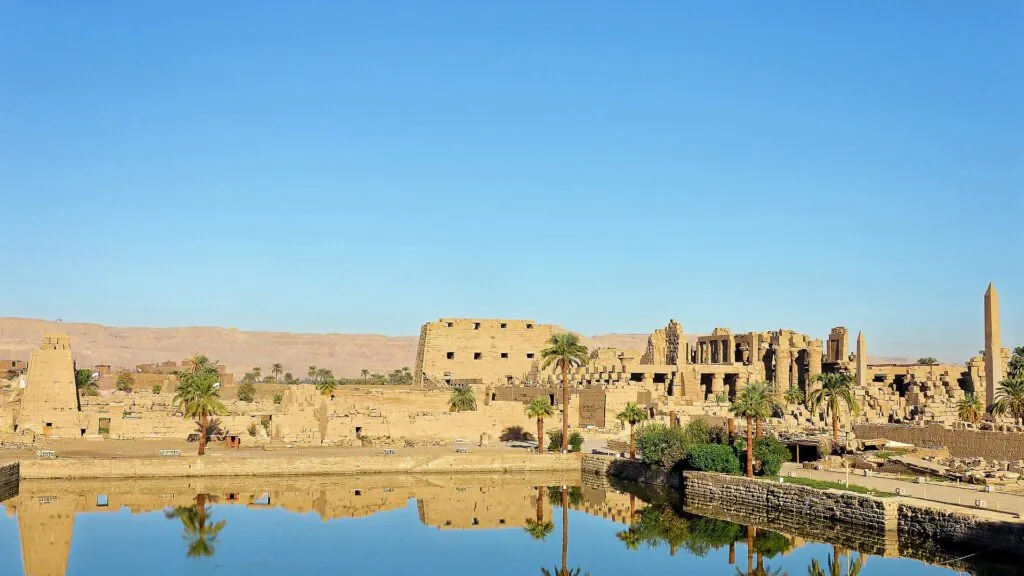
The Sacred Lake was used in temple ritual and priestly purification. Its still surface now offers one of Karnak’s most peaceful views, especially when the obelisks reflect in the water. The surrounding zone once included practical and ritual facilities supporting temple life.
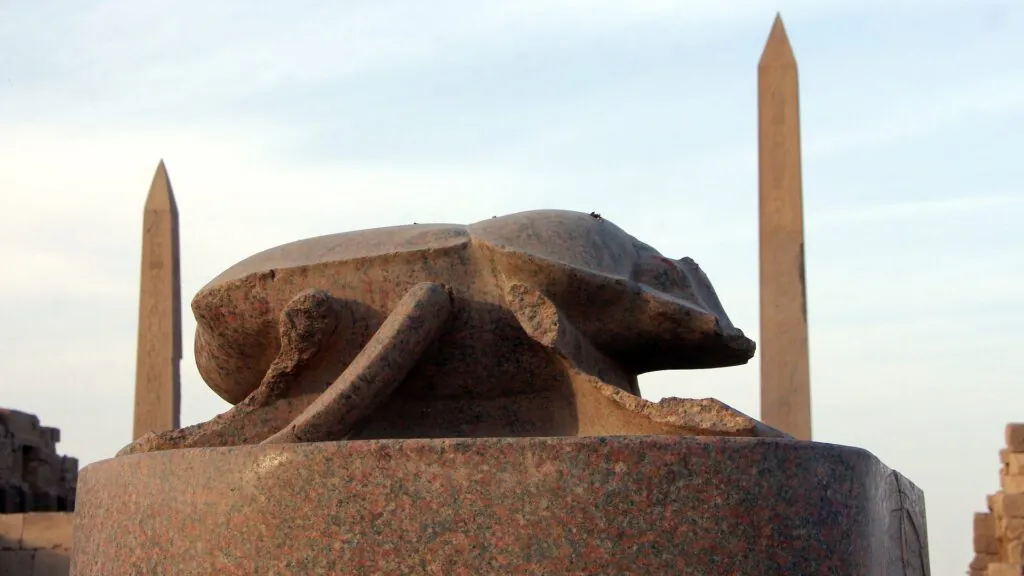
Nearby stands a large stone scarab associated with Amenhotep III and the solar god Khepri. Guides and social media posts often claim that walking around it a set number of times guarantees luck, love, fertility, or a wish. This is modern visitor folklore, not an established ancient ritual documented by archaeological evidence. Enjoy the tradition if you wish, but do not mistake it for a confirmed pharaonic practice.
9. Karnak Open-Air Museum
The Open-Air Museum is one of the best reasons to allow extra time. Archaeologists reconstructed earlier monuments using blocks recovered from the interiors of later pylons. Highlights include Senusret I’s White Chapel and Hatshepsut’s Red Chapel, along with barque shrines and architectural fragments from several reigns.
These reconstructions make Karnak’s history legible. A pylon that once seemed to be a single monument becomes an archive containing dismantled predecessors. The museum may require separate access or follow different operating arrangements, so ask at the ticket office before beginning the main route.
10. The Temple of Khonsu and Southern Monuments
The Temple of Khonsu, begun under Ramesses III and completed or modified by later rulers, stands in the southern part of the Amun precinct. Its compact, comparatively well-preserved plan helps visitors understand the progression from pylon and court to columned hall and sanctuary.
The southern axis also contains the Seventh through Tenth Pylons and connects conceptually with the Precinct of Mut. Not all areas are consistently open, and conservation work may change access. Travelers with a specialist interest should confirm which secondary zones can be visited before planning an extended day.
Reading the Walls: What Karnak’s Reliefs Really Say
Karnak’s inscriptions operate on several levels. Ritual scenes show the king offering food, incense, flowers, wine, or symbols of order to the gods. Foundation texts record construction and dedication. King lists, place names, and campaign scenes connect the temple to political history. Divine speeches promise life, stability, dominion, or jubilees in return for royal service.
These images were not created as modern journalism. A scene of the king striking foreign enemies represents the defeat of chaos and the maintenance of cosmic order, even when it also refers to historical conflict. Likewise, repeated images of a pharaoh before a god do not mean the same physical ceremony happened in every room exactly as depicted. Temple relief translated ritual ideals into permanent stone.
Look for differences in scale: the king and gods are usually much larger than attendants or enemies. Notice how figures face the sanctuary or respond to the direction of a doorway. Search sheltered ceilings and upper capitals for surviving blue, red, yellow, and green. The colors are not recent additions; they are remnants of an ancient visual environment whose stone surfaces were once painted extensively.
Karnak and Luxor Temples: What Is the Difference?
Karnak and Luxor temples are separate monuments with connected ritual histories. Karnak is a sprawling complex that grew through many reigns and centered primarily on Amun-Re and the wider Theban Triad. Luxor Temple is more compact, and much of its surviving monumental form belongs to Amenhotep III and Ramesses II. Its theology was closely connected with the renewal of kingship and the divine aspect of the ruler.
The processional Avenue of Sphinxes linked the two sites across approximately 2.7 kilometers. During the Opet Festival, sacred barques traveled between Karnak and Luxor, by land or river depending on period and ceremony. Today, the restored avenue makes that ancient urban relationship easier to visualize, although walking arrangements, entrances, and ticket rules should be checked locally.
If you have only one day on Luxor’s East Bank, visit Karnak near opening and Luxor Temple in the late afternoon or evening. Karnak benefits from cool air, low-angle light, and mental energy; Luxor Temple is especially atmospheric as daylight fades and the columns are illuminated.
Karnak Temple Myths, Facts, and Common Misunderstandings
“Karnak was built by one pharaoh”
False. Many kings and later rulers built, altered, restored, dismantled, or inscribed parts of the complex. Its architectural layers are one of its most important features.
“Every building at Karnak is part of one temple”
Misleading. Karnak contains several precincts and many individual temples, shrines, chapels, gateways, and processional spaces. The Amun-Re precinct is only the largest and most frequently visited section.
“The Hypostyle Hall was always open to the sky”
False. It was originally roofed. The taller central columns created a raised nave with clerestory windows, allowing controlled light into the hall.
“Walking around the scarab was an ancient wish ritual”
Unproven. Circling the scarab for luck is a popular modern tradition, but it should not be presented as documented ancient Egyptian practice.
“Military reliefs are photographic records”
False. They can contain historical information, but they also express ideal kingship and the symbolic triumph of order over chaos.
“Karnak Temple and Luxor Temple are the same place”
False. They are distinct temple complexes linked by theology, festivals, and a processional avenue.
Practical Guide to Visiting Karnak Temple
Karnak Temple location
Karnak stands on the East Bank of the Nile in the northern part of modern Luxor, roughly 3 kilometers north of Luxor Temple. The visitor entrance is reached by road from central Luxor and opens toward the reconstructed quay and ram-headed sphinx avenue.
For navigation, search for the official “Karnak Temple” listing rather than a nearby restaurant, sound-and-light entrance, or village pin. Arrange a clear meeting point with your driver because the parking and visitor approach cover a broad area.
Karnak Temple opening hours
Karnak generally opens early, commonly from 6:00 a.m., which makes sunrise-adjacent visits practical. Closing and last-entry times can change with season, Ramadan schedules, official events, or conservation requirements. Karnak also tends to close earlier than Luxor Temple.
When checked in September 2026, the official Egyptian monuments ticket portal listed a last entry of 4:00 PM, so plan to arrive by early afternoon. Do not plan to enter during the final hour: the main circuit needs considerably longer.
Karnak Temple tickets and entrance
As checked on September 1, 2026 through Egypt’s official monument ticket platform, the adult ticket for visitors of other nationalities was EGP 600. Admission prices change periodically, and optional experiences may be ticketed separately. Check the official portal immediately before travel for the current foreign adult, eligible student, Egyptian, and child policies. A valid student card and age limits may apply to reduced admission.
The Open-Air Museum and evening Sound and Light Show can have separate arrangements. Confirm what your main entrance ticket includes rather than assuming every zone or event is covered. If buying online, retain the ticket or QR code in a form available without mobile data. If buying at the site, carry a payment card and a backup option permitted by the official ticket office.
How to get to Karnak Temple
From an East Bank hotel, a taxi or prearranged private vehicle is usually the simplest option. Travel time depends on the hotel and traffic but is normally short from central Luxor. Agree on the fare before an independent taxi ride or use a clearly priced service.
From the West Bank, cross by road bridge with a vehicle or take the public ferry to the East Bank and continue by taxi. Travelers arriving on a Nile River cruise should confirm their vessel’s docking point; it may not be within convenient walking distance.
Walking from central Luxor is possible for fit travelers in mild weather, but heat, traffic, and limited shade can make the route tiring before the visit begins. Save your energy for the archaeological site.
Best time to visit
Arrive as close to opening as practical. The low morning sun brings carvings into relief, temperatures are more manageable, and the Hypostyle Hall is easier to appreciate before large groups accumulate.
Late afternoon can also offer beautiful light, but check closing and last-entry times carefully. Midday is the least comfortable period in warm months because the complex is exposed and distances are deceptive. From roughly October through April, conditions are generally milder, but early starts still improve the experience.
How long to spend at Karnak Temple
- 90 minutes: a fast route through the Great Court, Hypostyle Hall, obelisks, central sanctuary, and Sacred Lake. This is possible but rushed.
- 2–3 hours: the best choice for most first-time visitors, allowing time for the principal axis, details, photographs, and short pauses.
- 4 hours or more: suitable for archaeology enthusiasts who want the Open-Air Museum, Akh-menu, Khonsu Temple, and secondary spaces where accessible.
What to wear and bring
Wear breathable clothing, a sun hat, sunscreen, and supportive shoes with good grip. Karnak is an archaeological site rather than an active mosque, so there is no formal religious dress code for ordinary sightseeing, but respectful travel clothing is sensible. Bring water in a reusable bottle and any medication you may need.
Sand, thresholds, broken paving, and uneven stone can challenge sandals, strollers, and anyone with limited mobility. In cooler months, a light layer is useful at opening; desert mornings can feel crisp before the sun strengthens.
How to Combine Karnak with Other Luxor Sites
One day on the East Bank
Visit Karnak at opening and allow 2–3 hours. Pause for breakfast or an early lunch, then consider Luxor Museum during its published session. Save Luxor Temple for late afternoon or evening. This sequence minimizes heat and gives each temple a distinct atmosphere.
Two days in Luxor
Dedicate one morning to Karnak and the rest of that day to East Bank sites. Reserve the next morning for the Valley of the Kings and selected West Bank monuments. Although “Luxor Valley of the Kings” appears in broad searches alongside Karnak, the necropolis is a separate destination with different ticket choices, transport, and storytelling needs. Combining both in one compressed half-day shortchanges them.
Karnak before or after a Nile cruise
Many cruise programs include Karnak and Luxor temples in a shared sightseeing block. Ask how much actual time is allocated at each site and whether the visit begins at opening. If history is a priority, an extra night in Luxor before embarkation or after disembarkation provides a more relaxed pace.
Is a Guided Tour of Karnak Worth It?
A private visit makes timing easier. A guide and driver can coordinate an early start, adapt the route to mobility or family needs, and spend more time on the periods that interest you. Travelers considering broader Egypt tours can place Karnak within a sequence that includes Cairo, the Nile Valley, and Aswan without reducing Luxor to a rushed checklist. Those who prefer flexible pacing, private transport, and higher-end accommodation can compare luxury Egypt tours while keeping the temple visit focused on history rather than sales.
For Karnak with your own guide, choose our Karnak and Luxor Temple tour, add the Karnak Sound and Light Show in the evening, or see the full list of Luxor tours and excursions.
Frequently Asked Questions About Karnak Temple
Where is Karnak Temple located?
Karnak Temple is on the East Bank of the Nile in Luxor, Upper Egypt, about 3 kilometers north of Luxor Temple. It forms part of the UNESCO-listed Ancient Thebes landscape.
Who built Karnak Temple?
Many rulers contributed to Karnak. Important builders include Senusret I, Thutmose I, Hatshepsut, Thutmose III, Amenhotep III, Horemheb, Seti I, Ramesses II, Ramesses III, Taharqa, Nectanebo I, and Ptolemaic rulers. No single pharaoh built the entire complex.
How old is Karnak Temple?
The surviving monumental history begins prominently in the Middle Kingdom, around the early second millennium BCE, and construction or modification continued into the Ptolemaic and Roman periods. Much of what visitors see today dates to the New Kingdom.
What was Karnak Temple used for?
Karnak was primarily a religious complex, especially the principal cult center of Amun-Re. Priests performed daily rituals, kings dedicated monuments, administrators managed temple estates, and festival processions carried sacred images between temples.
Why is Karnak Temple famous?
Karnak is famous for its immense scale, long building history, 134-column Great Hypostyle Hall, royal obelisks, monumental pylons, sacred lake, and the way its architecture records changing religious and political priorities.
How many columns are in Karnak Temple?
The famous Great Hypostyle Hall contains 134 columns. Twelve taller columns form the central nave, while 122 shorter columns fill the side aisles.
Is Karnak Temple the largest temple in the world?
Karnak is often described as the largest ancient religious complex or one of the largest temple complexes ever built. Such claims depend on whether writers compare a whole precinct, one temple building, total enclosure area, or interior space. Its scale is unquestionably exceptional, but precise “largest” labels should state what is being measured.
Is Karnak Temple the same as Luxor Temple?
No. Karnak and Luxor Temple are separate sites. They were connected by the Avenue of Sphinxes and by festivals such as Opet, during which sacred images traveled between them.
Can you walk from Karnak Temple to Luxor Temple?
The sites are linked by the restored Avenue of Sphinxes, but access points, walking rules, hours, and ticket arrangements can change. Check locally before planning the avenue as your transfer between the two temples.
What are the Karnak Temple opening hours?
Karnak usually opens early, commonly at 6:00 a.m. Closing and last-entry times may vary seasonally and during Ramadan or special events. Verify the current schedule on Egypt’s official monuments ticket portal before visiting.
How much are Karnak Temple tickets?
As checked on September 1, 2026 through Egypt’s official monument ticket platform, the foreign adult ticket was EGP 600. Prices are revised periodically and differ by visitor category. Check the official Egyptian monuments ticket portal for the current adult, student, Egyptian, and child policies. Optional areas or evening shows may require additional tickets.
How long do you need at Karnak Temple?
Most first-time visitors need 2–3 hours. A focused visit can be completed in about 90 minutes, while archaeology enthusiasts should allow at least half a day.
Is there a dress code at Karnak Temple?
There is no mosque-style dress code for the archaeological site. Wear respectful, lightweight clothing, sun protection, and sturdy walking shoes.
Is Karnak Temple suitable for children?
Yes, especially with an early start and a visual, story-led route. The ram-headed sphinxes, giant columns, surviving colors, and obelisks are easy focal points. Bring water, sun protection, and allow breaks.
Is Karnak Temple wheelchair accessible?
Accessibility is partial rather than uniform. Some approaches and main spaces are open and relatively level, but uneven stone, sand, thresholds, and long distances create obstacles. Confirm the current accessible route and drop-off options before arrival.
Is the Karnak Sound and Light Show included in daytime admission?
It is normally a separate evening experience with its own schedule and ticket. Verify the current language program, start time, and booking arrangements before attending.
Why Karnak Belongs on an Egypt Itinerary
Karnak is more than a collection of oversized monuments. It is a record of how ancient Egyptians built sacred authority across generations. A Middle Kingdom chapel survives because its blocks were hidden inside later construction. Hatshepsut’s obelisk rises above changes made by her successors. Seti I and Ramesses II share the Hypostyle Hall, but their reliefs reward comparison. A late, unfinished pylon now serves as the entrance to a much older religious world.
That accumulation gives Karnak its emotional force. The site does not present ancient Egypt as one neat moment. It shows kings competing with the past, priests maintaining ritual, craftsmen adapting old spaces, and archaeologists reconstructing buildings from displaced stone.
Visit early, give the complex at least two hours, and arrive with a route rather than a checklist. If you want the architecture and inscriptions interpreted in context, Delta Tours Egypt can incorporate Karnak into a private, tailor-made Luxor stay with an Egyptologist and coordinated transport. The reward is not simply seeing the temple of Karnak—it is learning how to read one of the most complex sacred landscapes ever created.