Esna Temple of Khnum: The Restored Colors and How to Visit

Esna Temple is the last standing hall of a temple to Khnum, the ram-headed creator god, in the market town of Esna on the Nile’s west bank, about 60 km south of Luxor. Built under Roman emperors in the 1st century AD, it sits roughly 9 meters below today’s street level. After years of cleaning by a joint Egyptian-German team, its ceiling and columns now show their original strong reds and yellows, hidden under soot for centuries.
For a long time Esna was a quick stop for cruise passengers waiting at the river lock. The restoration has changed that. Here is what the temple is, what the cleaning revealed, what to look for inside, and how to fit Esna into a Luxor stay or a slow trip south on a dahabiya.
Esna Temple at a Glance
| Fact | Details |
|---|---|
| Location | Center of Esna town, west bank of the Nile, Luxor Governorate |
| Distance from Luxor | About 60 km south of Luxor |
| Dedicated to | Khnum, with the goddess Neith and other local deities |
| Period | Ptolemaic rear wall; the surviving hall was built under Emperor Claudius (AD 41–54) and decorated into the 3rd century AD |
| What survives | The pronaos (columned front hall), 37 m long, 20 m wide and 15 m high |
| Restoration | Joint project of Egypt’s Ministry of Tourism and Antiquities and the University of Tübingen, under way since 2018 |
| Time needed | Our planning suggestion: 45 minutes to 1 hour |
Why Esna Temple Matters
Esna was a temple town long before the Romans. Its Greek name was Latopolis, after the Nile perch fish the locals held sacred. The main god was Khnum, a ram-headed creator said to shape living beings on a potter’s wheel. He shared the temple with the ancient goddess Neith and with smaller local gods such as Heka, Menhyt and Nebetu.

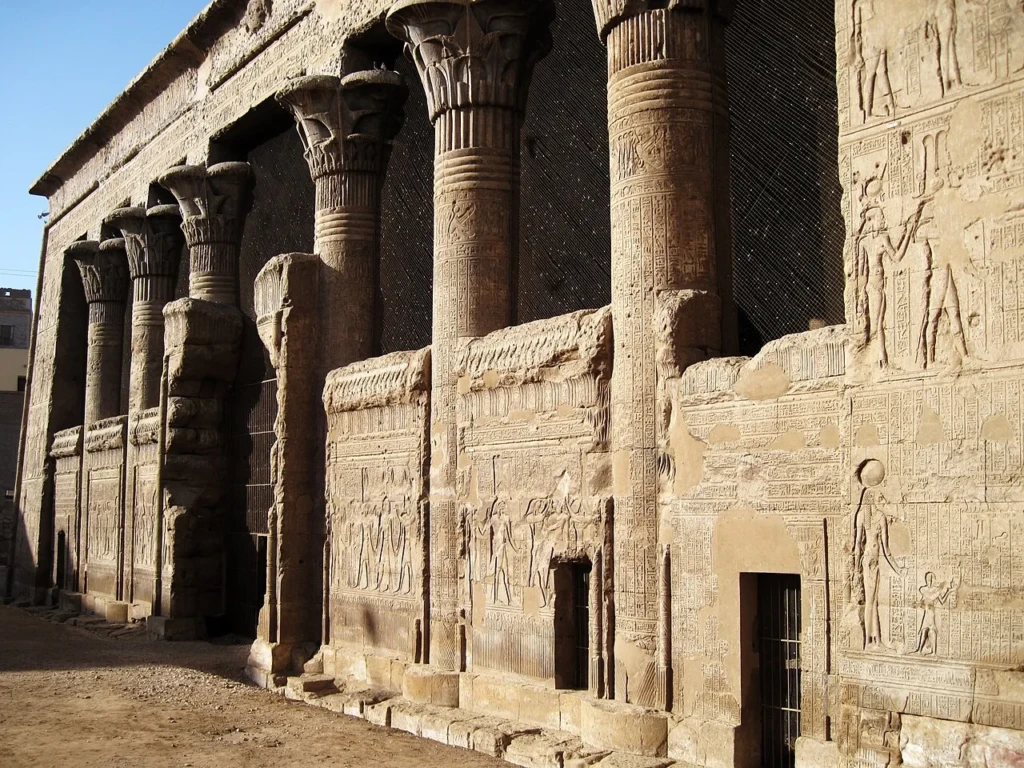
The temple you visit is only the front of a much larger building. The sanctuary and inner rooms have vanished or lie under the modern town. What survives is the pronaos, a great columned hall added in front of the older Ptolemaic temple. According to the University of Tübingen, this hall probably outshone the temple behind it. Its spot in the middle of town likely saved it. Many ancient buildings were quarried for stone during Egypt’s industrialization, while Esna’s hall stayed in use, at one point as a cotton warehouse.
The last pharaohs who were Roman emperors
Esna is one of the best places in Egypt to see Roman emperors presented as pharaohs. The walls name rulers from Claudius and Vespasian to Trajan, Hadrian, Septimius Severus and Caracalla. Each wears Egyptian crowns and makes offerings to the gods in the traditional way. The latest name is the emperor Decius, who ruled in AD 249–251. That makes Esna’s texts some of the latest large hieroglyphic inscriptions known from ancient Egypt.
The walls also record Roman power struggles. Two scenes of the emperor Philip the Arab were recut after Decius defeated him, with Decius’s name carved over Philip’s. Look closely and a guide can point out cartouches that were changed.
A temple written in puzzles
Scholars prize Esna for its texts as much as its art. Priests here used rare signs, unusual spellings and visual wordplay. Fourteen of the columns preserve parts of a long temple ritual, together with hymns and calendars. One inscription even lists the purity rules for anyone entering. They had to trim their nails, wash with natron, wear linen rather than wool, and stay celibate for several days beforehand.
The Restored Colors: What the Cleaning Revealed
For close to 1,800 years, people lit fires inside the hall. Smoke and bird droppings turned the ceiling and columns a dull black-brown. Visitors could make out the reliefs, but not their paint.
In 2018 the Ministry of Tourism and Antiquities and the University of Tübingen began a joint conservation project. Hisham El-Leithy of the Ministry’s Documentation Center leads the Egyptian side, and Egyptologist Christian Leitz leads the German side. A team of up to 30 Egyptian conservators under Ahmed Emam removed the soot section by section.
The Ministry has announced the completion of the ceiling work and new finds on the walls and columns. The University of Tübingen team reports that the ceiling and the 18 inner columns are now cleaned, with work moving on to the walls and the outer faces of the six front columns. The restored colors surprised even specialists. At Dendera, the other great astronomical ceiling of the period, white and light blue dominate. At Esna, strong yellows and reds take the lead.
New details on the ceiling
The cleaned ceiling is divided into seven sections, each on its own theme. These include the daily path of the sun, the phases of the moon, the hours of the night and the Egyptian New Year. Look for these scenes:
- A complete zodiac. The twelve signs reached Egypt from Babylonian astronomy via the Greeks. Apart from Esna, only two complete temple versions survive, both at Dendera.
- Orion, Sothis and Anukis. Sothis is the star Sirius. Its return to the dawn sky marked the Egyptian New Year and the coming of the Nile flood.
- The planets. Jupiter, Saturn and Mars appear among star groups once used to measure time.
- Fantastic creatures. A snake with a ram’s head, a bird with a crocodile’s head and four wings, and the south wind shown as a winged lion with a ram’s head.
The cleaning also exposed nearly 200 painted ink inscriptions that no one had recorded before. Many of them name the figures, which helped researchers identify many of the scenes.
New details on the walls
On the inner walls, the soot had hidden fine painted details on clothing, crowns and thrones. One scene shows priests carrying the sacred boat of Khnum out of the sanctuary in procession. On festival days, that was the closest ordinary people came to their god. In another, the king’s kilt is painted with papyrus and lily, the emblems of Lower and Upper Egypt. A third shows the local crocodile god Shemanefer, with fine painted details on his crown, wig, apron and throne.
What to See, in Visiting Order
1. The view from street level
Start at the railing above the excavation. From here you see how far the town has risen around the temple over the centuries. The front of the hall, with its row of six columns, faces you across the pit.
2. The facade and dedication
Walk down to the entrance. The dedication inscription above the doorway carries the names and titles of the emperor Vespasian, whose reign saw the hall completed.
3. The columns and their capitals
Inside, 18 columns and six half-columns hold up the roof. Look up at the capitals. Each is carved as a different combination of plants, and no two are the same. The column shafts carry the ritual texts and hymns that make Esna so valuable to scholars.
4. The ceiling
Give the ceiling most of your time. Stand near the center of the hall first for the overall pattern, then walk the aisles to find the zodiac signs and the figures of Orion and Sothis. Binoculars or a phone camera with zoom help.
5. The Ptolemaic rear wall
The back wall of the hall is the facade of the older Ptolemaic temple. It carries cartouches of Ptolemy VI beside two forms of Khnum. This is the only visible piece of the building the Romans extended.
How to Get to Esna Temple
Esna lies about 60 km south of Luxor, on the Nile’s west bank. There are three common ways to reach it:
- By road from Luxor. A private car makes Esna an easy half-day trip. Your driver or guide will confirm timing on the day.
- By dahabiya. Small sailing boats often begin their Luxor–Aswan route at Esna. The temple is usually the first visit, before you sail.
- By large cruise ship. Big ships pass through the lock at the Esna barrage. Waits there can stretch to several hours. Whether your ship stops for the temple depends on its itinerary.
The walk from the riverbank to the temple is short, roughly 200 meters.
Esna Temple Tickets and Opening Hours
The official Ministry of Tourism and Antiquities website (egymonuments.gov.eg) does not list opening hours or a ticket price for Esna Temple as of October 2026. Because we could not confirm current figures from an official source, we do not quote them here. Your guide can confirm the price and hours at the time of your visit.
Best Time to Visit
Morning light suits the temple best. The hall is open at the front, and soft daylight reaches deep inside before the sun climbs high. Midday sun leaves the pit hot and the ceiling harder to read.
Seasonally, the cooler months are best for Upper Egypt. Cleaning of the outer front columns is scheduled for the winter season, because summer heat makes the work impossible. So you may see scaffolding on some walls in the cooler months. The parts already cleaned stay open to view. Our guide to the best time for a Nile cruise covers river weather month by month.
Practical Tips
- Bring a zoom lens or binoculars. The best ceiling scenes are about 15 meters above you.
- Expect stairs down into the excavation, since the hall sits about 9 meters below the street.
- Dress modestly for the walk through town. Esna is a working market town, not a resort.
- Carry small Egyptian pound notes for the market and for tips.
- Ask your guide to point out the erased and recut cartouches. They are easy to miss on your own.
Beyond the Temple: Esna’s Old Town
Esna rewards an extra half hour outside the temple. Just south of the site, the covered section of al-Qisariyya market keeps its traditional wooden roof. More than a hundred small shops line it, mostly tailors and cloth sellers. Nearby stands Wekalet al-Geddawy, an 18th-century caravanserai built for traders arriving from Africa and the Red Sea. It is one of only three caravanserais in southern Egypt, and the only one that keeps its original design.
Combining Esna With Nearby Sites
Esna fits naturally into a trip south from Luxor. It also makes a strong pair with the temple of Hathor at Dendera, north of Luxor. Seeing both ceilings lets you compare two schools of temple painting. Our Dendera Temple guide explains that site.
Heading south, Esna is the first of the classic temple stops between Luxor and Aswan. Next comes Edfu Temple, one of the best-preserved temples in Egypt, then Kom Ombo Temple with its double sanctuary. If you are still choosing how to travel, our comparison of a dahabiya versus a Nile cruise will help. For the rest of your time in the area, see our Luxor travel guide.
Visit With Delta Tours Egypt
The most natural way to see Esna is at the start of a dahabiya cruise. Our dahabiya Nile cruises sail five nights from Esna to Aswan. The first visit, after the drive from Luxor, is the Temple of Khnum. Choose between the Nour El Nil Dahabiya, the Malouka Dahabiya and the Meroe Dahabiya. Each runs 6 days / 5 nights from $3,500 per person.
Staying in Luxor instead? Our full-day Luxor East and West Bank tour starts from $128 per person. Our Dendera and Abydos day tour starts from $150 per person. For a private Esna visit by car, ask us through our tailor-made tours page and we will arrange it on request.
Frequently Asked Questions
Is Esna Temple worth visiting?
Yes, especially since the restoration. The cleaned ceiling is one of only two great astronomical temple ceilings in Egypt, and its strong reds and yellows look nothing like Dendera’s. A visit takes under an hour.
Why is Esna Temple below street level?
Over the centuries the town built up around the temple, and the ancient ground level now lies about 9 meters below the modern street. Only the hall has been cleared; much of the old temple is still buried under houses.
Who restored the colors at Esna Temple?
Egypt’s Ministry of Tourism and Antiquities and Germany’s University of Tübingen run the project together. Since 2018, a team of up to 30 Egyptian conservators has removed the soot by hand.
How far is Esna from Luxor?
Esna is about 60 km south of Luxor on the Nile’s west bank. Most visitors come by private car or start a dahabiya cruise there.
Which god was worshipped at Esna Temple?
The main god was Khnum, a ram-headed creator linked with the potter’s wheel. The goddess Neith shared the temple, along with smaller local gods.
Do Nile cruise ships stop at Esna Temple?
Large ships pass through the Esna lock, but a temple stop depends on each ship’s program. Dahabiyas commonly start their sailing at Esna and visit the temple first.
Esna is the quiet opening act of the most relaxed way to travel the Nile. See our dahabiya Nile cruises and start your journey south at the Temple of Khnum.
Featured image: Columned facade of the Temple of Khnum at Esna. Photo: Olaf Tausch / Wikimedia Commons, CC BY 3.0