Kom Ombo Temple: Where Crocodile and Falcon Meet
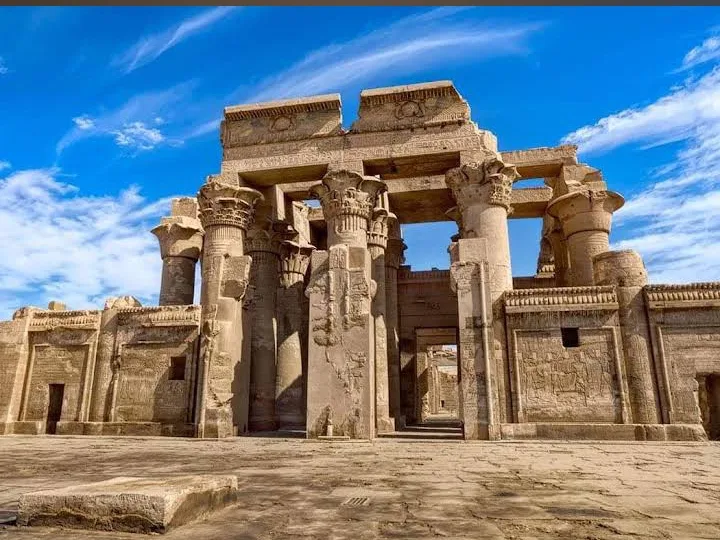
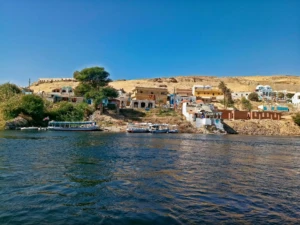
The Nile cruise rounds a bend as the afternoon begins to fade. Sugarcane fields lie behind the riverbank, the water turns copper beneath the sinking sun, and a line of columns appears on a low hill above the shore.
At first, Kom Ombo Temple looks like a single sanctuary waiting beside the river. Then you walk closer and notice something unusual. The entrance divides. Two doorways lead through parallel routes. Halls, chambers and sanctuaries appear in pairs, as though the building has been reflected along an invisible line.
This was not an architect’s experiment in decoration. The temple had two divine owners.
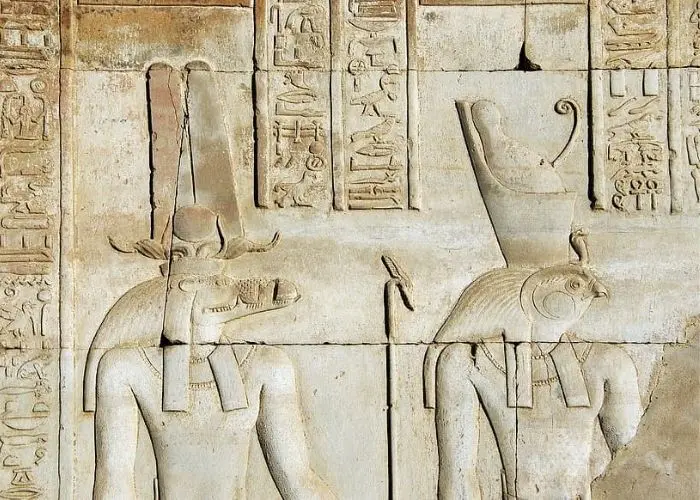
One was Sobek, the crocodile-headed god associated with the Nile’s power, fertility and dangerous waters. The other was Haroeris—Horus the Elder—the falcon god connected with the sky, kingship and protection. Their worlds were different, but at Kom Ombo neither was pushed aside. Priests and builders created two sacred paths within one monument, giving each god an entrance, a processional axis and a sanctuary.
The temple’s story does not end with symmetry. Its walls preserve a ritual calendar, scenes of kings presenting offerings, a famous panel filled with objects often identified as medical instruments and images connected with childbirth. Outside stands a nilometer once used to observe the river’s level. Beside the ruins, mummified Nile crocodiles rest in a modern museum dedicated to Sobek.
That combination makes the Temple of Kom Ombo one of the most distinctive stops between Luxor and Aswan. It is smaller than Karnak and less complete than Edfu, but it offers something neither can: a temple built around the difficult truth that the Nile could nourish life and take it away—and that ancient people might honor two powers at once rather than choosing between them.
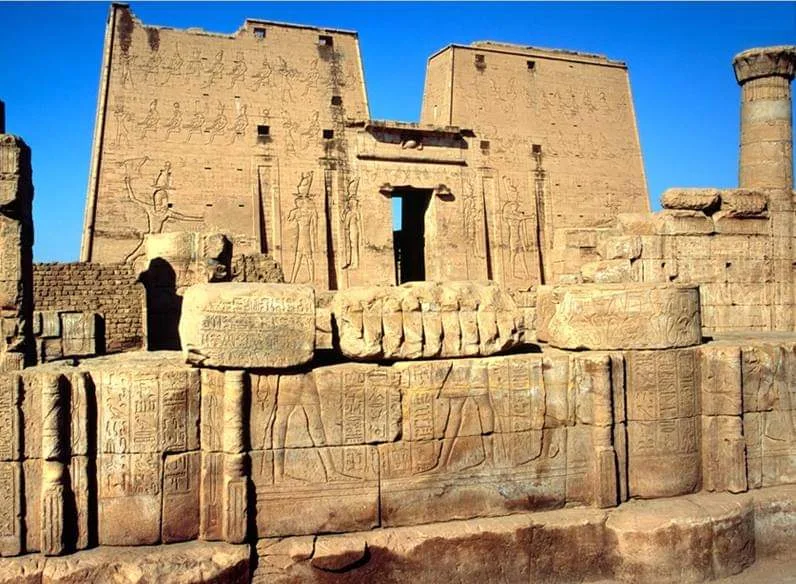
Kom Ombo Temple at a Glance
| Question | Quick answer |
|---|---|
| Where is Kom Ombo Temple? | On the east bank of the Nile, around 45 kilometers north of Aswan |
| When was the present temple built? | Mainly during the Graeco-Roman Period, beginning under Ptolemy VI in the second century BCE |
| Was there an earlier temple? | Yes. Evidence indicates that a temple stood here during the New Kingdom |
| Which gods were worshipped? | Sobek, the crocodile god, and Haroeris or Harwer, Horus the Elder |
| Why is the design unusual? | It has two parallel axes, entrances and sanctuaries—one for each principal deity |
| What should visitors look for? | Twin sanctuaries, decorated columns, the ritual calendar, the “medical instruments” panel and the nilometer |
| Is the Crocodile Museum included? | Yes. The current official area ticket includes the temple and museum |
| How long should you allow? | Around 1.5–2 hours for the temple and Crocodile Museum |
| Current opening hours | Daily, 7:00 AM–9:00 PM, according to Egypt’s Ministry of Tourism and Antiquities |
Before Kom Ombo Had Two Temples, It Had One River
The story begins with location.
Kom Ombo stands where the Nile makes a broad curve through Upper Egypt. The surrounding land is fertile, while routes from the valley once led toward the Eastern Desert and the resources of Nubia. Its ancient name, Nubt, has been interpreted as “the golden city,” perhaps reflecting its relationship with desert roads and gold-bearing regions to the south and east.
This was not an isolated ceremonial site. Boats, traders, farmers, officials, soldiers and pilgrims moved through the area. The river carried grain and people, but it also carried crocodiles. Anyone living beside the Nile understood that the same water supporting crops and communities could conceal sudden danger.
An earlier sanctuary existed at Kom Ombo during the New Kingdom, although little of that structure survives. The temple seen today belongs mainly to the Graeco-Roman age, when Egypt was ruled first by the Ptolemies and later by Rome.
The earliest royal name securely attested in the surviving building is Ptolemy VI Philometor, who ruled from 180 to 145 BCE. Later Ptolemaic kings continued the work, and much of the decoration was completed under Ptolemy XII Neos Dionysos in the first century BCE. Roman rulers added further reliefs and architectural elements.
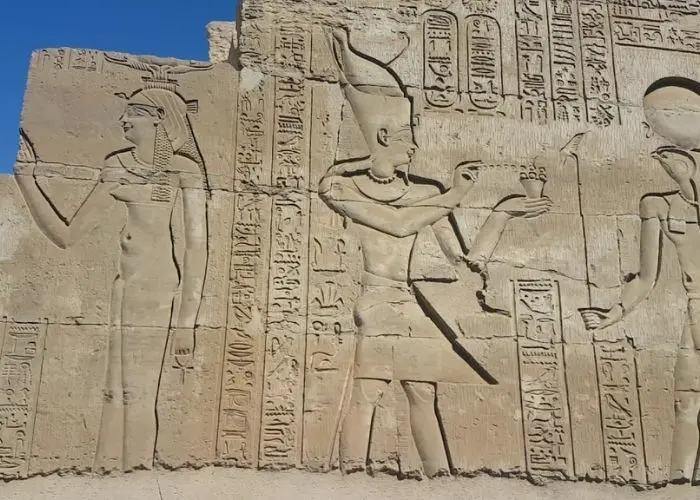
The kings changed, but the visual language remained Egyptian. Greek-speaking Ptolemies and Roman emperors appear on the walls wearing pharaonic crowns, performing rituals before ancient gods and maintaining the sacred order expected of an Egyptian king.
Kom Ombo is therefore a temple of continuity. Its builders lived in a multicultural world, yet they used an artistic and religious tradition already thousands of years old.
Sobek: The God With the Crocodile’s Face
To modern eyes, a crocodile-headed god can look frightening. For people living beside the ancient Nile, that fear was part of the meaning.
Crocodiles were strong, fast and difficult to see beneath the water. They could attack animals and people at the river’s edge. Worshipping Sobek did not mean ancient Egyptians misunderstood the danger. It meant they recognized it as a power worthy of respect.
Sobek embodied several qualities that seem contradictory only if the Nile is imagined as gentle. He was associated with water, fertility, vegetation and the inundation that renewed the fields. He could also represent physical strength, royal power and protection. The creature most feared in the river became a divine force capable of defending those who honored it.
At Kom Ombo, Sobek formed part of a local divine family with Hathor, goddess of love and motherhood, and Khonsu, a moon god. His half of the temple occupies the southern axis, on the right when facing inward.
The Sobek Temple was not simply a monument to crocodiles. It addressed a larger human problem: how do you live beside a force that gives life but can never be fully controlled?
The answer was not to deny the danger. It was to give the danger a name, a sacred image and a place within the order of the world.
Haroeris: The Falcon on the Other Side
The northern axis belonged to Haroeris, also called Harwer or Horus the Elder. He was represented as a falcon-headed god and associated with the sky, kingship, protection and victory over disorder.
He was worshipped at Kom Ombo with Tasenetnofret, whose name means “the Perfect Companion,” and Panebtawy, “the Lord of the Two Lands.” Together they formed a second divine family parallel to Sobek’s triad.
This pairing creates the temple’s central tension. Sobek represents the river’s physical force—fertile, dangerous and immediate. Haroeris represents order, kingship and watchful divine authority. One moves through water; the other commands the sky.
Yet the architecture does not show them fighting for possession of the site. It balances them.
The same king approaches both. Comparable ritual spaces serve both. At the rear of the temple, each god appears on his respective side in a carefully arranged composition. The building turns two different powers into one sacred system.
Why Kom Ombo Is Called a Double Temple
Ancient Egyptian temples usually emphasize a principal deity and a single central route toward the sanctuary. Kom Ombo divides that route in two.
The plan contains parallel axial passages running through the columned halls. The southern path terminates in Sobek’s sanctuary; the northern path leads to Haroeris. Entrances, doorways and ritual rooms correspond across the central line.
Travel descriptions often call the design “perfectly symmetrical.” That phrase captures the first impression, but the surviving structure is more complex. Kom Ombo developed over centuries, parts have been lost and the two cults had distinct theological needs. The important point is not mathematical perfection. It is the deliberate architectural equality given to two divine households.
Imagine a procession entering the temple during a festival. Priests carried sacred images, recited texts, burned incense and presented food, drink, cloth and precious substances. Every movement reinforced relationships among the gods, the king and the community.
At Kom Ombo, those ceremonial movements had to respect two sacred destinations. The architecture choreographed a shared building without erasing the identities of its occupants.
Arriving From the Nile
The riverside approach is part of the temple’s appeal.
Cruise ships dock only a short walk from the archaeological site. From the water, visitors see columns and walls rising above the bank, especially dramatic when the stone is illuminated after sunset. Unlike temples hidden behind modern streets or desert approaches, Kom Ombo still feels directly connected to the Nile.
That closeness is beautiful, but it also made the building vulnerable. Flooding and changes in the riverbank damaged parts of the monument. Earthquakes took their toll. Stone was reused in later construction, and some reliefs were altered when sections of the site served Christian worshippers.
The result is a temple that feels open. Walls end unexpectedly, missing roofs expose columns to the sky and the river remains visible beyond the ruins. You can read the structure, but you must also imagine what has disappeared.
This fragmentary quality suits the story. Kom Ombo was designed around balance, yet its survival has always depended on unstable forces—water, earth and human reuse.
The Forecourt and Columned Halls
The temple’s first pylon and parts of its forecourt have largely vanished, but the remaining columns immediately establish the building’s Graeco-Roman character.
Their capitals bloom in varied plant forms. Palm fronds, papyrus bundles and floral designs turn stone into an idealized version of the Nile landscape. The columns were once brightly painted, and traces of color can still appear in protected areas.
Reliefs show Ptolemaic and Roman rulers making offerings before the gods. These rulers governed an Egypt shaped by Greek and Roman political power, but inside the temple they appear as traditional pharaohs. The scenes were not portraits of daily life. They were ritual images ensuring that the king performed his sacred obligations forever.
The columned halls also demonstrate the doubled plan. Two doorways and two processional lines continue toward the inner chambers. When a guide points out the central division, the entire building becomes easier to understand. Details that first seem repetitive reveal themselves as carefully paired.
The Twin Sanctuaries
The innermost section originally contained two sanctuaries, one for each principal god. Sacred images or portable barques could be housed here, protected from the open courtyards and accessible only to authorized priests.
As in other Egyptian temples, the journey inward moved from bright, spacious areas toward darker and more restricted chambers. The decreasing light signaled increasing sacredness. Ordinary worshippers did not wander freely through every room as modern visitors do.
The sanctuaries are now damaged, but their paired position remains the clearest statement of the temple’s purpose. Neither Sobek nor Haroeris occupies a secondary side chapel. Both receive the architectural honor of a central cult.
That choice gives the Temple of Kom Ombo Egypt its distinctive personality. It is not two temples standing side by side. It is one sacred machine engineered to serve two divine centers.
The Famous Medical Instruments Relief: What Does It Really Show?
Near the rear of the temple is one of Kom Ombo’s most photographed carvings. Rows of recognizable objects appear on the wall: blades, hooks, forceps-like forms, containers, scales and other tools.
Many guides and websites describe the panel as the world’s first complete display of surgical instruments. Some go further and claim that Kom Ombo operated as an ancient hospital where priests performed surgery.
The relief is genuinely connected with ancient medical knowledge, but its context deserves more care.
The scene dates to the Roman Period, around the second or third century CE. Researchers identify many objects as medical or possibly surgical instruments, while other items relate to measurement, ritual practice and the preparation of substances. Most importantly, the tools form part of a larger offering scene. They were presented within a sacred composition rather than displayed as a modern medical catalog.
This does not make the panel less impressive. Ancient Egyptian and Graeco-Roman medicine combined practical observation, pharmacology, ritual and magic in ways that did not follow modern boundaries between science and religion. A tool could have medical use and sacred meaning at the same time.
What the wall does not prove by itself is that surgeons operated inside the temple or that Kom Ombo functioned as a hospital in the modern sense. Pilgrims may have sought healing and divine assistance here, as they did at many sanctuaries, but the popular hospital claim should be presented as interpretation rather than confirmed fact.
The relief is more interesting when allowed to remain complex. It shows a world in which medicine, measurement, ritual and divine protection belonged to the same system of knowledge.
The Ritual Calendar: Time Written in Stone
Another set of inscriptions records festivals, offerings, dates and ceremonial duties. This ritual calendar helped organize the sacred year.
Ancient Egyptian temples did not operate as silent monuments. Priests followed daily schedules and annual cycles. Gods received morning rites, clothing, food and incense. Festivals brought processions, music and larger public participation. Agricultural seasons, lunar cycles and royal celebrations shaped the religious calendar.
At Kom Ombo, the calendar reminds visitors that the doubled architecture had to function in time as well as space. Two cults required coordinated offerings and ceremonies. The temple was not merely divided between Sobek and Haroeris; it was maintained through repeated acts that renewed their presence.
Without those rituals, the building was only stone. With them, it became a living house of the gods.
The Nilometer: Reading the River
Near the temple complex is a deep, circular structure connected with the measurement of the Nile. Such devices are known as nilometers.
Before modern dams regulated the river, the annual inundation determined the prospects of Egyptian agriculture. Too little water could mean poor harvests; too much could damage settlements and fields. Measuring the river therefore had practical, economic and religious importance.
Nilometers used marked steps, wells or chambers linked to groundwater or the river to observe changing levels. Priests and officials could use those measurements to assess the flood and anticipate agricultural conditions. Nile levels also informed administrative decisions, including estimates connected with taxation.
The Kom Ombo nilometer brings the temple’s theology back to the physical landscape. Sobek’s power was not an abstract story. The river beside the temple governed whether communities flourished or suffered.
The Crocodile Museum: Meeting Sobek’s Sacred Animals
After leaving the temple, the story continues in the Crocodile Museum next door. Opened in 2012, it is devoted to Sobek and the sacred animals associated with his cult.
The museum displays mummified Nile crocodiles, including large adults, along with crocodile fetuses, body parts preserved during mummification, pottery coffins and statues of Sobek. A reconstructed burial context helps explain how sacred crocodiles were prepared and interred.
The atmosphere is different from the open-air temple. In the ruins, Sobek appears as a carved deity receiving offerings. In the museum, the physical animal lies before you—teeth, scales, long jaws and wrapped bodies transformed through mummification.
Animal cults were not based on the idea that every crocodile was literally a god. Particular animals could be treated as manifestations, representatives or sacred recipients connected with the deity. After death, they might be mummified and buried through established rituals.
For modern visitors, the museum can feel unsettling, especially when confronting the size of the crocodiles. That reaction helps recover something ancient worshippers understood immediately: Sobek was not a harmless mascot. He represented a real and formidable presence in the Nile.
Did Priests Keep Live Crocodiles at Kom Ombo?
Stories often describe a sacred crocodile kept in a temple pool, decorated with jewelry and fed by priests. Ancient authors recorded similar practices in Egyptian crocodile cult centers, particularly in the Fayoum.
It is reasonable to connect Kom Ombo with the care and ritual burial of sacred crocodiles because of the temple’s cult and the mummified remains found in the region. However, detailed claims about a specific named crocodile living in a particular Kom Ombo pool should be treated cautiously unless supported by direct evidence.
The confirmed story is already powerful. Crocodiles were mummified, Sobek received a complete temple cult and the animal’s divine meaning shaped the identity of the town.
What Happened to Kom Ombo Temple?
The monument visible today is only part of the original complex.
Its position beside the Nile exposed it to erosion and flooding. Earthquakes damaged walls and columns. Later builders reused stone, a common fate for ancient monuments that offered convenient cut blocks. During the Christian era, parts of the temple were adapted for worship and some images of older gods were defaced.
These changes are not separate from the temple’s history. They show that Kom Ombo remained within a living landscape. Communities did not preserve it as an archaeological site because archaeology as a modern discipline did not yet exist. They reused, transformed or ignored it according to their own needs.
Today, missing architecture makes the double plan harder to visualize without explanation. A guide or a simple temple diagram can transform the visit by revealing how the surviving doorways, halls and sanctuaries once fitted together.
Where Is Kom Ombo Temple?
Kom Ombo lies on the east bank of the Nile in Aswan Governorate, approximately 45 kilometers north of Aswan city. It stands along the traditional river route between Aswan and Luxor.
Most international visitors arrive during a Nile cruise. Ships dock below the archaeological site, making Kom Ombo one of the easiest temples to approach directly from the river. Independent travelers can also reach it by private car, taxi or organized road tour from Aswan.
The modern town extends beyond the ruins and is surrounded by agricultural land, particularly sugarcane fields. Travelers arriving by road see more of this contemporary landscape than cruise passengers moving directly between the ship and temple.
Kom Ombo Temple Tickets and Opening Hours in 2026
As of September 23, 2026, Egypt’s Ministry of Tourism and Antiquities lists Kom Ombo Temple and the Crocodile Museum as open daily from 7:00 AM to 9:00 PM.
The official combined area ticket currently includes entry to both the temple and the Crocodile Museum:
| Visitor category | Combined admission |
|---|---|
| Foreign adult | EGP 450 |
| Foreign student | EGP 225 |
| Egyptian adult | EGP 40 |
| Egyptian student | EGP 20 |
The ministry states that the Crocodile Museum ticket window closes at 8:00 PM. Ramadan hours may be reduced; the official museum page currently lists Ramadan opening from 9:00 AM to 3:00 PM, with last admission at 2:00 PM.
Prices and schedules can change. Check the official Kom Ombo Temple page and Crocodile Museum page shortly before visiting.
Visiting Kom Ombo on a Nile Cruise
Kom Ombo is included on most standard cruises between Luxor and Aswan. The exact day depends on sailing direction and schedule.
Ships commonly arrive in late afternoon or evening, and passengers walk from the dock to the temple with their Egyptologist. This is efficient, but group schedules can feel rushed. Listen to the architectural explanation before photographing: once you understand the two axes, every later room makes more sense.
The site pairs naturally with a Nile River cruise because the arrival preserves the temple’s relationship with the water. Delta Tours Egypt can also incorporate Kom Ombo into a private Egypt tour with an Egyptologist who explains the reliefs, double theology and crocodile cult without turning the stop into a list of dates.
Visiting Kom Ombo by Road
Travelers staying in Aswan can reach Kom Ombo in roughly an hour by private vehicle, depending on traffic and the starting point. A road visit provides more timing flexibility than a cruise stop and can be combined with other Upper Egyptian sites on the route toward Luxor.
Do not attempt to pack every temple between Aswan and Luxor into a rushed half-day. Kom Ombo rewards at least 90 minutes, especially when the museum is included. A private car is most useful for travelers who want photography time, family breaks or a later visit after the larger groups leave.
Common Myths and Confirmed Facts
“Kom Ombo was an ancient hospital.”
Not confirmed. Visitors may have sought healing and the temple contains a panel with objects interpreted as medical instruments, but the relief alone does not prove that the complex operated as a hospital or surgical center.
“The wall is a surgical manual.”
An oversimplification. The objects appear within a broader ritual offering scene and include items connected with medicine, measurement and cult practice.
“The temple is perfectly symmetrical.”
Broadly true in concept, but simplified. The design deliberately gives two parallel axes and sanctuaries to Sobek and Haroeris. Construction over centuries and later damage mean the complete complex was more nuanced than a perfect mirror image.
“Sobek was an evil god.”
False. Sobek embodied dangerous power, but he was also associated with fertility, water, vegetation, strength and protection.
“All crocodiles were worshipped as gods.”
False. Particular animals could serve as sacred manifestations or representatives linked with Sobek. The cult did not treat every wild crocodile as an individual deity.
Most travelers reach Kom Ombo by Nile cruise, often at sunset, while land-based itineraries such as Timeless Egypt stop there on the drive from Luxor to Aswan. See our Nile cruises for the ships that moor at the temple.
Frequently Asked Questions About Kom Ombo Temple
What is Kom Ombo Temple?
Kom Ombo Temple is a Graeco-Roman sanctuary in Upper Egypt famous for its double design. Two parallel sacred routes served Sobek, the crocodile god, and Haroeris, Horus the Elder.
Where is Kom Ombo Temple located?
It stands on the east bank of the Nile about 45 kilometers north of Aswan, along the traditional river route between Aswan and Luxor.
Who built Kom Ombo Temple?
The surviving temple was developed by several Ptolemaic and Roman rulers. The earliest attested royal name is Ptolemy VI Philometor, while much of the decoration was completed under Ptolemy XII.
When was Kom Ombo Temple built?
An earlier New Kingdom temple once occupied the site. The present structure was built and decorated mainly from the Ptolemaic Period into the Roman Period.
Why is Kom Ombo Temple unique?
It was deliberately divided between two principal gods, giving the building paired entrances, processional axes, halls and sanctuaries.
Who was Sobek?
Sobek was a crocodile-headed deity associated with water, the Nile inundation, fertility, vegetation, physical strength and protection.
Who was Haroeris?
Haroeris, or Harwer, was Horus the Elder, a falcon-headed god associated with the sky, kingship, protection and victory over disorder.
Are there really surgical instruments carved at Kom Ombo?
The Roman-period panel includes objects widely interpreted as medical or surgical instruments, alongside measuring, ritual and preparation tools. It forms part of a larger offering scene, so it should not be read as a modern surgical catalog.
What was the Kom Ombo nilometer used for?
It helped observe Nile levels. Flood measurements informed expectations for agriculture and could support administrative and taxation decisions.
Is the Crocodile Museum included in the temple ticket?
Yes. The Ministry of Tourism and Antiquities currently lists a combined area ticket covering Kom Ombo Temple and the Crocodile Museum.
Are there mummified crocodiles at Kom Ombo?
Yes. The adjacent museum displays mummified Nile crocodiles, fetuses, coffins, burial material and representations of Sobek.
Can you visit Kom Ombo Temple at night?
Yes. The official schedule currently runs until 9:00 PM, with the Crocodile Museum ticket window closing at 8:00 PM. Check current hours before visiting.
Is Kom Ombo Temple worth visiting?
Yes. Its twin design, Nile setting, medical and calendar reliefs, nilometer and crocodile museum create an experience unlike any other Egyptian temple.
Where the River’s Two Truths Meet
When the visit ends, the Nile is still below the temple, moving through darkness or reflecting the last light of day. The river looks peaceful from the hill. Ancient people knew better than to trust only that appearance.
The Nile brought water to the fields, boats to the towns and life to the valley. It also carried floods, uncertainty and crocodiles. Kom Ombo gave those realities divine form. Sobek embodied the strength and danger within the water. Haroeris represented watchfulness, protection and ordered kingship.
The builders did not force one god to defeat the other. They created two paths through a single sanctuary.
That is the lasting power of Kom Ombo Temple Egypt. Its doubled architecture is not merely a curiosity for photographs. It is an ancient answer to a timeless problem: opposing truths can belong to the same world, and balance does not require either one to disappear.