
Edfu Temple: Enter the Sacred World of Horus
The morning has barely begun when Edfu rises from the Nile. Beyond the riverbank, the city is already awake: shop shutters rattle open, bicycles slip through the streets, and the scent of bread drifts from ovens hidden behind ordinary walls. Nothing yet suggests that one of ancient Egypt’s most complete temples is waiting at the center of town.
Then the street opens, and the pylons appear.
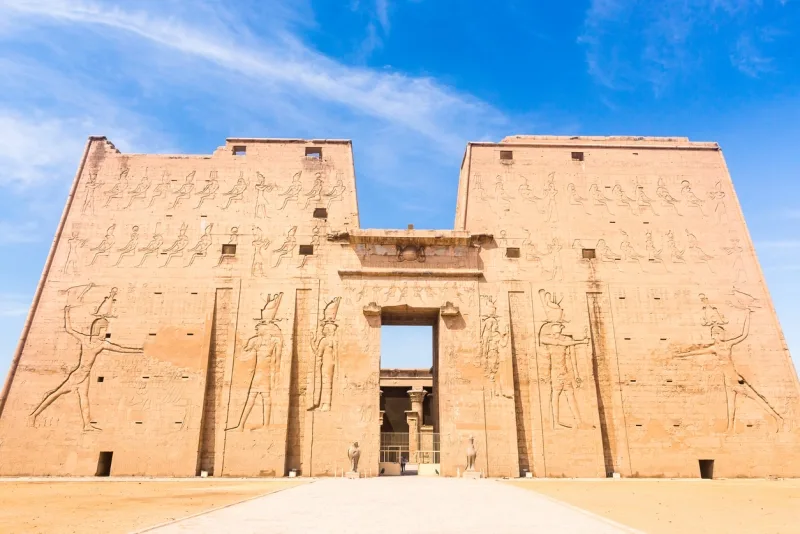
They do not look like ruins. They look like a gate that has simply been waiting for you to arrive. Across their sandstone face, a king raises his weapon before the gods; beneath him, carved figures seem small enough to emphasize the scale of royal power. Two granite falcons stand watch. Between the towers, a dark doorway draws the eye inward.
This is Edfu Temple, also called the Temple of Horus at Edfu. It was constructed during the Ptolemaic period, between 237 and 57 BCE, yet its builders followed sacred traditions that reached far deeper into Egypt’s past. Because much of the structure survived with its walls, roofed rooms, reliefs, and inscriptions intact, walking through it offers something rare: not merely a view of an ancient monument, but an understandable journey through an Egyptian temple.
The path leads from public sunlight to divine darkness. Along the way, architecture, ritual, kingship, perfume recipes, festival processions, and the victory of Horus over Seth are written into the stone. This guide follows that path as a story while giving you everything needed to plan a rewarding visit.
Edfu Temple at a Glance
| Question | Quick answer |
|---|---|
| What is Edfu Temple? | A large Ptolemaic temple dedicated principally to Horus of Behdet, the falcon god associated with protection, kingship, and the ordered world. |
| Where is it? | On the west bank of the Nile in Edfu, in Aswan Governorate, between Luxor and Aswan. |
| When was it built? | Construction began under Ptolemy III in 237 BCE and was completed under Ptolemy XII in 57 BCE. |
| Why is it famous? | It is among the most complete surviving temples in Egypt and preserves an exceptional body of architectural, religious, and ritual inscriptions. |
| How long should you allow? | About 90 minutes for a focused visit; two hours or more with an Egyptologist or a strong interest in the reliefs. |
| Best time to visit | Early morning, particularly before the heat and the largest cruise groups. |
| Official 2026 foreign ticket | EGP 550 adult; EGP 275 student. Prices can change, so verify before travel. |
| Official hours | Sunday and Wednesday, 6:00 AM–5:00 PM; other days, 7:00 AM–5:00 PM. Last entry is one hour before closing. Verify before travel. |
First, Meet the Falcon at the Gate
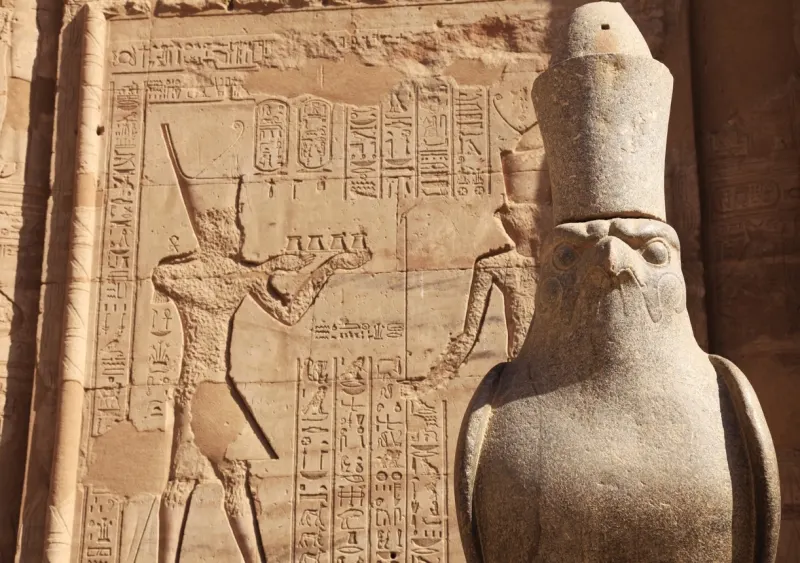
Before crossing the threshold, stop beside one of the granite falcons. Its surface is smooth, its posture still, and its gaze untroubled by the traffic and voices beyond the temple walls. This is Horus—but more precisely, Horus of Behdet, the local form of the god worshipped at ancient Edfu.
Ancient Egyptian religion was never as simple as matching one god to one job. Horus could appear in several forms and carry overlapping meanings. At Edfu, he was the winged protector, the powerful falcon, the defender of divine order, and a god closely linked to the living king. The temple was his earthly house. Priests served his cult image, performed purification rites, presented food and incense, and maintained the ritual order believed to sustain the cosmos.
The city itself was known in antiquity as Behdet, while Greek writers called it Apollinopolis Magna because they identified Horus with Apollo. The name changed with languages and empires, but the sacred identity of the place remained remarkably resilient.
The falcon at the entrance is therefore more than an attractive photo subject. It tells you how to read the monument. You are not approaching a palace built for a human ruler. You are entering a carefully ordered divine residence in which the king acts as intermediary between humanity and the gods.
A Temple Built by Greek Kings in an Egyptian Voice
The date 237 BCE can feel late to travelers who associate ancient Egypt only with the pyramids and the great New Kingdom pharaohs. By then, the Great Pyramid at Giza had already stood for more than two thousand years. Alexander the Great had conquered Egypt, and the country was ruled by the Ptolemies, a dynasty of Macedonian Greek origin.
Yet the Temple of Edfu Egypt presents itself in an unmistakably Egyptian architectural and religious language. That was not an accident. The Ptolemaic kings ruled a diverse kingdom, and temple building allowed them to take their place within the ancient institution of Egyptian kingship. On temple walls, they appear in pharaonic regalia, offering to Egyptian deities and defeating the forces of disorder. The images communicate legitimacy: the ruler protects the land, honors the gods, and keeps the universe in balance.
The foundation was laid during the reign of Ptolemy III Euergetes. Work continued through political unrest and successive reigns before the main building was completed under Ptolemy XII Neos Dionysos in 57 BCE. In all, the project took approximately 180 years. Later Roman emperors continued to appear in additions and decoration, showing how the ritual role of Egypt’s temples outlived the dynasty that began Edfu.
The builders were not inventing an imitation of an Egyptian temple. They were working with Egyptian priests, artisans, theological traditions, and architectural knowledge. Edfu is Ptolemaic in date but deeply Egyptian in conception. That tension—foreign dynasty, local sacred authority—is one reason the temple is so historically important.
The Pylons: A Monumental Lesson in Royal Power
From the plaza, the twin towers of the first pylon fill your field of vision. Their surface shows Ptolemy XII grasping enemies before Horus and Hathor. At first glance the scene appears to record a battle. It is better understood as a timeless statement rather than a piece of battlefield reporting.
Egyptian kings had used the image of striking enemies for millennia. Its message was cosmic as much as political: the ruler defeats rebellion and chaos, preserving maat—truth, justice, balance, and right order. At Edfu, the image also prepares you for the central sacred story carved deeper within the complex: Horus overcoming Seth.
Look up and notice how the doorway seems compressed between the huge towers. Temple architecture controls the body as well as the eye. The scale makes the visitor feel small; the gateway narrows movement; the thick masonry announces that the world beyond is set apart.
In antiquity, tall flagstaffs would have amplified the vertical drama of the façade. The massive grooves intended to hold them can still be seen. Festivals transformed this formal entrance into a place of sound, color, incense, priests, sacred images, and expectant crowds. The quiet sandstone you see today was once the background to a living institution.
Then you step through the gate, and the temple changes.
The Great Court: Sunlight, Columns, and Public Ceremony
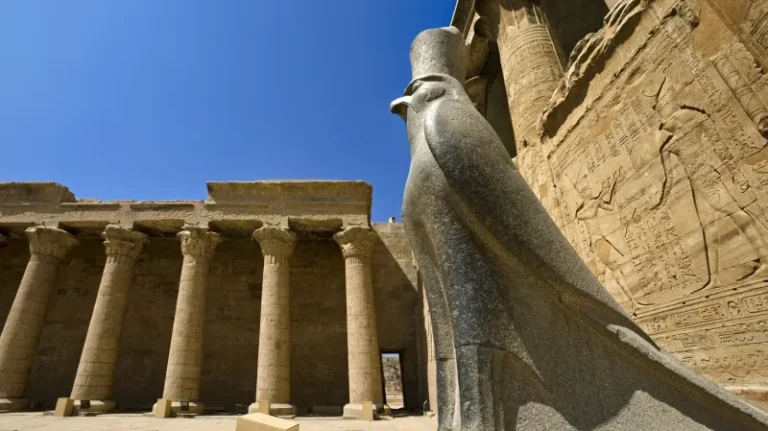
The open court is bright after the shadow of the pylon passage. Columns line three sides, their capitals shaped with plant forms that evoke the fertile world of the Nile. The space feels grand but accessible. Here, compared with the restricted chambers ahead, a broader group could participate in festival activity.
Reliefs cover the walls and columns. The king repeatedly approaches the gods with offerings. To a modern visitor, these scenes can look similar, but their repetition is meaningful. Each offering has a ritual function; each deity, crown, gesture, and caption contributes to the temple’s theological program. The walls do not decorate the building after the fact. Image, text, architecture, and ceremony belong to the same system.
This is a good point to slow down. Search for traces of color in sheltered areas. Observe how the plant capitals differ from one another. Turn back toward the gate and notice the granite falcon framed against the sky. If the first pylon is Edfu’s most imposing view, this reverse view is one of its most elegant.
At the far end of the court, another façade waits. The next doorway begins the transition from an exterior ceremonial world into an increasingly restricted interior.
Moving from Daylight into the God’s House
The first hypostyle hall changes the mood immediately. The roof returns, the temperature drops, and columns interrupt the light. From this point, Edfu Temple becomes a sequence of thresholds. Each chamber takes you farther from the ordinary world and closer to the sanctuary.
Ancient access was strictly controlled. A tourist can now walk a route that most people in antiquity would never have followed. The deepest rooms were the domain of purified priests and the divine image. Remembering that restriction gives the building its emotional logic: every step inward increases sacred exclusivity.
Near the entrance of the outer hypostyle hall were specialized rooms often described as the House of Books and the House of Morning. The so-called library was not a public reading room in the modern sense. Its wall inscriptions include lists of ritual books, and scholars understand the chamber as a place associated with sacred texts used in temple service. The House of Morning was connected with the priestly preparations and purification that preceded ritual duties.
Nearby spaces reveal another side of temple life. A laboratory was associated with preparing incense, oils, and unguents. Recipes and ingredient lists were recorded on the walls. This is one of Edfu’s quiet revelations: worship depended not only on grand myth but on trained people, stored materials, measured substances, clean water, schedules, and carefully repeated actions.
In the second hypostyle hall and the rooms beyond, the atmosphere grows dimmer. The route passes toward offering halls, a vestibule, side chapels, and finally the sanctuary. The architectural progression—from open sun to enclosed shadow—was part of the religious experience. The god’s presence belonged at the still center.
The Story Written on the Walls: Horus and Seth
To understand why Edfu mattered, imagine a world that must be renewed continually. The sun must rise, the Nile must sustain the fields, legitimate kingship must endure, and disorder must be held beyond the boundaries of the ordered land. None of this was taken for granted.
The temple’s most celebrated mythic cycle tells of the struggle between Horus and Seth. In the broad Egyptian tradition, Seth kills Osiris, and Horus, the son of Osiris and Isis, contests Seth’s claim to rule. The conflict unfolds through trials, transformations, divine judgments, and violent encounters until Horus is vindicated.
At Edfu, the story takes on a strongly local form. Horus of Behdet battles his enemies, who can appear as dangerous animals, including hippopotamuses and crocodiles. Reliefs on the enclosure walls show ritual episodes in which Horus and the king harpoon the enemy. The images are dramatic, but they should not be read as an illustrated adventure story alone. They belong to a sacred performance and ritual framework in which defeating Seth represents the triumph of order over chaos.
Scholars often refer to this sequence as the Triumph or Sacred Drama of Horus. Text and image suggest a ceremonial reenactment connected with the Festival of Victory. The king and priests did not merely remember a myth; through ritual, they made its victory present again. Seth’s defeat protected the temple, the kingship, and the ordered world.
This is where a knowledgeable Egyptologist transforms the visit. A guide can help distinguish Horus from the king, point out the harpoons and animal forms, and explain why one scene changes meaning according to its position. Without that context, the walls are beautiful. With it, they become a staged theological argument carved in stone.
The Beautiful Reunion: When Hathor Came to Edfu
Not every festival centered on conflict. One of the most important celebrations joined Horus of Edfu with Hathor of Dendera in a divine meeting commonly called the Beautiful Reunion.
Picture Hathor’s sacred image leaving her temple at Dendera and traveling south in a ceremonial barque. The journey itself carried religious meaning. When she reached Edfu, she was welcomed by Horus, her divine consort in this local tradition. Their meeting expressed joy, fertility, renewal, and harmony.
For the communities along the route, the festival brought the divine world out from behind temple walls. Processions allowed people to gather, celebrate, petition the gods, and encounter sacred images that were usually hidden. Music, offerings, boats, priests, and crowds would have changed the landscape of the river.
The Beautiful Reunion also helps a modern traveler connect Edfu with Dendera. The two temples are not isolated attractions on a checklist; their cults were linked through movement along the Nile. If your itinerary includes both, visit them as two chapters of one story. At Dendera, meet Hathor in her own house. At Edfu, imagine the anticipation of her arrival.
The Sanctuary: At the Still Center of Edfu Temple
By the time you reach the sanctuary, the bright city outside feels distant. The room is compact compared with the monumental entrance. This reversal is deliberate. The temple’s most sacred place did not need to be its largest.
Here stood the cult image of Horus, the divine focus of daily ritual. Priests opened the shrine, purified and clothed the image, presented food and incense, and eventually sealed the sanctuary again. These acts treated the god as a living presence. The offerings were not symbolic extras; they helped maintain the reciprocal relationship between gods, king, temple, and land.
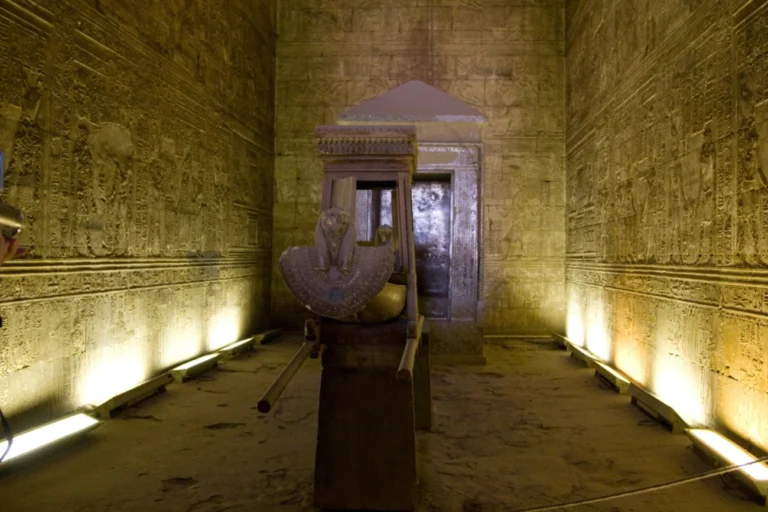
A dark granite naos, or shrine, survives in the sanctuary. It is associated with Nectanebo II, a ruler of the Thirtieth Dynasty who lived before the Ptolemaic temple was constructed. Its preservation within the later building created continuity with an earlier sacred structure on the site.
A ceremonial barque is also displayed in the sanctuary area. Visitors sometimes assume they are looking at the ancient original, but the wooden boat on view is a modern replica used to help explain how a sacred image could be carried during processions. The surviving naos is ancient; the displayed barque is interpretive. That distinction does not reduce the experience. It allows you to reconstruct how ritual moved beyond the sanctuary and, during festivals, beyond the temple itself.
Stand quietly for a moment. The journey from pylon to sanctuary has taken you from political power to divine presence, from sunlight to shadow, and from large public statements to intimate ritual service. Edfu’s architecture has told its story without speaking.
Why the Edfu Inscriptions Matter So Much
Edfu is frequently called one of Egypt’s best-preserved temples. The phrase is accurate, but it can hide what makes the site truly exceptional. Preservation is not only about standing walls. Edfu retains an enormous body of inscriptions connected with nearly every part of the temple.
The texts name rooms and describe their functions. They record offerings, festivals, foundation ceremonies, mythic geography, protective rituals, divine titles, and recipes for sacred substances. Temple plans and building traditions are embedded in the written program. For Egyptologists, the monument is a major source for understanding how a late Egyptian temple explained itself.
That richness requires caution. The inscriptions were composed in the Ptolemaic period, often preserving or reworking much older religious ideas. They are invaluable evidence for Egyptian theology, ritual, and learned priestly tradition, but they are not a transparent instruction manual for every temple in every era. Good interpretation respects both their antiquity and their historical context.
Scholarly projects have spent decades recording, translating, and analyzing the Edfu texts. Even specialists continue to debate difficult passages, wordplay, ritual relationships, and architectural meanings. For the traveler, this offers a refreshing lesson: not every hieroglyph has yielded a simple answer. The temple is extraordinarily informative, but it still holds intellectual mysteries.
How Edfu Survived: The City That Covered the Temple
The Temple of Horus did not remain pristine and empty after ancient worship ended. Over centuries, debris, windblown sand, and layers of settlement accumulated around and above it. People built homes across the buried complex. The living city occupied the old sacred landscape, and only the highest portions remained visible.
That burial created problems, but it also protected much of the monument from stone removal and prolonged exposure. In 1860, French Egyptologist Auguste Mariette began clearing the temple. Houses and accumulated material had to be removed before the ancient architecture could emerge again.
It is tempting to tell this as a simple rediscovery: a lost temple awakened from sand. The reality is more complicated. Edfu was not lost to the local community; it had become part of the town’s physical environment. Archaeological clearance revealed an ancient monument while also changing a later inhabited landscape.
Traces of subsequent history remain on the temple itself. Some figures were damaged in periods when the old images were rejected, and smoke darkened ceilings where parts of the complex were reused. These marks do not spoil Edfu. They show that the building had an afterlife, touched by communities whose beliefs and needs differed from those of its Ptolemaic founders.
What Not to Miss at the Temple of Horus
If your time is limited, follow this sequence rather than rushing toward the sanctuary.
1. The Granite Falcon Statues
Photograph them, but also examine the details of the crown, body, and base. They establish Horus as guardian before you cross the threshold.
2. Ptolemy XII on the First Pylon
Notice the scale of the king and gods compared with the defeated enemies. Ask why an image of victory belongs at the entrance to a sacred building.
3. The View Back Across the Great Court
Once inside the colonnaded court, turn around. The open sky, plant-form capitals, dark gateway, and falcon create one of the temple’s strongest compositions.
4. Traces of Ancient Color
Look in protected recesses and on ceilings. Egyptian temples were painted; the warm sandstone appearance familiar today is only part of their original visual world.
5. The House of Books and Laboratory
These smaller rooms are easy to overlook. They reveal the administrative and practical knowledge that supported ritual—the texts, perfumes, oils, and disciplined preparation behind the spectacle.
6. The Horus-and-Seth Reliefs
Seek the harpooning scenes on the enclosure wall. With an Egyptologist, follow the sequence as ritual drama rather than viewing one isolated image.
7. The Granite Naos
At the heart of the Horus Temple, this earlier shrine anchors the Ptolemaic building in an older sacred past.
8. The Mamisi
Southwest of the main temple stands the mammisi, or birth house. Its ritual program celebrated divine birth and the renewal of kingship. It is often missed when cruise schedules are tight, so ask your guide whether access and time allow a closer look.
Edfu Temple Ticket Prices
The official prices verified on September 26, 2026, are:
| Visitor | Adult | Student |
|---|---|---|
| Foreign visitor | EGP 550 | EGP 275 |
| Egyptian visitor | EGP 40 | EGP 20 |
Carry valid student identification if using a discounted ticket. Confirm the accepted payment method and latest price before arrival; monument fees in Egypt can change.
How Much Time Do You Need?
Allow at least 90 minutes. A two-hour visit is better if you want to trace the temple’s spatial journey and spend time with the reliefs. Cruise excursions may operate on a tighter schedule, so tell your guide in advance if Edfu is a priority rather than simply one stop among many.
Best Time of Day
Early morning is usually the most rewarding. The air is cooler, light strikes the façade cleanly, and arriving ahead of larger groups gives the inner rooms a calmer atmosphere. Late afternoon can also be beautiful, but cruise timing and the last-entry rule may limit this option.
From roughly May through September, Upper Egypt can be intensely hot. Wear a hat and breathable clothing, drink water, and complete most exterior viewing before lingering in the shaded halls. The cooler period from October through April is generally more comfortable, though popular travel months bring more visitors.
How to Reach Edfu Temple
From a Nile Cruise
For many travelers, Edfu arrives as part of a Nile River cruise between Luxor and Aswan. Ships dock near the city, and excursions continue from the river to the temple. This route fits Edfu into its natural geographical story: a sacred city connected to other cult centers by the Nile.
Departure times can be early, and multiple ships may arrive within a similar window. An organized private or small-group visit makes the timing easier to manage and gives you a guide who can begin the story before the crowd reaches the pylons.
By Road from Luxor or Aswan
Edfu can also be visited overland between Luxor and Aswan. A private vehicle is the most straightforward choice because schedules, road procedures, and stopping times can change. Pairing Edfu with Kom Ombo makes geographical sense on a transfer day, but it produces a long itinerary. If you prefer depth to speed, give Edfu its own generous stop.
About Horse-Drawn Carriages
Horse-drawn carriages have traditionally carried cruise passengers between the dock and the temple. Some travelers enjoy the old-fashioned arrival, while others have serious concerns about animal welfare. Standards can vary.
If you do not wish to use a carriage, tell your tour operator before the excursion and request an available alternative such as an arranged vehicle. Options depend on docking position, street conditions, and local operations, so advance planning matters. If you choose a carriage, avoid overloading it and decline an animal that appears injured, exhausted, or poorly treated. Responsible tourism includes asking how the final transfer is handled rather than discovering the arrangement at the dock.
A Smart Route Through Edfu Temple
When a guide is working against a departure deadline, the visit can become a race from the pylon to the sanctuary. A better route preserves the story:
- Begin outside. Read the pylon as a statement of kingship and divine protection.
- Meet Horus. Use the falcon statues to introduce the god and the ancient city of Behdet.
- Pause in the court. Study the public ceremonial space and changing column capitals.
- Cross the light threshold. Notice the physical shift as the roof closes above you.
- Visit the specialized rooms. Connect books, purification, water, perfume, and offerings to daily temple work.
- Reach the sanctuary slowly. Understand why access became more restricted with each doorway.
- Find the sacred drama. End with the Horus-and-Seth cycle, where myth, kingship, and ritual meet.
- Look back before leaving. The return from darkness into the great court makes the architecture’s design unmistakable.
This route answers the question many visitors do not think to ask: what was the temple designed to make a person feel?
Photography, Clothing, and Practical Comfort
Photography rules can change, and restrictions may apply to certain equipment or commercial work. Check the signs and follow the instructions of site staff. A phone or small camera is usually sufficient for the wide courtyard and details, but low interior light can challenge automatic settings. Never touch the reliefs for a photograph.
Egypt does not require special ceremonial clothing for the archaeological site, but modest, comfortable dress is considerate and practical. Choose shoes with stable soles; ancient paving can be uneven. Sunglasses and a hat help in the court, while a light layer can be useful on cool winter mornings.
The monument is easier to navigate than some rock-cut tombs, but thresholds, worn paving, and uneven surfaces can create accessibility challenges. Travelers with limited mobility should request current, site-specific arrangements from their operator before booking. Families should keep children close in crowded rooms and turn the visit into a visual search: falcons, crowns, boats, stars, flowers, and the king’s repeated offering pose are easy motifs to follow.
Is Edfu Temple Worth Visiting?
Yes—especially if you want to understand how an Egyptian temple worked as a complete idea.
Karnak overwhelms through scale and centuries of expansion. Luxor Temple is woven into the living city and the royal renewal of the Opet Festival. Philae brings mythology and island scenery together. Kom Ombo’s double dedication creates an unusual symmetry. Edfu offers something different: architectural coherence and an exceptionally detailed written program.
Because so much survives, you do not need to reconstruct every wall in your imagination. The sequence remains legible. The gates narrow, the light fades, the ceiling closes, and the sanctuary waits. Edfu is not simply “well preserved”; it preserves the experience of moving through sacred space.
It is equally valuable for first-time visitors and travelers returning to Egypt. A beginner receives a clear introduction to temple architecture. A specialist can spend hours with the inscriptions and ritual rooms. A photographer finds scale, symmetry, and shadow. A family finds a story of falcons, boats, festivals, and a battle between order and chaos.
Edfu Temple Myths and Facts
“Edfu Temple was built by the pharaohs of Egypt’s earliest age.”
The current structure is much later. It was built primarily during the Ptolemaic period, from 237 to 57 BCE, although it continued older Egyptian traditions and incorporated an earlier naos.
“Greek rulers built a Greek temple at Edfu.”
The ruling dynasty was of Macedonian Greek origin, but the temple was designed in Egyptian form for an Egyptian cult. Its inscriptions, rituals, deities, and visual language belong to Egyptian priestly tradition in a Ptolemaic political setting.
“The smiting scene records Ptolemy XII’s military victory.”
It is a conventional royal image with a larger ideological purpose. The king defeats enemies as the guardian of order; the scene should not be treated as a literal historical battle report.
“Best preserved means completely untouched.”
Edfu survived remarkably well, but it has experienced burial, occupation, damage, clearance, restoration, conservation, and modern visitor management. Its condition is the result of a long and complex history.
“The boat inside the sanctuary is an ancient original.”
The displayed wooden barque is a modern reconstruction that helps visitors visualize processional ritual. The granite naos in the sanctuary is ancient.
Edfu is a stop on almost every Nile cruise between Luxor and Aswan, so the easiest way to see it is from the river: compare the ships on our Nile cruises page, or read the day-by-day Luxor to Aswan cruise guide to see where Edfu falls in the itinerary.
Frequently Asked Questions About Edfu Temple
What is Edfu Temple famous for?
Edfu Temple is famous for its exceptional completeness, monumental pylons, granite falcon statues, sanctuary, and extensive inscriptions. Its walls preserve major evidence for the cult of Horus, temple ritual, sacred festivals, and the mythic victory of Horus over Seth.
Who built Edfu Temple?
Ptolemy III began the present temple in 237 BCE. Construction and decoration continued under later Ptolemaic rulers, and the main building was completed under Ptolemy XII in 57 BCE. Many priests, architects, scribes, stoneworkers, sculptors, painters, and laborers contributed across generations.
Is the Temple of Horus the same as Edfu Temple?
Yes. “Edfu Temple,” “Temple of Edfu,” and “Temple of Horus at Edfu” generally refer to the same principal monument dedicated to Horus of Behdet.
Why is Edfu Temple so well preserved?
Over time, settlement debris and sand accumulated around and above the temple, shielding much of the structure. Modern clearing began under Auguste Mariette in 1860. Its preservation does not mean it was untouched, but walls, rooms, roofed areas, and reliefs survive to an unusual degree.
How old is Edfu Temple?
Construction began more than 2,260 years ago, in 237 BCE, and the main building was completed in 57 BCE. The religious traditions represented there are older than the surviving structure.
How long did Edfu Temple take to build?
Approximately 180 years elapsed between the start of construction under Ptolemy III and completion under Ptolemy XII.
Which god was worshipped at Edfu?
The main deity was Horus of Behdet, represented as a falcon or a falcon-headed god. Hathor, his consort in Edfu’s local theology, and their divine child Harsomtus also held important roles.
Can you visit Edfu Temple from a Nile cruise?
Yes. Edfu is a standard cultural stop on many Luxor–Aswan cruise itineraries. Confirm whether entrance, an Egyptologist, and transport between the dock and temple are included in your cruise or tour.
Can I visit Edfu without using a horse carriage?
Alternative transport may be available, but it should be arranged in advance because conditions vary by dock and operator. Tell your travel planner clearly if you prefer not to use animal-drawn transport.
Is Edfu suitable for children?
Yes. The falcon statues, monumental gateway, boat, mythic animals, and changing light make the temple engaging for children. Early visits, water, sun protection, and a guide who can turn the reliefs into a story will improve the experience.
Should I hire a guide?
A guide is strongly recommended. Edfu’s walls contain dense ritual scenes and inscriptions whose meanings are not obvious from appearance alone. A qualified Egyptologist can help you see the temple as a connected sacred journey rather than a sequence of impressive rooms.
Building Edfu into an Egypt Itinerary
The most natural way to experience Edfu is during a Nile journey between Luxor and Aswan. On this route, temples stop feeling like isolated points on a map. You begin to understand the river as Egypt’s great corridor of movement, economy, pilgrimage, festival, and royal power.
A classic itinerary might combine Luxor’s East and West Banks with a cruise calling at Edfu and Kom Ombo before reaching Aswan. Travelers with more time can connect the story of Horus at Edfu with Hathor at Dendera. Those who prefer a slower pace can choose a private plan that leaves room for the mammisi, the sacred drama reliefs, and unhurried photography.
Delta Tours Egypt’s private Egypt tours can place Edfu within a broader route rather than treating it as an isolated stop. For travelers seeking a more refined pace, carefully selected accommodation, and private Egyptologist-led sightseeing, Egypt luxury tours can build the temple into a tailor-made journey. The best itinerary is not necessarily the one with the most monuments; it is the one that gives each story enough time to become memorable.
When You Walk Back into the Sun
Leaving Edfu reverses the sacred journey. The sanctuary recedes. The halls widen. Darkness gives way to the bright court, and the city’s sounds return beyond the pylons.
The falcon is still waiting at the gate.
But now it looks different. You have seen the god’s hidden house, followed the architecture from public ceremony to restricted sanctuary, and read the conflict between Horus and Seth as more than a mythic battle. You know that priests once measured incense in small rooms, that Hathor traveled the Nile to meet her consort, and that Greek-speaking kings clothed their authority in Egypt’s ancient sacred language.
That is the lasting power of the Temple of Horus Edfu. Its stones do not merely survive. They still lead the visitor through a story—one doorway, one shadow, and one carved ritual at a time.