Philae Temple: The Island Sanctuary That Rose Again
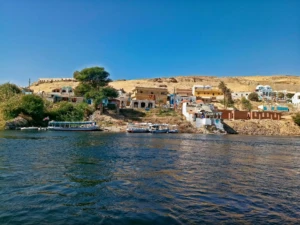
The boat leaves the marina with a low growl, cutting a silver path across the water south of Aswan. For a few minutes, there is no temple in sight—only rounded granite rocks, small islands and a sky that seems far larger than it did in the city.
Then the columns appear.
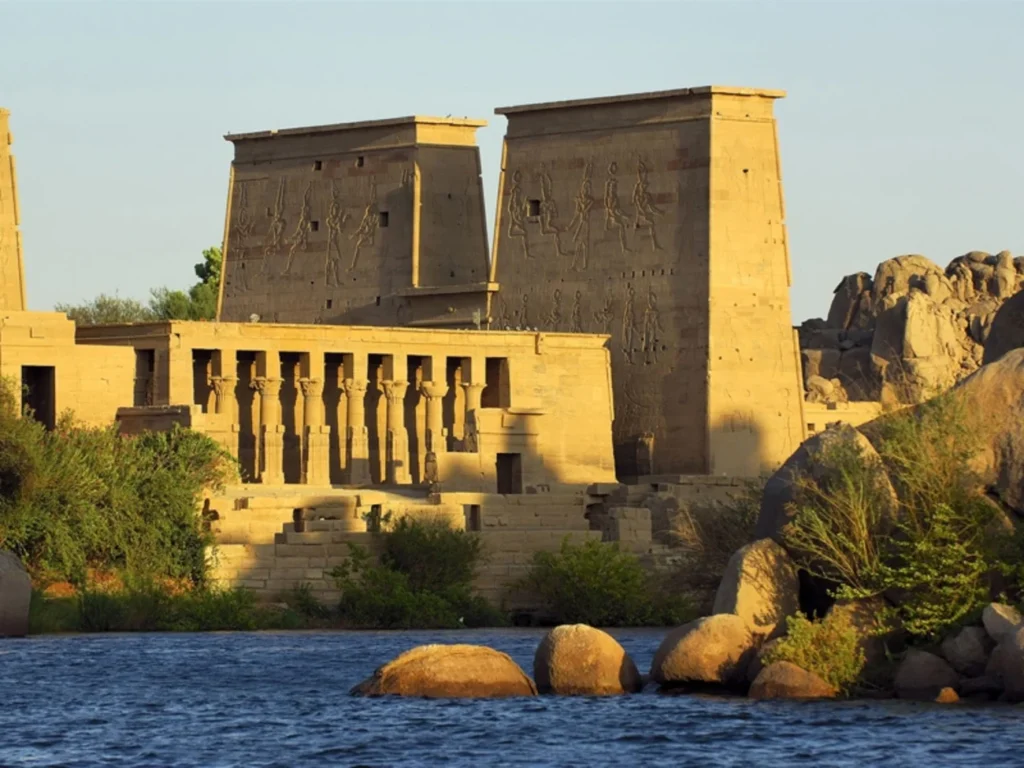
They rise above the shoreline in a long, elegant row. Behind them, two monumental pylons frame the entrance to a sacred world. From the boat, Philae Temple looks as though it has occupied this island forever. That first impression is part of its magic—and the beginning of its greatest surprise.
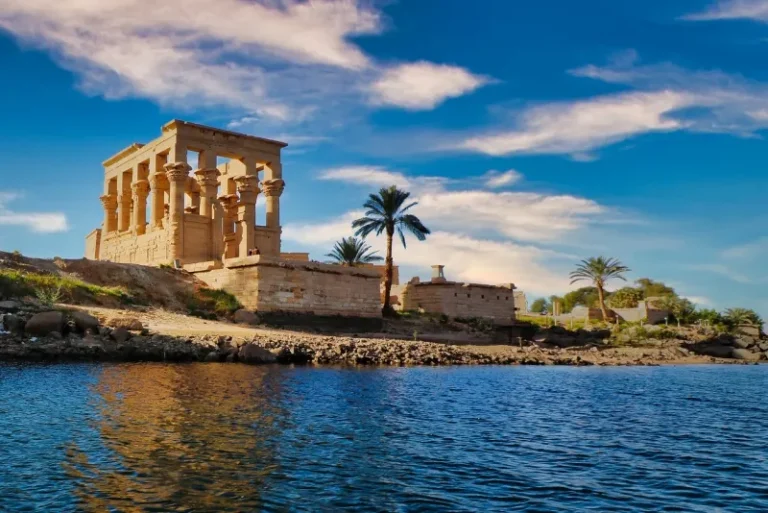
The sanctuary in front of you is ancient, but this is not its original island.
For centuries, pilgrims came to Philae to worship Isis, the goddess who restored her murdered husband Osiris and protected their son Horus. Later, Greek-speaking kings and Roman emperors carved themselves into its walls. Christians transformed rooms of the old temple into churches. Then modern dams caused the Nile to rise around the monuments until columns and courtyards stood in water for part of each year.
Philae might have disappeared beneath the river. Instead, it was taken apart and rebuilt on higher ground, block by numbered block.
That is why a visit to the Philae Temple in Egypt feels like two stories unfolding at once: the ancient story of a goddess who brought life back from death, and the modern story of a sanctuary that was itself rescued from the water.
Philae Temple at a Glance
| Question | Quick answer |
|---|---|
| Where is Philae Temple? | On Agilkia Island, reached by motorboat from the Philae marina south of Aswan |
| What was the original location? | Nearby Philae Island; the monuments were moved to Agilkia Island |
| Who was the main temple dedicated to? | Isis, goddess of healing, motherhood, protection and royal power |
| When was the main Temple of Isis built? | Work began under Ptolemy II Philadelphus, who ruled from 285 to 246 BCE, with later additions |
| What periods are represented? | Primarily Ptolemaic and Roman, with earlier remains and later Christian alterations |
| Why was the complex moved? | To save it from the rising waters associated with the Aswan dams |
| How do visitors reach it? | By road from Aswan to the marina, then by motorboat |
| How long should you allow? | Around 1.5 to 2 hours for the boat journey and a comfortable visit |
| Current opening hours | Daily, 7:00 AM–4:00 PM, according to Egypt’s Ministry of Tourism and Antiquities |
Before There Was a Temple, There Was a Story
To understand the Temple of Philae, begin with a family torn apart.
In one of ancient Egypt’s most powerful myths, the just king Osiris was murdered by his brother Seth. Isis, the wife and sister of Osiris, searched the country for what had been lost. Through loyalty, magic and persistence, she restored him long enough to conceive their son, Horus. She then hid the child among the papyrus marshes and protected him until he could challenge Seth and claim his inheritance.
The myth held several promises at once. It spoke of a wife whose devotion overcame death, a mother who guarded her child, a legitimate heir who restored order and a land that could return to life after loss. In a country shaped by the Nile’s annual renewal, Isis became far more than a character in a divine drama. She offered protection to families, hope to the sick and a model of rightful kingship.
Philae stood near Egypt’s southern frontier, close to the First Cataract and the historic meeting place of Egyptian and Nubian worlds. The landscape itself gave the island a sacred atmosphere. Granite broke the river into channels; neighboring islands carried traditions connected with Osiris; boats moved between water, rock and temple as though crossing from the everyday world into myth.
Pilgrims did not come only to admire architecture. They came to participate in a living sacred geography. Processions carried divine images by boat. Priests performed rituals in increasingly restricted rooms. Incense, music and spoken prayers animated spaces that now seem silent.
The temple island of Philae was therefore not simply a collection of handsome buildings. It was a stage on which the story of Isis, Osiris and Horus could be renewed through ritual—and where human visitors could ask the gods for protection, healing and continuity.
Kings Changed, but Isis Remained
The surviving monuments at Philae belong mainly to the Ptolemaic Period, which began after Alexander the Great conquered Egypt in 332 BCE. The Ptolemies were a Greek-speaking dynasty, yet the rulers presented themselves in Egyptian temples as pharaohs. They wore traditional crowns, made offerings to Egyptian gods and commissioned inscriptions in the established sacred language.
That may sound like a contradiction. At Philae, it becomes visible history.
The oldest surviving structure in the complex is associated with Nectanebo I, an Egyptian pharaoh of the Thirtieth Dynasty who ruled before the Ptolemies. The great Temple of Isis, however, began to take its recognizable form under Ptolemy II Philadelphus in the third century BCE. Successive Ptolemaic rulers enlarged and decorated it. Roman emperors later added gates, reliefs and buildings while continuing to appear on the walls in the visual role of pharaoh.
Walk through the Philae Temple complex and political power changes names, languages and capitals. The sacred story remains remarkably steady. Whether the ruler was a Ptolemy or a Roman emperor, he approached Isis as the divinely sanctioned king of Egypt.
This is one reason Philae matters so much. Its walls show that ancient Egyptian religion did not suddenly end when native dynasties lost the throne. It adapted. The temple became a meeting place where Egyptian traditions, Greek rule, Roman imperial power and Nubian devotion overlapped for centuries.
The First Pylon: Where the Story Becomes Monumental
After landing on Agilkia Island, the approach draws you toward the first pylon. The route is not perfectly symmetrical, and that slight irregularity makes the temple feel less like a diagram and more like a city that grew around generations of ritual.
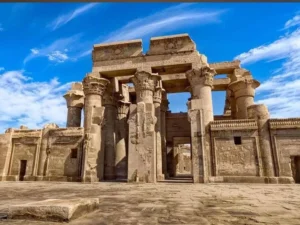
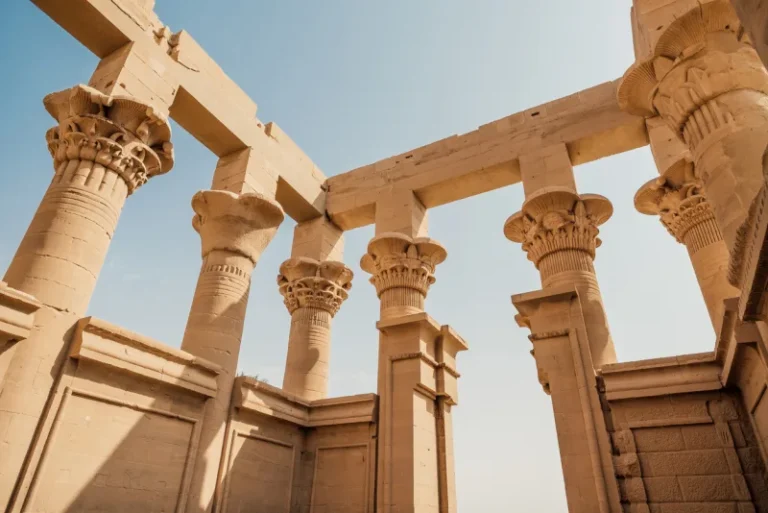
Colonnades line the outer court. Their capitals open like stone flowers—papyrus, lotus and palm forms transformed into architecture. When the light moves across them, carved details sharpen and disappear from one column to the next.
Then the first pylon fills your view.
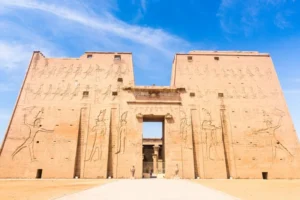
On its surface, Ptolemy XII is shown in the familiar pose of a pharaoh defeating enemies before the gods. The image is not a record of one ordinary battlefield moment. It is a statement of cosmic order: the king, supported by the divine world, defeats chaos and preserves balance.
For modern visitors, the scale is impressive. For ancient worshippers, the meaning would also have been immediate. Crossing this gateway meant leaving the open public approach and moving deeper into a controlled sacred landscape.
Look closely rather than hurrying through. The pylon rewards time: crowns, divine figures, ritual gestures and lines of hieroglyphs turn its immense façade into a theological text.
The Mammisi: A Divine Child Is Born
Inside the first court stands one of Philae’s most revealing buildings—the mammisi, or birth house.
Here, temple scenes celebrate the divine birth of Horus. Egypt’s Ministry of Tourism and Antiquities highlights a particularly tender image of Isis nursing her son among the marshes. Yet the room also served a political purpose. The birth of the divine child echoed the renewal of royal power. A ruler could connect his own legitimacy with Horus, the rightful heir who survived danger and restored order.
This is where the temple’s public drama becomes intimate. On the pylons, a king dominates enemies. In the birth house, power begins with a mother protecting a child.
That contrast helps explain the lasting appeal of Isis. She belonged to royal theology, but her story also spoke to ordinary fears: separation, illness, vulnerable children and the hope that love could preserve what violence threatened to destroy.
Beyond the Second Pylon: Entering the House of Isis
The second pylon leads toward the most sacred rooms of the Temple of Isis. The atmosphere changes as you advance. Open sky gives way to shade. Spaces become smaller. The route narrows. This progression was deliberate.
Ancient Egyptian temples were often arranged as journeys from brightness and public space toward darkness, restriction and divine presence. Most worshippers would never have wandered through every chamber as visitors do today. Access depended on ritual role and status. Priests purified themselves before serving within the temple, and the innermost sanctuary was the focus of daily ceremonies.
Imagine the building when it was active. Walls and columns were painted. Doors controlled movement. Oil lamps softened dark interiors. Priests washed, clothed and offered food to the sacred image of Isis. During festivals, the goddess’s portable shrine could leave the sanctuary aboard a ceremonial barque, turning the hidden deity into the center of a public procession.
The surviving stone can make ancient temples seem static. They were not. Philae once moved through cycles of dawn ritual, festival music, offerings, processions and pilgrimage.
The Temple of Hathor: Music Carved in Stone
Not every part of Philae carries the solemn weight of the sanctuary.
Near the main temple stands a smaller temple dedicated to Hathor, built under Ptolemy VI Philometor and later embellished in the Roman period. Hathor was associated with music, joy, love and motherhood. On its reliefs, musicians and playful figures create a livelier mood. The dwarf god Bes—protector of homes, mothers and children—appears amid scenes of celebration.
It is an easy building to overlook when the great pylons dominate the visit, but it adds an essential note to the story. Egyptian sacred life included joy as well as mystery. Music was not simply entertainment outside religion; it could calm, welcome and honor the divine.
Pause here and the silent reliefs almost suggest a lost rhythm.
Trajan’s Kiosk: The View Everyone Remembers
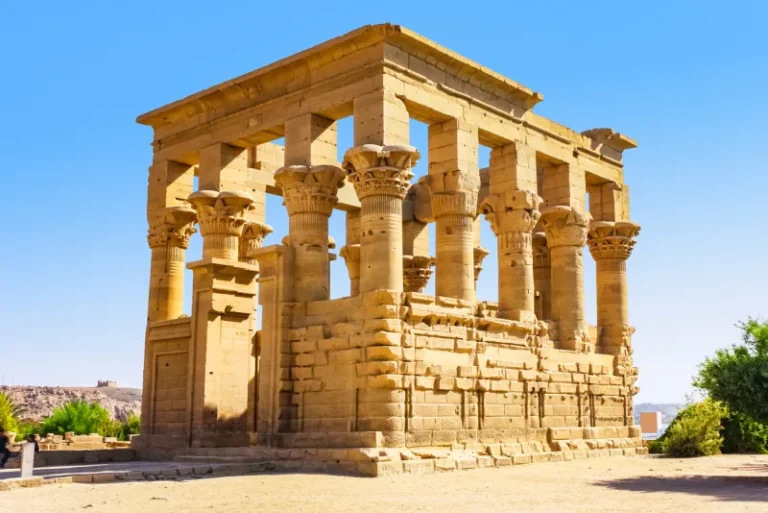
At the edge of the island stands the Kiosk of Trajan, one of the most photographed monuments in Aswan. Its fourteen columns support elegant capitals and high screen walls, while the roof is gone. The result is a structure that feels both architectural and open to the landscape.
Reliefs show the Roman emperor Trajan making offerings to Isis, Osiris and Horus. Once again, a foreign ruler appears in the role expected of an Egyptian pharaoh.
The kiosk is sometimes called “Pharaoh’s Bed,” although its ancient function is not known with certainty. It may have served as a ceremonial station connected with the sacred barque of Isis. What is certain is its visual power. Water surrounds the island, light passes freely through the columns, and the monument seems designed to mediate between boat and temple.
From here, it is easy to understand why nineteenth-century travelers repeatedly drew and described Philae. The island offered an irresistible composition of stone, river and sky—even when its future had already begun to change.
The Last Hieroglyph and a Changing World
Philae remained a center of traditional worship long after many other Egyptian temples had fallen silent.
On one wall, a priest named Esmet-Akhom carved the last known dated hieroglyphic inscription in 394 CE. The date matters because it turns an abstract historical transition into a human act. Someone who still understood the ancient script stood in this sanctuary and cut sacred signs into stone at the end of a writing tradition more than three thousand years old.
Christianity was already transforming Egypt. The Temple of Isis eventually closed during the reign of the Byzantine emperor Justinian I in the sixth century. Parts of the complex were converted for Christian worship. Crosses were carved into walls, and some older divine images were damaged or erased.
It is tempting to read these marks only as destruction, but they also document continuity of place. Philae did not become meaningless when one religious system gave way to another. The island remained important enough to reuse, reinterpret and inhabit.
Its walls are therefore not a single frozen moment. They are a record of competing beliefs, surviving traditions and changing communities.
Then the Nile Rose
For most of Philae’s ancient life, the river was part of its beauty and sacred identity. In the modern period, water became a threat.
The first Aswan Dam—often called the Aswan Low Dam—was completed in the early twentieth century and later raised. For part of each year, the old island and its temples were inundated. Historic photographs show columns rising directly from the water and visitors traveling through flooded courts by boat.
The images are romantic until you remember what repeated submersion does to stone. Water carried salts into the masonry. Painted surfaces suffered. The border between island and river disappeared.
Plans for the Aswan High Dam created a much larger emergency for the monuments of Nubia. Archaeological sites across the region faced flooding, and no single country could easily save them all. In 1960, UNESCO launched an international campaign that would continue until 1980.
The campaign changed the way the world thought about shared heritage. Countries contributed money, engineers, archaeologists and technical expertise. Temples were documented, dismantled and moved. Entire sites found new homes.
Philae became one of the campaign’s most complex rescue stories.
When Was Philae Temple Moved?
The rescue of Philae took place during the UNESCO Nubia Campaign of 1960–1980, with the temple complex dismantled and reconstructed on Agilkia Island during the 1970s. The rebuilt site was inaugurated in 1980.
Engineers first created a protective enclosure around the flooded monuments and pumped out the water. Archaeologists and conservators documented the buildings before the structures were carefully taken apart. Stone blocks were numbered so they could be returned to their correct positions.
The destination was nearby Agilkia Island, chosen because it stood on higher ground. The island was landscaped to resemble the contours and setting of old Philae. The temples were then reassembled, preserving their relationships as carefully as the project allowed.
The result is not a replica. These are the ancient stones of the Philae temples, bearing original reliefs, weathering, Christian crosses and centuries of human touch. Yet the ground beneath them is different.
That creates one of the most interesting questions at Philae: can a sacred place remain authentic after it has been moved?
UNESCO acknowledges that the temples are no longer in their original position, but emphasizes the exceptional care used to preserve their form, design and spirit. Most visitors experience that spirit before they know the details. The boat approach, island setting and relationship between monuments and water still shape the visit.
Perhaps the rescue feels so appropriate because it mirrors the temple’s central myth. Isis gathered what had been separated and restored it. Thousands of years later, people from many nations dismantled her sanctuary to save it—and assembled it again on a new island.
Where Is Philae Temple Today?
Modern Philae Temple Aswan stands on Agilkia Island, south of central Aswan and close to the Aswan Low Dam. There is no bridge to the archaeological site. The final part of every daytime visit is made by motorboat from the marina.
This matters for planning. A ticket to the archaeological site and the boat transfer should be treated as separate arrangements unless your organized tour explicitly includes both. Independent travelers should confirm the complete boat price, return journey and waiting time before leaving the dock.
The crossing itself is short—often around five to ten minutes, depending on the boat and conditions—but it is not wasted transit. It is the opening scene of the visit. Sit where you can see forward, keep your camera ready and watch for the first appearance of the colonnade above the water.
Philae Temple Tickets and Opening Hours in 2026
As of September 20, 2026, Egypt’s Ministry of Tourism and Antiquities lists the following information for the main archaeological site:
| Visitor category | Admission |
|---|---|
| Foreign adult | EGP 550 |
| Foreign student | EGP 275 |
| Egyptian adult | EGP 40 |
| Egyptian student | EGP 20 |
The ministry lists opening hours as 7:00 AM to 4:00 PM daily.
Prices and hours can change, sometimes with limited notice. Check the official Philae page shortly before visiting. Student discounts normally require valid identification, and the motorboat transfer may be charged separately. An evening sound-and-light program, when operating, uses its own schedule and ticket.
The Best Time to Visit Philae Temple
Early morning offers the best combination of softer light, cooler temperatures and fewer groups. The boat ride is peaceful, the first pylon catches warm light and shaded rooms still feel fresh.
Late afternoon can also be beautiful, especially around the colonnades and Trajan’s Kiosk. However, do not arrive too close to closing time. You need time for ticketing, arranging a boat, crossing to the island and returning.
From roughly October to April, Aswan’s daytime weather is generally more comfortable for extended sightseeing. Summer visits are still possible, but the heat can be intense. Shade is limited in the open courts, so carry water, use sun protection and slow your pace.
How Long Do You Need at Philae Temple?
Allow around 1.5 to 2 hours from the marina for a relaxed visit, including the crossings. Travelers who enjoy photography, inscriptions or detailed explanations may want longer.
A well-paced route looks like this:
- Take in the island from the boat before landing.
- Walk through the outer colonnades toward the first pylon.
- Spend time at the mammisi and first court.
- Continue through the second pylon into the inner rooms and sanctuary.
- Explore the smaller Temple of Hathor.
- Finish at Trajan’s Kiosk and the waterfront before returning to the dock.
Trying to race through Philae in 30 minutes misses its greatest strength. The complex is not about one famous object. Its impact comes from the sequence of spaces and the gradual movement from water to gateway, court, sanctuary and water again.
Visiting Independently or With an Egyptologist
An Egyptologist adds value because the reliefs are not self-explanatory. A guide can help you distinguish Isis from Hathor, show how a Roman emperor became an Egyptian pharaoh on the walls, explain why the mammisi mattered and identify the later Christian changes. Without context, it is easy to photograph a remarkable scene without realizing why it is important.
Delta Tours Egypt can incorporate Philae into a tailor-made Egypt tour or an Aswan stay connected to one of its Nile River cruises, with a private Egyptologist and transportation arranged around the pace of the traveler.
Philae Temple Sound and Light Show
The evening program presents the temple through illumination, narration and music. It can be atmospheric because reaching an island sanctuary after dark feels very different from a daytime visit.
The show should be considered an interpretation rather than a substitute for seeing the reliefs clearly. If your schedule allows, visit in daylight first and return in the evening only if the program appeals to you. Schedules, language rotations and operating days may change, so confirm them locally or through your tour provider before planning an evening around it.
Philae Temple Facts Worth Remembering
- Philae Temple is no longer on the original Philae Island. The monuments now stand on nearby Agilkia Island.
- The main sanctuary honored Isis. Her story of protection, healing and restoration shaped the identity of the site.
- Most visible monuments are Ptolemaic and Roman. The site preserves older elements, but it is not primarily an Old Kingdom temple.
- A last dated hieroglyph was carved here in 394 CE. It was made by a priest named Esmet-Akhom.
- The complex later served Christian worshippers. Crosses and altered reliefs record that new chapter.
- UNESCO’s international Nubia campaign saved the sanctuary. The campaign ran from 1960 to 1980, and Philae was reconstructed on higher ground.
- Trajan’s Kiosk has no surviving roof. Its open columns have become one of the defining images of Aswan.
- Every visit begins by boat. The water crossing is essential to the experience and to the site’s continuing sense of arrival.
Philae is part of our private Aswan day tour with the High Dam and the Unfinished Obelisk, and the temple returns after dark for the Philae Sound and Light Show. See all our Aswan tours.
Frequently Asked Questions About Philae Temple
What is Philae Temple?
Philae Temple is an island temple complex near Aswan. Its principal building is the Temple of Isis, begun under Ptolemy II Philadelphus and expanded by later Ptolemaic and Roman rulers. The wider complex includes the mammisi, Temple of Hathor, Trajan’s Kiosk, gateways, colonnades and later Christian remains.
Where is Philae Temple located?
The monuments are on Agilkia Island south of Aswan, between the Aswan Low Dam and High Dam. Visitors travel by road to the marina and complete the journey by motorboat.
Is Philae Temple on Philae Island?
Not anymore. The ancient complex originally stood on Philae Island. It was dismantled and reconstructed on nearby Agilkia Island during the international campaign to save Nubian monuments from flooding.
When was Philae Temple moved?
The relocation work took place in the 1970s as part of UNESCO’s 1960–1980 Nubia Campaign. The reconstructed sanctuary on Agilkia Island was inaugurated in 1980.
Who built Philae Temple?
No single ruler built the entire site. Nectanebo I created the earliest surviving structure, while the main Temple of Isis was begun under Ptolemy II in the third century BCE. Later Ptolemaic kings and Roman emperors expanded and decorated the complex.
Why is Philae Temple important?
It preserves a major sanctuary of Isis, evidence for the long survival of ancient Egyptian religion, the last known dated hieroglyphic inscription and traces of early Christian use. Its rescue also became a landmark in international heritage conservation.
How do you get to Philae Temple from Aswan?
Take a taxi, private car or organized tour to the Philae marina south of central Aswan, then board a motorboat to Agilkia Island. Confirm whether your transport, admission and boat are included in any quoted tour price.
Is the boat included in the Philae Temple ticket?
Do not assume it is. Boat arrangements are often separate for independent visitors, while some organized tours include them. Confirm the full return price and waiting time before boarding.
Can you visit Philae Temple at night?
An evening sound-and-light show may operate on selected days. It requires a separate ticket and schedule check. Normal archaeological-site admission is during daytime opening hours.
Is Philae Temple suitable for children?
Yes. The short boat journey and the story of Isis, Osiris and Horus make it engaging for families. Supervise children near docks and water, and plan shade and hydration carefully.
Is Philae Temple worth visiting?
Absolutely. It combines monumental architecture, mythology, late hieroglyphic and Christian history, a beautiful boat approach and one of the twentieth century’s great archaeological rescue projects. Few sites in Egypt tell so many chapters in such a compact setting.
The Island That Refused to Vanish
When the return boat pulls away, Philae slowly becomes a silhouette again. The pylons shrink. The colonnade returns to a line above the water. Soon, granite outcrops hide the sanctuary and the marina comes back into view.
But the story travels with you.
An Egyptian goddess searched for what had been broken and made it whole. Foreign kings adopted the language of pharaohs to approach her. A priest carved one of history’s final hieroglyphic messages. Christians left crosses in rooms once filled with incense for Isis. The river rose, and people from across the world came together to lift the temples onto another island.
That is the real power of Philae Temple Aswan Egypt. It is not beautiful because time left it untouched. It is beautiful because every age touched it—and because, when the water threatened to close over its stones, the world decided its story should continue.