City of the Dead, Cairo: History and Respectful Visiting

Yes, you can visit Cairo’s City of the Dead, the vast historic cemeteries east and south of the medieval city, and it holds some of the finest Mamluk architecture in Egypt. The best way is a daytime visit with a local guide, focused on a few major monuments such as the Qaytbay complex and the Khanqah of Faraj ibn Barquq. Remember that these are working cemeteries where people still bury, mourn and live, so dress modestly and move quietly.
This guide explains what the City of the Dead is, which monuments to prioritize, and how to visit in a way that respects the families who live and grieve there.
| Quick facts | Details |
|---|---|
| Location | Eastern and southern edges of historic Cairo, below the Muqattam hills |
| Main areas | The Mamluk (Northern) cemetery and the Southern cemetery around Imam al-Shafi’i |
| Period | Burials from the early Islamic centuries to today; most famous monuments are Mamluk (13th to 16th centuries) |
| World Heritage | Its main necropolises are part of UNESCO-listed Historic Cairo (1979) |
| Key monuments | Qaytbay complex (1472 to 1474), Khanqah of Faraj ibn Barquq (1398 to 1411), Mausoleum of Imam al-Shafi’i |
| Monument hours | 9:00 am to 4:00 pm daily for the listed monuments (official listing) |
| Time needed | 2 to 3 hours with a guide (our planning suggestion) |
What is the City of the Dead?
“City of the Dead” is the name visitors use for Cairo’s great historic cemeteries. Locally they are known as al-Qarafa. They run along the eastern side of the old city and wrap around the Citadel to the south.
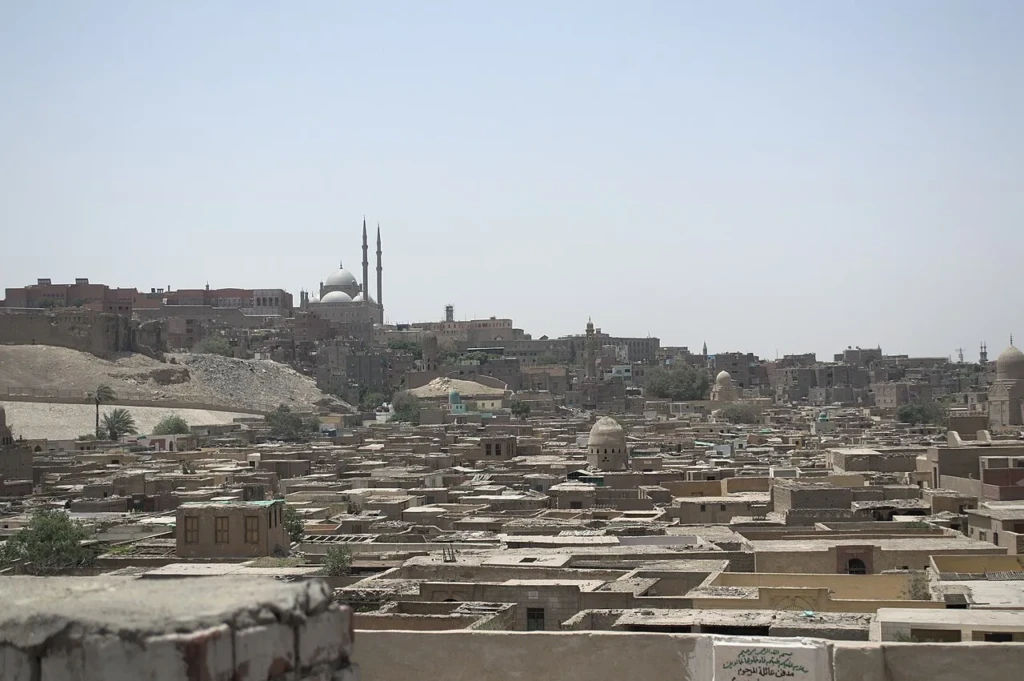
The name sounds bleak, but the place is not. Over centuries, sultans, emirs, scholars and ordinary families built tombs here. The richest built whole complexes, with mosques, schools, Sufi lodges and public fountains next to their graves. The result is a district of domes and minarets that reads like an open-air museum of Islamic architecture.
It is also a living neighborhood. Families care for tombs, run small workshops and raise children among the burial enclosures. Funerals and visits to graves happen every day. That is the single most important thing to understand before you go.
The Northern and Southern cemeteries
Two areas matter most to visitors. The Mamluk cemetery, often called the Northern Cemetery, lies east of the old city. It holds the great royal complexes of the 14th and 15th centuries, including those of Qaytbay, Faraj ibn Barquq and Barsbay.
The Southern Cemetery is older and sprawls south of the Citadel. Its best-known shrine is the mausoleum of Imam al-Shafi’i, one of the most revered figures in Sunni Islam. The Ministry of Tourism and Antiquities lists the Imam al-Shafi’i, Sayyida Nafisa and Qaytbay necropolises among the parts of Historic Cairo added to the UNESCO World Heritage List in 1979.
A short history in plain language
Cairo’s Muslim rulers buried their dead outside the city walls, as was common across the Islamic world. As the city grew, these burial grounds grew too. The Southern Cemetery developed early, in the centuries after the Arab conquest of 641 CE, near the old capital of Fustat.
Imam al-Shafi’i came to Egypt in 813 CE and taught at the Mosque of Amr ibn al-As. The Ministry dates his death to 819 CE. He was buried in the Southern Cemetery, and his tomb drew pilgrims and further burials around it. Salah al-Din (Saladin) built the first structure over the grave in 1176.
The Mamluk sultans, who ruled Egypt from the mid-13th century to 1517, turned the desert east of the city into a royal burial ground. They built large charitable foundations here, partly as acts of piety and partly as statements of power. Endowments paid for teachers, Sufis and water for passers-by. That is why many tombs here are attached to schools and fountains.
What to see in the City of the Dead
The cemeteries are too large to see in one visit. Choose two or three major monuments and let your guide link them by car. Here is the order we suggest for a first visit to the Mamluk cemetery, followed by the Southern Cemetery option.

1. Khanqah and Mausoleum of Faraj ibn Barquq
Start at the eastern side of the Mamluk cemetery with the complex of Sultan al-Nasir Faraj ibn Barquq. The Ministry dates it to between 1398 and 1411 and calls it one of the largest architectural units in Egypt. It combined a mosque, a khanqah (a lodge for Sufis) and a madrasa (school).
It is also where Sultan Barquq and his family are buried. Look for the two sabils (public water fountains) on the main facade, and above all the two minarets and two domes that make the building easy to spot from a distance. The Committee for the Preservation of Arab Antiquities restored the complex in 1940.
2. Complex of Sultan Qaytbay
Next, move to the complex of Sultan al-Ashraf Qaytbay, built between 1472 and 1474. Many consider it the high point of late Mamluk design, and the Ministry calls it one of the most magnificent complexes in the cemetery.
It includes a madrasa, a sabil, a kuttab (a Quranic school for poor children) and a family burial ground. The madrasa is arranged around a courtyard with four iwans, or vaulted halls. Look closely at the main entrance, decorated with colored marble and inscriptions, and at the door with its gilded copper designs.
Inside, the Ministry highlights the wooden pulpit and the Quran reciter’s chair, both inlaid with ivory, and the gilded wooden lantern in the center of the roof. The sabil-kuttab stands to the left of the madrasa entrance, with colored marble paneling.
3. The funerary complex of Sultan Barsbay
Sultan al-Ashraf Barsbay ruled from 1422 to 1437. He built a well-known madrasa in the old city, but the Ministry notes that he chose to be buried in his own complex in the Mamluk cemetery. If time allows, your guide can show you its exterior on the way between the larger monuments.
4. Mausoleum of Imam al-Shafi’i (Southern Cemetery)
If you want to see the Southern Cemetery, the mausoleum of Imam al-Shafi’i is the main reason to go. According to the Ministry, the present mausoleum is attributed to the Ayyubid Sultan al-Kamil, who built it after his mother was buried there in 1211. A carved wooden cenotaph sits over the grave, decorated with geometric patterns and Quranic inscriptions.
The wooden dome was renewed by Sultan Qaytbay in 1480. A long conservation project began in 2016, carried out with the Athar Lina initiative and funded by the U.S. Ambassadors Fund for Cultural Preservation. Next to the shrine stands the Imam al-Shafi’i Mosque, built in 1762 and later rebuilt under Khedive Tawfiq and Khedive Abbas Hilmi II.
This is an active place of pilgrimage. Non-Muslim visitors should follow their guide’s lead on where they may enter and when.
How to visit respectfully
Respect is not an optional extra here. It is the condition for a good visit. These points will help.
- Remember people live here. Many tomb enclosures are also homes. Do not walk into courtyards or open gates unless invited.
- Do not photograph people without asking. This applies especially to residents, children and anyone at a funeral or graveside.
- Give funerals space. If you meet a funeral procession or burial, step aside, lower your voice and put your camera away.
- Dress modestly. Cover shoulders and knees. Women should carry a scarf to cover their hair in mosques and shrines.
- Remove shoes where asked before entering prayer areas.
- Avoid prayer times inside working mosques, especially Friday midday prayers.
- Tip caretakers fairly. Custodians often unlock doors or show you a roof or minaret. A small tip in Egyptian pounds is customary.
Is the City of the Dead safe to visit?
Most visits pass without problems, but this is a large, low-income area with confusing lanes and few tourist facilities. We recommend visiting in daylight with a licensed guide and a driver, rather than wandering alone. Your guide knows which routes are suitable and which monuments are open that day. For a wider view of current travel conditions, read our guide on whether it is safe to travel to Egypt right now.
How to get there
The Mamluk cemetery lies on the eastern side of historic Cairo, near Al-Azhar Park. The Southern Cemetery extends south of the Citadel. Both are best reached by car. Distances inside the cemeteries are larger than they look on a map, so having a driver lets you move between monuments without long walks in the heat.
Travel time depends on traffic and your hotel location, so your driver or guide will confirm timing. Taxis and ride-hailing cars can drop you at major monuments, but finding a car back can be harder, which is another reason to arrange a driver.
Opening hours and tickets
The Ministry of Tourism and Antiquities lists the Qaytbay complex and the Faraj ibn Barquq complex as open daily from 9:00 am to 4:00 pm, as listed on the official Ministry of Tourism and Antiquities site in October 2026; check before you go. Neither listing shows a ticket price, so we do not quote one. The Imam al-Shafi’i Mosque is listed as open 9:00 am to 4:00 pm and free of charge.
The cemeteries themselves are public space with no entrance gate or fee. In practice, a caretaker may open a monument for you, and a tip is expected. Opening of individual buildings can vary, especially around prayer times and during restoration work.
Best time to visit
Go in the morning, when it is cooler and the light is good on the domes. Mid-morning on a weekday gives the best chance of monuments being open and caretakers being present. Avoid Friday midday, when mosques are full for congregational prayers.
Cairo’s cooler months, roughly late autumn to early spring, are the most comfortable for walking between tombs. See our month-by-month guide to Egypt’s weather for details.
How to combine it with nearby sites
The City of the Dead fits naturally into a day of Islamic Cairo. Good pairings include:
- Cairo Citadel: close to both cemeteries and the obvious anchor for the day.
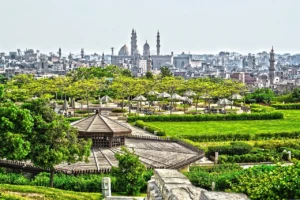
- Al-Azhar Park: next to the Mamluk cemetery, and a calm place to end the afternoon with a view over the old city.
- Al-Azhar Mosque and Khan el-Khalili: the Fatimid core of Cairo, a short drive west.
Our Cairo travel guide helps you plan areas and hotels. For a ready-made day in the historic city, the Old Cairo & Citadel tour (1 day, from $100 per person) covers the Citadel and the old quarters; ask us if you would like to add a cemetery stop. For a longer stay, Taste of Egypt, our 4-day Cairo tour (from $535 per person), leaves room for extra sights. You can also browse all our private Cairo day tours.
Who should visit?
The City of the Dead suits travelers with a real interest in Islamic architecture, Cairo’s social history, or photography of buildings rather than people. If this is your first short trip and your priority is ancient Egypt, start with Giza on our private Giza Pyramids tour (1 day, from $55 per person) and save the cemeteries for a return visit.
Visit with Delta Tours Egypt
Delta Tours Egypt does not sell a set tour of the City of the Dead. We can arrange a private visit on request, with a driver and a licensed guide who knows the monuments and the etiquette of the area. We usually build it into a tailor-made Egypt tour alongside the Citadel and the rest of Islamic Cairo, at a pace that suits you.
Frequently Asked Questions
Why is it called the City of the Dead?
The name describes a huge area of tombs that looks like a town, with streets, domes and houses. Many people also live there, caring for family tombs and working locally, which makes the name even more fitting.
Do people really live in the City of the Dead?
Yes. Families live in and around tomb enclosures, and the area has homes, shops and workshops. Treat it as a residential neighborhood and respect people’s privacy.
Is there an entrance fee for the City of the Dead?
No, the cemeteries are open public space. The Ministry lists hours for major monuments but shows no ticket price, and caretakers usually expect a small tip for opening doors.
What is the most important monument to see?
For most visitors it is the Qaytbay complex, built between 1472 and 1474. Its colored marble entrance, ivory-inlaid woodwork and gilded wooden lantern show late Mamluk craftsmanship at its best.
Can women visit the mosques and mausoleums?
Yes, with modest dress and a scarf to cover the hair inside religious buildings. Your guide will advise on any areas reserved for worshippers.
Can I visit without a guide?
It is possible but not recommended. The area is large and confusing, signage is limited, and a guide helps you find open monuments and behave appropriately around residents and funerals.
Seen with care, the City of the Dead is one of Cairo’s most rewarding visits for anyone who loves architecture and history. Tell us what interests you, and we will plan a respectful, guided visit as part of your tailor-made Egypt tour.
Featured image: Mausoleums and lanes in the City of the Dead, Cairo. Photo: Bertramz / Wikimedia Commons, CC BY-SA 3.0