Dendera Temple: Hathor, the Zodiac & Visiting from Luxor
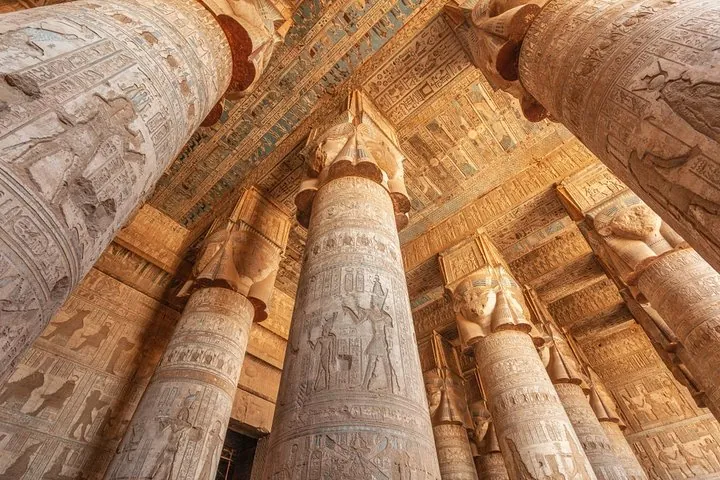
Dendera Temple is the Temple of Hathor at Dendera, about 60 km (37 miles) north of Luxor on the west bank of the Nile. It is one of the best-preserved temples in Egypt, famous for its Hathor-headed columns, restored painted ceilings, the Dendera zodiac and the crypt reliefs nicknamed the “Dendera light.” Most visitors see it on a day trip from Luxor, often paired with Abydos.
This guide explains the temple’s story in plain language, walks you through the highlights in the order you will meet them, and covers hours, tickets, travel time and how to fit Dendera into a Luxor stay.
Dendera Temple at a Glance
| Fact | Details |
|---|---|
| Location | Dendera, Qena Governorate, west bank of the Nile, about 5 km south of Qena city (across the river) |
| Distance from Luxor | About 60 km (37 miles) north; route planners estimate roughly 1 hour by car |
| Built | Main temple begun in 54 BC under Ptolemy XII; front hall added under the Roman emperor Tiberius |
| Dedicated to | Hathor, goddess of music, joy, dance and motherhood, called “the lady of the sky” |
| Site size | About 40,000 square meters inside a mud-brick enclosure wall |
| Opening hours | Daily, 7:00 AM to 5:00 PM (official listing, October 2026) |
| Foreign adult ticket | EGP 300 (student EGP 150); roof and crypt tickets extra (see below) |
| Time on site | Our planning suggestion: 2 to 3 hours, including the roof and crypt |
What Is the Temple of Hathor at Dendera, and Why Does It Matter?
Hathor was one of the most loved deities in ancient Egypt. She stood for music, dancing, joy and motherhood, and she was also a sky goddess. Dendera was her main cult center. The town was known as Iunet to the Egyptians and Tentyris to the Greeks, and it served as the capital of the sixth province of Upper Egypt.
The temple you visit today is late by Egyptian standards. Work on it began in 54 BC under Ptolemy XII, the father of Cleopatra VII. The great front hall was added in the Roman period under Tiberius. The Ministry of Tourism and Antiquities notes that older buildings once stood on the same ground, with evidence going back to King Pepy I of the Old Kingdom, more than two thousand years earlier.
Why does it matter to a modern traveler? Because almost everything is still here. The roof is on, the stairways still climb to the top, and the inner rooms keep their carved walls and painted ceilings. Many temples in Egypt show you ruins and leave the rest to imagination. Dendera shows you what a working temple felt like, from the dark sanctuary to the rooftop chapels. It is also a key place for understanding how Greek-speaking and Roman rulers presented themselves as pharaohs, carved in traditional Egyptian dress on Egyptian walls.
What to See Inside Dendera Temple, in Visiting Order
The complex is larger than the main temple alone. Below is the route most guided visits follow, from the gate to the rear of the enclosure.
- The north gate and enclosure. You enter through a monumental gateway in the mud-brick wall. Restorers cleaned the colors on its lintel and ceiling during the first phase of the ministry’s project.
- The open-air display. On terraces to the left of the main gate, the ministry has displayed stone pieces from the site since 2019, working with the French archaeological mission.
- The birth houses (mammisi). Two birth houses celebrate the divine child of Hathor. The older one was raised by Nectanebo II (360 to 343 BC) and is the earliest surviving building on the site. The Roman one dates to the reigns of Trajan and Marcus Aurelius.
- The façade. Six massive columns topped with the face of Hathor line the front. Her head is framed by sistrums, the rattles used in her worship. The façade is 35 meters wide and 12.5 meters high.
- The Great Hypostyle Hall. Twenty-four columns hold up a ceiling covered with astronomical scenes, including rectangular zodiac panels. This is where the restored colors are most striking.
- The inner halls and sanctuary. Smaller halls lead you deeper and darker toward the sanctuary, the home of the goddess’s image.
- The crypts. The temple has twelve crypts, small underground chambers where sacred objects were kept. These are where the so-called “Dendera light” reliefs are carved. A separate ticket applies.
- The staircases and roof. A processional staircase leads up to the roof, where the Kiosk of Hathor stands. Priests carried the goddess’s statue up here for rites tied to the sun. A separate ticket applies.
- The Osiris chapel and the zodiac copy. The circular Dendera zodiac decorated the ceiling of a small chapel dedicated to Osiris. What you see today is a copy; the original is in Paris.
- The rear wall. Walk around the outside to the back. Here Cleopatra VII appears with her son Ptolemy XV Caesarion, said to be the child of Julius Caesar.
- The Temple of the Birth of Isis, the sacred lake and the basilica. Behind and beside the main temple you will find a small temple linked to the birth of Isis, a sacred lake, the ruins of a Coptic church and a sanatorium where pilgrims bathed and slept in the hope of healing dreams.
The Dendera Zodiac: Where Is the Original?
The circular Dendera zodiac is a carved disc showing the night sky as the Egyptians mapped it in the Ptolemaic period. The north pole sits at the center. Around it run the constellations of the zodiac, some drawn in Greek and Roman style, such as the ram, the bull, the scorpion and the goat-fish. Others keep an Egyptian look; Aquarius, for example, appears as the flood god Hapi. An outer ring shows the 36 decans, star groups the Egyptians used to tell time at night.
Scholars Éric Aubourg and Sylvie Cauville dated it to about 50 BC from a planetary arrangement and two eclipses shown on it. In the early 1820s, a French antiques dealer had it cut out of the ceiling with saws, jacks and gunpowder. It reached Paris in 1821 and has been in the Louvre since 1922. A copy now fills its place at Dendera, so you still see the full design in its original setting.
The “Dendera Light” Bulb: What the Relief Really Shows
If you have searched for Dendera online, you have probably met the claim that a relief in the crypts shows an ancient electric light bulb. The image does look striking at first glance: a large oval shape with a wavy line inside, supported on one side by a pillar.
Egyptologists read it differently, and the hieroglyphic captions next to the scene back them up. The wavy line is a snake. It is the god Harsomtus, a son of Hathor and Horus, rising from a lotus flower, an old image of the sun being born each morning. The oval around him is the hn, a container that may stand for the womb of the sky goddess Nut. The pillar beneath is a djed pillar, a symbol of stability. The captions name the figures and even the materials of the cult statues they describe.
The crypts were treated as a kind of underworld, where sacred statues were stored in darkness. They were then carried up to the roof to be renewed by sunlight. Read that way, the scene is about rebirth and light in a religious sense, not a technical one. Archaeologist Kenneth Feder has also pointed out that working bulbs would leave glass, sockets and filaments behind, and none have been found. Visit the crypt, look closely, and enjoy the carving for what it is: one of the finest religious images in the temple.
Why Are the Dendera Ceilings So Colorful Now?
For centuries the ceilings were dark. The ministry explains that soot built up from cooking fires, burning wood for light and heat, and the temple’s long use as a dwelling. Wind-blown dust added another layer.
A restoration project began in 2005, paused in 2011 and resumed in 2017. Conservators removed soot from the sandstone using paper compresses, fixed the paint, filled cracks and replaced old repairs. According to the Ministry of Tourism and Antiquities, the inscriptions now show their original colors and the scenes read far more clearly. The first phase covered the birth house, the north gate, a staircase, the Hall of the Great Columns, three crypts and the roof. The second phase restored more halls and added new interior and exterior lighting.
In February 2020 the ministry opened three crypts and the roof to visitors; the roof had been closed for many years. Most of the twelve crypts remained closed at that time, while one behind the sanctuary was already open. Which chambers you can enter depends on current access, so ask at the ticket office.
Opening Hours and Ticket Prices
The following details are as listed on the official Ministry of Tourism and Antiquities site in October 2026; check before you go, because prices at Egyptian sites change often.
- Opening hours: every day, 7:00 AM to 5:00 PM.
- Foreign adult: EGP 300.
- Foreign student: EGP 150.
- Temple panorama (roof): EGP 100 extra for foreign visitors.
- Temple serdab (crypt): EGP 100 extra for foreign visitors.
“Serdab” is the Arabic word for a cellar or underground room, so this is the ticket for the crypts with the Harsomtus reliefs. If the roof and crypt matter to you, buy both add-ons at the start, since they sit at different ends of your route.
How to Get to Dendera from Luxor, and How Long It Takes
Dendera lies about 60 km (37 miles) north of Luxor, on the west bank of the Nile, roughly 5 km south of Qena, which sits on the opposite bank. Route planner Rome2rio estimates about an hour by car. Allow extra time for traffic and road checkpoints, and expect a half-day for the round trip and visit.
Your options:
- Private car with driver. The simplest choice. You leave when you want and stop where you like.
- Train to Qena. Rome2rio lists frequent trains from Luxor to Qena taking about an hour. You would still need a taxi from Qena station across the river to the temple and back.
- Organized day tour. A guided trip handles transport, timing and tickets, and usually pairs Dendera with Abydos.
- From a Nile cruise. Standard Luxor to Aswan cruises sail south of Luxor, so Dendera is usually a separate day trip taken before or after your sailing.
The site has a visitor center, a small bazaar and a cafeteria, so you can buy water and take a short break.
Best Time to Visit Dendera Temple
Time of day. Arrive close to the 7:00 AM opening. The courtyards and roof are cooler early, and you get the crypts and roof with fewer people. Midday is the hottest part of the day, and the roof has little shade.
Season. Upper Egypt is most comfortable for sightseeing in the cooler months. Summer days are long and hot, which makes a full Dendera and Abydos day tiring. Our guide to the best season to visit Egypt breaks down the months for Luxor and the Nile Valley.
Tips for Visiting Dendera
- Bring a small flashlight or use your phone light. The inner halls and crypts are dim, and ceiling details reward a closer look.
- Look up in the hypostyle hall. The restored ceiling is the main event. Give yourself time before moving inside.
- Think about the crypt before you pay. The crypts are small underground rooms. If you dislike enclosed spaces, the roof ticket may be the better add-on.
- Carry small Egyptian pounds. Useful for tips, restrooms and drinks at the cafeteria.
- Dress for sun and stairs. Wear a hat and comfortable shoes for the staircases and the roof.
- Read up on Hathor first. Knowing her roles (music, motherhood, the sky) makes the carvings much easier to follow.
How to Combine Dendera with Nearby Sites
Dendera and Abydos in one day
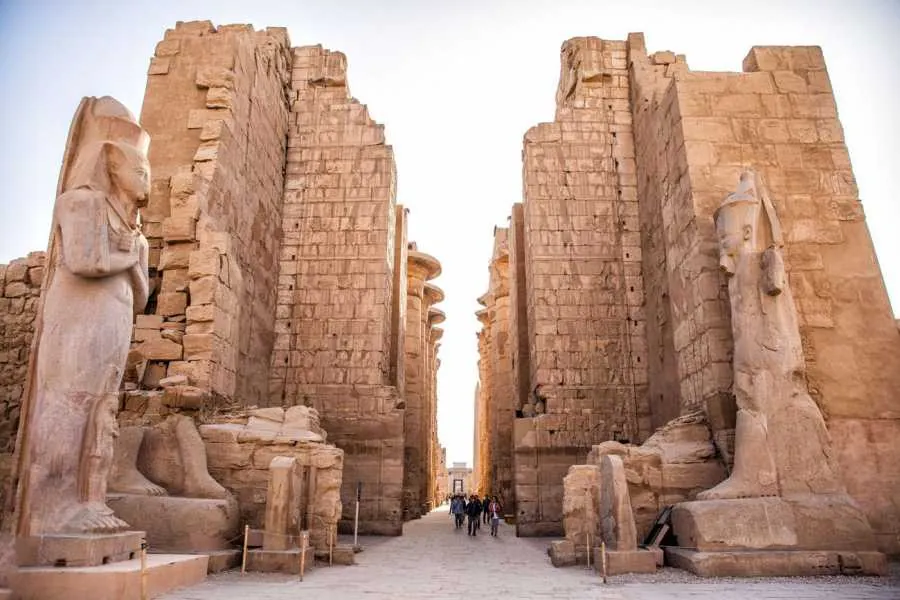
This is the classic pairing. Abydos, in Sohag Governorate, was the center of the cult of Osiris. Its Temple of Seti I, finished by Ramesses II, holds the Abydos King List, a carved roll call of earlier kings from the first rulers down to Seti’s time. Behind it lies the Osireion, a cenotaph for Seti built in the style of a royal tomb and now partly under water. Seeing Abydos’s New Kingdom carving and Dendera’s late temple in one day shows you more than a thousand years of Egyptian temple art.
Dendera with Luxor’s East Bank
If you start early, you can be back in Luxor by early afternoon. Rest through the heat, then visit Karnak Temple or Luxor Temple later in the day. You can also book the Karnak sound and light show (from $80 per person) for the evening.
Dendera as part of a temple trail
Dendera is one of the last great temples of ancient Egypt, much like Edfu Temple south of Luxor. In myth, Hathor of Dendera was closely tied to Horus of Edfu, and the two temples echo each other’s religious themes. Seeing both helps you compare how the Ptolemies built.
Visit Dendera with Delta Tours Egypt
Our Dendera and Abydos day tour from Luxor starts from $150 per person and covers both temples in one private day. If you want to see more of Luxor, you can pair it with our Luxor East and West Bank full-day tour (from $128 per person) or a sunrise Luxor hot air balloon ride (from $120 per person). Browse every option on our Luxor tours and excursions page, or read the Luxor travel guide to plan the rest of your stay.
Frequently Asked Questions
Is Dendera Temple worth visiting?
Yes, especially if you love painted interiors. It is among the best-preserved temples in Egypt, with its roof, staircases and crypts intact and its ceilings recently cleaned. It makes a good contrast to the ruined grandeur of Karnak.
How far is Dendera from Luxor?
About 60 km (37 miles) north of Luxor. Route planners estimate roughly an hour by car, but allow extra for traffic and checkpoints. Most travelers go by private car or on a guided day tour.
How much is the Dendera Temple ticket for foreigners?
The ministry’s official site listed EGP 300 for foreign adults and EGP 150 for students in October 2026. The roof and crypt each cost EGP 100 extra. Check before you go, as prices change.
Is the Dendera zodiac original?
No. The circular zodiac was removed in the early 1820s and taken to Paris. It has been in the Louvre since 1922, and a copy now sits in its place at Dendera.
Does the Dendera light show an ancient light bulb?
No. Egyptologists, guided by the captions carved beside it, identify a snake god, Harsomtus, rising from a lotus inside an oval container on a djed pillar. It is a religious image of birth and renewal.
Can I visit Dendera and Abydos in one day?
Yes, and it is the most popular way to see both. Start early from Luxor, and expect a full day. A private tour keeps the timing flexible.
Dendera rewards travelers who have already seen the big Luxor sites and want something quieter and better preserved. When you are ready to plan, explore our private Luxor day tours and we will help you fit Dendera into your trip.