Fayoum Oasis: Day Trip From Cairo Guide
A day trip to Fayoum Oasis takes you about 100 km southwest of Cairo into a green basin fed by a Nile canal, with a salt lake, Middle Kingdom pyramids, Greco-Roman towns and a desert valley full of fossil whales. In one long day you can cover Lake Qarun, a pottery village and either the archaeological sites or Wadi El Hitan. If you want all of it, plan an overnight stay.
This guide explains what Fayoum Oasis is, which sites are worth your time, how to build a realistic day from Cairo, what the official tickets cost, and what the UK travel advice says about the area.
| Quick facts | Details |
|---|---|
| Location | Faiyum Governorate, in a desert basin just west of the Nile Valley |
| Distance from Cairo | Fayoum city lies about 100 km (62 miles) southwest of Cairo; Wadi El Hitan is about 150 km (93 miles) southwest of Cairo |
| Main periods | Prehistoric lake settlements, 12th Dynasty pyramids (c. 1900–1800 BC), Ptolemaic and Roman farming towns |
| Main god | Sobek, the crocodile god, worshipped across the oasis |
| Natural sites | Lake Qarun Protected Area and Wadi El Rayan Protected Area, which contains the Wadi El Hitan World Heritage Site (listed 2005) |
| Time needed | Our planning suggestion: one full day for the lake, Tunis village and one cluster of sites; two days to add Wadi El Hitan and Wadi El Rayan without rushing |
| Site hours | Most archaeological sites 8:00 am to 5:00 pm; Kom Aushim Museum 9:00 am to 3:00 pm (official list, October 2026) |
What is Fayoum Oasis?
Fayoum is not a classic desert oasis watered by springs. It is a large natural hollow west of the Nile, and its fields are irrigated by the Bahr Yussef, a branch of the Nile that flows into the basin and then fans out into smaller canals. Drainage water collects at the lowest point in Lake Qarun, a salt lake whose surface sits about 43 m (141 ft) below sea level.
The basin covers somewhere between 1,270 and 1,700 square kilometers, depending on how its edge is measured. That makes it far bigger than most visitors expect. Farmland, villages and the city of Fayoum fill the center, while desert ridges, the lake shore and ruined towns ring the edges.
Why it matters in Egyptian history
Fayoum holds some of the earliest evidence of farming in Egypt. Its ancient lake, which the Greeks called Lake Moeris, was once much larger than Lake Qarun is today. Kings of the 12th Dynasty in the Middle Kingdom invested heavily here. They improved the water channels, used the lake as a reservoir and built their pyramids at Hawara and El Lahun at the mouth of the basin.
The capital, called Shedet by the Egyptians, was the main center of the crocodile god Sobek. The Greeks named it Crocodilopolis, and a sacred crocodile was kept in a temple pool there. Under Ptolemy II, the city was renamed Arsinoe, and new farming towns such as Karanis were laid out around the basin. In Roman times, Fayoum became one of the empire’s grain baskets.
Fayoum also gave its name to the Fayum mummy portraits. These lifelike faces were painted on wooden panels in hot wax and placed over the faces of mummies during the first three centuries AD. They are now spread across museums worldwide and form the richest body of portrait painting to survive from antiquity.
What to see in Fayoum, in a sensible order
The sites are scattered across a wide area, so the order matters more than at a single temple. The sequence below follows the road from Cairo into the northeast of the basin, around the lake and out to the southwest desert. Few people do all of it in one day.
1. Karanis and the Kom Aushim Museum
Karanis is the first major site you reach on the road from Cairo, in the northeast corner of the oasis at modern Kom Aushim. It was a farming town founded in the 3rd century BC under Ptolemy II and occupied until about the 7th century AD. Mud-brick houses, granaries and two limestone temples survive. The South Temple was dedicated under Nero to two crocodile gods, Pnepheros and Petesouchos.
The dry ground at Karanis preserved thousands of papyri, which is why archaeologists know so much about daily life here. The small Kom Aushim Museum at the entrance displays finds from excavations around Fayoum and is a useful first stop before you walk the site.
2. Lake Qarun
From Karanis the road drops toward the north shore of Lake Qarun. The lake is protected under Egyptian law and is listed as a Ramsar wetland. It is a wintering ground for many migrating water birds, including grebes, egrets and several kinds of ducks. Rising salt levels have pushed out most Nile fish, and local fishermen now catch introduced mullet and sole alongside tilapia.
Most visitors stop for a lakeside lunch or a short walk on the shore. Bring binoculars in winter if you enjoy birds.
3. Qasr Qarun temple
At the western end of the lake, about 44 km from Fayoum city, stands the Ptolemaic temple of Qasr Qarun. It was built for Sobek and later linked with Dionysus, and the town around it was called Dionysias from about 330 BC to AD 640. Each year around 21 December, the rising sun is reported to light up the inner sanctuary, and the event draws local crowds.
4. Tunis village
Tunis is a village on the slope above the southwest side of Lake Qarun, known for its glazed pottery workshops. It is a good place to watch potters at the wheel, buy a piece directly from a workshop and have a slow lunch in one of the guesthouses. The Ministry of Tourism and Antiquities has itself pointed to Tunis village as the best-known source of Fayoum handicrafts.
5. Wadi El Rayan
Southwest of the lake, the road enters the Wadi El Rayan Protected Area, declared in 1989. It covers about 1,758 square kilometers of desert, dunes and two man-made lakes fed by agricultural drainage. A short run of waterfalls links the upper and lower lakes, and they are often described as the largest waterfalls in Egypt. The protected area is also home to rare slender-horned gazelles, though you are unlikely to see one.
6. Wadi El Hitan (Valley of the Whales)
Wadi El Hitan sits inside the Wadi El Rayan Protected Area and is the reason many travelers come to Fayoum at all. UNESCO added it to the World Heritage List in 2005 for its hundreds of fossils of archaeoceti, early whales that still had small hind legs and feet. They date from the Middle Eocene, about 40 to 41 million years ago, when this desert lay under a shallow sea.
A marked public trail leads between partly exposed skeletons of the large Basilosaurus and the smaller Dorudon, with small shelters along the way. You will also see fossil shark teeth, a sawfish snout and sea shells scattered across the sand. The site is reached by a desert track, and visitors are kept to guided routes along the set trail to protect the fossils.
For pyramid fans: Hawara and El Lahun
Two Middle Kingdom pyramids stand at the eastern entrance to the basin. Hawara is the pyramid of Amenemhat III, built of mud brick around a stone core between the 19th and 18th centuries BC. Its vanished mortuary temple is thought to be the “Labyrinth” that Herodotus described. El Lahun is the pyramid of Senusret II, also mud brick, with the remains of a workers’ town nearby. Both look more like eroded hills than the smooth pyramids of Giza, but they show a later chapter in pyramid building that most visitors never see.
For more ruins: Medinet Madi
In the southwest of the oasis, Medinet Madi preserves a well-kept Middle Kingdom temple built for the cobra goddess Renenutet, the harvest goddess, under Amenemhat III and Amenemhat IV. Ptolemaic settlers later laid out a grid-plan town around it, with a long processional way running north to south. It is a long drive from the other sites, so it suits travelers who stay overnight.
How to plan a Fayoum Oasis day trip from Cairo
A single day forces a choice. You can either focus on archaeology or focus on the desert and fossils. Trying to do both usually means more time in the car than at the sites.
| Day plan | Main stops | Best for |
|---|---|---|
| Ancient Fayoum | Karanis and Kom Aushim Museum, Lake Qarun, Qasr Qarun, Tunis village | History lovers and first-time visitors |
| Desert and fossils | Lake Qarun, Wadi El Rayan waterfalls, Wadi El Hitan | Nature lovers, families with older children, photographers |
| Pyramid route | Hawara, El Lahun, Fayoum city waterwheels, Lake Qarun | Travelers who have already seen Giza, Saqqara and Dahshur |
| Two-day trip | Day one: Karanis, lake, Qasr Qarun, overnight near Tunis. Day two: Wadi El Rayan and Wadi El Hitan | Anyone who wants to see the oasis properly |
Getting there and travel time
Fayoum is reached by road from Cairo and Giza. Travel time depends on your starting point, traffic and which side of the oasis you visit first, so your driver or guide will confirm timing for your route. For Wadi El Hitan, plan on a vehicle suited to the desert track and a local guide. The UK government advises using a qualified guide and a Ministry of Interior permit for any off-road travel in Egypt.
Start early. Sites close in the late afternoon, and the drive back to Cairo is easier before the evening rush.
Fayoum ticket prices and opening hours
Each archaeological site in Fayoum sells its own ticket. The figures below are for foreign visitors, as listed on the official Ministry of Tourism and Antiquities ticket price list in October 2026; check before you go, as prices and hours can change.
| Site | Foreign adult | Foreign student | Hours |
|---|---|---|---|
| Karanis | EGP 150 | EGP 75 | 8:00 am – 5:00 pm |
| Kom Aushim Museum | EGP 100 | EGP 50 | 9:00 am – 3:00 pm |
| Qasr Qarun | EGP 150 | EGP 75 | 8:00 am – 5:00 pm |
| Hawara Pyramid | EGP 150 | EGP 75 | 8:00 am – 5:00 pm |
| El Lahun Pyramid | EGP 150 | EGP 75 | 8:00 am – 5:00 pm |
| Medinet Madi | EGP 120 | EGP 60 | 8:00 am – 5:00 pm |
Wadi El Rayan and Wadi El Hitan are nature protectorates managed by the Egyptian Environmental Affairs Agency, not by the antiquities ministry. We could not find a current official fee for them, so we do not list one here. Your guide will confirm entry costs when you book.
Best time to visit Fayoum
October to April is the most comfortable period. Days are mild, the desert sites are pleasant to walk, and winter is when migrating water birds gather on Lake Qarun. Summer days are hot, especially at Wadi El Hitan, where there is little shade along the trail. If you go in the warmer months, start at dawn and do the desert first.
For a month-by-month view of Egypt’s weather, see our guide to the best season to visit Egypt.
Is Fayoum safe to visit?
The UK Foreign, Commonwealth and Development Office advises against all but essential travel to most of the area west of the Nile Valley, but it lists the Faiyum Governorate as an exception, as checked on the FCDO Egypt travel advice in October 2026. That means Fayoum is outside the restricted zone. Advice can change, so check the current UK and US government pages before you travel. Our page on whether it is safe to travel to Egypt right now explains the wider picture.
Practical tips for your visit
- Bring cash in Egyptian pounds for entry tickets, pottery purchases and lunch.
- Wear closed shoes with grip for Wadi El Hitan and the uneven ground at Karanis and Hawara.
- Carry more water than you think you need, plus a hat and sunscreen. Shade is scarce at the desert sites.
- Stay on the marked paths at Wadi El Hitan and never touch or move fossils.
- Dress modestly in villages and in Fayoum city. Shoulders and knees covered is a good rule.
- Ask before photographing local people, and do not photograph children.
- Mobile signal can be weak in the desert protectorates, so agree on meeting times with your driver.
How to combine Fayoum with other sites near Cairo
Fayoum works well as a third or fourth day in Cairo, after you have covered the main sights. A few pairings make sense:
- The full pyramid story: see the Old Kingdom pyramids first on our All Pyramids in Giza day tour (from $105 per person), then visit Hawara and El Lahun to see how the Middle Kingdom kings built theirs. Our guide to the Bent and Red Pyramids at Dahshur covers the step in between.
- Saqqara first: the Saqqara visitor guide helps you plan the great necropolis south of Cairo, a natural partner for the Middle Kingdom pyramids at Fayoum.
- Museums: pair a Fayoum day with the Grand Egyptian Museum and pyramids tour (from $95 per person), or the shorter Pyramids Day Tour (from $55 per person).
- Sobek further south: if Fayoum’s crocodile god catches your interest, the Kom Ombo Temple on a Nile cruise is his best-known temple.
For a broader plan of the capital, read our Cairo travel guide or browse all Egypt day tours and excursions.
Visit Fayoum with Delta Tours Egypt
Delta Tours Egypt does not currently sell a fixed Fayoum tour. We can arrange a private Fayoum day trip or overnight visit on request through our tailor-made tours service, built around the sites you care about most. It can also be added to a Cairo stay such as our Taste of Egypt 4-day Cairo tour (from $535 per person). Tell us your dates and interests, and our Cairo team will suggest a route and confirm what is possible.
Frequently Asked Questions
Is Fayoum Oasis worth a day trip from Cairo?
Yes, if you have already seen the main Cairo and Giza sights. Fayoum shows a different side of Egypt: farmland, a large lake, Greco-Roman towns and fossil whales in the desert. It is quieter than the major monuments and gives a real sense of rural Egyptian life.
How far is Fayoum from Cairo?
Fayoum city is about 100 km (62 miles) southwest of Cairo. Wadi El Hitan is farther out, about 150 km (93 miles) southwest of Cairo. Your driver will confirm the travel time for your route on the day.
Can I visit Wadi El Hitan and the archaeological sites in one day?
It is possible but rushed, because the sites lie on opposite sides of the oasis and Wadi El Hitan is reached by a desert track. Most travelers enjoy Fayoum more by choosing one focus for a day trip, or by staying one night near Lake Qarun.
How much are tickets at the Fayoum sites?
Foreign adults pay EGP 150 each at Karanis, Qasr Qarun, Hawara and El Lahun, EGP 120 at Medinet Madi and EGP 100 at the Kom Aushim Museum, according to the official Ministry list in October 2026. Students pay half. The nature protectorates charge separately.
Is Fayoum included in travel warnings for the Western Desert?
No. The UK FCDO lists the Faiyum Governorate as an exception to its advice against all but essential travel in the Western Desert, as of October 2026. Always check the latest government advice before you go.
What is the best time of year to visit Fayoum?
October to April is best, with mild days for the desert sites and winter birdlife on Lake Qarun. In summer, start very early and avoid long walks at midday.
Fayoum rewards travelers who give it a full day or more. If you would like a private visit shaped around fossils, pyramids or village life, start with our tailor-made Egypt tours and we will plan it with you.
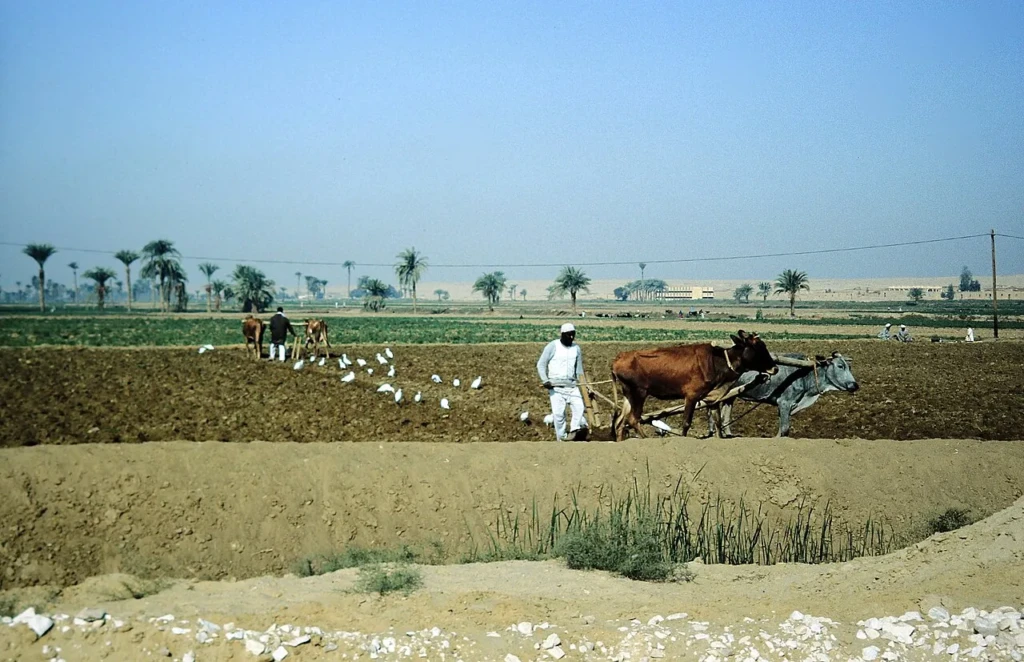
Featured image: Farmers ploughing fields in the Fayoum Oasis. Photo: Christian-wittmann-1964 / Wikimedia Commons, CC BY-SA 4.0