Dahabiya vs Nile Cruise: Which Is Worth It for Your Trip?
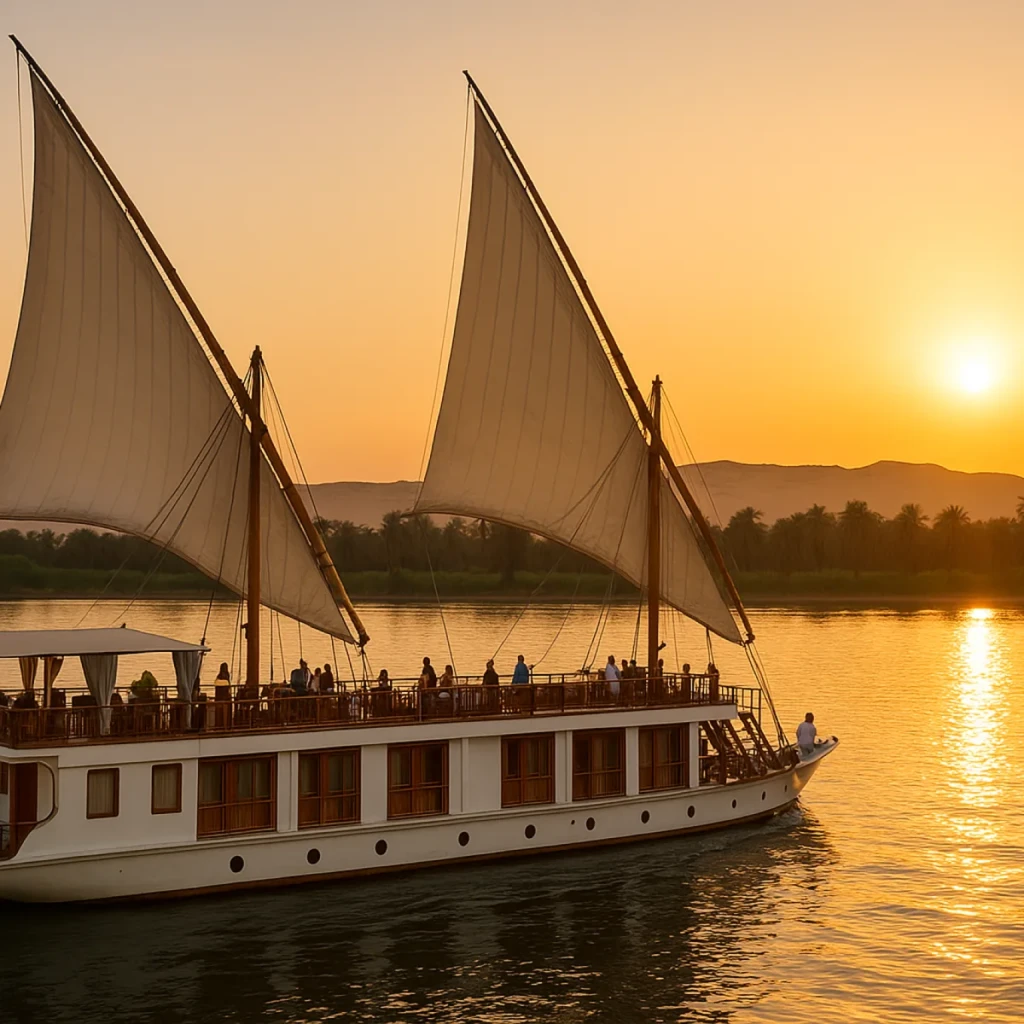
A dahabiya is a small sailing boat with roughly 7 to 13 cabins that takes five nights to travel from Esna to Aswan, with stops big ships cannot make. A standard Nile cruise ship carries 30 to 50-plus cabins, covers Luxor to Aswan in three or four nights, and costs much less. Choose the dahabiya for quiet, pace and privacy; choose the ship for value, facilities and a shorter schedule.
This guide sets the two side by side, explains where the real differences show up on the river, and uses our own current prices so you can see what the upgrade costs in dollars, not adjectives.
Dahabiya vs Nile Cruise Ship at a Glance
| Feature | Dahabiya | Standard Nile cruise ship |
|---|---|---|
| Size | About 50 to 55 meters long on the Nour El Nil boats | Larger multi-deck ships |
| Cabins | Roughly 7 to 13, depending on the boat | About 30 to 53 on the Sonesta fleet, for example |
| Route | Esna to Aswan, sailing south | Luxor to Aswan or Aswan to Luxor |
| Length | 5 nights, 6 days | 3 nights (from Aswan) or 4 nights (from Luxor) |
| Extra stops | El Kab, Gebel el-Silsila, islands and quiet riverbanks | Mainly Esna, Edfu and Kom Ombo |
| Propulsion | Sails, with a tug when the wind drops | Engine-powered |
| Facilities | Sun deck, lounge, small dining area | On some ships: spa, gym, bars, evening entertainment |
| Delta price | From $3,500 per person | From $790 per person on our most affordable ships |
| Best for | Couples, small groups, repeat visitors, slow travelers | First-timers, families, budget-aware and time-limited trips |
What Is a Dahabiya, Exactly?
A dahabiya is a flat-bottomed Nile passenger boat with two or more sails. The word comes from the Arabic for “gold,” after the gilded barges once used by Egypt’s rulers. Until the 1870s it was the normal way for foreign visitors to travel the Nile. Steamers, then trains, then large cruise ships pushed it aside.
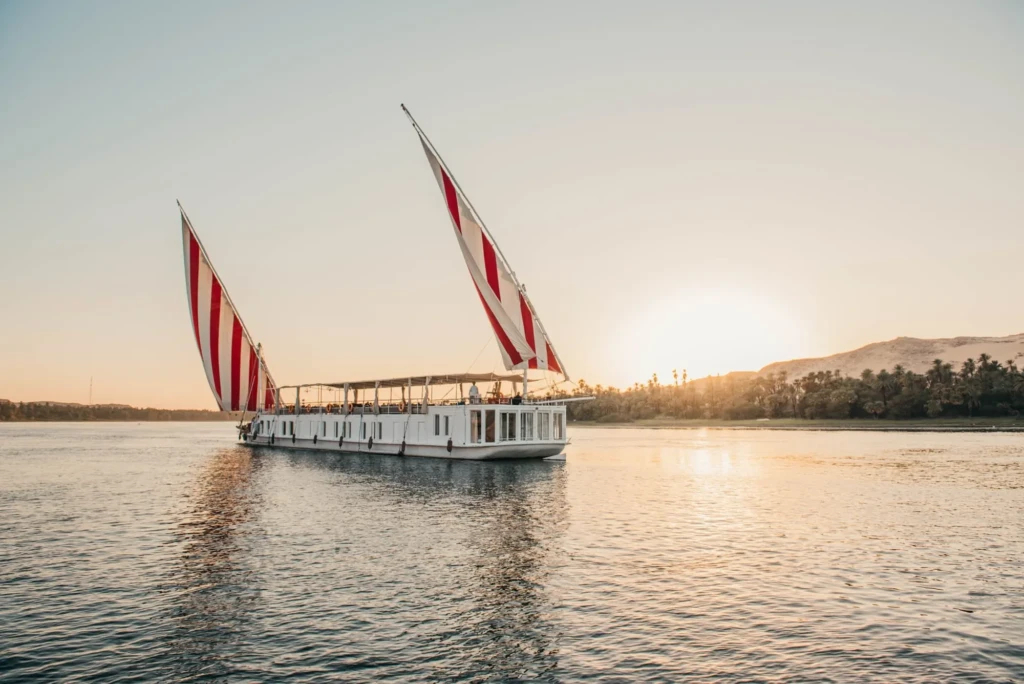
Today’s dahabiyas keep the old hull shape and rig but add private bathrooms and modern cabins. Wikipedia’s entry on the dahabeah notes that modern boats generally have no engine-driven propeller. They rely on the wind, are towed by a small tug when needed, and run a generator for electricity.
How big is a dahabiya?
The three dahabiyas we sell all come from the Nour El Nil fleet. On the operator’s own pages, Meroe measures 55 by 8.5 meters, Malouka 52 by 7.5 meters, and both have 10 rooms: two panoramic suites and eight cabins. Occupancy is limited to two guests per room, so a full boat carries about 20 people.
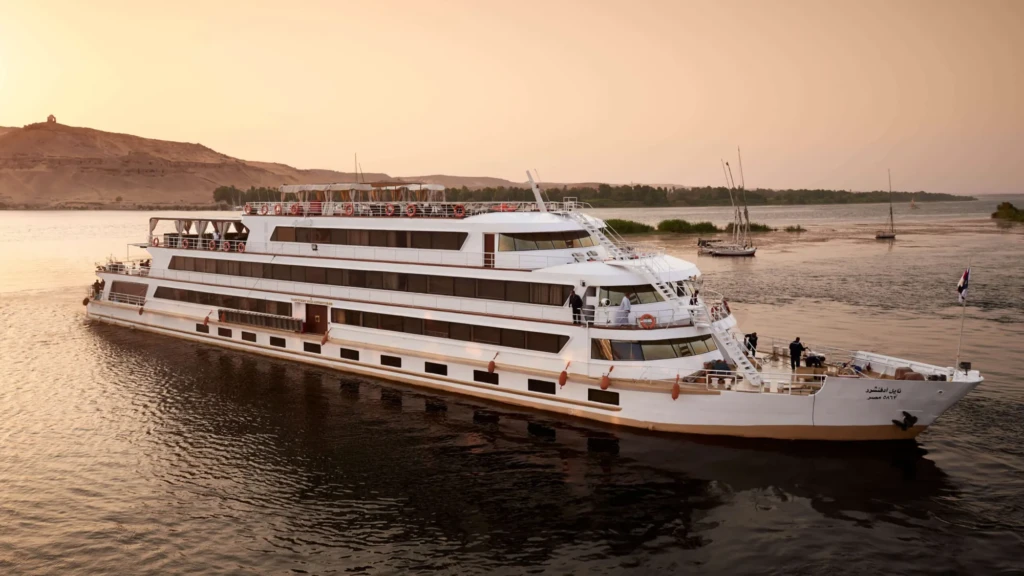
Other operators build in the same range. Sonesta’s Nile fleet page lists one dahabiya with 7 cabins and suites and another with 13. A standard Sonesta cruise ship on the same page has 30, 33 or 53 cabins and suites. That gap, roughly one-third to one-fifth the guest count, shapes everything else in this guide.
How the Routes and Schedules Compare
Both options cover the same stretch of river between Luxor and Aswan. The way they use the time is very different.
The standard cruise ship schedule
Sonesta’s published itinerary is typical of the big ships. The 4-night cruise boards in Luxor, covers Karnak, Luxor Temple and the West Bank, then sails south. It stops at Edfu and Kom Ombo and reaches Aswan for the High Dam, the granite quarries and Philae. The 3-night version runs the opposite way, from Aswan back to Luxor.
Because the ship docks in Luxor, the Luxor sightseeing sits inside the cruise. Our day-by-day Luxor to Aswan cruise itinerary walks through both versions.
The dahabiya schedule
Dahabiyas begin at Esna, about 33 miles south of Luxor, and sail south to Aswan over five nights. According to the Nour El Nil itinerary, the days run roughly like this:
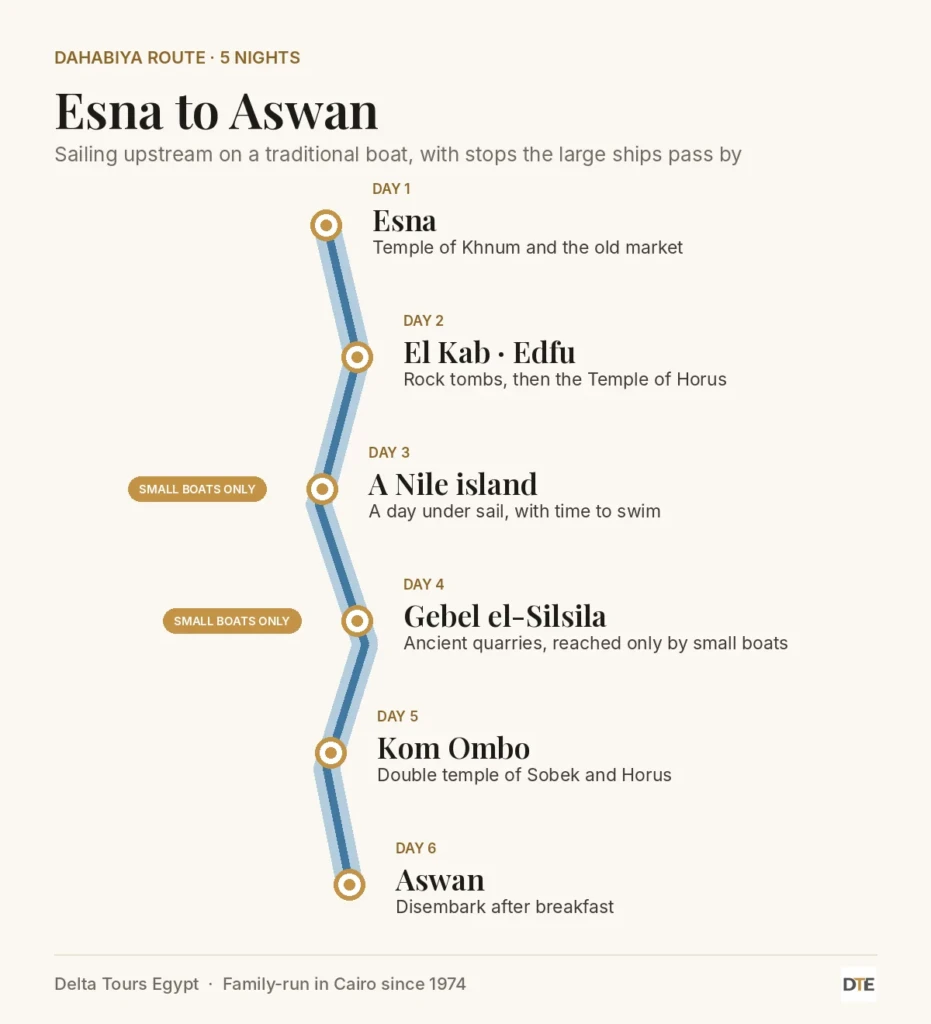
- Esna: boarding, then the Temple of Khnum, which sits below the level of the modern town.
- El Kab and Edfu: a walk through a fishing village to the El Kab tombs, then the Temple of Horus at Edfu. The night is spent at an island.
- A river day: sailing, a stop at a quiet bank for a walk or swim, and a desert walk at dusk. The boat moors below Gebel el-Silsila.
- Gebel el-Silsila: the rock-cut chapel of Horemheb and the ancient sandstone quarries, then more sailing.
- Kom Ombo: the double temple of Sobek and Haroeris and the Crocodile Museum.
- Aswan: the cruise ends in the morning.
The operator says river conditions and Nile authority rules can change the plan at short notice. It also notes that dahabiyas must spend the last night at a dock beside the Aswan bridge, which is less scenic than the other moorings.
Notice what is missing: the dahabiya does not include Luxor’s temples and tombs. If Luxor is new to you, you need extra nights there before boarding. That matters for both cost and total trip length.
What Can a Dahabiya Stop at That Big Ships Skip?
This is the main practical reason to choose a dahabiya. Two sites on the Nour El Nil route are not on the standard big-ship itinerary.
El Kab
El Kab is an ancient town and burial ground on the east bank between Esna and Edfu, and the home of a temple to the vulture goddess Nekhbet. Dahabiyas tie up at the bank, and guests reach the necropolis on foot through a fishing village. Big ships sail past it on their way to Edfu.
Gebel el-Silsila
Gebel el-Silsila is where the Nile narrows between sandstone cliffs. Egypt’s Ministry of Tourism and Antiquities describes more than a hundred quarries worked from the Middle Kingdom onward. It also lists the Speos of Horemheb, a rock-cut temple for seven deities, and 32 rock chapels cut for New Kingdom officials. Nour El Nil states that large cruise ships cannot stop here, and that dahabiya guests are often the only visitors on site.
The official Gebel el-Silsila page lists the site as open from 7:00 AM to 4:00 PM daily, with a foreign adult ticket of EGP 100, as listed in October 2026.
Islands and empty riverbanks
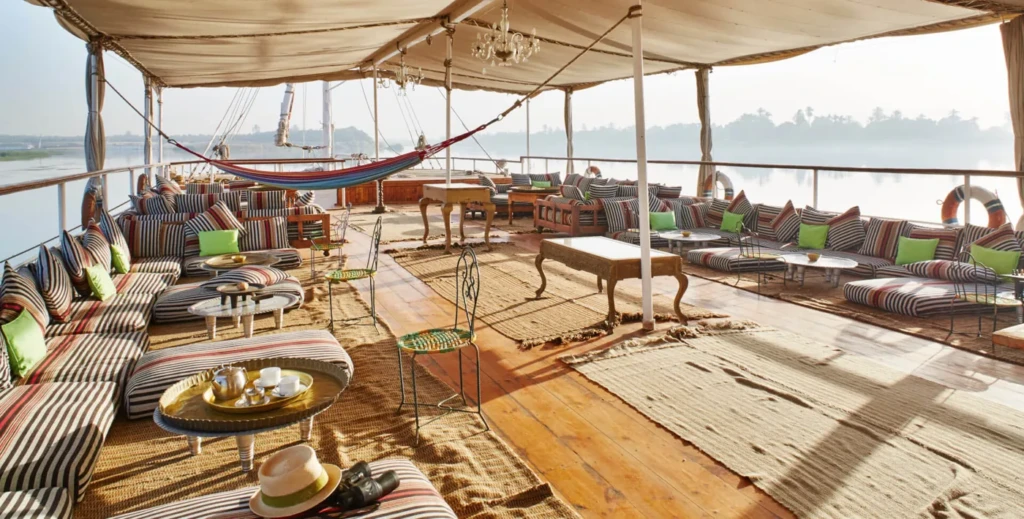
The rest of the difference is not a monument. A dahabiya can tie up at an island or a stretch of bank with nobody else around. Guests walk, swim where the crew says it is safe, or simply sit on deck. A ship’s schedule is built around the main temple towns, so its moorings follow the temples rather than the scenery.
Pace, Privacy and Life on Board
Pace
A dahabiya spends five nights on a journey a ship completes in three or four. Much of that extra time is spent sailing slowly with nothing scheduled. Some travelers find this the best part of their whole trip. Others get restless by day three. Be honest about which you are.
Privacy and social life
With about 20 guests, you get to know everyone on board. That can be a pleasure or a pressure, depending on the group. On a 50-cabin ship you can stay anonymous, choose your own table and skip the evening program.
If your party is large enough, a whole dahabiya can feel like a private boat. Ask us about availability for family or friends groups through our dahabiya Nile cruise page.
Food
Nour El Nil says its kitchens cook Egyptian dishes from produce bought daily from river farmers and fishermen. Nile perch and handmade falafel are among the examples it gives. On a large ship, the galley feeds far more people, so menus tend to be broader and less tied to the day’s market. Neither is better for everyone. Travelers who want familiar international choices often prefer the ship.
Facilities
A boat with about 10 rooms is built around its open deck, lounge and dining area. Do not expect the spas, gyms or bars of larger ships. Sonesta, for example, lists a full-service spa, fitness center, bars and nightly entertainment on its St. George ship. If a pool or gym matters to you, the ship wins.
Crowds at the Temples
Every standard cruise from Luxor to Aswan stops at Edfu and Kom Ombo, so these two temples receive ship passengers in large numbers. The dahabiya visits the same two temples, so it does not avoid them entirely. What changes is the share of your trip spent at busy sites.
On a ship, almost every stop is a major temple shared with other ships. On a dahabiya, El Kab, Gebel el-Silsila and the riverbank stops are quiet. Your guide may also be able to adjust timing at Edfu or Kom Ombo, since the boat carries so few people.
Price: What the Upgrade Really Costs
Here are our current “from” prices for the boats compared in this guide. All prices are per person.
| Boat | Type | Length | Price |
|---|---|---|---|
| Meroe Dahabiya | Dahabiya | 6 days / 5 nights | From $3,500 |
| Malouka Dahabiya | Dahabiya | 6 days / 5 nights | From $3,500 |
| Nour El Nil Dahabiya | Dahabiya | 6 days / 5 nights | From $3,500 |
| Sonesta Sun Goddess | All-suite cruise ship | 5 days | From $1,960 |
| Sonesta Moon Goddess | Cruise ship | 5 days | From $1,077 |
Our most affordable ships, such as Farida, Salima and Blue Shadow, start from $790 per person. At the top end, the Oberoi Philae is listed from $2,995 for a 5-day sailing, and Historia from $3,000.
Three points help put these numbers in context:
- Night for night, the dahabiya works out at about $700 per night at $3,500 for five nights. That is more than most ships, but in the same range as the most expensive ones.
- The dahabiya adds a night. You get five nights on the river instead of three or four, though you still need hotel nights in Luxor for that city’s sights.
- The real comparison is with ultra-luxury ships. If you were already looking at the top of our ultra deluxe Nile cruises, the dahabiya costs only modestly more.
If your budget points to a mid-range ship, the gap is large. A dahabiya costs roughly three times as much as the Moon Goddess. For a family of four, that difference can pay for several extra days elsewhere in Egypt.
Is a Dahabiya Worth It?
For the right traveler, yes. A dahabiya is worth the price if you value calm evenings, small groups and off-route sites more than facilities and value. It is probably not worth it if the cruise is just a way to get from Luxor to Aswan between the big sights.
A quick test: imagine an afternoon with no sightseeing, just sailing past fields and villages. If that sounds like a highlight, book the dahabiya. If it sounds like wasted time, book a ship and spend the savings on a day trip.
Who Should Choose Which?
Couples and honeymooners
The dahabiya suits couples well. Quiet moorings, small numbers and long evenings on deck are what most couples hope a Nile trip will feel like. Ask about the two panoramic suites when you book.
Families with children
Families usually do better on a ship. Prices for several travelers add up fast on a dahabiya. Ships also offer more space, more menu choice and, on some, a pool. A family that books a whole dahabiya is the exception, since the boat then becomes their own private space.
First-time visitors
Most first-timers should choose a ship. Its schedule includes Luxor’s main sites and the Aswan highlights, and the cost leaves room for Cairo and Abu Simbel. A dahabiya rewards travelers who already know what the major temples look like and want something different.
Travelers with limited mobility
Think carefully before booking a dahabiya. The El Kab visit involves a walk through a village, Gebel el-Silsila involves uneven ground, and riverbank moorings mean stepping ashore without a proper quay. Larger ships stop at the main temple towns, where access is usually simpler. Speak with us before booking either option, and we will check the specific boat.
Summer travelers
Nour El Nil does not sail from June to August because of the heat. If you are traveling in summer, a cruise ship with air-conditioned public areas is your only option. See our month-by-month guide to Nile cruise weather for help picking dates.
How to Fit Either Option Into a Full Egypt Trip
With a ship, a simple plan is Cairo first, a flight south, then the cruise between Luxor and Aswan. Our Nile river cruises page lists every ship we sell, from budget to ultra deluxe.
With a dahabiya, add at least two nights in Luxor before boarding at Esna. That gives you time for Karnak, Luxor Temple and the West Bank. After the cruise, Aswan is the natural base for Abu Simbel. Tell us your dates and we will check the departure for the boat you want.
Frequently Asked Questions
How many people are on a dahabiya?
Usually fewer than 30. The Nour El Nil boats we sell have 10 rooms with up to two guests each, so about 20 people. Sonesta lists dahabiyas with 7 and 13 cabins and suites.
Does a dahabiya really sail?
Yes, when there is wind. Modern dahabiyas generally have no propeller and are towed by a small tug when the wind drops or the schedule requires it. Expect a mix of the two on most trips.
Why does a dahabiya start in Esna instead of Luxor?
The published dahabiya route runs from Esna, about 33 miles south of Luxor, to Aswan. Starting there gives five nights to the river south of Luxor. You see Luxor’s sights before boarding, usually with hotel nights in the city.
Is a dahabiya good for a first trip to Egypt?
It can be, if budget and time allow. Most first-timers get better value from a standard ship, which covers Luxor, Edfu, Kom Ombo and Aswan in three or four nights. A dahabiya works best when you add Luxor hotel nights before it.
Can you get seasick on a Nile cruise or dahabiya?
The Nile is a river, not open sea, so there is no ocean swell. Motion on board is usually gentle. If you are very sensitive, bring what you normally use.
Can we book a whole dahabiya for our group?
Often, yes, subject to availability. Because the boats have only about 10 rooms, a family or group of friends can fill one. Contact us with your dates and group size for a quote.
Still deciding? Compare all three boats, their sailing dates and what each includes on our dahabiya Nile cruise page, and tell us how you like to travel. We will tell you honestly whether a dahabiya or a ship fits your trip better.