Valley of the Kings: Inside Egypt’s Royal Afterlife
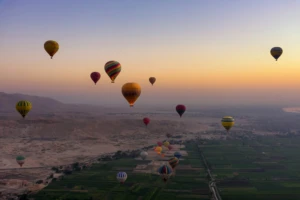
The road leaves Luxor’s riverbank almost without warning. One moment, there are palms, sugarcane fields, and villages gathered close to the Nile. Then the green narrows behind you, the air becomes drier, and the western cliffs rise ahead like a wall.
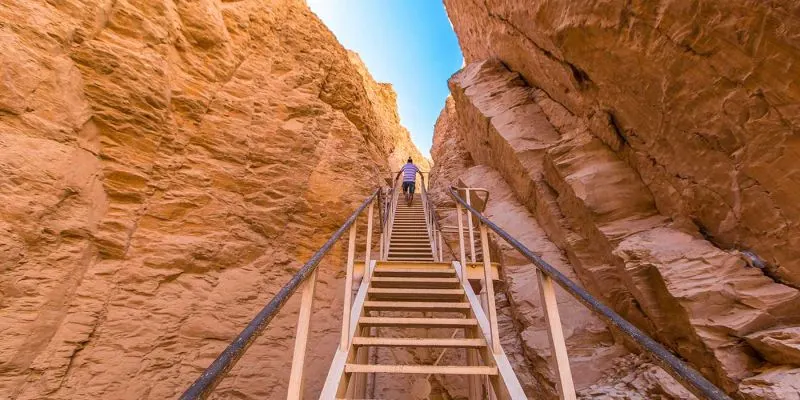
At first, the Valley of the Kings seems almost empty. There are no giant statues guarding its entrance, no forest of columns, and no pyramid announcing where a ruler was buried. There is only pale limestone, sharp sunlight, and a winding desert path disappearing between the hills.
That emptiness was the point.
More than 3,000 years ago, Egypt’s New Kingdom pharaohs stopped building conspicuous royal tombs in the form of pyramids. They turned instead to this remote valley on the west bank of ancient Thebes, modern Luxor, and ordered their burial places cut deep into the rock. The entrances were sealed. The paths were hidden. The king’s name, body, and treasures were meant to vanish from the world of the living.
But the real monument was never the barren landscape outside. It was the world waiting below.
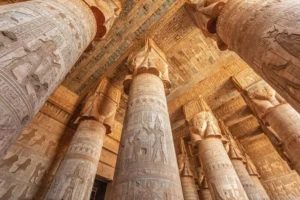
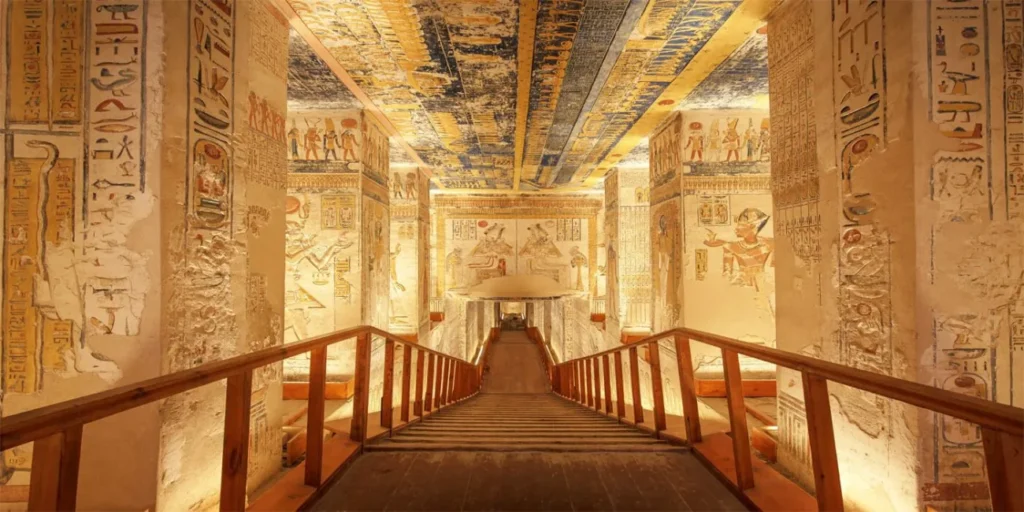
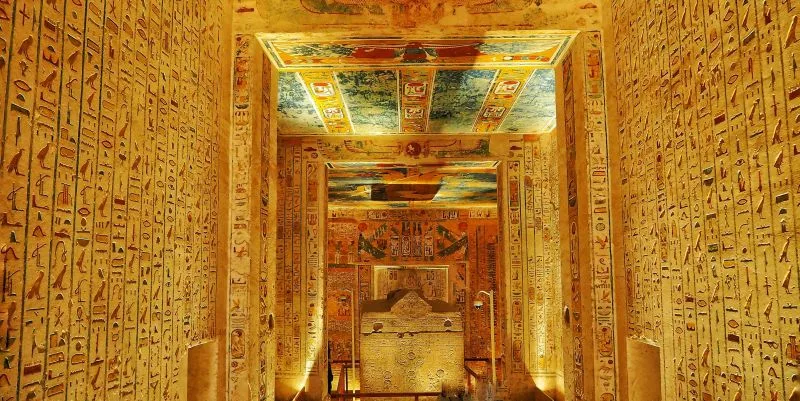
Walk down the sloping passage of a royal tomb and the desert falls away behind you. Painted gods appear along the walls. Stars spread across ceilings. Protective serpents, solar boats, gatekeepers, and sacred texts guide the dead king through the most dangerous hours of the night. Every corridor leads farther from daylight, yet every image promises that the sun—and the pharaoh—will rise again.
This is why a visit to the Valley of the Kings in Luxor feels different from seeing a temple. You are not simply entering an ancient building. You are following a carefully designed journey from death toward rebirth.
Where Is the Valley of the Kings?
The Valley of the Kings location is on Luxor’s West Bank, across the Nile from the modern city and behind the fertile plain. It forms part of the vast Theban Necropolis, the ceremonial “city of the dead” that also includes the Valley of the Queens, Deir el-Medina, Medinet Habu, and the mortuary temples of several pharaohs.
The royal burial ground is divided into two branches. Most of the famous tombs lie in the East Valley, which is where nearly every first-time visit takes place. The quieter West Valley contains fewer known tombs, including that of Ay, Tutankhamun’s successor.
Above both rises al-Qurn, a natural peak whose triangular outline resembles a pyramid. The resemblance is striking from certain angles, but the mountain was more than a convenient landmark. The western horizon was associated with death, the setting sun, and the realm of the dead, while the peak itself stood in a sacred landscape connected with the goddess Hathor.
The New Kingdom kings had found a place that was secluded, symbolically powerful, and watched over by a pyramid made not by human hands, but by the mountain itself.
Why the Pharaohs Left the Pyramids Behind
For centuries, Egypt’s rulers had made their immortality visible. The pyramids of the Old Kingdom towered above the desert, and later royal monuments still proclaimed the wealth and authority of the people buried within them. Yet a monumental tomb carried an obvious risk: it told thieves exactly where to look.
By the beginning of the New Kingdom, around 1550 BCE, the royal strategy had changed. The tomb would be separated from the mortuary temple where priests performed offerings for the king. The ceremonial temple could remain near the cultivated land, while the burial chamber disappeared into a guarded valley beyond it.
Thutmose I is generally regarded as the first confirmed New Kingdom ruler buried in the valley. Those who followed him transformed the cliffs into a royal necropolis used through the 18th, 19th, and 20th Dynasties. Tutankhamun, Seti I, Ramesses III, Ramesses IV, Ramesses VI, Ramesses IX, and many others were laid to rest here.
Today, the Valley of the Kings contains more than 60 known tombs as well as unfinished shafts and pits. Their archaeological labels begin with “KV,” meaning Kings’ Valley. KV62 is Tutankhamun. KV17 is Seti I. KV9 belongs to Ramesses V and Ramesses VI. These numbers reflect the modern order in which the monuments were catalogued, not the order in which their owners ruled.
The new hiding place did not defeat tomb robbers forever. Yet it produced something extraordinary: an underground archive of Egyptian religion, art, royal ambition, crime, restoration, and remembrance.
Before the Tombs, There Were People
It is easy to picture a pharaoh pointing at a cliff and commanding a tomb to appear. The truth was more human.
Across the ridge stood a purpose-built settlement now called Deir el-Medina. Its residents included stonecutters, draftsmen, painters, plasterers, scribes, and other specialists responsible for the royal tombs. They were not anonymous laborers dragged into the desert. They formed a skilled community, received state rations, raised families, worshipped local gods, filed complaints, told jokes, and recorded pieces of everyday life on limestone flakes and pottery fragments.
When a king came to the throne, work on his burial place could begin. Crews cut corridors into the limestone with simple metal tools and stone pounders. Rubble moved out in baskets. Plasterers prepared uneven surfaces, draftsmen placed grids and outlines, and artists filled the walls with color. Scribes monitored supplies and attendance.
One surviving episode even records what is often described as the earliest known organized labor strike. During the reign of Ramesses III, delayed rations pushed the royal tomb workers to stop work and demand what they were owed. Behind the divine kings and celestial imagery were people with families to feed.
Knowing their story changes the way you see the walls. A line of hieroglyphs is no longer just decoration. It is the trace of a hand steadied in lamplight, deep inside a mountain, creating eternity to a deadline no one could predict.
How a Royal Tomb Became a Path Through the Night
The tombs were not built to be admired by crowds. After burial, they were supposed to be closed, sealed, and left in darkness. Their paintings were made for the dead king and the gods.
Earlier New Kingdom tombs often followed turning or bent plans, while many later tombs developed straighter axes. Size, depth, decoration, and completion varied according to the ruler’s reign and the quality of the rock. A king who died unexpectedly might inherit an unfinished tomb, rush the decoration, or be buried somewhere not originally intended for him.
Despite those differences, the royal tomb often tells a recognizable story. The entrance descends from the world of daylight. Corridors carry scenes and sacred texts describing the sun god’s nightly passage through the underworld. Wells, pillared chambers, side rooms, and gates create transitions before the route reaches the burial chamber.
Texts known today as the Amduat, the Book of Gates, the Book of Caverns, the Litany of Re, and the Book of the Earth were more than illustrated books placed on a wall. They mapped an unseen universe. They named its beings, identified its dangers, and gave the king the knowledge needed to pass through it.
Look closely and the images begin to move. The sun travels in a boat. Deities pull it through darkness. Enemies threaten cosmic order. The dead king joins the gods, overcomes the night, and participates in the sunrise.
That is the emotional heart of the Valley of Kings. The deeper you walk into a tomb, the farther you appear to travel from life. In ancient Egyptian thought, however, you are also moving toward renewal.
When the Secret Valley Was No Longer Secret
The pharaohs chose the valley to resist robbery, but secrecy could not last for centuries. Tomb building required workers, officials, guards, supplies, and records. People knew the valley. Some knew its hiding places intimately.
Ancient thieves broke into many tombs, sometimes not long after a burial. They took portable wealth, stripped precious materials, and damaged royal bodies in their search for jewelry. Later, as central authority weakened, priests and officials moved several royal mummies to protected caches. Their actions deprived kings of their intended resting places but also saved many bodies from complete destruction.
By the time modern explorers entered the valley, the greatest treasures had usually disappeared. What survived was often scattered, damaged, or buried beneath debris. Even so, each cleared corridor added another chapter to the history of ancient Thebes.
Then, in 1922, a set of steps appeared beneath the sand.
The Morning King Tut’s Tomb Returned to the World
Howard Carter had spent years searching the valley for the burial place of Tutankhamun. Many believed there was little left to find. The valley had been excavated, mapped, disturbed, and searched by earlier teams. Carter’s patron, Lord Carnarvon, was close to ending the work.
On November 4, 1922, laborers uncovered the first step of a staircase near the tomb of Ramesses VI. More steps led downward to a sealed doorway bearing ancient impressions. Carter had the passage protected and sent for Carnarvon.
Weeks later, the team reached another sealed door. Carter opened a small breach and looked through by candlelight. As his eyes adjusted, the chamber beyond began to reveal gilded objects, carved animals, dismantled chariots, ceremonial beds, boxes, and shrines crowded into the darkness.
The discovery made Tutankhamun the most famous pharaoh in the world.
Yet King Tut’s tomb is not the valley’s largest or most elaborately painted. The young king ruled for only about a decade and died unexpectedly. His tomb, KV62, is unusually small for a royal burial, and only the burial chamber carries extensive wall decoration. Its importance comes from what survived: thousands of objects that showed, in astonishing detail, how a New Kingdom king had been equipped for eternity.
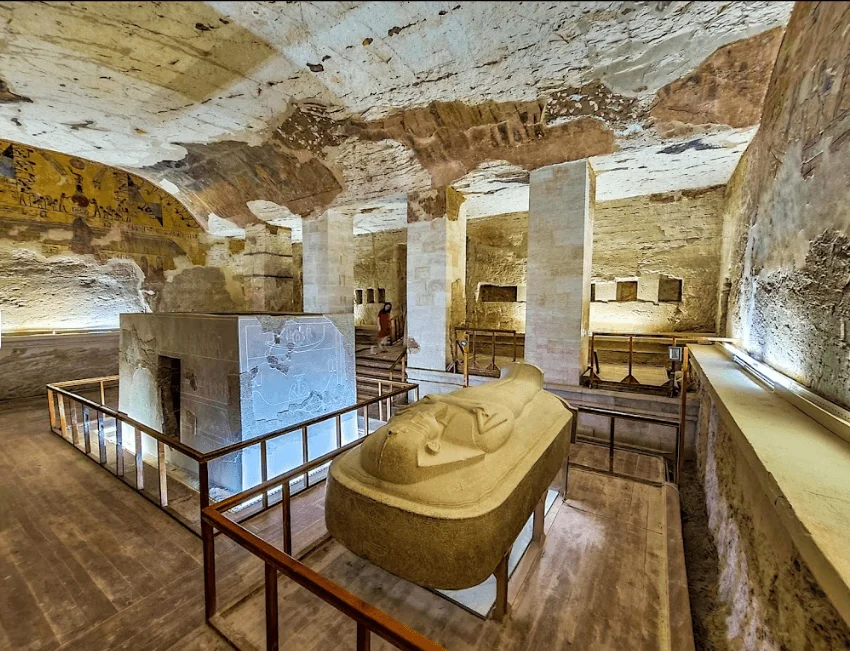
The famous treasures have been removed for preservation and museum display, but the tomb still has a powerful intimacy. You descend a short staircase, pass through compact spaces, and stand close to the place where Tutankhamun lay hidden for more than three millennia. His mummy remains in the tomb, while the stone sarcophagus and painted chamber restore a sense of scale that photographs of the gold mask cannot provide.
The so-called “curse of the pharaoh” grew through sensational newspaper stories after Carnarvon died in 1923. The legend is entertaining, but it obscures a better story: the painstaking recording, conservation, and study of a royal burial whose contents continue to reshape what we know about ancient Egypt.
What Does It Feel Like Inside a Tomb?
The experience begins with heat and brightness outside. You hand over your ticket, step beneath the rock, and start downward. The light changes first. Then the sound does. Voices soften in the enclosed passage, and the dry valley air gives way to the warmer stillness of the tomb.
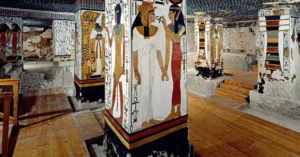
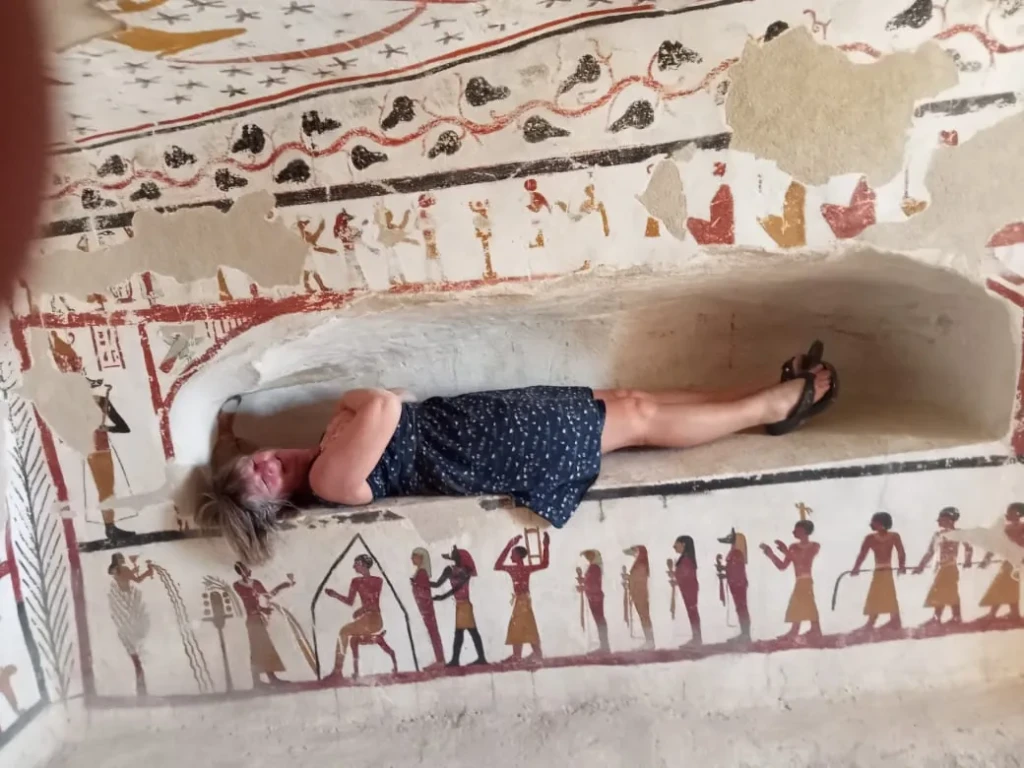
In one corridor, figures stand against a pale background as if painted yesterday. In another, yellow stars cover a deep blue ceiling. A serpent stretches across the wall. The sun god appears with the head of a ram. Rows of deities wait beside mysterious gates.
No two tombs create exactly the same feeling. Some are narrow and steep, pulling you toward a chamber far below. Others have broad corridors and decorations visible almost from the entrance. Some impress through color; others through scale, intricate carved relief, an astronomical ceiling, or an unexpected change in direction.
The real surprise is how alive the images remain. These chambers were created for death, but their subject is movement: boats sailing, gods speaking, doors opening, the sun returning.
The Best Tombs in the Valley of the Kings
The answer depends on what you want from the visit. Tombs open on a rotating basis for conservation, and some of the most famous require separate tickets. Rather than arriving with one rigid list, choose a combination of color, architecture, story, and physical accessibility from what is open that day.
| Tomb | Why it is memorable | Ticket note |
|---|---|---|
| KV2 — Ramesses IV | A broad, comparatively straightforward descent with vivid scenes and an impressive stone sarcophagus; often a good introduction to royal tomb imagery. | Usually part of the rotating standard selection when open. |
| KV6 — Ramesses IX | Rich color, detailed divine figures, and a dramatic astronomical burial chamber reached without one of the valley’s longest descents. | Usually part of the rotating standard selection when open. |
| KV11 — Ramesses III | Long corridors, unusual side chambers, and scenes that once earned it the name “Tomb of the Harpers.” | Usually part of the rotating standard selection when open. |
| KV14 — Tausret and Setnakht | An unusually long tomb shaped by two royal histories: Queen Tausret and the later pharaoh Setnakht. | Usually part of the rotating standard selection when open. |
| KV62 — Tutankhamun | Small and less extensively decorated, but unmatched for its discovery story and the presence of the young king’s mummy. | Requires a separate ticket. |
| KV9 — Ramesses V and VI | One of the most visually spectacular choices, with long painted corridors and a burial chamber beneath a vast astronomical ceiling. | Requires a separate ticket. |
| KV17 — Seti I | A masterpiece of carved and painted decoration, remarkable depth, and an almost complete religious program. | Requires a high-priced separate ticket. |
If this is your first visit and the rotation allows it, a balanced standard trio might include KV2 for its accessible layout, KV11 or KV14 for length and narrative variety, and KV6 for color. Add KV9 if you want the strongest visual impact for a moderate supplement. Add KV62 if standing in King Tut’s tomb matters more to you than seeing the valley’s most elaborate decoration. Choose KV17 when tomb art is a central reason for your trip and the extra cost fits your plans.
Openings can change without much notice, so treat any online list as a snapshot rather than a promise.
Valley of the Kings Tickets and Opening Hours
The practical details below were checked on September 19, 2026. Egypt’s admission prices and visiting arrangements can change, so confirm them on the official booking platform shortly before your visit.
| Visitor information | Current details |
|---|---|
| Opening hours | From 6:00 AM; last entry 5:00 PM in summer and 4:00 PM in winter |
| Standard foreign adult ticket | EGP 750 |
| Standard foreign student ticket | EGP 375 |
| Standard Egyptian adult ticket | EGP 60 |
| Standard Egyptian student ticket | EGP 30 |
| What the standard ticket covers | Entry to three tombs chosen from the standard tombs open that day |
| Tutankhamun, KV62 | Separate ticket; EGP 700 for a foreign adult at the time of checking |
| Seti I, KV17 | Separate ticket; EGP 2,000 at the time of checking |
| Ramesses V and VI, KV9 | Separate ticket; EGP 220 for a foreign adult at the time of checking |
The small electric tram between the visitor center and the main tomb area is generally ticketed separately. Buy every tomb supplement you want before taking the tram, as returning to the sales area wastes time. Payment procedures can change, so bring a working bank card as well as some Egyptian pounds for small personal expenses.
Student discounts normally require acceptable current identification. Do not assume that a photograph of a card will be accepted.
How to Choose Tickets Without Regretting Your Visit
The names on the ticket board can feel like a puzzle, especially when tour groups are arriving behind you. A simple plan helps.
First, look at the list of standard tombs open that morning. Choose three that give you contrast rather than three similar layouts. Next, decide what you value most among the premium tombs:
- Choose KV62, Tutankhamun, for historical emotion and the discovery story.
- Choose KV9, Ramesses V and VI, for color, scale, and one of the valley’s great ceilings.
- Choose KV17, Seti I, for the most ambitious artistic experience and a longer visit underground.
For many travelers, three standard tombs plus one premium tomb is satisfying. Visiting too many in quick succession can turn extraordinary chambers into a blur. The tombs also involve repeated descents and climbs, and the heat becomes more noticeable with every corridor.
When to Visit and How Long to Stay
The valley opens early for a reason. There is almost no natural shade between tombs, and the limestone reflects the sun. Arriving near 6:00 or 7:00 AM is especially valuable in warmer months. You gain cooler air, gentler light on the cliffs, and often a calmer first tomb before larger groups arrive.
Allow around two hours for three standard tombs at an unhurried pace. Add another 30 to 60 minutes if you include one or two premium tombs, and more if you want to study the signs or manage the visit slowly because of mobility concerns. A serious tomb enthusiast could spend three hours or longer.
Late afternoon can also be quieter, but do not arrive so late that the closing time forces you to rush. Tomb entrances may stop admitting visitors before the wider site fully clears.
A Morning on Luxor’s West Bank
The most rewarding half-day begins early at the Luxor Valley of the Kings, while the cliffs are still holding the night’s cooler air. Visit your three chosen tombs and one premium tomb if desired. Pause between them. Look back at al-Qurn and remember that this exposed, empty landscape was designed to conceal what lay beneath it.
From the valley, continue to the Temple of Hatshepsut at Deir el-Bahari. Its bright terraces create a powerful contrast with the hidden royal tombs: here, architecture announces itself openly against the cliffs. End at the Colossi of Memnon, the two seated guardians that once stood before the mortuary temple of Amenhotep III.
With a full day, add Medinet Habu, whose walls preserve dramatic reliefs from the reign of Ramesses III, or Deir el-Medina, where the people who created the royal tombs built beautifully painted tombs of their own.
Travelers beginning or ending a Nile River cruise in Luxor can fit the West Bank naturally into a wider journey through Upper Egypt. Those planning a longer private itinerary can also explore Egypt tours that connect Luxor with Cairo, Aswan, and Abu Simbel without compressing the valley into a hurried photo stop.
Practical Advice Before You Descend
Wear shoes with reliable grip
Tomb floors may include wooden ramps, stone steps, and sloping passages. Comfortable closed shoes are a better choice than loose sandals.
Carry water, but protect the tombs
Drink between visits and keep food and beverages out of decorated interiors. Never touch the walls. Skin oils, moisture, dust, and repeated contact all contribute to damage that cannot simply be repainted.
Plan for heat above and below ground
Use a hat and sunscreen outside. Inside, some tombs become warm and close, particularly when crowded. Move slowly and step out if you feel unwell.
Valley of the Kings Facts That Make the Visit Better
The tombs were never ordinary graves. They were ritual environments designed to help transform a dead ruler into an eternal being.
Tutankhamun was not the valley’s most powerful king. His fame comes largely from the survival and discovery of his burial, not from a long reign or vast empire.
Most royal treasures did not remain in place. Ancient robbery affected many tombs, and some royal mummies were deliberately relocated for protection.
The valley includes nonroyal burials. Although created principally for kings, some privileged nobles and royal family members were also buried there.
The walls were not painted for visitors. Much of the decoration was expected to remain unseen by living people after the tomb was sealed.
The site remains archaeologically active. Survey, excavation, conservation, documentation, and environmental monitoring continue to change what scholars know—and which tombs can safely open.
To see the Valley of the Kings with your own guide, look at our West Bank tour with the Temple of Hatshepsut, or the full-day Luxor East and West Banks tour. All our Luxor day tours are private.
Frequently Asked Questions
What is the Valley of the Kings?
The Valley of the Kings is a New Kingdom royal burial ground on Luxor’s West Bank. More than 60 known tombs and numerous unfinished features have been recorded there, including the tombs of Tutankhamun, Seti I, and several pharaohs named Ramesses.
Where is the Valley of the Kings in Egypt?
It lies in the desert hills west of the Nile at Luxor, in southern Egypt. The main visitor area is in the East Valley, behind the cultivated West Bank and beneath the peak of al-Qurn.
Who was buried in the Valley of the Kings?
Pharaohs of Egypt’s 18th, 19th, and 20th Dynasties were buried there, along with selected members of royal families and high-status individuals. Famous royal occupants include Tutankhamun, Thutmose III, Seti I, Ramesses III, Ramesses IV, Ramesses VI, and Ramesses IX. Ramesses II had a tomb in the valley as well, though it is not a standard visitor tomb.
Can you enter King Tut’s tomb?
Yes, King Tut tomb, KV62, is normally open with a separate ticket in addition to general Valley of the Kings admission. Access may be suspended for conservation or operational reasons, so confirm current availability before visiting.
Is Tutankhamun’s tomb worth the extra ticket?
It is worth it if the discovery story and seeing the young king’s burial place are priorities. It is a small tomb with less wall decoration than KV9 or KV17, so travelers seeking the most spectacular art may prefer a different premium tomb.
How many tombs can you enter with the standard ticket?
The standard ticket currently allows entry to three tombs selected from the rotating list open under general admission. Premium tombs require their own tickets.
Which Valley of the Kings tomb is the most beautiful?
Seti I’s KV17 is often regarded as the artistic masterpiece, while KV9, belonging to Ramesses V and VI, offers one of the most dramatic combinations of color, long corridors, and astronomical imagery. Beauty is subjective, and a quieter standard tomb can be just as moving.
Why are some tombs closed?
Closures protect fragile decoration, allow conservation work, manage humidity and visitor pressure, or address safety needs. Rotation is an essential part of preserving the valley.
Is the Valley of the Kings suitable for children?
Many children find the tombs exciting, but families should plan around heat, stairs, and short attention spans. Choose two or three visually distinct tombs, carry water for the outdoor sections, and turn the imagery into a story about the sun’s journey rather than trying to explain every inscription.
That is the memory the Valley of the Kings Luxor leaves behind. The pharaohs tried to hide their burials from the living, yet the worlds they created below the cliffs have made their hopes, fears, and names visible across thousands of years.
For travelers who want time to understand that story, Delta Tours Egypt can incorporate the valley into a private, tailor-made Luxor program with an Egyptologist guide and coordinated transportation. Explore Egypt luxury tours for a more personalized journey, or use the practical details in this guide to begin shaping your own morning on the West Bank.