Hatshepsut Temple: The Story Carved Into the Cliffs
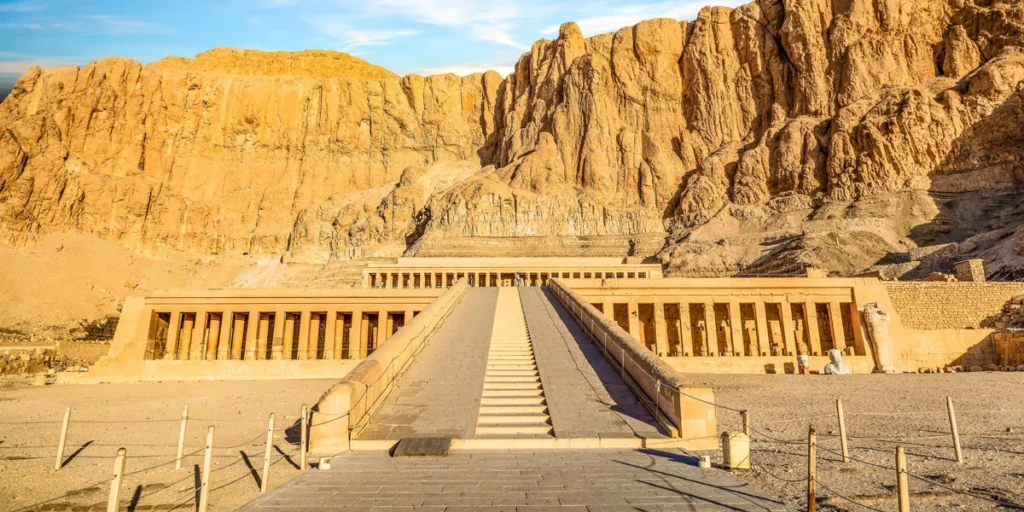
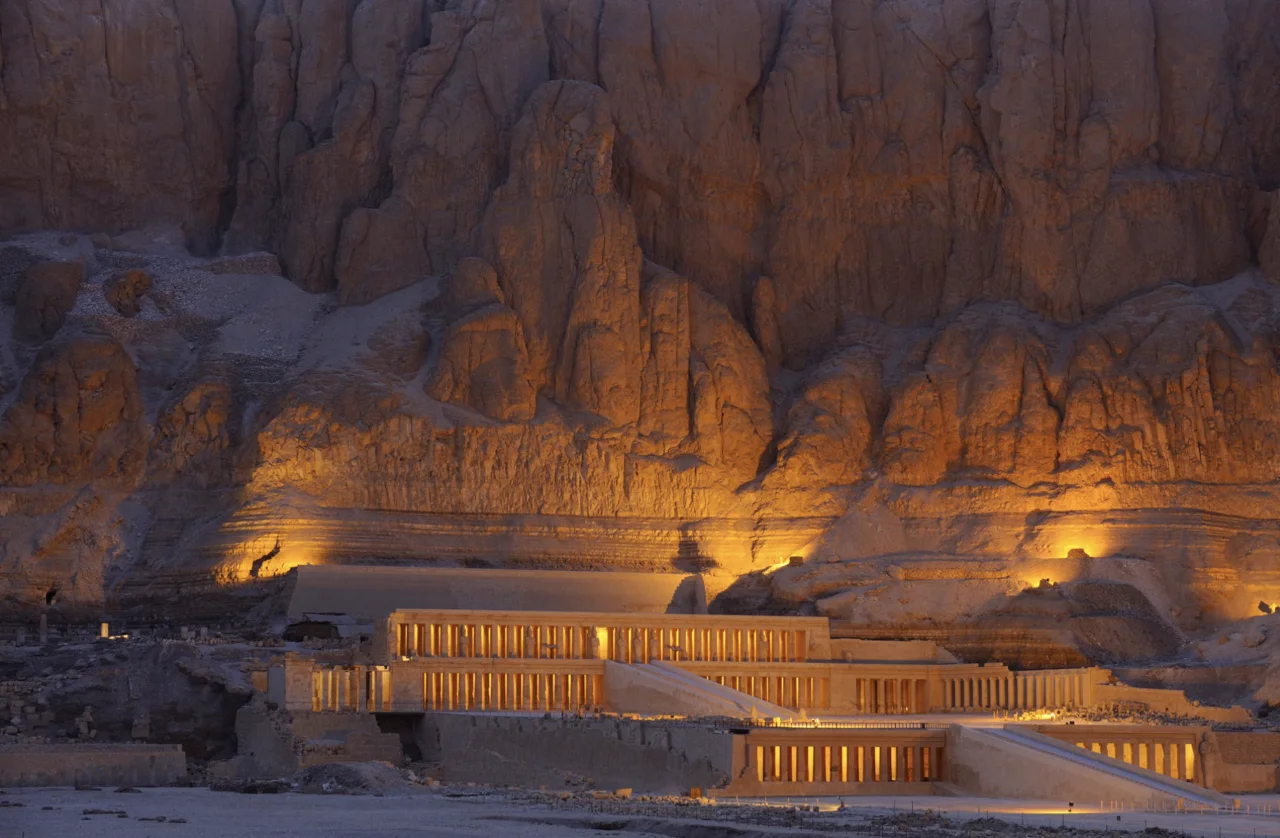
The road to Hatshepsut Temple leaves the green fields of Luxor’s West Bank and enters a landscape of pale stone. Ahead, the cliffs of Deir el-Bahari rise in enormous folds, their surface glowing gold, cream, and rose as the sun moves across them. At first, the temple almost disappears into the mountain. Then its straight lines come into focus: one terrace above another, long colonnades stretching across the rock, and a central ramp climbing toward the shadows.
Today, visitors walk across an exposed forecourt and raise their cameras toward one of the most famous façades in Egypt. More than 3,400 years ago, the approach was very different. A ceremonial causeway led from the edge of the cultivated land. Sphinxes watched the route. Gardens, pools, and trees brought color and fragrance into the desert. Priests carried sacred objects toward the terraces while the mountain, associated with the western realm of the dead, towered above them.
At the center of this entire vision stood a ruler whose life had broken the usual pattern of Egyptian kingship. Hatshepsut had begun as a king’s daughter, become a king’s wife, served as regent for a boy, and then taken the titles and authority of pharaoh for herself. Her temple was where architecture, religion, memory, and political ambition came together.
The story of Hatshepsut Temple is therefore not simply the story of a beautiful building. It is the story of how a woman claimed the throne, how she transformed a cliff-backed bay into her vision of eternity, how later generations attacked that vision, and how archaeologists slowly brought it back into the light.
Hatshepsut Temple at a Glance
| Visitor information | Quick answer |
|---|---|
| Location | Deir el-Bahari, in the Theban Necropolis on Luxor’s West Bank, near the Valley of the Kings |
| Built | During Hatshepsut’s joint reign with Thutmose III, approximately 1479–1458 BCE |
| Tickets | Foreign adults EGP 440, foreign students EGP 220 (official listing checked September 16, 2026) |
| Opening hours | From 6:00 AM; last entry 5:00 PM in summer and 4:00 PM in winter |
| Time needed | 90 minutes to two hours for a first visit |
| Best time | Early morning, close to opening |
| How to get there | Usually as part of a West Bank half-day with the Valley of the Kings and the Colossi of Memnon; a short site transfer may carry visitors from the ticket area toward the temple |
Before the Temple, There Was a Young King
Hatshepsut was born into Egypt’s 18th Dynasty, during the early New Kingdom, when Thebes was becoming the heart of a wealthy and increasingly powerful state. She was the daughter of Thutmose I and later married her half-brother, Thutmose II, following royal custom. As his principal wife, she occupied one of the most important positions in the court.
When Thutmose II died, the heir was not Hatshepsut’s daughter but a young son born to another woman. That child became Thutmose III. Because he was too young to rule alone, Hatshepsut initially acted as his regent, managing the affairs of the kingdom in his name. Royal women had served as regents before; what happened next was extraordinary.
Within several years, Hatshepsut adopted the complete royal titulary of an Egyptian king. She did not remove Thutmose III from the throne. The two were presented as co-rulers, although Hatshepsut held the senior position and exercised the full authority of kingship. Temple walls, statues, obelisks, and official texts began calling her Maatkare, her throne name, and depicting her in roles traditionally performed by a male pharaoh.
Modern writers sometimes describe this transformation as though Hatshepsut disguised herself as a man. That turns a complex act of statecraft into a costume story. Egyptians at court knew she was a woman. Her monuments could use feminine language, and some images preserved her feminine form. But kingship was an ancient sacred office expressed through a fixed visual vocabulary: crowns, kilts, ritual poses, broad shoulders, and the ceremonial false beard. To appear unmistakably as king, Hatshepsut gradually adopted that vocabulary.
A Place Chosen for Eternity
Across the Nile from the city of Thebes, the western desert was already filled with royal memory. Kings were buried in hidden valleys, nobles cut decorated tombs into the rock, and memorial temples stood between the cultivated fields and the mountains. Sunset made the west a natural symbol of death, though, like the sun, the deceased could pass through darkness and be renewed.
Hatshepsut selected Deir el-Bahari, a great natural bay in the cliffs, for her mortuary temple. The site was already sacred. Centuries earlier, Mentuhotep II—the king who reunified Egypt and inaugurated the Middle Kingdom—had built a terraced memorial complex there. By placing her own monument beside his, Hatshepsut connected herself with one of Egypt’s most celebrated restorers of order.
Her builders did not simply copy the earlier temple. They expanded the idea until it seemed inseparable from the landscape. They opened wide terraces, emphasized a straight processional axis, added sanctuaries for several gods, and created an enormous program of royal sculpture. The final building was called Djeser-Djeseru, commonly translated as “Holy of Holies.”
The Hatshepsut Temple location was significant for another reason. It faced toward the great religious world of Thebes. Across the river stood Karnak, the center of the cult of Amun-Re. During the Beautiful Festival of the Valley, the god’s portable barque left Karnak, crossed the Nile, and traveled among sacred places on the West Bank. Hatshepsut’s temple became one of the destinations in this ritual journey, designed not as an isolated memorial but as part of a living religious landscape.
Who Built Hatshepsut Temple?
The royal order came from Hatshepsut, but a monument of this scale required thousands of hands: quarry workers, hauling teams, architects, masons, sculptors, and painters who filled pale walls with red, blue, green, yellow, and black.
One official stands closest to the story: Senenmut, who rose to remarkable power during Hatshepsut’s reign. He served as chief steward, held responsibility for royal works, and was trusted with the education of Hatshepsut’s daughter Neferure. His name and image appear in unusual places connected with Djeser-Djeseru, suggesting that his role was far more than ceremonial.
For generations, travel guides have called him the architect of the temple. He probably directed or played a leading role in its construction, but the evidence does not name him as the sole designer in the modern sense. Other officials, including religious administrators and overseers of royal workshops, would have contributed to a project so deeply tied to Amun’s cult and the state.
The careful answer to “who built Hatshepsut Temple?” is therefore more than a single name: Hatshepsut commissioned it, Senenmut was probably one of its principal organizers, and the royal workshops of Egypt created it together. The essential parts of the temple were built during Hatshepsut’s joint reign with Thutmose III, probably in about fourteen to sixteen years. By the time Hatshepsut died around 1458 BCE, the central religious spaces were functioning, although some decoration remained incomplete.

The Lost Road to Djeser-Djeseru
Before the modern road, visitor center, and open forecourt existed, the journey began near the cultivation, where a valley temple received processions coming from the Nile. From there, a long causeway ran west toward the mountain. Sphinxes bearing the ruler’s image lined parts of the route, repeating Hatshepsut’s authority as the cliffs grew larger ahead.
The lower court was not the empty expanse visitors cross today. Trees and pools softened the desert. Archaeological evidence and temple inscriptions point to gardens that included exotic species brought from distant lands. Myrrh trees were especially important. Their fragrant resin was used in temple ritual, and living trees connected the monument with one of Hatshepsut’s proudest achievements: an expedition to Punt.
As a procession advanced, the temple unfolded gradually. The first ramp lifted the eye toward a colonnade. A second led to the upper façade, where colossal figures of Hatshepsut stood in the form of Osiris. Behind them lay a court, and beyond that court, a sanctuary cut into the mountain for Amun-Re.
The route moved from sunlight into shadow and from open space into increasingly sacred, restricted rooms. Ordinary visitors would never have wandered through the complex as modern travelers do. Priests and authorized officials carried out rituals in spaces arranged according to rank, purity, and religious purpose.
The First Terrace: Where the Desert Once Bloomed
Stand at the base of the central ramp and look up before climbing: long horizontal lines stretch across the foot of the cliff, and nothing competes with the mountain.
This first level once announced that Hatshepsut could bring order and abundance even to the edge of the desert. Reliefs along the colonnades connected the building with Egypt’s landscapes, rituals, and monumental works.
One surviving cycle showed the transport of obelisks toward Karnak. Hatshepsut erected great granite obelisks there, linking her reign with Amun’s most important temple. By including their journey at Deir el-Bahari, she tied the monument on the West Bank to her building program across the river.
Other scenes were damaged, dismantled, or lost over the centuries. The temple’s story survives in fragments: a leg, a crown, part of a ship, or a few columns of hieroglyphs may be all that remains of a once-complete scene. Archaeologists reconstruct the narrative by comparing fragments, inscriptions, parallel images, and the positions in which pieces were found.
The Voyage to Punt
On the middle terrace, ships sail across the wall: long, elegant vessels with high ends, rigging, oars, and crews shown in carefully ordered rows. Elsewhere in the sequence, Egyptians arrive in a foreign land. They meet local people, observe unfamiliar houses, record plants and animals, and load rare goods for the return journey. Among the cargo are incense products and living myrrh trees, their roots protected for transport. This is Hatshepsut’s expedition to Punt, one of the most famous narrative cycles in ancient Egyptian art.
Punt was not newly discovered by Hatshepsut. Egypt had traded with the region before her reign. What made her version exceptional was the scale and visibility of the account. The expedition became proof that the gods favored her rule and that distant lands opened their riches to Egypt under her authority.
The precise location of Punt remains debated. Most scholars place it somewhere around the southern Red Sea region, perhaps involving areas within or near modern Eritrea, eastern Sudan, Ethiopia, or neighboring territories. The reliefs contain valuable clues—vegetation, animals, products, architecture, and people—but they do not draw a modern political map.
The scenes should not be read as photographs. Egyptian artists arranged events to communicate meaning: the voyage followed divine instruction, valuable goods reached Amun’s temple, and order had extended beyond Egypt’s borders and returned carrying fragrance, wealth, and prestige. Yet the details—sailors pulling on ropes, cargo being measured, trees carried toward the ships—are so vivid that travelers often pause here longer than they expect.
A Birth Planned by a God
The divine-birth cycle begins with Amun. According to the temple narrative, the god takes the appearance of Hatshepsut’s father, Thutmose I, and visits her mother, Queen Ahmose. Amun announces that a royal child will be born. Khnum, the ram-headed creator god, fashions Hatshepsut and her spiritual double. Other gods attend the birth, protect the child, and prepare her for kingship.
To a modern reader, the sequence may sound like a miraculous biography. To an ancient audience, it was a statement about legitimacy. Egyptian kings were already understood as possessing a divine relationship. Hatshepsut’s walls made that relationship visible and explicit: she ruled not merely because political circumstances had placed her near the throne, but because Amun had intended her kingship before her birth.
The message did not replace her human ancestry. Other texts emphasized that Thutmose I had recognized her royal potential. The two claims worked together. Her earthly father connected her to the dynasty; her divine father connected her to the cosmic order.
This is royal propaganda, but it reveals how Egyptian kingship explained itself. A ruler maintained maat—the divinely ordered balance of the world—through ritual, temple building, justice, offerings, and defense. To present Hatshepsut as chosen by Amun was to present her reign as part of that order, and the divine-birth reliefs are one of the clearest surviving statements of how she wanted her authority understood.
Anubis in the Shadows
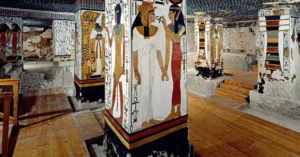
Away from the open portico, the Chapel of Anubis feels more intimate. Colors survive in protected areas, reminding visitors that the temple was never meant to be a world of bare beige stone.
Anubis, the jackal-headed god, was closely connected with embalming, cemeteries, and the protection of the dead. In his chapel, Hatshepsut appeared before the gods, performed offerings, and participated in rituals that joined royal identity with divine protection.
Look closely at the walls and another story emerges. Some images have been carved away. Other areas were patched or recut. A missing figure of Hatshepsut may belong to the campaign against her memory. A damaged image or name of Amun may come from the Amarna period, roughly a century later, when Akhenaten’s religious revolution targeted traditional gods. A later craftsman may then have restored part of the divine scene without restoring Hatshepsut.
This is why the temple becomes more compelling with an Egyptologist beside you. What looks like ordinary damage may distinguish one political attack from another, and a difference in relief depth can reveal a later restoration.
Hathor Comes Out of the Mountain
On the southern side of the temple, the Chapel of Hathor extends partly into the rock. Hathor belonged naturally in this landscape. In western Thebes, she could be imagined as a cow emerging from the cliffs, welcoming the dead and offering protection, nourishment, music, and renewal.
Her face appears on distinctive column capitals: human features, cow ears, and a heavy wig supporting a shrine-like form. Reliefs show sacred encounters and royal ritual.
Hathor had already been important at Deir el-Bahari before Hatshepsut’s temple was built. The neighboring complex of Mentuhotep II had its own strong connection with her cult. By placing a major Hathor sanctuary within Djeser-Djeseru, Hatshepsut’s builders respected the older holiness of the site while drawing it into a new royal program.
The chapel is sometimes hurried through by visitors eager to reach the upper terrace, yet its columns, surviving color, and rock-cut spaces reveal the temple’s character more intimately than the grand façade does.
The King Who Stood as Osiris
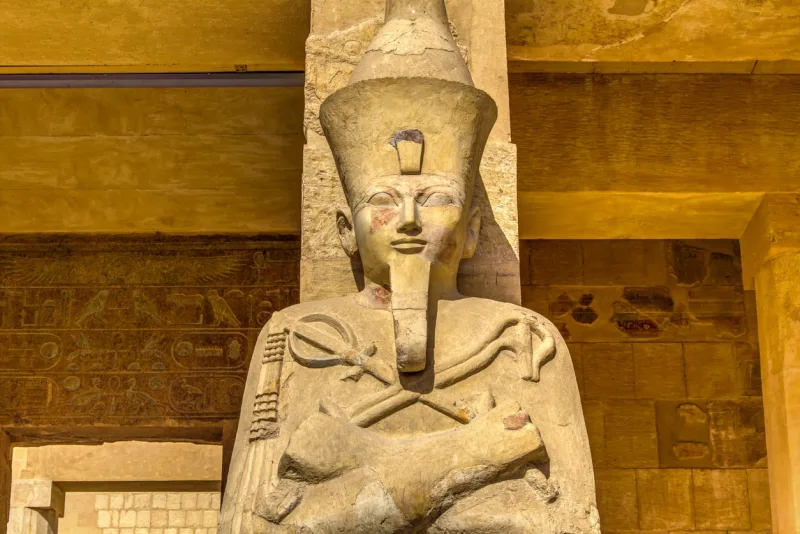
Across the upper portico, tall mummiform figures stand with crossed arms. They wear royal crowns and hold the emblems of authority. Their bodies are wrapped in the form of Osiris, the god who died, was restored, and ruled the afterlife.
These Osiride statues transformed Hatshepsut into an eternal king. They did not show her as a corpse. They joined her with the divine cycle of death and regeneration, promising that the royal cult would continue beyond her lifetime.
While much of the temple’s most sacred ritual occurred in small interior rooms, Hatshepsut’s kingship was displayed across the exterior in repeated colossal forms.
Many of the figures visible today are reconstructions made from ancient fragments. After Hatshepsut’s death, her statues were pulled down, broken, and discarded. Pieces later appeared in pits, construction fill, and areas around the neighboring causeways. Archaeologists and conservators spent decades identifying joins and returning surviving fragments to their architectural positions.
At the Heart of the Temple
The upper level gathered several sacred worlds together. Side rooms maintained the royal cults of Hatshepsut and her father, Thutmose I. A solar complex included an open-air altar where worship took place beneath the sun. Other spaces served offerings, festivals, and encounters with gods. But the central axis belonged to Amun-Re. At the far end of the court, a passage entered the living rock. The temple’s long approach—from valley edge to causeway, from gardens to terraces, from sunlight to shadow—ended in the god’s sanctuary inside the mountain.
This placement explains why calling the building merely the mortuary temple of Hatshepsut tells only part of its story. Hatshepsut’s posthumous cult was essential, but Amun occupied the architectural center. The god who legitimized her rule, whose temple she enriched at Karnak, and whose sacred barque crossed the Nile during festival was given pride of place.
Hatshepsut’s own offering chapel remained within the complex, as did a chapel for Thutmose I. She would receive offerings not as an isolated dead ruler, but as a king whose eternity was bound to Amun, the sun, Osiris, Hathor, Anubis, and the royal ancestors.
To understand what Hatshepsut intended, imagine priests reciting ritual words, incense burning, and the portable barque of Amun resting within the sanctuary after its journey from the Karnak Temple Complex. The temple was built to keep that world alive forever, but it did not happen as Hatshepsut planned.
The Attempt to Erase a King
Hatshepsut died around 1458 BCE. Thutmose III, who had shared the throne with her since childhood, continued as sole ruler and became one of Egypt’s most successful military kings. For years, Hatshepsut’s monuments remained standing.
Then, roughly two decades after her death, something changed. Her royal images were attacked. Cartouches containing her names were chiseled away. Statues at Deir el-Bahari were toppled and broken. In some scenes, her figure was replaced by an object or recarved as another ruler. Elsewhere, her name was substituted with that of Thutmose I, Thutmose II, or Thutmose III.
Early historians turned the destruction into a personal drama. Thutmose III, they argued, had hated his stepmother for taking power and finally avenged himself by trying to remove her from history.
The timing makes that simple revenge story difficult to sustain. If rage had driven the campaign, why wait about twenty years? Scholars now examine dynastic politics, royal succession, temple ritual, and the desire to present a conventional line of male kings. The erasures may have helped protect the succession of Thutmose III’s son or reshape the official record. Yet no surviving decree explains the motive, and research into the pattern of destruction continues.
Even the word “erasure” can make the process sound more complete than it was. Some images survived, some cartouches were only partly attacked, and divine elements within Hatshepsut’s names could be spared out of reverence.
Later generations added more layers of damage. During the Amarna period, images of Amun and other gods were hacked out. Ramesside restorers repaired some divine figures. Stone robbers carried blocks away. Rockfalls struck the complex. A Christian monastery eventually occupied part of the ruins, giving Deir el-Bahari its modern Arabic name, “Northern Monastery.” By the modern era, Hatshepsut’s perfectly ordered vision had become a vast field of fragments, but her name had not disappeared.
The Queen Returns From the Ruins
European and Egyptian scholars began clearing and documenting Deir el-Bahari during the 19th century. As hieroglyphs were deciphered, an unexpected problem emerged. Images that looked like a male king sometimes carried feminine language. Royal names had been replaced, but traces of an earlier identity remained. Gradually, Egyptologists recognized Hatshepsut—not simply as a queen beside a king, but as the king herself.
Excavations continued into the early 20th century. The Metropolitan Museum of Art worked around the forecourt and lower terraces and recovered masses of shattered royal sculpture. As fragments were joined, kneeling, seated, sphinx-shaped, and Osiride images of Hatshepsut emerged from the debris.
The work did not end with excavation. Since 1961, the Polish-Egyptian Archaeological and Conservation Mission has studied, stabilized, and reconstructed major areas of the temple. Relief blocks have been returned to their walls, statues rebuilt from surviving pieces, and chapels conserved. Every intervention has required a judgment about how much can be restored without disguising what is modern.
This is why the temple visitors see today looks far more complete than photographs from a century ago. Considerable ancient architecture and decoration survive, while carefully identified fragments have been reassembled to recover the original plan. Modern support is generally intended to remain distinguishable from ancient stone.
In 1979, Ancient Thebes with its Necropolis—including Hatshepsut’s funerary temple at Deir el-Bahari—was inscribed on UNESCO’s World Heritage List. Conservation continues because the monument is not frozen in time. Heat, rock movement, tourism, environmental change, and the fragile condition of ancient pigment all remain active concerns.
The Temple Is Not Hatshepsut’s Tomb
If this was her mortuary temple, was she buried inside it? No. The tomb of Hatshepsut and her temple were separate parts of the royal funerary landscape.
Her burial is associated with KV20 in the Valley of the Kings. The tomb descends through a long, curving series of corridors deep into the mountain and was connected with both Hatshepsut and her father, Thutmose I. It was meant to protect the royal burial, although it was entered and cleared in antiquity.
Djeser-Djeseru had a different purpose. It was the visible ceremonial place where priests made offerings, divine processions arrived, and Hatshepsut’s memory was maintained. The tomb hid the dead king; the temple made the eternal king present.
This separation became standard in the New Kingdom. Unlike Old Kingdom pyramid complexes, where tomb and cult temple belonged to one connected architectural ensemble, New Kingdom rulers placed their tombs in secluded valleys and their memorial temples closer to the cultivation and festival routes.
Walking the Temple Today
The modern visit begins far closer to the main building than the ancient procession did. A short site transfer may carry visitors from the ticket area toward the temple. The final approach remains exposed, giving the façade time to grow against the cliffs.
Do not begin by hurrying toward the ramp. Stop where the three levels can be seen together, then turn around and look east toward the cultivated valley: the temple makes more sense when viewed as a route between river and mountain.
On the middle terrace, move slowly between the Punt and divine-birth stories, the two halves of one royal message.
Enter the chapels when accessible and look for color in protected corners and ceilings. Then climb to the Osiride façade, where the scale changes and the king appears in eternal form.
In the upper court, the importance lies in the relationships among spaces: the solar altar open to the sky, the royal cult chapels at the side, and Amun’s sanctuary on the main axis.
Before descending, look outward again. The view back across the plain reconnects the terraces with the wider world of Thebes: Karnak and Luxor Temple on the East Bank, the royal tombs hidden behind the mountains, and the memorial temples scattered across the West Bank.
What Not to Miss
If time is limited, focus on the details that carry the story forward:
- The complete façade from the forecourt: the clearest view of the temple’s union with the cliffs.
- The Punt reliefs: ships, foreign landscapes, valuable cargo, and the living myrrh trees brought to Egypt.
- The divine-birth cycle: Hatshepsut’s claim that Amun had intended her kingship.
- The Chapel of Anubis: intimate scale, surviving color, and visible layers of erasure and restoration.
- The Hathor sanctuary: cow-eared capitals and architecture entering the mountain.
- The Osiride statues: Hatshepsut presented as an eternal, regenerated king.
- The upper court and Amun sanctuary: the religious heart of Djeser-Djeseru.
- The view back toward the Nile Valley: the best way to understand the monument within ancient Thebes.
A rushed visitor can photograph the façade in twenty minutes; a meaningful visit needs the time suggested below.
Hatshepsut Temple Tickets and Opening Hours
The following information was checked against Egypt’s official monuments portal on September 16, 2026. Prices, access, payment procedures, and schedules can change, so verify them again before traveling.
| Visitor information | Official listing checked September 16, 2026 |
|---|---|
| Opening hours | From 6:00 AM; last entry 5:00 PM in summer and 4:00 PM in winter |
| Foreign adult ticket | EGP 440 |
| Foreign student ticket | EGP 220 |
| Egyptian adult ticket | EGP 40 |
| Egyptian student ticket | EGP 20 |
Consult the official Hatshepsut Temple page and the official Egypt monuments ticket platform shortly before your visit. Student admission may require acceptable proof of eligibility. Individual rooms can close temporarily for conservation even when the site remains open.
When to Visit Hatshepsut Temple
The temple is most atmospheric early in the morning, when the cliffs are changing color and the heat has not yet settled into the forecourt. Arriving close to opening also helps you beat larger tour groups.
From October through April, sightseeing conditions are generally more comfortable. Winter mornings may feel cool until the sun reaches the stone, so wear light layers. During late spring and summer, the pale paving and high cliffs reflect intense heat; an early visit, water, a hat, and sun protection are essential.
Late afternoon can produce beautiful light, but it leaves less room for delays and room closures. Confirm the final admission time (see the table above) rather than assuming you can enter immediately before closing.
How Long to Spend at the Temple
Plan 90 minutes to two hours for a first visit. If you have only one hour, begin with the complete façade, then prioritize the Punt reliefs, divine-birth scenes, Osiride statues, and upper-court axis. Travelers interested in archaeology, royal iconography, or photography can easily spend two and a half hours examining the altered reliefs and restored architecture.
The temple is especially rewarding with a qualified Egyptologist, because the difference between an original scene, an ancient alteration, and a modern repair is rarely obvious without explanation.
What to Combine With Hatshepsut Temple
The most natural half-day route combines Djeser-Djeseru with the Valley of the Kings and the Colossi of Memnon. Together, they show where New Kingdom kings were buried and where their public cults were maintained.
For a fuller day, add Medinet Habu and one group of nobles’ tombs or Deir el-Medina. This adds the people behind the royal monuments.
Keep the East Bank for another day if possible; Karnak and Luxor Temple are large, complex sites that deserve their own time.
A carefully paced Nile River cruise can connect Thebes with Edfu, Kom Ombo, and Aswan, but check the cruise schedule carefully. Deir el-Bahari should not be compressed between embarkation and several other major monuments.
Frequently Asked Questions
Where is Hatshepsut Temple located?
At Deir el-Bahari on Luxor’s West Bank, beneath high limestone cliffs near the Valley of the Kings and beside the older temple of Mentuhotep II.
When was Hatshepsut Temple built?
The main temple was built during Hatshepsut’s joint reign with Thutmose III in the 15th century BCE, approximately 1479–1458 BCE. Its essential sections were probably completed in about fourteen to sixteen years.
Who built Hatshepsut Temple?
Hatshepsut commissioned the temple. Her chief steward Senenmut probably supervised or played a leading role in the project, but the monument was created by a large organization of officials, architects, quarry workers, masons, sculptors, and painters.
Why was the Temple of Hatshepsut built?
It maintained Hatshepsut’s royal cult after death, honored her father Thutmose I, housed important divine sanctuaries, and received Amun-Re during festival processions. Its architecture and reliefs also proclaimed Hatshepsut’s legitimacy as king.
Was Hatshepsut buried inside her temple?
No. Her royal burial is associated with tomb KV20 in the Valley of the Kings. The Hatshepsut mortuary temple was the visible ceremonial site where offerings, rituals, and divine festivals preserved her memory.
Why is Hatshepsut sometimes shown as a man?
She adopted the established visual conventions of Egyptian kingship, including the male royal body, kilt, crowns, and ceremonial beard. This was not a secret disguise; it presented her clearly within the traditional office of king.
Why did Thutmose III erase Hatshepsut?
The exact motive is still debated. The attacks began roughly twenty years after her death, making immediate personal revenge unlikely as a complete explanation. Dynastic succession and the desire to reshape the official royal line may have contributed.
Can visitors go inside Hatshepsut Temple?
Visitors can enter the publicly accessible terraces, porticoes, courts, and selected chapels or sanctuary areas. Particular rooms may close temporarily for conservation.
How much are Hatshepsut Temple tickets?
As checked on September 16, 2026, the official foreign admission was EGP 440 for adults and EGP 220 for students (Egyptians EGP 40 and EGP 20). Always confirm current prices before visiting.
What are the Hatshepsut Temple opening hours?
From 6:00 AM, with last entry at 5:00 PM in summer and 4:00 PM in winter (official schedule checked September 2026). Verify holiday arrangements on the official platform.
Is Hatshepsut Temple worth visiting?
Yes. It combines one of Egypt’s most dramatic architectural settings with an exceptional story of kingship, trade, religion, destruction, and rediscovery.
Let the Temple Tell Its Story
It is possible to visit Hatshepsut Temple quickly, but Djeser-Djeseru deserves more. A knowledgeable Egyptologist does more than identify figures; they reconnect the fragments until the building begins to speak again.
Delta Tours Egypt can include the temple within private, tailor-made Egypt tours with organized transport and professional Egyptologist guidance. Travelers seeking flexible pacing, private sightseeing, and refined accommodation can also explore luxury Egypt tours. Hatshepsut’s temple is also part of our private West Bank of the Nile tour with the Valley of the Kings, and of most Nile cruise itineraries; see our Luxor tours and excursions for the options. However you travel, give the temple enough time to reveal the woman behind the stone.
Hatshepsut built Djeser-Djeseru so that her name would live for eternity. For centuries, history almost denied her that wish. Then the cliffs gave her story back.