The Temple of Medinet Habu: Ramses III’s Monument of Power and Legacy
Medinet Habu is the mortuary temple of Ramesses III on Luxor’s West Bank, built around 1150 BC and enclosed by a fortress-like mud-brick wall. It is one of the best-preserved temples in Egypt, with deeply carved battle reliefs, ceilings and columns that still show their original color, and far fewer visitors than Karnak or the Valley of the Kings. Allow one and a half to two hours, ideally early in the morning or late in the afternoon.
This guide covers the temple’s history, what to see inside the enclosure, how it fits into a West Bank day, and practical tips for your visit.
Medinet Habu at a Glance
| Item | Details |
|---|---|
| What it is | Mortuary temple of Ramesses III, plus older and later temples inside one enclosure |
| Built | Reign of Ramesses III, about 1186 to 1155 BC (20th Dynasty) |
| Location | Southern end of the Theban necropolis, Luxor West Bank |
| Known for | Sea Peoples battle reliefs, colored ceilings, the fortified gatehouse |
| Time needed | 1.5 to 2 hours |
| Best time | Opening time or the last two hours before closing |
| Nearby | Colossi of Memnon, Deir el-Medina, Valley of the Queens |
History of the Temple of Ramesses III
Before Ramesses III
The site was sacred long before Ramesses III chose it. In the 18th Dynasty, Hatshepsut and Thutmose III built a small temple here to Amun. Local tradition linked the spot with the Ogdoad, the eight primeval gods of creation. Later kings kept adding to that small temple for over a thousand years.
Ramesses III and His Temple
Ramesses III was the second king of the 20th Dynasty and is often described as the last great ruler of the New Kingdom. He modeled his temple closely on the Ramesseum, the mortuary temple of Ramesses II nearby, and built it as the place where his cult would continue after his death. The complex also served as an administrative center for western Thebes, with storerooms, offices, priests’ houses and a royal palace inside its walls.
His reign was marked by war. Inscriptions at the temple record campaigns against the Libyans in his 5th and 11th years and, in his 8th year, a land and sea battle against the coalition known as the Sea Peoples, who were attacking Egypt and much of the eastern Mediterranean. His later years were less secure. Records show grain rations for the royal tomb workers failing, leading to what is often called the first recorded strike, and the king died after a palace conspiracy known as the harem conspiracy.
Later Centuries
Medinet Habu remained important after Ramesses III. Between the 8th and 6th centuries BC, chapels were built inside the enclosure for the God’s Wives of Amun, powerful priestesses who governed Thebes in the king’s name. In the Christian era a town called Djeme grew up around and inside the temple, and a church was built in the second court. The town was abandoned around the 9th century AD.
Since 1924, the Epigraphic Survey of the University of Chicago has been recording the temple’s reliefs and inscriptions, one of the longest-running projects in Egyptology. Its work is the reason the decoration here is so well documented.
What to See at Medinet Habu
The Fortified Gate
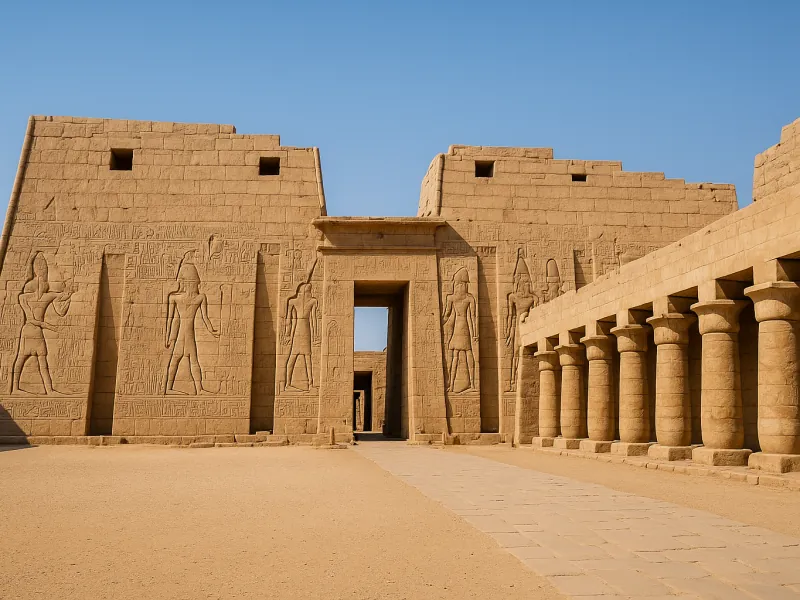
You enter through a tall stone gatehouse in the eastern wall, modeled on a Syrian fortress, often called the Migdol. The upper rooms show the king relaxing with women of the royal household, a rare private scene. Around the whole complex runs a massive mud-brick wall that once rose about 18 meters high.
The Small Temple of Amun
Just inside the gate on the right is the small 18th Dynasty temple begun by Hatshepsut and Thutmose III, with additions from much later rulers on its front. It is easy to miss but worth a few minutes.
The Chapels of the God’s Wives of Amun
To the left of the entrance stand the chapels of the God’s Wives, including Amenirdis I. They are small but well built, and they show how the site continued in use long after the New Kingdom.
The First Pylon and First Court
The massive first pylon is carved with huge scenes of Ramesses III striking his enemies before the god Amun. Through it, the first court has statues of the king in the form of Osiris along one side. On the left (south) side, the Window of Appearances connected the court to the royal palace, so the king could appear to reward officials.
The Palace
Behind the south side of the first court lie the low mud-brick remains of Ramesses III’s palace, with its throne room and the bases of columns. It was a ceremonial residence used when the king visited for festivals rather than a permanent home.
The Second Court
This is where most visitors stop and look up. The colonnades of the second court keep much of their original blue, red and yellow paint, and the reliefs show religious festivals, including the festival of the god Min. Scenes elsewhere in the temple show scribes counting the hands cut from defeated enemies, a grim record of how victories were tallied.
The Hypostyle Hall and Inner Rooms
Beyond the second court, the hypostyle hall has lost its roof and most of its columns, but the side rooms that held temple treasure and cult equipment keep fine painted reliefs. Look for the scenes of offerings stacked in rows.
The Outer Walls: the Sea Peoples Battle
Walk around the outside of the temple to the north wall. Here a series of scenes tells the story of the king’s wars, ending with the naval battle against the Sea Peoples: Egyptian archers firing from ships, enemy boats overturned, prisoners in feathered headdresses being led away. It is one of the most important historical images to survive from the ancient Near East. The south outer wall carries a long religious calendar listing the offerings due for each festival.
How Medinet Habu Fits a West Bank Day
Medinet Habu sits at the southern end of the West Bank, a few minutes’ drive from the Colossi of Memnon and close to the Valley of the Queens and the workers’ village of Deir el-Medina. That makes it easy to add to a standard day. A practical order is:
- Early morning: the Valley of the Kings, before the heat and the tour groups.
- Mid-morning: the Temple of Hatshepsut at Deir el-Bahari.
- Late morning: Medinet Habu, which is usually quieter by then.
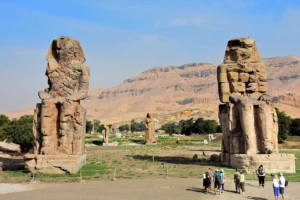
- On the way back: the Colossi of Memnon by the main road.
If you have a second West Bank day, pair Medinet Habu with the Valley of the Queens and Deir el-Medina, which are all in the same corner of the necropolis. Ramesses III’s own tomb is in the Valley of the Kings, so seeing both gives a complete picture of his reign.
Our private West Bank of the Nile tour covers the Valley of the Kings, the Temple of Hatshepsut and the Colossi of Memnon with your own Egyptologist; ask us to add Medinet Habu when you book. For a single full day in Luxor, the Luxor East and West Banks tour combines the West Bank with Karnak and Luxor Temple. You can see all our Luxor tours and excursions in one place.
Practical Tips for Visiting
- Timing: Arrive at opening time or in the late afternoon. Low light brings out the depth of the carvings, and temperatures are lower.
- Season: From May to September, West Bank afternoons are very hot. October to April is far more comfortable; see our best time to visit Egypt guide.
- Tickets: Medinet Habu needs its own ticket, separate from the Valley of the Kings. Prices change, so check the current rate before you go; if you add Medinet Habu to one of our tours, ask us to include its ticket in your quote.
- Shade and water: The courts are open to the sky. Bring water, a hat and sun protection.
- Footwear: Ground is uneven in the palace area and around the outer walls, so wear closed shoes.
- Go with a guide: The reliefs tell a sequence of stories that are hard to follow alone. An Egyptologist will show you where to look on the outer walls.
- See it from the air: Dawn hot air balloon flights take off on the West Bank and give an overview of the temples and the cultivated fields before you visit on foot.
- Add the Ramesseum: Ramesses III copied the plan of the Ramesseum, the temple of Ramesses II a short drive north. Seeing the ruined original and the well-preserved copy on the same morning makes the design easy to understand.
- Where to stay: West Bank hotels put you minutes from the temple; our guide on where to stay in Luxor compares both banks.
FAQ
What is Medinet Habu?
It is the mortuary temple of Ramesses III on Luxor’s West Bank, built around 1150 BC, together with older and later temples inside the same walled enclosure.
Why is Medinet Habu famous?
For its well-preserved painted reliefs and for the outer wall scenes of Ramesses III’s battle against the Sea Peoples.
How long do you need at Medinet Habu?
One and a half to two hours lets you see the gate, both courts, the palace and the outer walls without hurrying.
Is Medinet Habu worth visiting if I have seen Karnak?
Yes. It is smaller and more complete, the color is better preserved, and it is usually much quieter.
Is Medinet Habu included in the Valley of the Kings ticket?
No. It has a separate ticket.
Where is the tomb of Ramesses III?
In the Valley of the Kings. His mummy is now in the National Museum of Egyptian Civilization in Cairo.
Medinet Habu rewards travelers who give Luxor’s West Bank more than a rushed morning. Choose a day from our Luxor tours and excursions and ask us to include it.