Red Sea Egypt Travel Guide: Best Resorts, Beaches, Diving & Things to Do
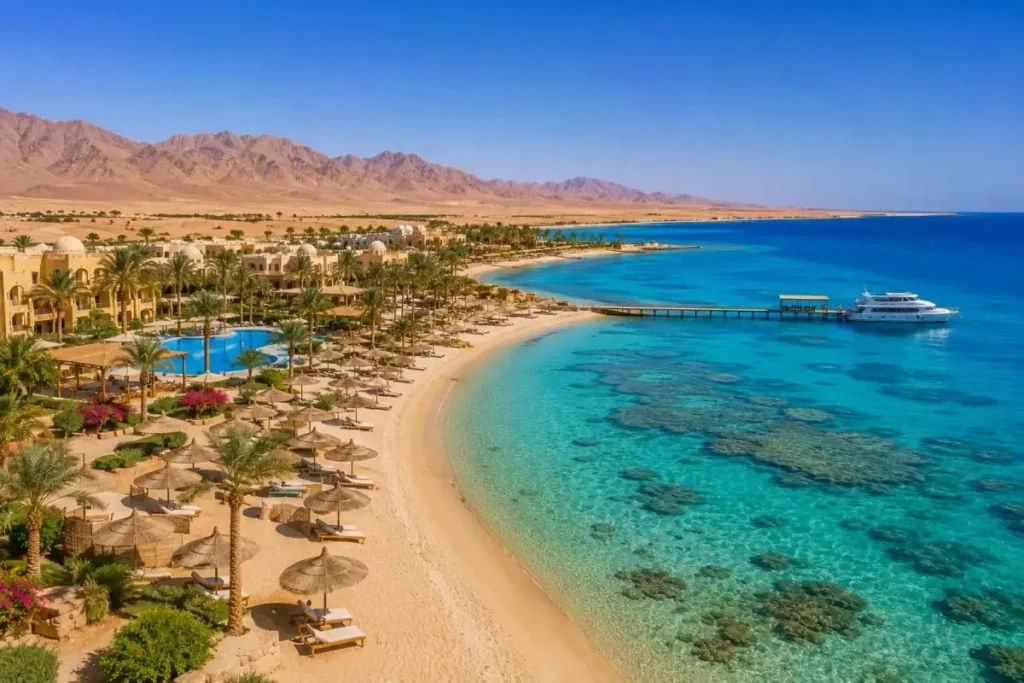
The first sight of Egypt’s Red Sea can feel almost unreal. On one side, the Eastern Desert rises in shades of copper and gold. On the other, clear blue water reveals coral gardens just below the surface. Between them are lively resort cities, quiet bays, fishing communities, desert mountains, mangroves, islands, and some of the world’s best-known diving sites.
Yet planning a Red Sea holiday is not as simple as choosing a hotel beside the water. Egypt’s coastline is long, and its destinations are remarkably different. Hurghada suits travelers who want convenience and variety. Sharm El Sheikh combines polished resorts with celebrated reefs. Dahab has a more independent rhythm. Marsa Alam rewards travelers who place nature and diving above nightlife. El Gouna and Soma Bay offer carefully designed resort environments, while Nuweiba and Taba exchange busy entertainment for space and mountain scenery.
This Red Sea Egypt travel guide explains where the sea is, how to read a map of the Red Sea, why it has its unusual name, which Egyptian resort best fits your trip, and what to expect from its beaches, snorkeling, diving, climate, and marine life. It also shows how to combine the coast with Cairo, Luxor, and a Nile cruise—often the most satisfying way to experience Egypt’s two defining landscapes.
Red Sea Egypt at a Glance
| Planning question | Quick answer |
|---|---|
| Where is the Red Sea? | Between northeastern Africa and the Arabian Peninsula; Egypt borders its northwestern side and both arms around Sinai. |
| Best all-round resort | Hurghada for access, hotels, excursions, and choice. |
| Best for famous dive sites | Sharm El Sheikh, Dahab, and the southern Red Sea around Marsa Alam. |
| Best for families | Hurghada, Makadi Bay, Soma Bay, El Gouna, and selected Sharm El Sheikh resorts. |
| Best for a quieter nature trip | Marsa Alam, El Quseir, Nuweiba, or Taba. |
| Best for independent travelers | Dahab and Hurghada town. |
| Best months for comfortable sightseeing | March–May and September–November, with regional differences. |
| Easy heritage combination | Luxor with Hurghada, Soma Bay, Safaga, El Quseir, or Marsa Alam. |
| Ideal stay | Four to seven nights for a dedicated beach break; longer when adding diving courses or an Egypt circuit. |
Where Is the Red Sea?
The Red Sea is a long, narrow inlet of the Indian Ocean separating northeastern Africa from the Arabian Peninsula. At its southern end, the Bab el-Mandeb Strait leads into the Gulf of Aden and onward to the Arabian Sea. At its northern end, the Sinai Peninsula divides the water into two arms: the Gulf of Suez to the west and the Gulf of Aqaba to the east. The Suez Canal links the Gulf of Suez with the Mediterranean.
Egypt occupies a strategic part of this geography. Its mainland Red Sea coast runs south from the Gulf of Suez past Ain Sokhna, Hurghada, Safaga, El Quseir, Marsa Alam, and onward toward the Sudanese border. Across the water, the Sinai coast follows the Gulf of Aqaba through Sharm El Sheikh, Dahab, Nuweiba, and Taba. In travel language, destinations on both the mainland coast and South Sinai are often grouped under the Egyptian Red Sea or Red Sea Riviera.
This distinction matters when planning. Hurghada and Marsa Alam are on Egypt’s African mainland, east of the Nile Valley. Sharm El Sheikh and Dahab are in Sinai, on the Asian side of the country. A traveler can therefore visit the Red Sea in Egypt without every resort being on the same shore—or even the same continent.
How to Read a Map of the Red Sea
If you search for a map of Red Sea destinations, begin with Sinai at the top. The Gulf of Suez forms Sinai’s western edge; the Gulf of Aqaba forms its eastern edge. Sharm El Sheikh sits near Sinai’s southern tip, between the two gulfs. Dahab, Nuweiba, and Taba continue north along the Gulf of Aqaba.
On the African side, Cairo lies inland and northwest of the principal resorts. Ain Sokhna is the closest major beach destination to Cairo. Farther south come El Gouna and Hurghada, followed by Sahl Hasheesh, Makadi Bay, Soma Bay, Safaga, El Quseir, Port Ghalib, and Marsa Alam. Luxor lies inland, west of the central mainland resorts, which is why a Luxor–Red Sea combination works so well.
Red Sea map: Egyptian destinations from north to south
| Coast | Destination order | What the position means for travelers |
|---|---|---|
| Gulf of Suez and mainland | Ain Sokhna → Ras Gharib area → El Gouna → Hurghada → Sahl Hasheesh → Makadi Bay → Soma Bay → Safaga → El Quseir → Port Ghalib → Marsa Alam → Hamata | Ain Sokhna is easiest from Cairo; Hurghada has the broadest infrastructure; reefs and wilderness generally become more prominent farther south. |
| South Sinai and Gulf of Aqaba | Sharm El Sheikh → Dahab → Nuweiba → Taba | Sharm has full-service resorts; Dahab favors diving and independent travel; Nuweiba and Taba are quieter and mountain-framed. |
When looking at the Red Sea on a map, do not judge transfer times by straight-line distance. Mountain ranges, protected areas, road routes, ferry availability, and flight schedules shape the practical journey. Sharm El Sheikh may look close to Hurghada across the water, for example, but they are separate resort regions and should not be treated as an effortless day trip. Confirm current flights, ferries, and road transfers before designing a multi-coast itinerary.
That answers the geographic question far better than a decorative map without travel hubs.
Why Is It Called the Red Sea?
Despite the name, the Red Sea normally appears blue, turquoise, or deep indigo. So why is it called the Red Sea? There is no single explanation accepted beyond doubt.
The most repeated theory connects the name to occasional blooms of Trichodesmium erythraeum, a cyanobacterium sometimes called sea sawdust. Under certain conditions, blooms may create reddish-brown patches on the surface. Another theory suggests that ancient cultures used colors to indicate cardinal directions, with red associated with the south. The English name also descends through ancient Greek and Latin traditions that referred to the Erythraean or Red Sea.
The accurate answer to “why called the Red Sea?” is therefore not that the water is permanently red. It is an ancient geographic name with several plausible natural and linguistic explanations. Travelers should be cautious of pages presenting the algae theory as settled fact.
What Makes the Egyptian Red Sea So Special?
The appeal begins with an unusual meeting of climate and geography. Very little freshwater drains into the Red Sea, rainfall is sparse, and evaporation is high. These conditions help make the water saltier than the open ocean. Limited sediment runoff also contributes to the clear water that divers and snorkelers value, although visibility still changes with wind, plankton, currents, and location.
Along much of the coast, fringing reefs grow close to shore. In other places, offshore islands, pinnacles, walls, and submerged reefs create different underwater environments. The official Egyptian tourism portal highlights more than 300 coral species and over 1,000 fish species in the Red Sea. Those figures describe the wider ecosystem, not a checklist any visitor will see on a single excursion.
The northern Red Sea, particularly the Gulf of Aqaba, is also scientifically important. Research has found unusually high heat tolerance among some corals there. That resilience does not make the reefs immune to climate change. Pollution, coastal construction, physical damage, warming, and poorly managed tourism can still degrade them. Their exceptional character is a reason for careful protection, not complacency.
Egypt has designated several Red Sea and Sinai protected areas. These include Ras Mohammed, Nabq, Abu Galum, Wadi El Gemal–Hamata, the Northern Red Sea Islands, and the Great Fringing Reefs protected area declared in 2025. Rules and access conditions vary, so visitors should follow park instructions and licensed operators rather than assuming every beach or reef can be used in the same way.
The Best Red Sea Destinations in Egypt
There is no universal “best” resort. The right answer depends on whether your priority is an easy family beach, sophisticated hotels, nightlife, shore snorkeling, advanced diving, wind sports, or quiet desert scenery.
Hurghada: the best all-round choice
For many first-time visitors, Red Sea Hurghada Egypt is the most practical starting point. Hurghada grew from a small coastal settlement into a large tourism center with an international airport, marinas, established dive operations, shopping, restaurants, and hotels at almost every price level. It offers the broadest range of experiences without requiring travelers to specialize in one type of holiday.
Hurghada town is not a single resort strip. El Dahar is the older district, with a more local urban character. Sekalla is busier and close to the marina, restaurants, and shops. The long hotel zone and nearby planned bays provide resort-style stays. This variety is useful: budget and solo travelers can stay near city services, while families and couples can choose self-contained beachfront properties.
Popular days on the water include snorkeling around the Giftun Islands area, beginner diving, private boat charters, and introductory water sports. The region also works for desert excursions and trips inland. Depending on route and traffic, Luxor is often reachable by a long road transfer, making Hurghada in Egypt one of the easiest places to pair temples with the sea.
The phrase Red Sea Egypt Hurghada covers very different experiences, so hotel selection matters. A lively central property, a quiet southern resort, and a diving-oriented hotel may all be sold as Hurghada while providing completely different holidays.
Best for: first visits, families, mixed-interest groups, value, nightlife, day boats, and Nile Valley combinations.
El Gouna: lagoons, marinas, and polished independence
North of Hurghada, El Gouna is a planned resort town built around lagoons, marinas, beaches, hotels, residences, restaurants, and activity centers. It suits travelers who want a refined environment but prefer moving between cafes, beaches, and neighborhoods instead of remaining inside one hotel.
Kitesurfing and sailing are major draws, while golf, spas, diving, and dining broaden the appeal. The town can work particularly well for couples, longer stays, and multi-generational families who appreciate organization and choice. It is generally more curated—and often more expensive—than central Hurghada.
Best for: upscale independent stays, couples, dining, marinas, kitesurfing, and long weekends.
Sahl Hasheesh, Makadi Bay, and Soma Bay: resort comfort
These purpose-built areas south of Hurghada offer a quieter alternative to the city. Their main advantage is convenience: beachfront hotels, pools, restaurants, family facilities, spas, and water-sports centers are concentrated within a managed resort setting.
Makadi Bay has a wide selection of family-oriented hotels and accessible holiday activities. Soma Bay is particularly associated with upscale properties, wellness, golf, diving, and wind sports. Sahl Hasheesh offers landscaped promenades and high-end resort environments close enough to Hurghada for airport access.
The tradeoff is that travelers seeking spontaneous street life or everyday Egyptian city atmosphere may find these enclaves less engaging than Hurghada town or Dahab.
Best for: families, couples, luxury stays, easy beach time, wellness, and travelers who value hotel facilities.
Safaga: diving, wind, and a quieter base
Safaga is a port town and diving base south of Hurghada. It has fewer entertainment options than Hurghada but gives experienced divers access to offshore sites and appeals to windsurfers and kitesurfers. Some resorts sit outside the working town, so check the precise location before booking.
Safaga’s relative proximity to the Qena–Luxor corridor also supports heritage combinations. It is a sensible choice for travelers who value water sports and a relaxed hotel over nightlife.
Best for: divers, wind sports, quieter resorts, and Luxor extensions.
El Quseir: history and house reefs
El Quseir is one of the coast’s most atmospheric towns, with layers of maritime history, an Ottoman-era fortress, traditional architecture, and older streets. Nearby hotels are often chosen for house-reef access and a slower pace.
The destination rewards travelers who want cultural texture alongside the sea. It does not provide Hurghada’s nightlife or shopping range, and some reefs require jetty access because coral platforms reach the shore.
Best for: repeat visitors, shore diving, history, tranquility, and couples.
Marsa Alam and Port Ghalib: nature and serious diving
Marsa Alam refers both to a town and a broad southern tourism region. Many hotels marketed under the name sit along a long stretch of coast rather than inside the town itself. Marsa Alam International Airport is near Port Ghalib, a marina development north of Marsa Alam town, so transfer time can vary substantially by hotel.
This region is known for reef-rich bays, desert-backed beaches, southern dive sites, and access to Wadi El Gemal–Hamata National Park. Abu Dabbab is associated with green turtles and occasional dugong sightings; neither encounter should be promised. Sha’ab Samadai, often marketed as Dolphin House, is managed to reduce pressure on spinner dolphins, and visitors must obey zoning and guide instructions.
Advanced offshore sites such as Elphinstone can involve current, depth, open-water conditions, and negative entries. They are not appropriate simply because a traveler holds an entry-level certification. Less experienced guests can still enjoy sheltered bays, house reefs, guided snorkeling, and beginner-friendly dives selected for the day’s conditions.
Best for: marine life, dedicated diving, quiet resorts, nature, repeat visitors, and longer stays.
Ain Sokhna: Cairo’s nearest major beach escape
Ain Sokhna lies on the Gulf of Suez and is the most convenient Red Sea resort zone for a short road trip from Cairo. It works well for a weekend, a night or two after sightseeing, or families who want a simple beach break without adding a domestic flight.
It is not the strongest choice for travelers building an entire trip around celebrated coral reefs or multiple dive sites. Think of Ain Sokhna as a convenient coastal pause rather than a substitute for Sharm El Sheikh or the southern Red Sea.
Best for: Cairo stopovers, short breaks, families, and travelers with limited time.
Sharm El Sheikh: resorts and iconic reefs
Sharm El Sheikh occupies the southern Sinai Peninsula, between Ras Mohammed National Park and the Nabq protected area. It combines international hotels, entertainment, restaurants, spas, and a mature diving industry. Naama Bay is lively and central; Ras Um Sid is known for reef access; Sharks Bay and Nabq have extensive resort options, though swimming conditions and jetty lengths differ by property.
Divers come for Ras Mohammed, the Straits of Tiran, local reefs, and boat excursions. The SS Thistlegorm is one of the region’s most famous wrecks, but the long boat journey, depth, current, penetration hazards, and diver traffic require an appropriate operator and experience level.
For non-divers, Sharm offers resort beaches, glass-bottom boats, snorkeling, desert landscapes, and access to wider Sinai excursions. Families should verify whether a chosen beach has a sandy, gradual entry; many hotels rely on a jetty over a shallow reef platform.
Best for: luxury resorts, nightlife, diving, mixed-interest couples, families, and fly-and-flop holidays.
Dahab: relaxed, independent, and shore-diving focused
Dahab lies north of Sharm El Sheikh on the Gulf of Aqaba. Its waterfront cafes, dive centers, smaller hotels, camps, and mountain views create a more informal atmosphere. Many dive sites are reached from shore, making it attractive to learners and experienced divers who want multiple days underwater without a boat-based schedule.
The Blue Hole is famous, but its reputation requires precision. Recreational divers can visit suitable areas around the outer reef under professional guidance. The deep underwater arch is a technical dive with a tragic accident history and is not a recreational challenge. Certification, gas planning, depth limits, and local rules must be respected.
Dahab also suits freediving, windsurfing, hiking, and travelers who enjoy arranging their days locally. It is less polished than Sharm and more social than an isolated resort.
Best for: solo travelers, divers, freedivers, budget-conscious visitors, cafes, and a relaxed pace.
Nuweiba and Taba: mountains, stillness, and simple beaches
Farther north along the Gulf of Aqaba, Nuweiba and Taba exchange large-scale resort energy for quieter shoreline and dramatic mountain views. Nuweiba has beach camps and simple lodgings as well as hotels; Taba includes resort zones and access to the far northeast of Sinai.
These destinations suit travelers who actively want stillness. Logistics, dining choice, and evening entertainment can be limited compared with Sharm or Hurghada. Always check current transport arrangements and official travel guidance before committing to remote itineraries.
Best for: seclusion, mountain scenery, simple stays, reading, swimming, and slow travel.
Which Red Sea Resort Is Right for You?
| Destination | Atmosphere | Strongest reasons to go | Consider before booking |
|---|---|---|---|
| Hurghada | Lively, varied, accessible | Choice, value, boats, families, nightlife | Hotel zones differ greatly |
| El Gouna | Polished, walkable, marina-led | Dining, kitesurfing, upscale independence | Usually higher prices |
| Makadi Bay/Soma Bay | Resort-focused, relaxed | Families, wellness, beach facilities | Limited local urban life |
| Safaga | Quiet, sport-oriented | Diving, wind sports, Luxor access | Fewer evening options |
| El Quseir | Historic, low-key | House reefs, heritage, tranquility | Smaller tourism scene |
| Marsa Alam | Nature-led, dispersed | Reefs, marine life, southern diving | Long transfers and fewer off-resort options |
| Sharm El Sheikh | Full-service, energetic | Iconic reefs, resorts, nightlife | Many beaches use jetties |
| Dahab | Informal, independent | Shore diving, solo travel, cafes | Fewer conventional resort luxuries |
| Nuweiba/Taba | Remote, scenic | Quiet beaches and mountains | Transport and services require planning |
| Ain Sokhna | Convenient, weekend-oriented | Fastest beach add-on from Cairo | Less compelling for a dive-focused week |
Red Sea Diving: What Divers Need to Know
Red Sea diving ranges from calm introductory sites to current-swept offshore reefs and deep wrecks. The destination name alone does not determine difficulty. Wind, waves, visibility, current, depth, boat entry, reef topography, and guide ratios can change the demands of a dive.
Beginners often do well with protected local reefs around Hurghada, Sharm El Sheikh, Dahab, and selected bays near Marsa Alam. Qualified divers seeking more demanding conditions can explore walls, wrecks, pinnacles, and offshore reef systems with an operator who reviews certification and recent experience.
Notable Egyptian Red Sea diving areas
| Area or site | Known for | Typical access | Planning note |
|---|---|---|---|
| Giftun and Hurghada reefs | Coral gardens, reef fish, varied local dives | Day boat | Many choices for mixed experience levels |
| Abu Nuhas | Multiple wrecks on a reef north of Hurghada | Day boat or liveaboard | Conditions and itinerary determine suitability |
| Ras Mohammed | Walls, reef systems, pelagic potential | Boat; some land access | Current can be significant |
| Straits of Tiran | Four major reefs and dramatic drop-offs | Boat from Sharm | Exposed conditions require judgment |
| SS Thistlegorm | Historic World War II wreck | Long day boat or liveaboard | Depth, current, overhead areas, and traffic add risk |
| Dahab local sites | Shore access, walls, canyon topography | Shore | Excellent variety; site choice must match training |
| Blue Hole, Dahab | Deep sinkhole and outer reef | Shore | The arch is technical, not recreational |
| Elphinstone Reef | Steep walls and pelagic encounters | Boat | Advanced conditions; sightings never guaranteed |
| Abu Dabbab | Seagrass, turtles, accessible bay reefs | Shore/boat | Dugong encounters are possible, not promised |
| Brothers/Daedalus offshore reefs | Walls, pelagics, remote diving | Liveaboard | Generally for experienced divers; rules may change |
| Fury Shoals/Hamata | Southern reef systems and lagoons | Day boat/liveaboard | Remote location favors dedicated dive trips |
Before diving in Red Sea waters, choose a recognized dive center, disclose your experience honestly, and ask about oxygen, emergency procedures, guide ratios, equipment maintenance, boat shade, water, and the nearest appropriate medical support. Divers should have insurance that explicitly covers their planned activity and depth. Avoid flying or traveling to altitude too soon after diving; follow the conservative guidance of your training agency and operator.
Never touch coral, stand on a reef, chase wildlife, or accept a guide’s invitation to exceed your certification. Good operators cancel or change sites when conditions deteriorate. That is professionalism, not a lost holiday opportunity.
Snorkeling, Swimming, and Beaches
You do not need scuba certification to enjoy the Egyptian Red Sea. Some of its most memorable views are available from the surface. House reefs can make snorkeling easy, but “beachfront” does not always mean a sandy swimming entry. In many areas, a shallow coral platform extends to a drop-off, and guests enter from a jetty.
When comparing hotels, ask five specific questions:
- Is there a sandy swimming area at low and high tide?
- Is reef access from the beach, a jetty, or a boat?
- How long is the jetty, and is it suitable for children or guests with limited mobility?
- Is the house reef supervised, and are flotation aids available?
- Does wind frequently restrict snorkeling at that location during your travel month?
Strong swimmers should not underestimate currents. Use a buddy, stay within marked zones, listen to lifeguards and guides, and wear a well-fitted flotation vest if appropriate. A rash guard protects skin from sun and reduces dependence on sunscreen; any sunscreen used should be applied well before entering the water and selected with reef impact in mind.
Abu Dabbab, Ras Mohammed, Ras Um Sid, Sharm El Naga, the Giftun area, and numerous hotel house reefs are widely known, but conditions are never identical from day to day. The “best” snorkeling site is the one that matches the current weather, swimmer ability, and conservation rules.
Marine Life You May See
The Red Sea supports coral gardens, butterflyfish, angelfish, surgeonfish, parrotfish, moray eels, rays, turtles, dolphins, and numerous other species. In selected offshore or southern areas, experienced divers may encounter reef sharks or oceanic whitetip sharks. Dugongs occur in the region’s seagrass habitats but are uncommon and vulnerable.
Wildlife language matters. No ethical company can guarantee dolphins, turtles, dugongs, manta rays, or sharks on a specific outing. Responsible guides keep distance, avoid surrounding animals, and prioritize natural behavior over photographs. If an encounter feels crowded or aggressive, step back rather than joining the pressure.
Seven simple rules for reef-safe travel
- Keep fins, hands, and equipment away from coral.
- Never stand on or collect pieces of reef, even if they appear dead.
- Do not feed fish or marine mammals.
- Secure cameras and gauges so they do not drag.
- Use mooring systems where provided rather than encouraging anchor damage.
- Take all waste back to shore and reduce single-use plastic.
- Choose operators that brief guests, respect protected areas, and limit wildlife disturbance.
Things to Do Beyond Diving and Snorkeling
The coast is more than an underwater destination. Wind conditions make El Gouna, Soma Bay, Safaga, Ras Sudr, and Dahab popular for kitesurfing and windsurfing. Sailing, kayaking, paddleboarding, glass-bottom boats, and private boat charters provide gentler ways onto the water.
The mountains and wadis behind the coast add a second landscape. Carefully managed desert trips may include hiking, stargazing, geology, and visits hosted by local communities. Choose experiences that pay residents fairly and present living Bedouin cultures with respect, rather than reducing them to a staged “tribal” attraction.
In the south, Wadi El Gemal protects marine and terrestrial environments and contains traces of ancient travel, mining, and settlement. El Quseir preserves a strong sense of maritime history. From the central coast, Luxor’s temples and tombs offer one of Egypt’s most dramatic sea-to-civilization journeys. From Sharm or Dahab, longer Sinai itineraries may include Saint Catherine’s region when current access and conditions permit.
Spa days, golf, restaurants, markets, marinas, and resort entertainment can fill the spaces between excursions. Families may prefer a glass-bottom boat or shallow lagoon to a full snorkeling day. A good Red Sea itinerary leaves room for weather changes and unplanned rest.
The Red Sea’s Long History
The coast may look timeless, but it has been part of intercontinental movement for thousands of years. Ancient Egyptian expeditions used Red Sea routes in connection with trade to Punt. Middle Kingdom activity at Mersa Gawasis provides archaeological evidence for seafaring from Egypt’s eastern shore.
During the Ptolemaic and Roman periods, ports such as Berenike linked the Mediterranean world with routes toward East Africa, Arabia, and the Indian Ocean. Goods, people, beliefs, and languages moved between the Nile and the sea along desert roads supported by wells and stations. El Quseir’s wider region also carries the memory of ancient and later ports serving trade and pilgrimage.
In the modern era, the opening of the Suez Canal in 1869 transformed global shipping by creating a direct navigable connection between the Mediterranean and Red Sea. Tourism later reshaped towns such as Hurghada and Sharm El Sheikh, particularly as recreational diving brought international attention to coral reefs that earlier generations knew through fishing, navigation, science, and trade.
This history explains why a Red Sea holiday belongs within a broader story of Egypt. The coast is not an appendix to the Nile Valley; it is another route through which Egypt has faced the wider world.
Best Time to Visit the Red Sea in Egypt
The Red Sea can be visited throughout the year, but “year-round destination” does not mean every month feels the same. Air and water conditions vary between northern Sinai and the southern mainland, and wind can matter as much as temperature.
| Season | General character | Best suited to | Watch for |
|---|---|---|---|
| December–February | Mild days; cooler evenings; cooler water in the north | Winter sun, sightseeing, diving with suitable exposure protection | Wind, chilly boat rides, short daylight, cooler pools |
| March–May | Warming air and water; generally comfortable | Mixed beach and heritage trips, families, active travel | Spring wind and occasional heat spikes |
| June–August | Very hot on land; warm water | Resort relaxation, experienced heat-tolerant travelers, diving-focused schedules | Intense midday sun, dehydration, hot desert excursions |
| September–November | Warm sea; gradually milder air | Diving, snorkeling, beach stays, Cairo/Nile combinations | Popular dates can book early |
For many travelers, March to May and late September to November provide the best balance. Winter is appealing for escaping cold climates, especially in southern resorts, but evenings and boat journeys can feel cool. Summer offers warm water and long daylight, yet sightseeing and desert activities need early starts and serious heat management.
Divers should ask about conditions for a specific region rather than rely on a nationwide month-by-month promise. Water temperature, currents, marine sightings, and wind differ from Sharm to Marsa Alam and from sheltered bays to exposed offshore reefs.
How to Get to Egypt’s Red Sea
Hurghada, Sharm El Sheikh, and Marsa Alam have airports serving tourism, with routes that change seasonally. Domestic or connecting flights through Cairo may simplify a combined itinerary. Road transfers connect Cairo with Ain Sokhna and Hurghada, the Nile Valley with the mainland coast, and Sharm El Sheikh with Dahab and other South Sinai destinations.
Do not build an itinerary around an unverified flight or ferry. Schedules change, charter routes may operate only on selected days, and road times depend on the exact resort—not merely the destination name. A hotel sold as “Marsa Alam,” for instance, may be far north or south of the town.
For a smooth arrival, arrange a licensed private transfer or confirm the hotel’s official transport. Keep the property name, address, and telephone number available offline. If traveling with dive equipment, verify airline baggage rules before ticketing.
How Many Days Do You Need?
Three nights can provide a short beach recovery after Cairo, but four to seven nights is more rewarding. Divers completing a course or using a liveaboard need a schedule built around training, embarkation, and no-fly time.
Four-day Red Sea break
- Day 1: Arrive, settle in, and inspect beach and reef access.
- Day 2: Guided snorkeling, beginner diving, or a beach day.
- Day 3: Boat, desert, spa, or town experience.
- Day 4: Relaxed morning and departure.
Seven-day coast-focused holiday
- Two water-based days, spaced according to conditions.
- One desert or cultural excursion.
- Two flexible beach, spa, or activity days.
- Arrival and departure days without overplanning.
Ten-day Cairo and Red Sea itinerary
- Three nights in Cairo for Giza, major museums, and historic districts.
- One travel day.
- Five nights in Hurghada, Sharm El Sheikh, or a nearby resort.
- One departure buffer depending on international flight timing.
Fourteen-day classic Egypt and Red Sea itinerary
- Three nights in Cairo.
- Three to four nights on a Nile River cruise.
- One or two nights in Luxor or Aswan as routing requires.
- Four or five nights on the Red Sea.
- Sensible travel and departure buffers.
The best sequence often places the Red Sea at the end. Ancient sites involve early mornings, walking, and concentrated attention; the coast then becomes a genuine exhale rather than an interruption.
Choosing by Travel Style
Luxury travelers
Look at El Gouna, Soma Bay, Sahl Hasheesh, selected Sharm El Sheikh properties, and high-end resorts around Hurghada and Marsa Alam. Prioritize room location, beach entry, house reef quality, private transfers, dining variety, and access to private boats or guides—not only the star rating. A tailored Egypt luxury tour can connect these details with Cairo and the Nile without wasting days in transit.
Families
Hurghada, Makadi Bay, Soma Bay, El Gouna, and selected Sharm properties offer strong family infrastructure. Check the child’s swimming ability, sandy entry, water depth, shaded areas, heated pools in winter, kids’ club age limits, and transfer length. “Family friendly” should describe the exact property and beach, not an entire city.
Budget travelers
Dahab and central Hurghada usually provide the widest range of modest hotels, cafes, local transport, and competitively priced dive centers. Compare total cost, including airport transfers, equipment rental, meals, and boat fees. A low room rate in a remote location can become expensive if every meal and excursion must be bought inside the resort. Travelers comparing value can also explore Egypt budget tours.
Solo travelers
Dahab is particularly social for divers and independent visitors, while Hurghada offers a large tourism network and broad accommodation choice. Vet activity providers, share plans with your hotel, and use established transport. Group diving, guided excursions, and small hotels can create easy social contact without requiring a full group tour.
Classic culture travelers
Choose Hurghada, Safaga, Soma Bay, El Quseir, or Marsa Alam if pairing the sea with Luxor and the Nile. Sharm El Sheikh works well after Cairo when air connections align. A classic Egypt tour can be adapted to add beach days without turning the entire trip into a resort package.
Practical Red Sea Travel Advice
- Carry strong sun protection, a hat, a reusable water bottle, and a light layer for winter evenings and boat rides.
- Use footwear suitable for hot surfaces and designated water entry; do not walk on coral.
- Drink enough safe water and increase intake during boat and desert days.
- Confirm whether your travel insurance covers scuba diving, freediving, kitesurfing, and any planned depth or certification level.
- Keep at least one flexible day. Wind or sea conditions may change a boat itinerary.
- Respect warning flags, lifeguards, park zones, and local guide decisions.
- Ask before photographing people, especially in smaller communities.
- Dress for the setting when leaving a resort; beachwear belongs at the beach or pool.
- Verify current visa, entry, health, and official travel-advisory information before departure.
- Never remove shells, coral, or archaeological material.
Planning a Red Sea Trip with Delta Tours Egypt
The most useful travel service is not simply a hotel booking. It is the coordination of the coast with everything around it: the correct airport, a realistic transfer, the right beach for the traveler, licensed guides, well-timed heritage visits, and enough flexibility for the sea.
Delta Tours Egypt has arranged travel in Egypt since 1974 and designs private and tailor-made journeys for luxury, classic, family, solo, and budget travelers. Explore the wider collection of Egypt tours or ask for a route that combines Cairo, the Nile Valley, and the Red Sea. The strongest itinerary is the one built around your pace, swimming ability, diving experience, and preferred atmosphere—not a generic list of famous resort names.
Several of our tours end on the Red Sea, including HAPI, Nile Dream and Hatshepsut Dive; our Egypt tour packages page compares every beach combination.
Frequently Asked Questions About the Red Sea
Where is the Red Sea located?
The Red Sea lies between northeastern Africa and the Arabian Peninsula. Egypt borders its northwestern side and both northern gulfs around the Sinai Peninsula.
Is Hurghada on the Red Sea?
Yes. Hurghada is on Egypt’s mainland Red Sea coast, east of the Nile Valley. It is one of the country’s largest and most accessible coastal tourism centers.
Is Sharm El Sheikh on the Red Sea?
Yes. Sharm El Sheikh is at the southern end of the Sinai Peninsula. Its reefs connect with the Red Sea system around the Straits of Tiran and Ras Mohammed.
Why is it called the Red Sea?
The origin is uncertain. Leading explanations involve occasional reddish blooms of Trichodesmium and ancient color-based geographic naming. The water is normally blue, not red.
What is the best Red Sea resort in Egypt?
Hurghada is the best all-round choice for variety; Sharm El Sheikh for major resorts and iconic dive areas; Dahab for independent travel and shore diving; Marsa Alam for nature and southern reefs; El Gouna and Soma Bay for polished resort stays.
Is the Red Sea good for families?
Yes, provided the hotel and beach match the family. Look for sandy entry, sheltered swimming, lifeguards, shade, reasonable transfers, and age-appropriate activities.
Can beginners dive in the Red Sea?
Yes. Many destinations offer introductory dives and entry-level training at suitable sites. Beginners should use a recognized center and never be taken to conditions beyond their training.
Do I need to dive to see coral?
No. Many reefs are accessible to snorkelers from beaches, jetties, or boats. Glass-bottom boats are an option for non-swimmers and families, though access varies by resort.
When is the best time for Red Sea diving?
Diving operates throughout the year, but the best month depends on destination, exposure protection, wind tolerance, experience, and desired marine life. Spring and autumn offer a popular balance of warm water and manageable air temperatures.
Are sharks common in the Red Sea?
Several shark species live in the wider Red Sea. Encounters are more associated with certain offshore and southern sites and are never guaranteed. Follow local rules and professional guidance for all water activities.
Can I see dolphins or dugongs?
They occur in the Egyptian Red Sea, but sightings are unpredictable. Select wildlife-sensitive operators and avoid any excursion that promises touching, feeding, or guaranteed close encounters.
Is Hurghada better than Sharm El Sheikh?
Hurghada is usually better for mainland access, hotel variety, and combining the coast with Luxor. Sharm El Sheikh is often stronger for South Sinai reefs, large resort facilities, and excursions around Ras Mohammed and Tiran. The better choice depends on the wider route.
How far is the Red Sea from Cairo?
Ain Sokhna is the nearest major Red Sea beach zone to Cairo. Hurghada and Sharm El Sheikh usually require a longer road journey or a flight. Exact times depend on traffic, route, and the specific hotel.
Can I combine a Nile cruise with the Red Sea?
Yes. A Nile cruise followed by Hurghada, Soma Bay, Safaga, El Quseir, or Marsa Alam is a natural combination. A private transfer from Luxor is often the simplest connection, depending on the final resort.
How long should I stay at the Red Sea?
Four to seven nights suits most beach holidays. Allow longer for dive training, a liveaboard, or a deliberately slow resort stay.
Is the Red Sea safe for swimming?
Many designated beaches and bays are suitable for swimming, but no sea is universally safe. Wind, waves, currents, reef edges, boats, and swimmer ability matter. Use marked areas, obey flags, and follow lifeguards and guides.
What should I pack for the Red Sea?
Pack breathable clothing, sun protection, secure sandals, swimwear, a rash guard, any prescription medicine, a light winter layer, and certification cards if diving. Bring reusable items that help reduce waste.
Final Thoughts
Egypt’s Red Sea is not one resort, one reef, or one style of holiday. It is a vast travel region where an easy family beach can sit within reach of desert mountains, where a dive may reveal a vertical wall alive with fish, and where ancient trade routes remind visitors that this coast has connected Egypt with the wider world for millennia.
Use the map first. Decide whether you want mainland Egypt or Sinai, city energy or seclusion, sandy swimming or a house reef, casual snorkeling or demanding offshore diving. Then fit the coast into the rhythm of the wider journey. Done well, the Red Sea does more than add relaxation to an Egypt itinerary—it reveals an entirely different side of the country.