Roman Amphitheatre Alexandria: Kom el-Dikka Visitor Guide
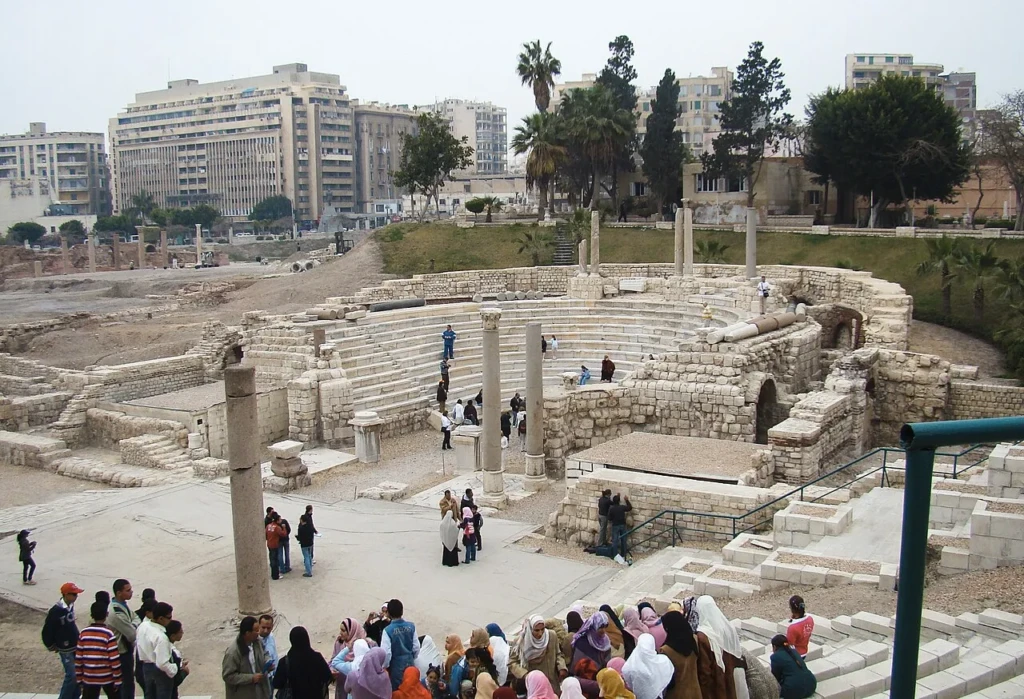
The Roman amphitheatre in Alexandria is a small marble theater at Kom el-Dikka, in the center of the modern city. Workers clearing land for a building found it in 1960, and it is the only structure of its kind known in Egypt. The site around it also preserves Roman baths, lecture halls and mosaic floors, and foreign adults pay EGP 200 to enter.
This guide focuses on Kom el-Dikka itself: what the theater really was, what else stands around it, and how to plan an hour or two there. For the wider city, see our Alexandria travel guide.
Kom el-Dikka Quick Facts
| Fact | Details |
|---|---|
| Location | Kom el-Dikka, central Alexandria |
| Period | Roman and Byzantine residential and civic quarter, 2nd to 6th centuries AD |
| The theater | 13 rows of marble seats; most sources date its current form to the 4th century AD |
| Excavated by | Polish archaeologists, working at the site since 1960; today the Polish Centre of Mediterranean Archaeology, University of Warsaw |
| Hours | Daily 9:00 am–5:00 pm |
| Foreigner ticket | Adult EGP 200, student EGP 100 |
| Time needed | Our planning suggestion: 1 to 1.5 hours |
| From Cairo | A full day by road; our Alexandria day trip allows around three hours each way, depending on traffic |
Hours and prices are as listed on the official Ministry of Tourism and Antiquities site in October 2026; check before you go.
Is It an Amphitheatre, a Theater or an Odeon?
The name on most maps is not quite right. A Roman amphitheatre is a full oval arena, built for gladiators and animal shows. The structure at Kom el-Dikka is a semicircle of seats facing a small stage area, which makes it a theater in form. Many specialists call it an odeon, a small roofed hall for music and recitation.
Its exact purpose is still debated. Some researchers compare it with similar buildings in Italy, Greece and North Africa and suggest it was designed for meetings of officials rather than shows. In the Byzantine period it seems to have served as a hall for public assemblies. You will see “Roman Amphitheatre,” “Roman Theatre” and “Odeon” on signs and tickets. They all mean the same site.
A Short History of Kom el-Dikka
Kom el-Dikka is a mound in the heart of Alexandria. For centuries it lay under later layers of the city. In 1960, while the ground was being cleared for a government building, workers struck ancient columns. Archaeological work began that year under the Polish Egyptologist Kazimierz Michałowski.
Polish teams have worked at the site ever since. The current Polish-Egyptian mission comes from the Polish Centre of Mediterranean Archaeology at the University of Warsaw. Their work turned a building site into what the Ministry of Tourism and Antiquities describes as an open-air museum of a prestigious Roman and Byzantine quarter.
Why the site matters
Most of ancient Alexandria is lost beneath the modern city or the sea. Kom el-Dikka is one of the few places where you can walk through a slice of the real urban fabric: streets, a bath house, houses, classrooms and a public hall. It shows the city after its Hellenistic peak, as a busy Roman and then Byzantine metropolis.
What to See, in Visiting Order
The site is compact and flat, with paths between the main areas. Your guide will choose the route on the day, but this order follows the logic of the site.
1. The theater
Start with the centerpiece. Thirteen rows of white marble seats rise in a tight curve, and the rows are marked with Roman numerals and letters. The marble was recycled from older buildings, a common practice in late antiquity. Along the top, mismatched granite columns of different sizes also come from earlier structures.
The theater is small. Estimates of its capacity range from about 600 to 800 people. Walk up to the top row for the best view over the whole site, and look for graffiti cut into the seats. Some of it shows support for the Blues and the Greens, the rival factions that cheered chariot teams across the Roman and Byzantine world.
2. The Roman baths
Nearby are the remains of a large public bath complex. It was built in the 4th century AD and rebuilt after earthquakes in 447 and 535. The Ministry points out the hypocaust, the raised floor that let hot air circulate underneath to heat the rooms. Water came from a large cistern nearby.
3. The lecture halls
These are the most unusual ruins at Kom el-Dikka. Excavators had uncovered at least twenty small lecture halls by 2010, arranged in two groups. Each could hold roughly 20 to 30 students. They are generally read as part of a late Roman school or university, a reminder that Alexandria remained a center of learning long after the Ptolemies.
4. The Villa of the Birds
This wealthy townhouse was probably built in the 1st century AD and destroyed by fire in the late 3rd century. Four of its floor mosaics survive, two of them complete. The best known shows nine birds in separate panels, which gave the villa its name. Other floors use geometric patterns. Whether the villa is open on the day of your visit can vary, so ask at the entrance.
5. Statues from the sea
The site also displays sculpture and architectural pieces recovered from the sunken parts of ancient Alexandria. These pieces connect Kom el-Dikka to the harbor and the lost royal quarter.
Opening Hours and Ticket Prices
The official Ministry page for Kom el-Dikka lists these figures, as of October 2026. Check before you go, since prices and hours can change.
| Item | Details |
|---|---|
| Opening hours | Sunday to Saturday, 9:00 am–5:00 pm |
| Foreign adult | EGP 200 |
| Foreign student | EGP 100 |
We did not find an official listing for Ramadan hours, last ticket time or photography rules at Kom el-Dikka. Ask at the ticket office, and carry a valid student card if you want the student rate.
How to Get There and How Long It Takes
Kom el-Dikka is in central Alexandria, so it fits easily between the museums and the Corniche. Most international travelers visit Alexandria on a day trip from Cairo. Our Alexandria day tour from Cairo allows around three hours of driving each way, depending on traffic.
Once you are in the city, a private car is the simplest way to move between sites. Your driver or guide will confirm timing on the day, since central Alexandria traffic can be slow at peak hours.
Best Time to Visit and Practical Tips
- Go in the morning. The site is open-air with little shade, and the marble seats reflect the sun by midday.
- Wear shoes with grip. Old marble steps can be smooth and uneven. Take care climbing to the top row.
- Bring water and a hat, even in spring and autumn.
- Use a guide. The lecture halls and baths are low ruins that are hard to read without explanation.
- Pair it with a museum. Seeing mosaics and statues indoors first makes the outdoor ruins easier to understand.
Alexandria has a Mediterranean climate and is usually milder than Cairo in summer. Our guide to the best season to visit Egypt explains how the seasons affect sightseeing.
Combining Kom el-Dikka With Nearby Sites
Kom el-Dikka belongs in a central Alexandria day. A good sequence is Kom el-Dikka first thing, then a museum during the warmer hours, then the sea in the late afternoon.
- The Graeco-Roman Museum holds the statues, coins and mosaics that give the ruins their context.
- The Alexandria National Museum covers the whole span of Egyptian history in a 1926 palace.
- Bibliotheca Alexandrina stands on the Corniche on the theme of the ancient library.
- Qaitbay Citadel, the 15th-century fort on the harbor, makes a good end to the day.
Pompey’s Pillar and the Catacombs of Kom el-Shoqafa lie in the west of the city. They pair well with Qaitbay if you have a second day. Our Alexandria travel guide groups the sites by area.
If you are combining Alexandria with the rest of Egypt, our Egypt itinerary guide shows where a coastal day fits in a 7, 10 or 14-day trip.
Visit With Delta Tours Egypt
Kom el-Dikka is not part of any fixed Delta itinerary. Our Alexandria Over Day trip from Cairo, from $130 per person, follows a set route to Pompey’s Pillar, the Catacombs of Kom el-Shoqafa and Qaitbay Citadel. Our longer packages with an Alexandria day, such as the Alexander the Great 10-day tour from $1,310 per person, also follow their published itineraries. So does the 4 Days Egypt Budget Tour – Cairo & Alexandria, from $390 per person, whose Alexandria day covers the catacombs, Pompey’s Pillar, Qaitbay and the Bibliotheca Alexandrina.
If you want to see the Roman theater, we can arrange a private visit on request through our tailor-made tours service, with a private car and guide, and combine it with the museums or the sites in the west of the city.
Frequently Asked Questions
Is the Roman amphitheatre in Alexandria a real amphitheatre?
Not in the strict sense. It is a semicircular theater, often called an odeon, rather than an oval arena for games. “Roman Amphitheatre” is simply the name that stuck.
How old is the Roman theater at Kom el-Dikka?
Most sources date its current form to the 4th century AD, with a remodeling around 500 and use into the early 7th century. Some accounts place its origins earlier, in the 2nd century AD.
How much does it cost to visit Kom el-Dikka?
Foreign adults pay EGP 200 and foreign students EGP 100, as listed on the official Ministry of Tourism and Antiquities site in October 2026. Check before you go.
How long should I spend at the Roman theater?
Our planning suggestion is 1 to 1.5 hours. That covers the theater, the baths, the lecture halls and the outdoor sculpture at a comfortable pace.
Who discovered the Kom el-Dikka theater?
It was found by chance in 1960 when land was being cleared for a government building. A Polish archaeological team began work that year and has continued excavating the site.
Can I visit Kom el-Dikka on a day trip from Cairo?
Yes. It is in the city center and takes about an hour, so it fits a day trip well. Remember the road journey takes around three hours each way.
Kom el-Dikka is small, but it shows everyday Roman Alexandria better than almost anywhere else. To add it to your trip, start with our tailor-made Egypt tours and tell us how much time you have on the coast.
Featured image: Roman amphitheatre at Kom el-Dikka, Alexandria. Photo: isawnyu / Wikimedia Commons, CC BY 2.0