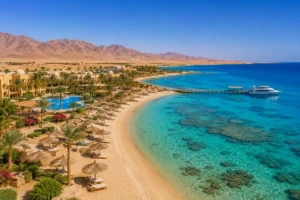
Alexandria Travel Guide: Egypt Beside the Sea
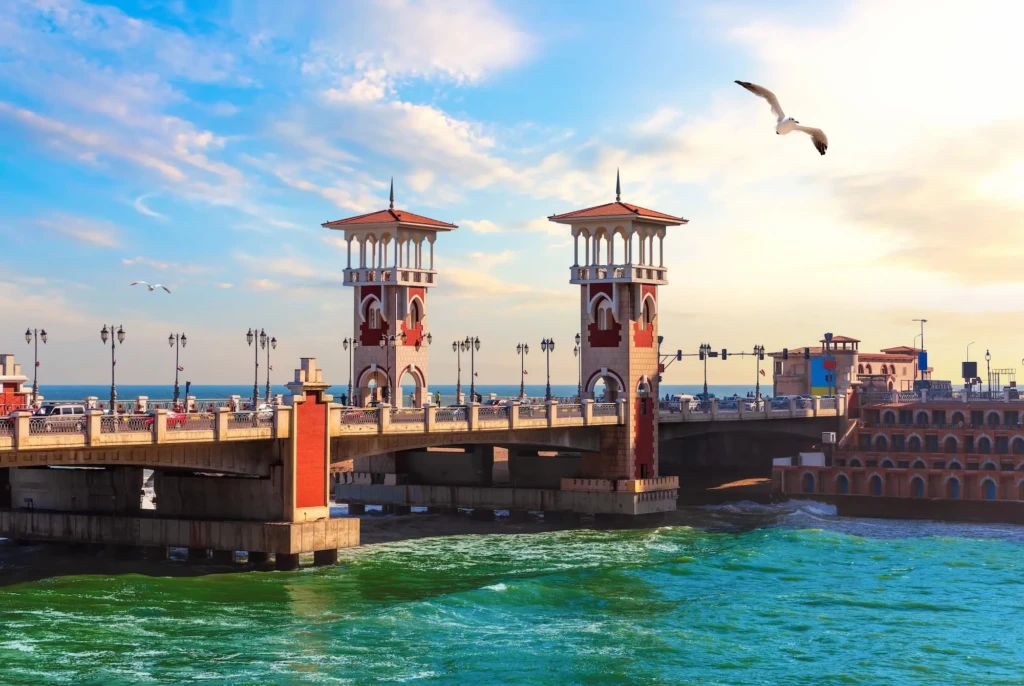
The first sign that Alexandria is different is not a monument. It is the air.
After the dry horizons of Cairo, the road reaches the Mediterranean and the light begins to change. Salt hangs in the breeze. Gulls circle above apartment roofs. Old trams rattle through streets where balconies lean toward the sea, and the Corniche curves along water that has carried Greek settlers, Roman grain ships, medieval fleets, European merchants, and generations of Egyptian fishermen.
Alexandria does not reveal itself like Luxor, where temples rise visibly from the landscape, or Giza, where the pyramids announce themselves from miles away. Much of ancient Alexandria has disappeared beneath later construction or slipped below the harbor. Its legendary lighthouse is gone. The palaces of the Ptolemies lie partly underwater. No visitor can walk into the original Great Library and see the scrolls that made the city famous.
Yet Alexandria is not a city of empty spaces. It is a city of clues.
You find them underground in the Catacombs of Kom el-Shoqafa, where Egyptian gods wear Roman clothes. You find them in a column incorrectly named for Pompey, in lecture halls uncovered at Kom el-Dikka, and in statues raised from the sea. You find the memory of the ancient lighthouse beneath the walls of Qaitbay Citadel. And on the shore, where scholars once pursued the dream of universal knowledge, the modern Bibliotheca Alexandrina opens its vast reading room to the daylight.
This Alexandria Travel Guide follows those clues through the city’s history, monuments, museums, food, and waterfront. It also explains how to visit from Cairo, what deserves more than a quick photograph, and how to plan one, two, or three days without reducing Egypt’s Mediterranean capital to a rushed excursion.
Alexandria at a Glance
| Question | Quick answer |
|---|---|
| Where is Alexandria? | On Egypt’s Mediterranean coast, about 220 kilometers northwest of Cairo. |
| Who founded the city? | Alexander the Great founded Alexandria in 331 BCE near an older Egyptian settlement known as Rhakotis or Raqote. |
| Why is Alexandria famous? | The ancient Great Library, the Lighthouse of Pharos, Ptolemaic rulers including Cleopatra VII, Greco-Roman scholarship, its harbor, and its modern Mediterranean culture. |
| Best places to visit | Bibliotheca Alexandrina, Qaitbay Citadel, Catacombs of Kom el-Shoqafa, Serapeum and Diocletian’s Column, Kom el-Dikka, the Graeco-Roman Museum, and the Corniche. |
| How long should you stay? | One day covers selected highlights; two days provide a far better introduction; three days allow museums, gardens, meals, and the waterfront at a relaxed pace. |
| Best time to visit | Spring and autumn for comfortable walking; winter for museums and atmosphere; summer for the liveliest seaside mood but heavier local crowds. |
| How do you reach Alexandria? | Private road transfer, intercity train, or coach from Cairo. Schedules and travel times should be checked shortly before departure. |
| Is it suitable for families? | Yes. The library, citadel, waterfront, museums, and food make it one of Egypt’s most varied family destinations. |
A City Created for the World
In 331 BCE, Alexander the Great chose a position between the Mediterranean and Lake Mareotis for a new city bearing his name. An Egyptian settlement already existed in the area, but Alexander’s foundation transformed the site into a planned Mediterranean capital with access to Egypt’s agricultural wealth and the sea routes beyond it.
Alexander left Egypt and never saw the city completed. After his death, Ptolemy I took control of Egypt and established the dynasty that would rule for nearly three centuries. Under the Ptolemies, Alexandria became the royal capital: Greek-speaking in its court and administration, Egyptian in the land that sustained it, and international in its population and ambitions.
Its harbors welcomed merchants and envoys. Jewish, Greek, Egyptian, and other communities lived within a city shaped by opportunity as well as tension. The royal district contained palaces, temples, gardens, and institutions of research. The Mouseion—an institution devoted to the Muses—and the Great Library drew scholars who studied literature, mathematics, geography, medicine, astronomy, language, and the natural world.
Names associated with Alexandria still echo through intellectual history. Euclid’s geometry was taught there. Eratosthenes calculated the Earth’s circumference with astonishing skill. Callimachus developed a great catalogue of texts. Herophilus advanced the study of anatomy. Centuries later, the mathematician and philosopher Hypatia became one of antiquity’s most famous women scholars.
At the harbor entrance rose the Lighthouse of Pharos, one of the Seven Wonders of the ancient world. Its light guided vessels toward a city that wanted to be not only powerful, but central to how the world understood itself.
That ambition is the key to Alexandria. The city was built as an encounter—between Egypt and the Mediterranean, kingship and scholarship, trade and ideas. More than two thousand years later, its identity still comes from those crossings.
The Ancient Library of Alexandria: History Beyond the Legend
The Great Library has become Alexandria’s most powerful symbol, but its fame has also produced myths.
The institution developed in the early Ptolemaic period, probably under Ptolemy I and Ptolemy II, as part of the royal intellectual world surrounding the Mouseion. The rulers sought texts on an extraordinary scale. Scholars edited major works, compared manuscripts, translated, classified knowledge, and debated in an environment supported by royal patronage.
Ancient sources do not give us a reliable final catalogue, and modern estimates of the number of scrolls vary widely. A scroll was not the same as a modern book, and multiple scrolls could make up one work. The famous large totals should therefore be treated as literary claims rather than exact inventory figures.
The destruction of the Library is equally complicated. Popular stories often describe one catastrophic fire that erased the ancient world’s knowledge in a single night. Historical evidence points instead to a long decline involving several episodes.
Fires connected with Julius Caesar’s Alexandrian campaign in 48 BCE may have destroyed books stored near the harbor, though historians debate whether the main Library was affected and to what extent. The city suffered later warfare and political upheaval. The Serapeum, which housed a secondary collection sometimes called the Daughter Library, was destroyed after imperial policies against pagan cults in the late fourth century CE. Institutions also decline when funding, scholarly communities, and political support disappear.
No surviving source proves the popular story that the Arab conquest of Alexandria in the seventh century destroyed the Great Library. That account appears in much later writings and is rejected by most modern historians.
The honest conclusion is more interesting than the legend: the ancient Library was not one room that vanished in one cinematic blaze. It was part of a changing scholarly ecosystem whose collections and institutions suffered disruption, dispersal, destruction, and eventual disappearance over centuries.
Bibliotheca Alexandrina: A New Library Facing the Sun
The modern library does not attempt to reconstruct a lost Greek building. Instead, it turns the old idea of Alexandria—the gathering and sharing of knowledge—into contemporary architecture.
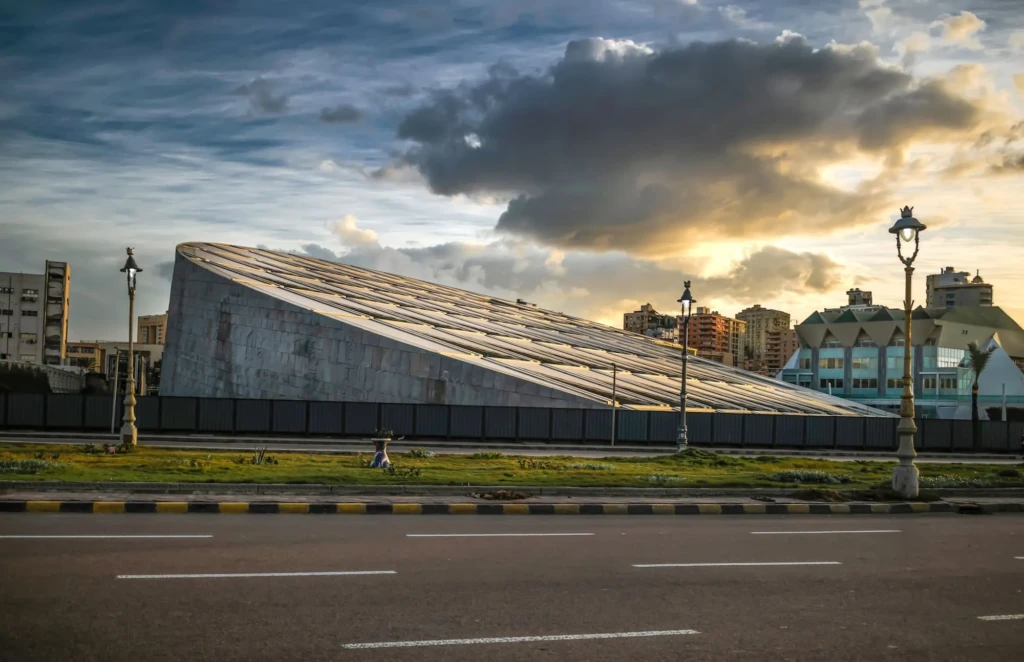
Approaching from the Corniche, the building appears as a vast tilted disc rising beside the Mediterranean. Its circular form suggests a sun emerging from the horizon. Letters and symbols from writing systems around the world cover the exterior granite wall. Inside, the main reading room descends in broad terraces beneath a roof designed to admit controlled natural light.
The Bibliotheca Alexandrina Egypt officially opened in October 2002. It is a working library, cultural center, research institution, exhibition venue, museum complex, planetarium, and public landmark. That distinction matters. The new building commemorates the ancient Library’s intellectual purpose; it is not the ancient Library rebuilt on a proven archaeological footprint.
Visitors who expect only shelves may be surprised by the scale of the complex. The principal attractions can include the main library, Antiquities Museum, Manuscripts Museum, Sadat Museum, temporary exhibitions, Culturama presentations, and Planetarium Science Center activities. Some areas require separate or inclusive tickets, and operating schedules can differ.
The Main Reading Room
The reading room is the emotional center of the Bibliotheca Alexandrina Library. From the upper level, rows of desks descend toward the sea-facing side while slim columns support the angled roof. It is grand without copying ancient temple architecture. The space communicates that knowledge is still alive rather than sealed inside a memorial.
Public visits may include a guided introduction. Listen for the architectural explanations before moving quickly to photographs; understanding the roof, terraces, multilingual exterior, and orientation makes the building far more meaningful.
The Antiquities Museum
The Antiquities Museum deserves time. Discoveries made during construction of the modern library form part of its collection, while other objects trace Egypt’s Pharaonic, Greco-Roman, Coptic, and Islamic history. The museum also includes material recovered from underwater archaeological sites near Alexandria and Abu Qir.
This creates a fitting relationship: objects from the ground and sea beneath modern Alexandria are preserved within an institution dedicated to the city’s intellectual memory.
The Manuscripts Museum and Exhibitions
The Manuscripts Museum explores written heritage through original material, facsimiles, conservation, and digital interpretation. Temporary exhibitions change, so check the official calendar before visiting. Travelers interested in Arabic manuscripts, printing, cartography, or the history of science may need longer than a standard city-tour schedule allows.
Planetarium and Family Experiences
Families should review the Planetarium Science Center schedule in advance. Planetarium shows, the ALEXploratorium, and other activities use separate tickets and fixed times. The library’s official visitor page currently notes that the History of Science Museum is closed for maintenance, which demonstrates why current checking matters.
Bibliotheca Alexandrina Tickets and Hours in 2026
The official schedule checked on September 27, 2026, lists:
- Monday–Thursday: 9:30 AM–4:00 PM
- Saturday and Sunday: 10:00 AM–2:00 PM
- Friday is not included in the regular public-opening schedule
The main-library ticket for non-Egyptians is currently EGP 150 for adults and EGP 20 for students. An inclusive non-Egyptian ticket covering the main library, Antiquities Museum, Manuscripts Museum, and free museums is listed at EGP 300 for adults and EGP 120 for students. Individual museum and Planetarium tickets are also available.
Schedules, included attractions, maintenance closures, age rules, and prices can change. Confirm them on the official admission page before you travel. Allow at least 90 minutes for a focused visit and two to three hours if you want the museums rather than only the reading-room overview.
Today the name refers to this modern library and cultural center. It is properly named the Bibliotheca Alexandrina and should not be confused with the vanished Great Library of the Ptolemies.
Qaitbay Citadel: Where the Lighthouse Once Watched the Sea
At the western end of the Eastern Harbor, the Citadel of Qaitbay meets the Mediterranean with thick limestone walls. Fishing boats rock below it, families gather along the breakwater, and waves strike the stones at the tip of the Pharos peninsula.
The location carries two stories separated by many centuries.
The first belongs to the Lighthouse of Alexandria. Constructed under the early Ptolemies, the Pharos became one of the ancient world’s most celebrated monuments. It survived for centuries before a series of earthquakes contributed to its collapse. Much of the structure disappeared into the sea.
The second story begins in the fifteenth century. Mamluk sultan al-Ashraf Qaitbay built the fortress between 1477 and 1479 to strengthen Alexandria’s coastal defenses. The Ministry of Tourism and Antiquities states that it was constructed over the ruins of the Lighthouse. Ancient blocks from the Pharos area may have been reused, but visitors should be cautious about treating every large stone as conclusively identified lighthouse masonry.
Inside, the citadel’s passages, chambers, defensive openings, and central tower reveal a medieval military monument rather than a surviving fragment of the ancient lighthouse. From outside, the setting is the greater reward: harbor, open sea, fishing activity, and the sense of standing where ships once searched the horizon for the Pharos.
The official 2026 listing gives daily hours of 9:00 AM–8:00 PM and foreign admission of EGP 200 for adults and EGP 100 for students. Because coastal weather or operational changes can affect access, verify before going.
Under the City: Catacombs of Kom el-Shoqafa
Alexandria’s most revealing monument lies below ground.
A spiral staircase descends into the Catacombs of Kom el-Shoqafa, a Roman-period funerary complex developed from approximately the second century CE. The air cools as street noise disappears. Chambers open from the central shaft, and the decoration begins to challenge every simple label visitors bring with them.
Figures are posed according to Egyptian funerary tradition yet modeled with Greco-Roman features. Anubis can appear dressed like a Roman soldier. Egyptian crowns, Greek architectural details, Roman clothing, and local burial customs occupy the same sacred space.
This mixture is not careless copying. It reflects how families in Roman Alexandria could draw on multiple cultural vocabularies at once. A person did not need to choose between being Alexandrian, Egyptian, Greek, or Roman in the rigid way modern labels sometimes suggest. Identity could be layered, situational, and expressed through the rituals of death.
The complex contains burial niches, decorated tomb chambers, a triclinium used for commemorative meals, and the haunting Hall of Caracalla. Some lower areas have historically been affected by groundwater and may not always be accessible. The stairs and enclosed underground environment also make this one of the city’s less accessible major sites.
Allow about 45–60 minutes. A guide is valuable because the strongest details are symbolic rather than monumental. Without explanation, the catacombs can seem like a sequence of dim rooms. With context, they become a portrait of Alexandria’s cultural fusion.
Pompey’s Pillar That Was Never Pompey’s
The tall red-granite column rising above the Serapeum is universally known as Pompey’s Pillar, but the name is wrong.
The monument was erected in honor of the Roman emperor Diocletian in the late third century CE. Medieval travelers associated it with Pompey the Great, and the incorrect name endured. Calling it Diocletian’s Column is historically clearer, though most signs and itineraries still use the traditional name.
The column stands within the remains of the Serapeum, once Alexandria’s great temple of Serapis. Serapis was a deity promoted under the Ptolemies, combining aspects that could speak across Greek and Egyptian religious traditions. The sanctuary became one of the city’s principal religious institutions and probably housed a collection known as the Daughter Library.
Little of the monumental complex survives above ground, but the column, subterranean passages, foundations, and sphinxes help reconstruct the scale and importance of the site. The Ministry of Tourism and Antiquities notes that the Serapeum was destroyed after Emperor Theodosius I’s policies against pagan worship in 391 CE.
Visit the Serapeum before or after the nearby Catacombs. Together, they show two forms of Greco-Roman Alexandria: public sacred architecture and private funerary belief.
Kom el-Dikka: Classrooms, Mosaics, and Roman City Life
From the surrounding streets, Kom el-Dikka can appear less dramatic than the citadel or catacombs. Step inside, and an entire urban quarter begins to emerge.
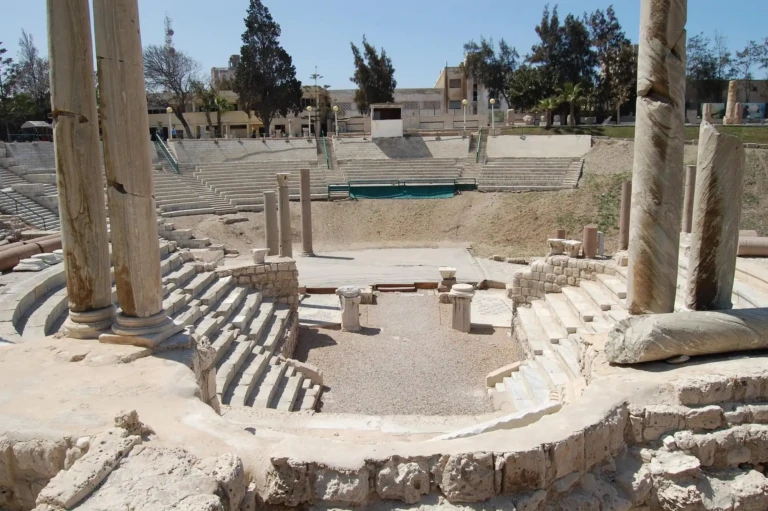
The site preserves remains from Alexandria’s Roman and Byzantine periods, including a small theater or odeon, bath complex, elite residences, workshops, mosaics, and rows of lecture halls. The Ministry describes the theater as the only surviving example of its kind in Egypt. Its marble seats create a compact semicircle, while nearby structures reveal that the site was not only a place of entertainment.
The lecture halls are particularly important. Their arrangement suggests an organized center of higher education in late antique Alexandria. Here the city’s reputation for learning becomes physical. Scholarship was not confined to the legendary Library centuries earlier; teaching and intellectual life continued in changing institutions.
The Villa of the Birds preserves mosaic floors whose creatures and geometric patterns offer a more intimate view of wealthy domestic life. The baths, with traces of underfloor heating, show the engineering behind public comfort. Objects recovered from underwater sites add another link between excavated land and submerged city.
Official hours checked for 2026 are 9:00 AM–5:00 PM daily. Foreign tickets are listed at EGP 200 for adults and EGP 100 for students. Allow at least an hour, especially if the mosaics and lecture halls are open during your visit.
The Graeco-Roman Museum: Alexandria Regains Its Context
For years, travelers encountered Alexandria’s ancient history in fragments. The renovated Graeco-Roman Museum now offers the broadest museum introduction to the city’s Hellenistic and Roman worlds.
Founded in the nineteenth century and housed in a purpose-designed neoclassical building, the museum reopened after a major renovation. Its galleries help explain the cultural blending visible at sites across Alexandria: royal portraiture, deities, domestic objects, funerary customs, trade, civic life, and the adaptation of Egyptian traditions under Greek and Roman rule.
Visit the museum early in an Alexandria stay if history is your priority. It gives names and context to what you later see at the Catacombs, Serapeum, and Kom el-Dikka. Alternatively, visit after the sites and use the collection to assemble the pieces.
The Ministry’s current schedule lists 9:00 AM–5:00 PM from Sunday to Thursday, with later opening until 8:00 PM on Friday and Saturday. Foreign admission is EGP 400 for adults and EGP 200 for students. The wording on the official page contains a minor inconsistency in its summary of evening days, so confirm the schedule before relying on a late visit.
Alexandria National Museum: The Whole City in One Palace
While the Graeco-Roman Museum concentrates on a defining period, the Alexandria National Museum follows a longer timeline. It occupies the former Italianate palace of Asaad Basili Pasha and displays material ranging from ancient Egypt through the Greco-Roman, Coptic, Islamic, and modern eras.
The museum is especially useful for travelers who want a concise overview of Alexandria’s many historical identities. Its collection includes antiquities recovered from underwater excavations, coins, ceramics, glass, metalwork, and objects associated with the Muhammad Ali dynasty.
Official 2026 hours are 9:00 AM–5:00 PM daily, with the final ticket at 4:00 PM. Foreign admission is listed at EGP 220 for adults and EGP 110 for students. The building provides a ramped entrance and elevator, making it a stronger choice than the catacombs for some visitors with limited mobility.
You do not need to visit both major museums on a one-day trip. Choose the Graeco-Roman Museum for depth in Alexandria’s classical identity or the National Museum for a broader chronological story. With two or three days, both are worthwhile.
The Corniche: Where Alexandria Lives in the Present
Ancient Alexandria demands imagination. The Corniche asks only that you walk.
The coastal road follows the curve of the city for kilometers. Waves break against concrete defenses. Fishing rods angle over the water. Taxis, minibuses, and trams create the constant motion of a large Egyptian city, while cafés offer a slower rhythm above the shore.
The Corniche is not one attraction with an entrance gate. It is the thread connecting Alexandria’s landmarks and daily life. Near the Eastern Harbor, you can see Qaitbay Citadel across the water. Around the Bibliotheca, students and visitors move between the city and the sea. Farther east, Stanley Bridge frames one of modern Alexandria’s most recognizable views.
Sunrise gives the waterfront a calm, silvery atmosphere. Late afternoon brings warmer light and more people. Winter storms reveal the Mediterranean’s power; summer evenings can continue long after midnight as families reclaim the cooler hours.
Traffic makes some sections noisy and crossing the road requires attention. Choose a walkable segment rather than trying to cover the entire coast on foot. The harbor between the Bibliotheca area and Qaitbay works especially well when combined with stops, food, and a private vehicle for longer transfers.
Montazah: Gardens at the Far End of the City
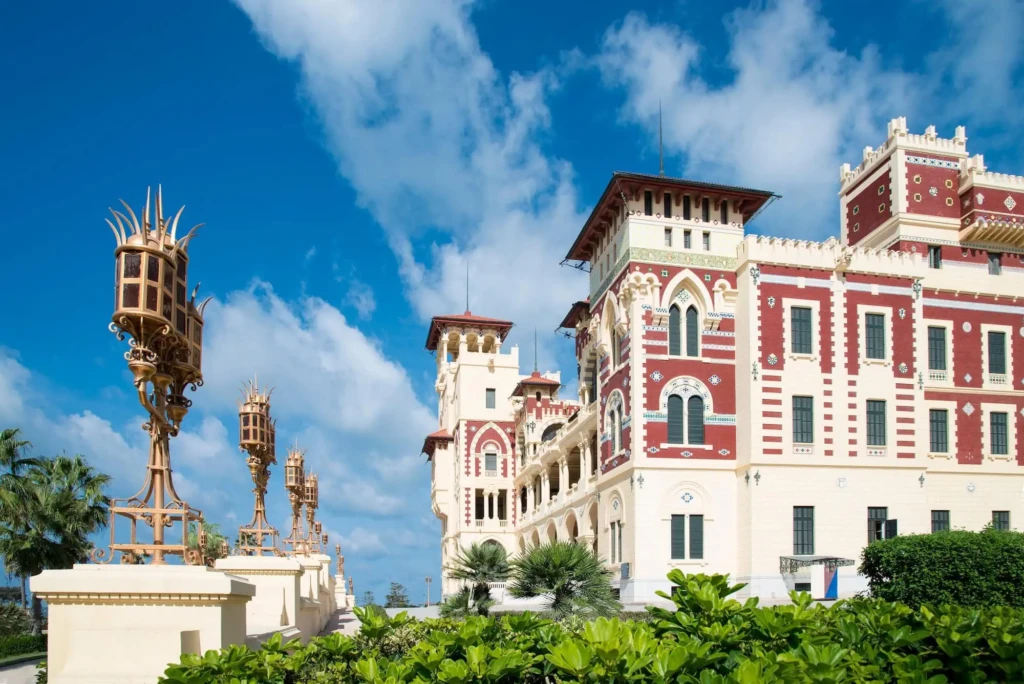
At Alexandria’s eastern edge, the Montazah estate offers gardens, sea views, and palaces associated with Egypt’s former royal family. The Salamlek was established under Khedive Abbas II, while the more visually famous Haramlek Palace was developed under King Fuad I and displays a blend of Ottoman and Florentine-inspired elements.
The gardens can provide relief from dense city streets, especially for families and travelers who want a slower afternoon. However, restoration projects, official use, and local regulations can affect which palace interiors, beaches, bridges, or garden sections are accessible. Do not build an itinerary around entering a specific palace without checking current conditions.
Montazah is some distance from the western archaeological sites. It fits best into a two- or three-day stay, not a rushed Cairo day trip.
Ras el-Tin Palace, another important royal landmark in western Alexandria, remains connected with official state use and should generally be viewed from permitted exterior areas rather than advertised as a standard interior visit.
The City Beneath the Harbor
Alexandria’s water is not only scenery. Beneath the Eastern Harbor and Abu Qir Bay lie architectural blocks, statues, columns, and traces of settlements and royal structures affected by earthquakes, subsidence, coastal change, and the long transformation of the shoreline.
Underwater archaeology has recovered and documented thousands of objects. Some are displayed at the Bibliotheca’s Antiquities Museum, Alexandria National Museum, Kom el-Dikka, and other collections. Seeing them in a museum is the practical route for most visitors.
Recreational access to underwater remains is not equivalent to visiting a normal open-air site. Diving conditions, permits, conservation rules, certified operators, visibility, and official access all matter. Travelers should not assume that a harbor dive can be arranged on demand. Any specialist underwater-heritage experience must be planned through properly authorized channels.
This submerged city also changes how you view Qaitbay. The lost lighthouse is not merely absent; parts of its surrounding ancient landscape remain in the sea directly beyond the fortress.
Cavafy, Cosmopolitan Memory, and Modern Alexandria
Alexandria’s more recent history is written in apartment buildings, schools, churches, synagogues, villas, cinemas, and cafés. During the nineteenth and early twentieth centuries, the port expanded and attracted communities from across the Mediterranean and beyond. Greeks, Italians, Armenians, Levantines, Jews, Europeans, and Egyptians contributed to the city’s commercial and cultural life.
The poet Constantine P. Cavafy turned Alexandria into an interior landscape of history, desire, memory, and loss. His former apartment is now a museum, offering a quieter experience than the monumental sites. It is valuable not because every room survives exactly as he knew it, but because his work captures the city’s habit of living among vanished worlds.
That cosmopolitan past is often romanticized. Alexandria was not an effortless paradise without inequality or conflict. Its communities changed through nationalism, war, migration, political transformation, and economic shifts. The modern city is not a faded European relic; it is Egyptian, populous, creative, complicated, and alive.
Travelers understand Alexandria best when they allow both truths to exist: the city remembers an international Mediterranean past, and it belongs fully to the Egyptians who live there now.
What to Eat in Alexandria
The sea shapes the table.
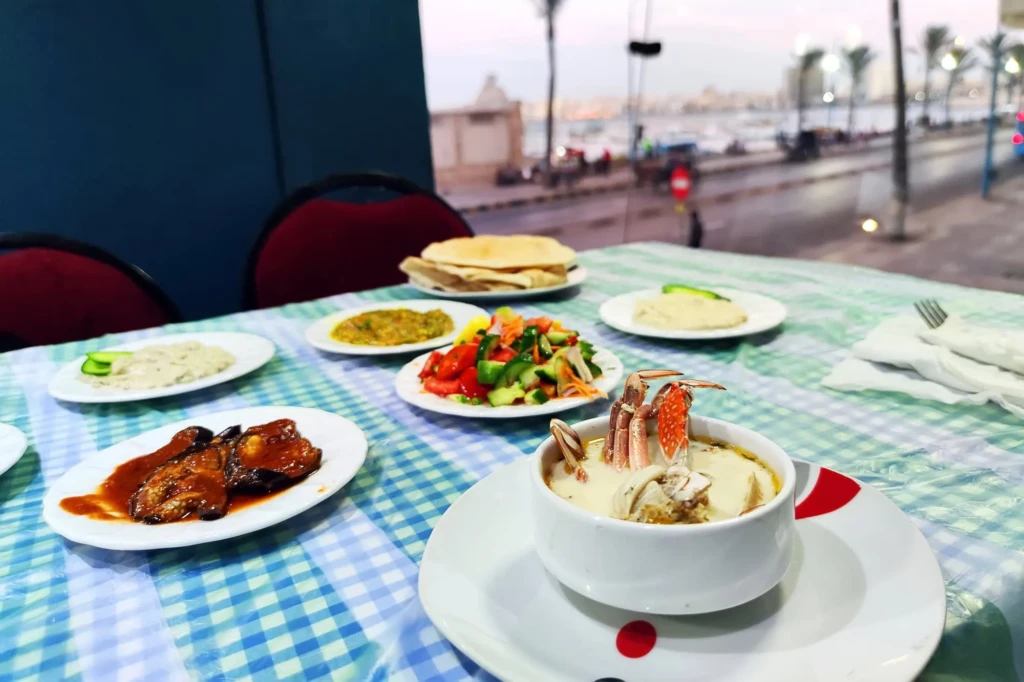
Fresh fish is commonly selected by weight and cooked grilled, fried, or baked with seasoning. Seafood soup, calamari, shrimp, rice, salads, tahini, and warm bread can turn lunch into the day’s longest and most enjoyable stop. Ask clearly about preparation and price before ordering, particularly when fish is sold by weight.
Alexandria is also known for kebda Iskandarani—spiced Alexandrian liver, often served in small sandwiches with peppers and garlic. It is intense, fast, inexpensive, and very different from a formal seafood meal. Travelers who do not eat meat will find grilled fish and vegetarian Egyptian dishes, but should communicate dietary restrictions carefully.
Finish with ice cream, coffee, or a pastry near the waterfront. The point is not to chase one famous restaurant name. Alexandria’s food experience comes from timing: lunch after the catacombs, coffee when the sea wind rises, or dinner while lights appear around the harbor.
Getting from Cairo to Alexandria
Private Car and Driver
A private vehicle offers the easiest door-to-door journey, usually taking about 2.5–3.5 hours depending on traffic, departure point, rest stops, and road conditions. It is the best option for a one-day trip, families, groups, travelers carrying luggage, or anyone combining multiple sites with limited time.
The major advantage is not luxury alone; it is control. You can leave Cairo early, begin at western Alexandria’s archaeological sites, cross the city in a logical direction, and return without building the day around station transfers.
Train
Intercity trains connect Cairo and Alexandria regularly, with different service classes and journey times. The train can be comfortable and economical, and Alexandria’s Misr Station is central. Purchase through official Egyptian National Railways channels when available and verify the departure station, train number, carriage class, baggage needs, and identification requirements.
Schedules change, and delays are possible. Train travel works better for an overnight stay than for a tightly scheduled day trip with many entrance tickets.
Coach
Several companies operate air-conditioned coaches between the two cities. Coaches can suit budget travelers but may use terminals outside the most convenient sightseeing areas. Confirm the exact arrival point before booking.
Arriving by Cruise Ship
Alexandria receives Mediterranean cruise calls. Shore time can be limited, and port procedures affect the usable sightseeing window. A pre-arranged private shore excursion should prioritize two or three major experiences rather than promise the entire city.
Getting Around Alexandria
Alexandria stretches along the coast, so map distances can be deceptive. Sites that look aligned on the Corniche may still require substantial travel in traffic.
Taxis and ride-hailing services are widely used. Agree on the transport method and destination clearly. Trams are atmospheric and inexpensive, but they are not the fastest way to build a full sightseeing itinerary. For a first visit, a private car with an Egyptologist removes logistical friction and allows the historical story to continue between scattered sites.
The best route generally groups western sites—Catacombs, Serapeum, and Qaitbay—with central sites such as Kom el-Dikka, the museums, and Bibliotheca. Montazah belongs to the eastern end and requires separate time.
Practical Visitor Advice
Clothing and Weather
Alexandria is a large, socially varied Egyptian city rather than a beach resort. Light, modest clothing works well in summer, while winter requires layers and rain protection. Comfortable shoes are essential for uneven archaeological ground and long museum days.
Alexandria Myths and Facts
“Julius Caesar destroyed the entire Great Library in one fire.”
Caesar’s campaign likely caused a major fire and may have destroyed stored books, but the evidence does not support a simple story in which the complete institution vanished at once. The Library’s decline involved several events over centuries.
“The modern Bibliotheca stands exactly where the ancient Library stood.”
The Bibliotheca Alexandrina commemorates the ancient institution and stands near Alexandria’s historic royal quarter, but the precise location and form of the original Library remain uncertain.
“Pompey’s Pillar was built for Pompey.”
It was erected in honor of Emperor Diocletian. The name connecting it with Pompey is a later error.
“Qaitbay Citadel is the surviving Lighthouse of Alexandria.”
The citadel is a fifteenth-century Mamluk fortress built at the lighthouse site. Ancient blocks may have been reused, but the standing fort is not the Pharos itself.
“Alexandria is basically a European city in Egypt.”
Alexandria has deep Mediterranean and cosmopolitan connections, but it is an Egyptian city with Egyptian communities, rhythms, food, language, and modern history. Describing it only as European erases most of its identity.
“There is little ancient history left to see.”
Much has been lost or submerged, but the catacombs, Serapeum, Kom el-Dikka, museums, underwater finds, and surviving necropoleis provide substantial evidence when interpreted together.
Alexandria works as a full day trip from Cairo: our private Alexandria day tour covers Pompey’s Pillar, the catacombs and the Qaitbay Citadel with a guide and car, and the 10-day Cleopatra package adds the city to a Cairo and Nile cruise trip.
Frequently Asked Questions About Alexandria
Is Alexandria worth visiting?
Yes. Alexandria offers a side of Egypt that Cairo, Luxor, and Aswan cannot: Greco-Roman archaeology, Mediterranean waterfront life, the Bibliotheca Alexandrina, excellent museums, medieval coastal defenses, and a distinctive food culture.
How many days do you need in Alexandria?
Two days are ideal for a first visit. One day can cover selected highlights from Cairo, while three days allow a museum-rich itinerary, Montazah, literary sites, and relaxed meals.
Can you visit Alexandria as a day trip from Cairo?
Yes, but it creates a long day. Leave early, use private transport, and choose four or five compatible stops. An overnight stay provides a better experience.
What are the best things to do in Alexandria, Egypt?
Visit Bibliotheca Alexandrina, Qaitbay Citadel, the Catacombs of Kom el-Shoqafa, the Serapeum and Diocletian’s Column, Kom el-Dikka, and the Graeco-Roman Museum. Add a Corniche walk and seafood meal.
Is the ancient Library of Alexandria still standing?
No. The ancient institution disappeared over centuries, and its precise archaeological form is not preserved. The Bibliotheca Alexandrina is a modern library and cultural center inspired by its intellectual legacy.
Is Bibliotheca Alexandrina only for researchers?
No. Visitors can tour the main library and access museums, exhibitions, guided introductions, and cultural or science experiences according to current schedules and tickets.
Is Bibliotheca Alexandrina suitable for children?
Yes, particularly when combined with age-appropriate Planetarium Science Center programming. Age restrictions apply to parts of the main reading room, so review the official visitor information first.
What is the difference between the Graeco-Roman Museum and Alexandria National Museum?
The Graeco-Roman Museum specializes in Egypt during the Greek and Roman periods. Alexandria National Museum presents a broader timeline from ancient Egypt through later periods and modern royal history.
Can tourists enter Montazah Palace?
Access to palace interiors and parts of the estate can change because of restoration or official management. Treat the gardens and exterior views as the reliable experience unless current access is confirmed.
Can you dive to Alexandria’s underwater ruins?
Underwater heritage exists, but access depends on official regulations, certified operators, permits, conditions, and conservation requirements. It is not a guaranteed walk-in tourist activity.
Is Alexandria safe for tourists?
Alexandria is widely visited, but it is a busy major city. Use normal urban precautions, secure belongings, use reliable transport, respect local guidance, and check current government travel advice before departure.
What should you buy in Alexandria?
Books and cultural gifts from the Bibliotheca shops, locally produced food items, and carefully selected crafts make better souvenirs than unverified “ancient” objects. Never purchase archaeological material.
Let Alexandria Become More Than a Day Trip
When evening reaches the Eastern Harbor, the citadel turns pale gold and the library’s tilted disc catches the last light. Fishing boats return beneath a skyline built above older shorelines. Somewhere below the water lie stones from palaces, temples, and the Pharos. Behind the modern streets are lecture halls, catacombs, and the foundations of a city that once believed knowledge could be collected from the whole world.
Alexandria’s greatest monuments are partly absent, but absence is not emptiness. It invites attention. The city teaches you to look beneath names, below streets, through museum glass, and across the sea.
A well-planned visit makes those layers easier to understand. Delta Tours Egypt’s private Egypt tours can connect Alexandria with Cairo, Giza, and the rest of the country using private transport and professional Egyptologist guidance. Travelers who want a more flexible pace, carefully selected hotels, and time for museums and waterfront dining can include the city in a tailor-made luxury Egypt tour.
Come for the Library and the lighthouse. Stay long enough to discover the living Egyptian city between them.