Pompey’s Pillar and the Serapeum of Alexandria
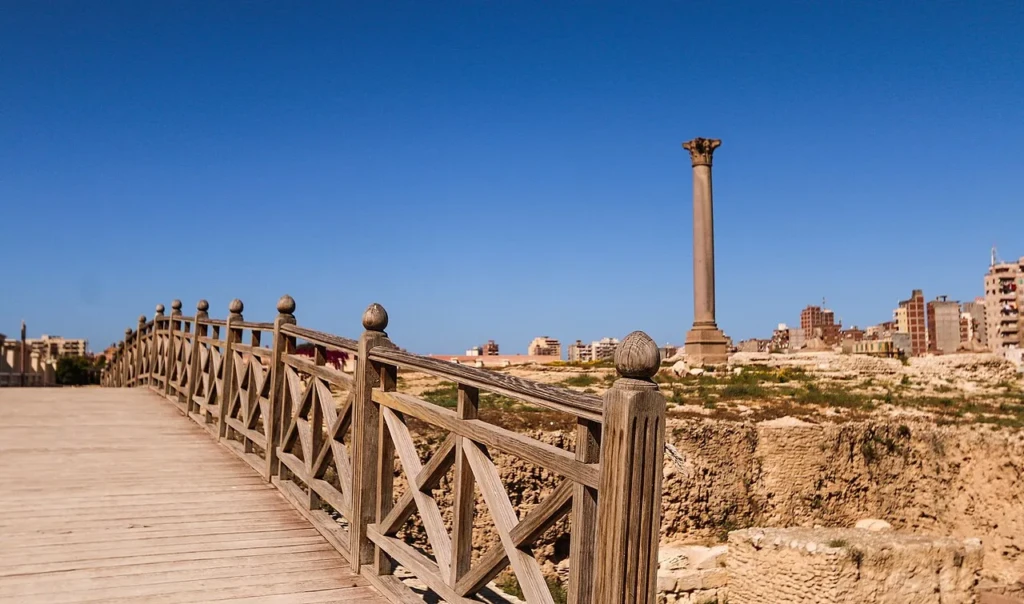
Pompey’s Pillar has nothing to do with Pompey. It is a Roman granite column raised in Alexandria in the late 290s AD in honor of Emperor Diocletian, and it stands beside the ruins of the Serapeum, the city’s great temple of the god Serapis. Foreign adults pay EGP 200 to enter, and the site opens 9:00 am to 5:00 pm, according to the Ministry of Tourism and Antiquities.
This guide covers the column and the temple ground around it: what you are looking at, how long to stay, and how to pair the visit with the rest of western Alexandria. For the wider city, see our Alexandria travel guide.
Pompey’s Pillar at a Glance
| Fact | Details |
|---|---|
| Location | Western Alexandria, on the old Serapeum temple ground, near the Catacombs of Kom el-Shoqafa |
| Date | Column: late 290s AD (most sources give about 298–302 AD). Serapeum: founded in the 3rd century BC |
| Dedicated to | Emperor Diocletian, by Publius, the Roman prefect of Egypt |
| Serapeum built by | Ptolemy III Euergetes, for the god Serapis |
| Height | About 26.85 m (88 ft) including base and capital |
| Material | Pink granite from the quarries of Aswan |
| Hours | 9:00 am – 5:00 pm |
| Foreigner ticket | Adult EGP 200, student EGP 100 |
| Time on site | Our planning suggestion: 45 minutes to 1 hour |
| From Cairo | A full day by road; Delta’s Alexandria day trip allows around three hours each way, depending on traffic |
Why Is It Called Pompey’s Pillar?
The name is a mistake that stuck. The Greek inscription on the base names the man who set up the monument, the prefect Publius. In Greek letters his name, Pouplios, looks close to Pompeios, the Greek form of Pompey. Later readers made the connection, and the famous Roman general Pompey the Great got the credit for a monument he never saw.
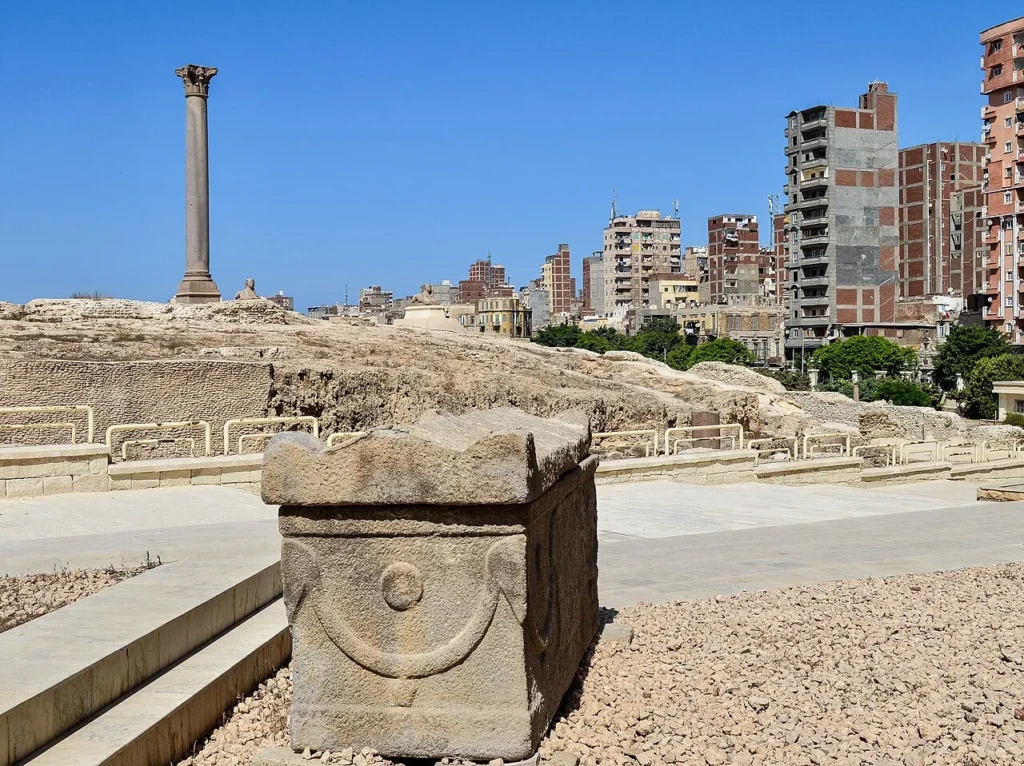
The Ministry of Tourism and Antiquities calls it Diocletian’s Column and notes that the popular name is incorrect. You will see both names on signs and maps. Either name will get you there; older signs and many itineraries still use Pompey.
Why Diocletian?
In 297 AD a usurper named Domitius Domitianus seized power in Egypt. Diocletian came in person, besieged Alexandria and took the city in 298. The column is generally read as a monument to that victory and to the emperor’s authority over Egypt. A statue, now lost, once stood on top.
The Column in Numbers
Size is the reason people stop and stare. The figures below come from published surveys summarized on Wikipedia:
- Total height today is about 26.85 m (88 ft), including the base and the capital.
- The shaft is a single piece of granite, a little over 20 m (about 67 ft) long.
- Its diameter at the bottom is about 2.7 m (almost 9 ft).
- The shaft alone is estimated to weigh around 285 tonnes.
- The shaft and base are pink granite from Syene, the ancient name for Aswan. The capital is gray granite.
That granite traveled roughly the full length of Egypt by river before it reached the Mediterranean. If you have seen the quarries in Aswan, the column makes a neat bookend to that story. It is also the only ancient monument in Alexandria that still stands where it was first set up.
The Serapeum: The Temple Around the Column
The column is the tallest thing on the site, but the ground under your feet is older. This was the Serapeum, the main sanctuary of Serapis. The Ptolemies promoted Serapis as a god both Greeks and Egyptians could accept. His cult mixed Egyptian ideas, including the sacred Apis bull, with Greek religious imagery.
Ptolemy III Euergetes, who ruled from 246 to 222 BC, built the temple. Excavations in 1944 found his foundation deposits: small plaques of gold, silver, bronze, faience, glass and sun-dried Nile mud. An inscription in Greek and Egyptian records that Ptolemy III built the Serapeion. The temple was later rebuilt on a larger scale in the Roman period.
The “Daughter Library”
The Serapeum held an offshoot of the famous Library of Alexandria, often called the daughter library. Ancient writers placed it in the west of the city, which matches this hill. Nothing of the book collection survives, but standing here helps you picture Alexandria as a city of scholars, not only of kings.
How the Temple Ended
In 391 AD, after Emperor Theodosius I moved against pagan cults, Roman soldiers destroyed the Serapeum. Accounts tie the events to clashes in the city under Bishop Theophilus. The Ministry of Tourism and Antiquities dates the destruction to 391 AD. The column survived, which is why it now stands almost alone on the hill.
What to See, in Visiting Order
The site is compact. Most visitors follow a loose loop from the entrance up to the column and back.
1. The approach and the sphinxes
Near the column stand two large sphinx statues on plinths, with more sphinx statues displayed around the site. They are the easiest place to start your photos, with the column rising behind them.
2. Pompey’s Pillar itself
Walk around the full base. The Greek dedication survives on the base; it is weathered, so ask your guide to point out the letters. Then step back to the edge of the hill to take in the full height. Mid-morning light shows the pink tone of the granite well.
3. The temple platform and foundations
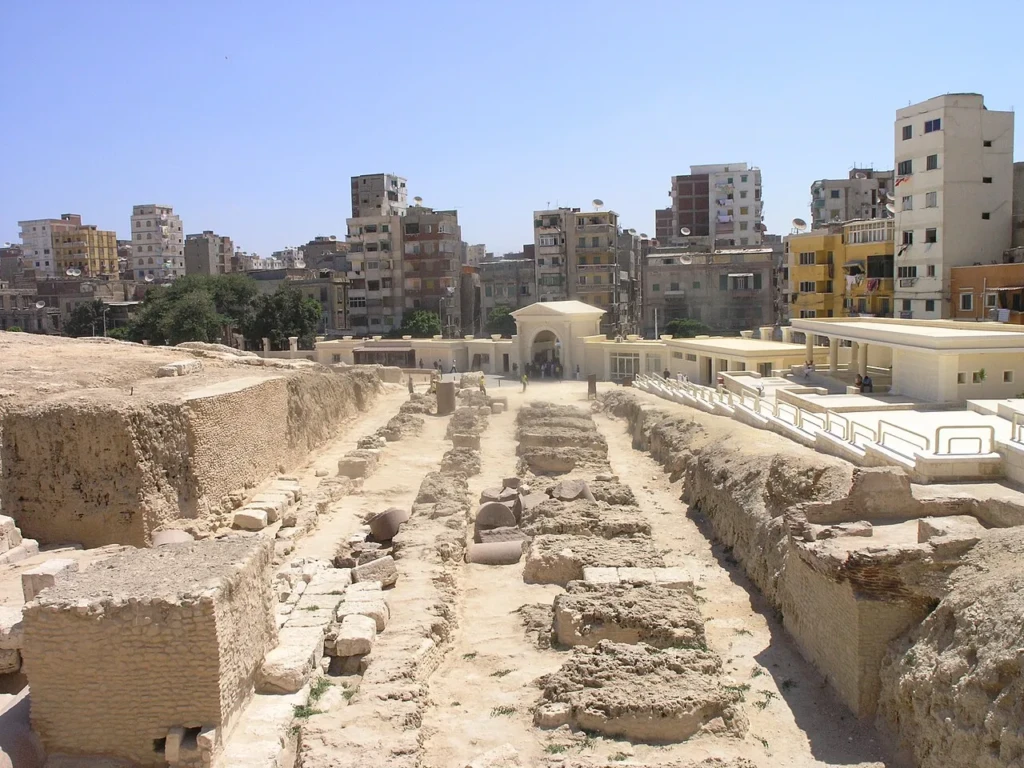
Scattered column drums, blocks and cut foundations mark where the temple courts once stood. Hardly anything remains above ground, so this part rewards a guide who can explain the layout.
4. The underground passages
Rock-cut galleries run beneath the temple area. Scholars think they were used for the rites of Serapis. Access can vary, so ask on the day whether they are open before you plan time for them. Shoes with grip help on the uneven floors.
Opening Hours and Ticket Prices
As listed on the official Ministry of Tourism and Antiquities ticket list in October 2026, check before you go:
| Item | Details |
|---|---|
| Opening hours | 9:00 am – 5:00 pm |
| Foreign adult | EGP 200 |
| Foreign student (with valid card) | EGP 100 |
Prices for Egyptian sites change from time to time, and the ministry updates its list without much notice. If you travel with a guide on a package, check whether entry fees are already included in your tour price.
How to Get There and How Long to Stay
Pompey’s Pillar is in the older western part of the city, close to the Catacombs of Kom el-Shoqafa. The two sites are usually visited one after the other. In city traffic a taxi or private car is the simplest option; your driver or guide will confirm timing from your hotel.
From Cairo, Alexandria works as a long day trip. Delta’s own Alexandria day trip from Cairo by private car allows around three hours each way, so you start early and return in the evening. Staying a night or two in Alexandria gives you a far more relaxed pace.
On site, 45 minutes to an hour is our planning suggestion. Add time if the underground galleries are open or if you like to read every block.
Best Time to Visit and Practical Tips
- Go early. Opening time gives you softer light and fewer groups, and leaves the afternoon for the waterfront.
- Bring sun protection. The hilltop has little shade. A hat and water help, even outside summer.
- Wear sturdy shoes. Paths are uneven, and the underground passages have steps.
- Carry small cash. Tickets are priced in Egyptian pounds. Ask at the gate which payment methods are accepted that day.
- Season. Our month-by-month guide to the best time to visit Egypt helps with timing.
- Dress. This is a city site, not a beach. Light, modest clothing fits in best. Our Egypt packing and dress guide has more detail.
Don’t confuse it with the Serapeum of Saqqara
Egypt has two famous sites called the Serapeum. This one is the Ptolemaic temple of Serapis in Alexandria. The other is the underground burial place of the Apis bulls near Cairo. If that is the one you meant, read our Serapeum of Saqqara guide.
How to Combine Pompey’s Pillar With Nearby Sites
The pillar sits at the heart of a natural western Alexandria route:
- Pompey’s Pillar and the Serapeum first, while the hilltop is still cool.
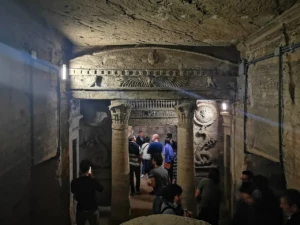
- Catacombs of Kom el-Shoqafa, a short ride away. The ministry lists them at EGP 200 for foreign adults, 9:00 am to 5:00 pm.
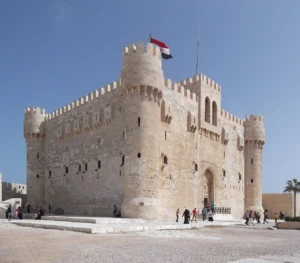
- Lunch on the seafront, then the Qaitbay Citadel on the harbor, built on the site of the ancient lighthouse.
- With extra time, the Bibliotheca Alexandrina or the Greco-Roman Museum. Our Alexandria guide covers both.
This order follows the city’s story from the Ptolemies to the Mamluks in a single day. Browse all our Egypt packages with Alexandria to see how it fits into a longer trip.
Visit With Delta Tours Egypt
Our private Alexandria Over Day trip from Cairo, from $130 per person, visits Pompey’s Pillar together with the Catacombs of Kom el-Shoqafa and the Qaitbay Citadel. If you prefer two days in Egypt’s north, the 4 Days Egypt Budget Tour – Cairo & Alexandria starts from $390 per person.
Longer itineraries that add Alexandria to the Nile include the Cleopatra 10-Day Cairo, Nile Cruise & Alexandria Tour from $1190 per person and the Alexander the Great 10-day tour from $1310 per person. If you want a different pace, a longer stop at the Serapeum, or Alexandria as part of a wider route, we can arrange a private visit on request through our tailor-made Egypt tours team.
Frequently Asked Questions
Who built Pompey’s Pillar?
The column was set up by Publius, the Roman prefect of Egypt, in honor of Emperor Diocletian in the late 290s AD. Pompey had no role in it. The name comes from a misreading of the prefect’s name in the Greek inscription.
How tall is Pompey’s Pillar?
It stands about 26.85 m (88 ft) tall, including its base and capital. The main shaft is a single block of Aswan granite a little over 20 m long. A statue once crowned the top but has not survived.
How much is the ticket for Pompey’s Pillar?
Foreign adults pay EGP 200 and foreign students EGP 100, as listed by the Ministry of Tourism and Antiquities in October 2026. The site opens 9:00 am to 5:00 pm. Check the latest list before you go, as prices change.
What is the Serapeum of Alexandria?
It was the main temple of Serapis, a god promoted by the Ptolemies for both Greeks and Egyptians. Ptolemy III founded it in the 3rd century BC, and it was destroyed in 391 AD. Today you see its foundations, sphinxes and underground passages around the column.
How long do I need at Pompey’s Pillar?
Our planning suggestion is 45 minutes to an hour. Allow more if the underground galleries are open. Most travelers pair it with the nearby Catacombs of Kom el-Shoqafa.
Can I visit Pompey’s Pillar on a day trip from Cairo?
Yes. A private day trip lets you see the pillar, the catacombs and the Qaitbay Citadel. Plan on around three hours by road each way, depending on traffic.
Pompey’s Pillar is a quick stop, but it carries some of the best stories in Alexandria. To see it with a private guide, at your own pace, start with our tailor-made Egypt tours and tell us how much time you have.
Featured image: Pompey's Pillar, Alexandria. Photo: Aya Mahmoud Naguib Ibrahim / Wikimedia Commons, CC BY-SA 4.0