Memphis, Egypt: Mit Rahina Open-Air Museum & Visitor Guide
Memphis, Egypt, was the first capital of united Egypt, founded around 3100 BC on the west bank of the Nile about 20 km (12 miles) south of modern Cairo. Little of the city survives above ground. Today you visit its remains at the village of Mit Rahina, where an open-air museum displays a fallen limestone colossus of Ramesses II and a large alabaster sphinx.
Most travelers see Memphis as a short stop on a day with Saqqara and Dahshur. This guide explains what the city was, what you actually see at Mit Rahina, and how to fit it into your day.
Memphis at a Glance
| Fact | Details |
|---|---|
| Location | Mit Rahina village, Badrashin district, Giza Governorate, west bank of the Nile |
| Distance from Cairo | About 20 km (12 miles) south of the city |
| Period | Capital in the Early Dynastic Period (c. 3100–2686 BC) and Old Kingdom (c. 2686–2181 BC); an important city for more than 3,000 years |
| Founded by | Tradition credits Menes, the legendary first king of Egypt |
| Main god | Ptah, patron of craftsmen, whose temple stood at the heart of the city |
| World Heritage status | Part of “Memphis and its Necropolis,” UNESCO World Heritage List, 1979 |
| Time on site | Our planning suggestion: 45 minutes to 1 hour |
What Was Memphis, and Why Does It Matter?
Think of Memphis as the Washington, D.C., or London of the pyramid age. It sat at the point where the Nile Valley opens into the Delta, a natural place to govern both halves of the country. Egyptian tradition says Menes founded it when he united Upper and Lower Egypt. Historians now treat Menes as a figure of legend, but they agree that Memphis was the first capital of the united state.
The city’s earliest name was Inebu-hedj, “the white walls.” From the New Kingdom it was called Men-nefer, “enduring and beautiful.” The Greeks turned that name into Memphis. Kings ruled from here through the Early Dynastic Period and the Old Kingdom, the age of the great pyramids. Even after the royal court moved, Memphis stayed one of Egypt’s leading cities for more than three thousand years.
The city of Ptah, and the origin of the word “Egypt”
Memphis was the home of Ptah, the patron god of craftsmen. His temple was one of the most important in the whole country. Its ancient name, Hut-ka-Ptah or “Hikuptah,” meant roughly “the temple of the soul of Ptah.” The Greeks heard it as Aigyptos, and that word gave us “Egypt.” In a sense, the whole country is named after a building in this village.
Why the pyramids are where they are
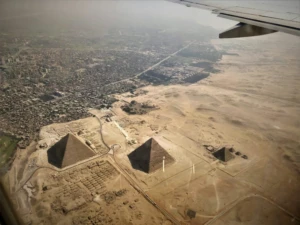
The pyramids you know were the cemeteries of this city. The Ministry of Tourism and Antiquities lists them from north to south: Abu Rawash, Giza, Zawyet al-Aryan, Abu Ghurab, Abusir, Saqqara, Mit Rahina itself and Dahshur. When you stand at Giza or Saqqara, you are standing in the burial grounds of Memphis. That is why UNESCO lists the whole stretch together as “Memphis and its Necropolis – the Pyramid Fields from Giza to Dahshur.”
How did such a great city disappear?
Memphis faded slowly. Under Roman rule, the new coastal capital of Alexandria took over its trade. It remained Egypt’s second city until Fustat, the forerunner of Cairo, was founded in AD 641. After that, people largely abandoned it and used its buildings as a stone quarry. That long reuse is why so little of the city stands today.
What Do You See at Memphis Today?
Set your expectations before you go. You will not walk through ancient streets. The visit centers on the Mit Rahina open-air museum, a garden of statues and stone pieces gathered from the ruins of the city. It is small, but it holds two of the most photographed sculptures in Egypt. Here are the highlights in the order most visits follow.
- The colossus of Ramesses II. The star of the site is a giant limestone statue of Ramesses II, now lying inside a hall built around it. It measures more than 10 meters even with its feet missing. Giovanni Battista Caviglia found it in 1820 near the south gate of the temple of Ptah. It was offered to Grand Duke Leopold II of Tuscany and later to the British Museum, and both declined because moving it was too hard and too costly. So it stayed, and a museum was built over it.
- The alabaster sphinx. In the garden stands a great sphinx carved from alabaster, a soft, yellowish-white stone. It measures about 8 meters long and 4 meters high and weighs an estimated 90 tons. It dates to the 18th Dynasty, but it carries no inscription. Its face has been compared with Hatshepsut, Amenhotep II and Amenhotep III. Flinders Petrie’s team uncovered it in 1912.
- Statues and blocks in the garden. Other statues and carved stone pieces recovered from the ancient city are set out around the museum grounds.
- Recent finds from the temple of Ptah. The ministry has reported rescue excavations near the temple of Ptah that uncovered pink granite and limestone blocks showing Ptah and Ramesses II celebrating his jubilee (Sed) festival. The same work found the upper part of a granite ka-statue of Ramesses II, which the ministry described as the first royal granite ka-statue ever found. These pieces were taken to the Mit Rahina open-air museum for restoration, with their final display place still to be decided, so ask your guide whether any are on view.
The Apis embalming house
Memphis also has a direct link to the Serapeum of Saqqara. In 1941, Ahmed Badawy found an embalming house within the temple of Ptah grounds where the sacred Apis bulls were mummified. After embalming, each bull was carried up to Saqqara for burial. Access to this area varies, so check with your guide.
Where is the other colossus of Ramesses II?
Many visitors ask why there is only one giant statue at Mit Rahina. A second colossus, carved in red granite and about 11 meters tall, was found at Mit Rahina in pieces. In 1955 it was set up in Cairo’s Bab al-Hadid Square, renamed Ramses Square. It was moved to Giza in 2006 and has stood at the entrance of the Grand Egyptian Museum since 2018. You can see it on our Grand Egyptian Museum tour, linked below.
How to Get to Memphis (Mit Rahina) and How Long It Takes
Memphis lies about 20 km (12 miles) south of Cairo on the west bank of the Nile. It sits in farmland below the desert edge, close to Saqqara, which was its main cemetery. Drive time from central Cairo or Giza depends almost entirely on traffic, so plan with your driver rather than relying on a fixed number.
We recommend a private car with a driver or a guided day tour rather than public transport. Because the site is small, it rarely makes sense as a trip on its own. It works best as one stop in a longer day south of Cairo.
Opening Hours and Tickets
The Ministry of Tourism and Antiquities’ official site did not list opening hours or ticket prices for the Mit Rahina open-air museum when we checked in October 2026, so we have not printed them here. Buy your ticket at the entrance, and confirm current hours with your guide or tour operator the day before.
For the sites you will likely combine it with, the ministry lists these details, as listed on the official Ministry of Tourism and Antiquities site in October 2026; check before you go:
- Saqqara: open daily, 8:00 AM to 4:00 PM. Foreign adults pay EGP 600 for the Saqqara area (students EGP 300). An inclusive ticket costs EGP 1,400 (students EGP 700) and covers the site, the Imhotep Museum, the Nobles’ Tombs, the New Kingdom tombs and the tombs of Mereruka and Mehu.
- Dahshur: open daily, 8:00 AM to 5:00 PM. Foreign adults pay EGP 200 (students EGP 100).
How Memphis Fits a Saqqara and Dahshur Day
The three sites run along the same stretch of the west bank, and together they tell one story: the capital and its royal cemeteries. A typical order looks like this.
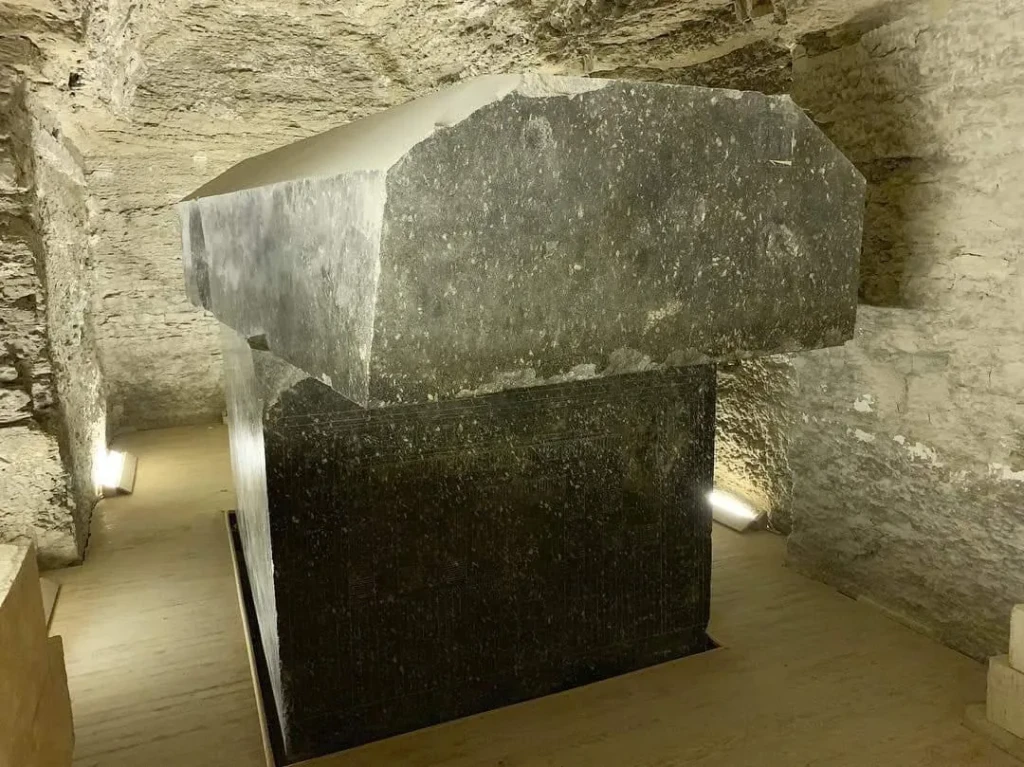
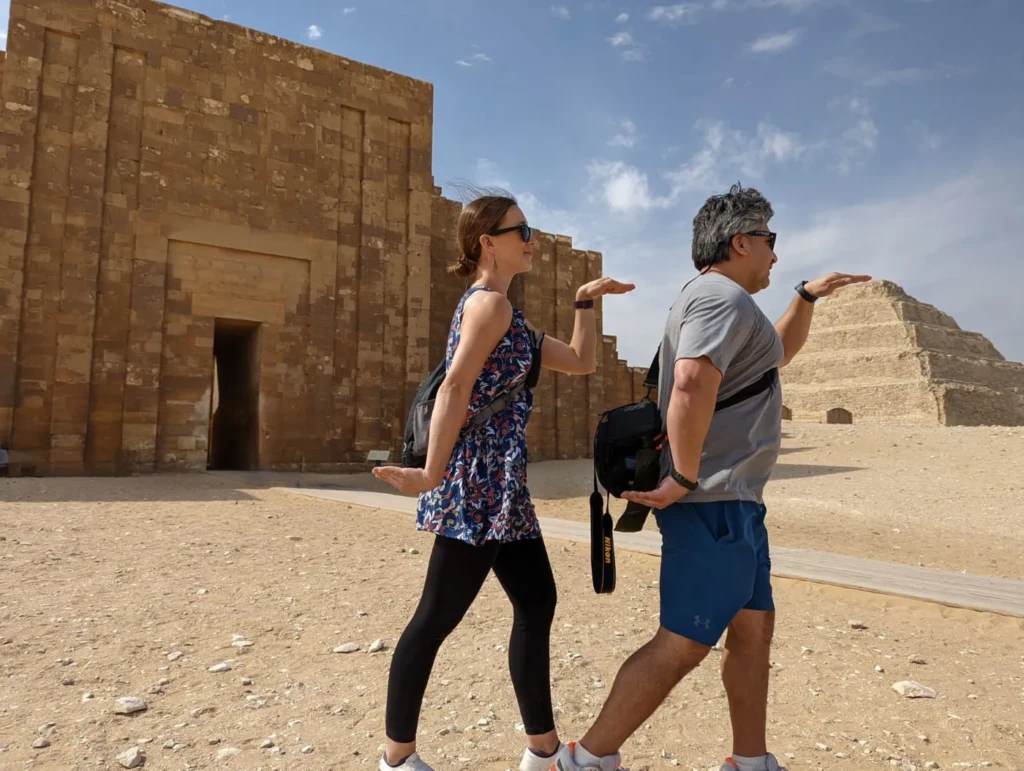
- Start at Saqqara. Arrive early. See the Step Pyramid of Djoser, the monument that changed building in stone forever, and the decorated tombs of the nobles. Saqqara closes at 4:00 PM, so it is best tackled first.
- Continue to Dahshur. Here stand the Bent Pyramid and the Red Pyramid of Sneferu, the king who learned how to build a true smooth-sided pyramid. Dahshur stays open until 5:00 PM.
- Finish at Memphis. The open-air museum is compact, which makes it a good last stop on the drive back toward Cairo. You end the day in the city that built all of it.
Some travelers reverse the order and start at Memphis. Either way works; what matters is giving Saqqara the most time. Our list of things to do in Saqqara will help you choose which tombs to open with your ticket.
Best Time to Visit Memphis
Time of day. Apart from the colossus hall, the open-air museum is outdoors. Morning and late afternoon are the most pleasant times. If Memphis is your last stop, aim to arrive with time to spare before closing.
Season. The cooler months make a full day of desert sites far easier. In summer, start as early as possible, and carry plenty of water.
Tips for Visiting Memphis
- Visit after you know the story. Memphis is easy to underrate. A guide who can explain the city behind the statues makes all the difference.
- Pair it with the Grand Egyptian Museum. Seeing the granite colossus at the GEM after the limestone one at Mit Rahina makes a neat pair.
- Bring sun protection. The garden is open to the sky.
- Carry small Egyptian pounds. Useful for tips and restrooms.
- Do not expect ruins of a city. If you go in knowing you will see a sculpture garden, you will enjoy it far more.
Visit Memphis with Delta Tours Egypt
Our Giza, Saqqara and Dahshur pyramids day tour starts from $105 per person and covers the great pyramid fields of Memphis in one private day. Memphis itself is not named in that tour’s title, so if you want the Mit Rahina open-air museum added, ask when you book or build your own day through our tailor-made tours. To see the second colossus of Ramesses II, add our Grand Egyptian Museum and pyramids tour (from $95 per person). For a longer stay, the 4-day Cairo tour starts from $535 per person. You can compare every option on our Cairo tours and excursions page.
Frequently Asked Questions
Is Memphis, Egypt, worth visiting?
Yes, if you go with the right expectations. The site is small, but the colossus of Ramesses II and the alabaster sphinx are major sculptures. It adds meaning to Saqqara and Dahshur, which were the city’s cemeteries.
Where is ancient Memphis today?
Its remains lie at the village of Mit Rahina in Giza Governorate, about 20 km south of Cairo on the west bank of the Nile. Most of the ancient city is buried under fields and palm groves.
What is the Memphis open-air museum?
It is the garden museum at Mit Rahina where finds from the ancient city are displayed. The highlights are the fallen limestone colossus of Ramesses II, housed in its own hall, and the alabaster sphinx outside.
How big is the colossus of Ramesses II at Memphis?
The limestone statue measures more than 10 meters even without its feet. It lies inside a hall built around it at Mit Rahina. Its granite companion, about 11 meters tall, now stands at the Grand Egyptian Museum.
How long do you need at Memphis?
About 45 minutes to an hour is enough for most visitors. That leaves the bulk of your day for Saqqara and Dahshur nearby.
Can you visit Memphis, Saqqara and Dahshur in one day?
Yes, and that is the usual plan. Start early, give Saqqara the most time and use Memphis as a short stop at the beginning or end of the day.
Memphis makes the most sense when you see it as the city behind the pyramids. Browse our private Cairo day tours and we will help you plan a day south of Cairo that connects the capital with its royal cemeteries.