The Pyramid of Teti: Inside Egypt’s Hidden Pyramid of the Sixth Dynasty (2026)
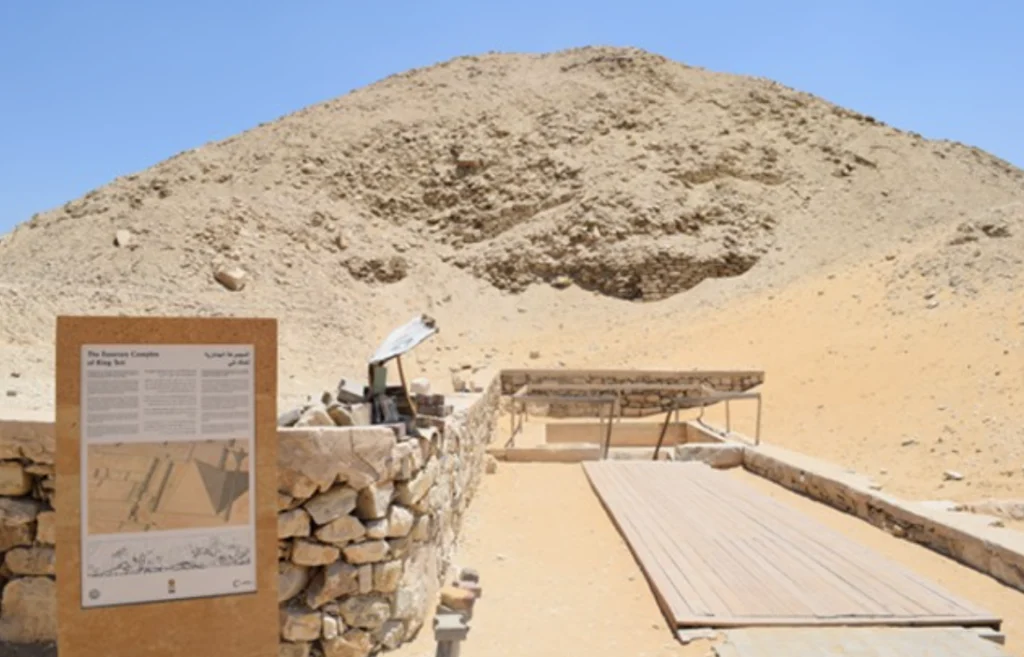
Among the remarkable monuments scattered across the vast Saqqara Necropolis, the Pyramid of Teti is one of the most rewarding yet frequently overlooked archaeological sites in Egypt.
At first glance, the pyramid appears little more than a weathered mound rising gently from the desert floor. Centuries of erosion have stripped away much of its smooth limestone casing, leaving visitors with little indication of the extraordinary monument hidden beneath.
Yet appearances can be deceiving.
Beneath this modest exterior lies one of the finest surviving royal tombs of the Old Kingdom. Visitors who descend into the pyramid discover beautifully carved Pyramid Texts, a remarkably preserved burial chamber, and a unique opportunity to stand inside one of the earliest decorated pyramids in history.
Built around 2323 BC for King Teti, the founder of Egypt’s Sixth Dynasty, the pyramid continued the revolutionary religious tradition first introduced by King Unas only a generation earlier. While the Pyramid of Unas pioneered the use of sacred funerary inscriptions, the Pyramid of Teti expanded this practice, demonstrating how deeply these religious texts had become embedded within royal burial traditions.
Today, the Pyramid of Teti offers travelers one of the most authentic archaeological experiences in Saqqara. With far fewer visitors than Egypt’s better-known monuments, it provides the rare chance to explore an ancient royal tomb in relative peace while discovering the Pyramid Texts, part of the oldest known body of Egyptian religious texts.
Whether you are fascinated by archaeology, ancient Egyptian religion, or the evolution of pyramid construction, the Pyramid of Teti deserves a place on every well-planned Saqqara itinerary.
Quick Facts About the Pyramid of Teti
| Feature | Details |
|---|---|
| Location | Saqqara Necropolis, Egypt |
| Built For | Pharaoh Teti |
| Dynasty | Sixth Dynasty |
| Construction Date | c. 2323 BC |
| Original Height | Approximately 52.5 meters (172 feet) |
| Pyramid Type | True Pyramid |
| Famous For | Beautifully preserved Pyramid Texts |
| Interior | Open to visitors (subject to regulations) |
| UNESCO Status | Memphis and its Necropolis World Heritage Site |
Who Was King Teti?
King Teti founded Egypt’s Sixth Dynasty, succeeding the prosperous Fifth Dynasty during the later years of the Old Kingdom.
Although historians continue debating the exact length of his reign, most estimates place it between 12 and 30 years.
His rule marked an important transition in Egyptian history.
While earlier kings focused heavily on monumental architecture and centralized royal authority, Teti governed during a period when powerful provincial officials were beginning to gain greater influence. This gradual shift would eventually contribute to the political changes that ended the Old Kingdom centuries later.
Despite these broader developments, Teti remained committed to maintaining traditional royal funerary practices.
His pyramid demonstrates both continuity and innovation.
Architecturally, it followed the established design perfected during earlier dynasties.
Religiously, however, it embraced the increasingly sophisticated funerary beliefs reflected in the Pyramid Texts.
For this reason, Teti’s pyramid serves as an important bridge between the monumental pyramid age of the Fourth Dynasty and the more elaborate religious traditions of later periods.
Why the Pyramid of Teti Matters
The Pyramid of Teti may not be the largest or most visually impressive pyramid in Egypt, but its historical significance is extraordinary.
It represents a period when Egyptian religion became increasingly focused on written rituals intended to guide the king safely into the afterlife.
Inside the pyramid, visitors encounter hundreds of carefully carved hieroglyphic inscriptions that continue the tradition established by King Unas.
These texts provide invaluable evidence about:
- Ancient Egyptian religious beliefs.
- Royal funerary rituals.
- Concepts of resurrection and eternal life.
- The evolution of hieroglyphic writing.
- The spiritual role of the pharaoh.
For archaeologists and historians, the Pyramid of Teti is therefore far more than a royal tomb.
It is a priceless historical document preserved in stone.
Why You Should Visit
Many visitors overlook the Pyramid of Teti while focusing on the Step Pyramid or the Serapeum.
That is unfortunate.
The Pyramid of Teti offers one of the most complete and authentic experiences available in Saqqara.
Its underground chambers are remarkably atmospheric, the Pyramid Texts remain beautifully preserved, and the surrounding tombs provide exceptional insight into the lives of Egypt’s highest officials.
For travelers seeking a deeper understanding of ancient Egyptian religion and royal burial traditions, the Pyramid of Teti is one of the hidden gems of the Saqqara Necropolis.
Inside the Pyramid of Teti: Architecture, Burial Chamber & Royal Legacy
Although the Pyramid of Teti has lost much of its original outer appearance, its interior remains one of the finest surviving examples of Old Kingdom royal funerary architecture.
Descending beneath the weathered limestone mound, visitors quickly realize that the pyramid’s true treasures lie underground. Narrow passageways, ancient burial chambers, beautifully carved hieroglyphs, and one of Egypt’s oldest royal tombs combine to create an unforgettable archaeological experience.
Unlike many pyramids where only fragments remain, the Pyramid of Teti still allows visitors to experience much of the original royal journey from the entrance to the king’s burial chamber.
The Pyramid Complex
The Pyramid of Teti formed the center of an impressive royal funerary complex designed to ensure the eternal survival of the king.
The original complex consisted of several carefully planned structures.
These included:
- A Valley Temple, located near the ancient Nile floodplain.
- A long processional causeway connecting the valley to the pyramid.
- A Mortuary Temple, where priests performed daily offerings.
- Storage rooms for food, incense, oils, and ceremonial equipment.
- Open courtyards used during funerary rituals.
- The royal pyramid itself.
Although much of the complex survives only as foundations, archaeological excavations have uncovered numerous reliefs depicting offering bearers, priests, craftsmen, and scenes from everyday Egyptian life.
These discoveries provide valuable insight into the religious ceremonies that continued long after King Teti’s burial.
Entering the Pyramid
The entrance to the Pyramid of Teti follows the traditional design established during the Old Kingdom.
Located on the north face of the pyramid, a descending limestone passage leads visitors beneath the monument.
As you begin the descent, daylight gradually disappears.
The cool underground air, the smooth limestone walls, and the narrow corridor create an atmosphere that immediately separates the visitor from the busy archaeological site above.
Unlike the massive interiors of later monuments, the passages inside Teti’s pyramid feel intimate.
Every architectural element was carefully designed to protect the king while symbolically guiding him toward eternal life.
The Descending Corridor
The descending passage extends deep beneath the pyramid before reaching a horizontal corridor leading toward the inner chambers.
Originally, the passage was protected by large granite blocking stones intended to prevent unauthorized entry.
Although these security measures were ultimately defeated by ancient tomb robbers, they demonstrate the extraordinary effort invested in safeguarding the king’s final resting place.
Walking through this corridor today offers visitors a rare opportunity to follow the same route taken during the royal burial ceremony over four thousand years ago.
The Antechamber
Beyond the main corridor lies the antechamber.
This room served as an important transition between the outer passages and the king’s burial chamber.
Although architecturally simple, it carries profound symbolic meaning.
Here, visitors begin to encounter the beautifully carved hieroglyphic inscriptions that distinguish the Pyramid of Teti from many earlier pyramids.
The atmosphere changes dramatically.
Rather than focusing solely on architecture, attention shifts toward the sacred words covering the walls.
These inscriptions were intended to protect the king and assist his journey through the afterlife.
The Burial Chamber
The burial chamber is the true highlight of the monument.
Constructed from massive limestone blocks, it houses the remains of King Teti’s royal sarcophagus and preserves one of the finest collections of Old Kingdom religious inscriptions.
The chamber itself is relatively compact.
Its importance comes not from its size but from its extraordinary decoration.
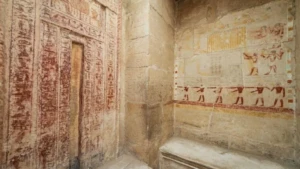
Every wall is covered with vertical columns of carefully carved hieroglyphs.
Unlike painted tombs from later periods, the decoration here is elegant in its simplicity.
The precision of the carving demonstrates the exceptional skill of Old Kingdom craftsmen.
Standing inside the chamber today, visitors experience one of the oldest decorated royal tombs accessible anywhere in the world.
The Pyramid Texts Inside Teti’s Pyramid
Following the innovation introduced by King Unas, Teti continued the tradition of inscribing sacred funerary texts directly onto the walls of his burial chamber.
These inscriptions are among the best-preserved examples of the Pyramid Texts.
They include prayers, hymns, magical utterances, and protective formulas intended to guide the king safely through the dangers of the afterlife.
The inscriptions emphasize several recurring themes:
- Resurrection.
- Divine protection.
- Ascension to the heavens.
- Union with the gods.
- Eternal kingship.
- Victory over death.
Although many of the spells resemble those found inside the Pyramid of Unas, they also demonstrate how Egyptian religious traditions continued to develop during the Sixth Dynasty.
Rather than copying earlier inscriptions exactly, priests refined and expanded them, reflecting evolving theological ideas while preserving the essential goal of ensuring the king’s eternal existence.
The Star-Covered Ceiling
Above the burial chamber stretches one of the most beautiful symbolic features of the pyramid.
The ceiling was decorated with white stars against a dark background, representing the eternal night sky.
For the ancient Egyptians, these stars symbolized immortality.
King Teti hoped to join the Imperishable Stars, celestial bodies that never disappeared below the northern horizon.
Because these stars remained constantly visible, they became powerful symbols of eternal life and everlasting kingship.
This celestial decoration transformed the burial chamber into a symbolic gateway between the earthly world and the heavens.
Security and Tomb Robbery
Like many royal tombs of ancient Egypt, the Pyramid of Teti was not immune to tomb robbery.
Despite carefully designed blocking stones, concealed passages, and massive construction techniques, thieves eventually gained access to the burial chamber.
Most valuable grave goods disappeared long before modern archaeology began.
Nevertheless, the architectural features and beautifully preserved inscriptions survived remarkably well.
Today, visitors come not to admire lost treasures but to appreciate one of Egypt’s earliest surviving decorated royal tombs.
Its historical importance remains undiminished.
Why Historians Value the Pyramid of Teti
Although it rarely appears on lists of Egypt’s most famous monuments, the Pyramid of Teti is considered exceptionally important by Egyptologists.
Its value lies in the combination of:
- Well-preserved architecture.
- Extensive Pyramid Texts.
- Accessible underground chambers.
- Rich surrounding cemetery.
- Evidence of changing religious beliefs during the Sixth Dynasty.
For researchers, it offers a unique opportunity to study the transition from the Fifth to the Sixth Dynasty while observing how royal funerary traditions continued to evolve.
For visitors, it provides one of the most authentic and rewarding experiences within the Saqqara Necropolis.
Visiting the Pyramid of Teti Today
While millions of travelers visit the Pyramids of Giza every year, relatively few make their way to the Pyramid of Teti. Those who do are rewarded with one of the most authentic archaeological experiences in Egypt.
Unlike many famous monuments where large crowds can limit the experience, the Pyramid of Teti offers a quieter and more intimate journey into the heart of Egypt’s Old Kingdom. Walking through its ancient corridors, surrounded by more than four thousand years of history, allows visitors to appreciate the remarkable achievements of one of humanity’s earliest civilizations without distraction.
For travelers interested in archaeology, history, or ancient religion, the Pyramid of Teti is one of Saqqara’s hidden gems.
Can You Enter the Pyramid of Teti?
Yes.
When open to the public, visitors are permitted to descend into the Pyramid of Teti and explore its underground chambers.
Unlike many pyramids where only the exterior can be admired, Teti’s pyramid offers the rare opportunity to stand inside an authentic Old Kingdom royal tomb.
The experience is especially rewarding because of the beautifully preserved Pyramid Texts covering the walls of the burial chamber.
Access is subject to conservation work and regulations issued by Egypt’s Ministry of Tourism and Antiquities, so availability may occasionally change.
What You’ll See Inside
Although the pyramid appears modest from the outside, its interior reveals a fascinating sequence of spaces.
Visitors pass through:
- The northern entrance.
- A descending limestone corridor.
- Horizontal passageways.
- The antechamber.
- The burial chamber.
The highlight of the visit is undoubtedly the burial chamber itself.
Here, the walls are covered with finely carved hieroglyphic inscriptions that continue the tradition first introduced by King Unas.
Unlike later royal tombs decorated with colorful paintings, the Pyramid of Teti relies on the elegance of carved hieroglyphs.
The atmosphere is peaceful, mysterious, and deeply spiritual.
Standing beside the royal sarcophagus while surrounded by sacred inscriptions creates an unforgettable connection with the ancient world.
How Long Should You Spend Here?
The ideal visit depends on your interests.
Quick Visit
20–30 minutes
Suitable for visitors following a packed Saqqara itinerary.
Recommended Visit
40–50 minutes
This allows enough time to:
- Explore the underground passages.
- Study the Pyramid Texts.
- Photograph the burial chamber (where permitted).
- Learn about King Teti’s reign.
History Enthusiasts
60–75 minutes
Visitors with a strong interest in Egyptology often spend additional time examining the inscriptions and exploring the surrounding royal cemetery.
Opening Hours
The Pyramid of Teti follows the operating hours of the Saqqara archaeological site: 8:00 AM to 4:00 PM daily, all year, as listed on the official Egyptian Ministry of Tourism and Antiquities site in October 2026.
Hours may occasionally change because of archaeological excavations, restoration work, or national holidays.
Tickets
The Pyramid of Teti is located within the Saqqara archaeological area, and entry policies may change depending on current conservation efforts. Some monuments within the necropolis require separate admission, while others are included with the general Saqqara entrance ticket (EGP 600 for foreign adults, EGP 300 for students, as listed on the official Egyptian Ministry of Tourism and Antiquities site in October 2026; prices change, so check before you go).
To avoid uncertainty, many travelers choose a private guided tour where entrance arrangements, transportation, and historical interpretation are handled in advance.
Best Time to Visit
The Pyramid of Teti can be visited throughout the year, but cooler months provide the most comfortable experience.
October to April
This is considered the best season.
Advantages include:
- Pleasant temperatures.
- Comfortable walking conditions.
- Excellent photography.
- Easier exploration of nearby monuments.
May to September
Summer temperatures often exceed 35°C (95°F) during the afternoon.
If visiting during this period:
- Arrive early in the morning.
- Wear light clothing.
- Carry water.
- Use sunscreen and a hat.
Fortunately, the underground chambers remain significantly cooler than the surrounding desert.
Photography Tips
The Pyramid of Teti offers excellent photographic opportunities both inside and outside the monument.
Exterior Photography
The best images are usually captured during the morning when sunlight creates soft shadows across the desert plateau.
Recommended shots include:
- The pyramid from the northeast.
- Wide views showing the surrounding mastabas.
- The entrance against the desert landscape.
Interior Photography
Inside the pyramid:
- Increase ISO rather than using flash.
- Use image stabilization if available.
- Photograph hieroglyphs from a slight angle to emphasize their depth.
- Capture the sarcophagus with part of the decorated walls visible to illustrate the scale of the chamber.
Always respect current photography regulations issued by site authorities.
Accessibility
Because the Pyramid of Teti is an underground monument, visitors should expect:
- Descending passageways.
- Narrow corridors.
- Uneven limestone floors.
- Limited lighting.
- Low ceilings in some sections.
The monument is unfortunately not suitable for wheelchairs, and visitors with mobility limitations should consult their guide before entering.
Comfortable walking shoes are strongly recommended.
Nearby Attractions
One of the Pyramid of Teti’s greatest advantages is its location within one of the richest archaeological areas in Egypt.
Within walking distance, visitors can explore several extraordinary monuments.
Mastaba of Mereruka
The largest private tomb in Saqqara, famous for its detailed reliefs illustrating daily life during the Old Kingdom.
Recommended visit: 30–40 minutes.
Mastaba of Kagemni
One of the finest decorated tombs of the Sixth Dynasty, renowned for its beautiful carvings of animals, hunting scenes, and offering rituals.
Recommended visit: 20–30 minutes.
Mastaba of Ankhmahor
Often called the Tomb of the Physician, this remarkable mastaba contains unique scenes believed to depict early medical procedures and daily life.
Recommended visit: 20–30 minutes.
Step Pyramid of Djoser
The world’s first pyramid and one of the greatest architectural achievements in history.
Recommended visit: 60–90 minutes.
Serapeum of Saqqara
The underground burial place of the sacred Apis Bulls, famous for its enormous stone sarcophagi.
Recommended visit: 45–60 minutes.
The Legacy of King Teti and Egypt’s Sixth Dynasty
The Pyramid of Teti represents far more than the tomb of a single pharaoh.
It marks the beginning of Egypt’s Sixth Dynasty, a period that preserved the traditions of the Old Kingdom while gradually introducing political and social changes that would reshape ancient Egyptian civilization.
Although the pyramid itself appears modest today, it stands at the center of one of the most important royal cemeteries ever discovered. Together with the surrounding mastabas of high-ranking officials, it offers an extraordinary glimpse into how Egyptian society functioned during one of its most fascinating historical periods.
For historians, the Pyramid of Teti is not simply a monument—it is a gateway to understanding the final centuries of Egypt’s Old Kingdom.
King Teti’s Lasting Influence
While rulers such as Khufu and Djoser are remembered primarily for their architectural achievements, King Teti’s importance lies in preserving and strengthening the religious traditions that had begun during the reign of Unas.
Under Teti, the practice of decorating royal burial chambers with sacred inscriptions became firmly established.
This continuity ensured that future generations of pharaohs inherited a well-developed funerary tradition that emphasized protection, resurrection, and eternal kingship.
Although historians continue to debate certain aspects of Teti’s reign, his pyramid demonstrates that religious beliefs remained at the heart of royal ideology during the early Sixth Dynasty.
His monument symbolizes stability during a period of gradual political transition.
The Beginning of a New Dynasty
Teti was the first king of Egypt’s Sixth Dynasty.
His accession marked the continuation of the Old Kingdom rather than a dramatic break from the past.
Architecturally, pyramid construction followed well-established traditions.
Religiously, however, Egyptian beliefs continued to evolve.
The increasingly elaborate Pyramid Texts, expanded funerary rituals, and growing importance of priesthoods reflected a society placing greater emphasis on the spiritual journey of the king.
These developments would influence Egyptian religion for centuries.
The Royal Cemetery Around the Pyramid
One of the Pyramid of Teti’s greatest archaeological treasures lies not only within the pyramid itself but in the remarkable cemetery surrounding it.
Many nobles deliberately chose to build their mastabas near the king’s pyramid. Unlike earlier royal pyramids that stood relatively isolated, Teti’s monument became the preferred burial place for many of Egypt’s most powerful officials.
These included:
- Viziers.
- High priests.
- Royal administrators.
- Military commanders.
- Court officials.
- Members of the royal family.
Their decision to build elaborate tombs beside the king reflected a widespread belief that proximity to the pharaoh increased one’s chances of eternal life.
Today, this concentration of elite tombs makes the Pyramid of Teti one of the richest archaeological areas in Saqqara.
Visitors interested in ancient Egyptian daily life should allow additional time to explore these remarkable tombs after visiting the pyramid itself.
Mastaba of Mereruka
The most famous tomb near Teti’s pyramid belongs to Mereruka, one of the most powerful officials of the Sixth Dynasty.
Serving as vizier under King Teti, Mereruka oversaw many aspects of royal administration.
His enormous mastaba contains more than thirty decorated rooms filled with scenes illustrating:
- Agriculture.
- Fishing.
- Hunting.
- Metalworking.
- Furniture production.
- Religious ceremonies.
- Family life.
The remarkable preservation of these reliefs provides one of the clearest windows into everyday life during the Old Kingdom.
For many visitors, Mereruka’s tomb is every bit as fascinating as the royal pyramid itself.
Read our full guide to the Mastaba of Mereruka.
Mastaba of Kagemni
Another nearby masterpiece is the Mastaba of Kagemni.
Kagemni served as one of Egypt’s highest-ranking officials during the transition between the Fifth and Sixth Dynasties.
His beautifully decorated tomb is especially admired for its naturalistic depictions of animals.
Visitors can observe:
- Birds.
- Crocodiles.
- Hippopotamuses.
- Monkeys.
- Hunting scenes.
- Marsh landscapes.
These carvings reveal the extraordinary artistic abilities achieved by Egyptian craftsmen more than four thousand years ago.
Mastaba of Ankhmahor
Known as the Tomb of the Physician, the Mastaba of Ankhmahor is another highlight of the area surrounding Teti’s pyramid.
Its reliefs include scenes that many scholars interpret as some of the earliest known representations of medical procedures.
Although debate continues regarding the precise meaning of these scenes, they offer fascinating insight into healthcare and daily life during the Old Kingdom.
Together with Mereruka and Kagemni, Ankhmahor’s tomb demonstrates why the Pyramid of Teti should never be viewed in isolation.
The surrounding cemetery is an essential part of the visitor experience.
Why Egyptologists Love the Pyramid of Teti
Among archaeologists, the Pyramid of Teti enjoys a reputation far greater than its modest exterior might suggest.
Several factors contribute to its importance.
Exceptional Preservation
The interior chambers remain remarkably intact, preserving both architecture and inscriptions.
Rich Archaeological Context
Few pyramids are surrounded by such a concentration of beautifully decorated elite tombs.
This allows researchers to study royal and private funerary traditions side by side.
Religious Continuity
The monument illustrates how religious traditions introduced during the reign of Unas became fully integrated into Sixth Dynasty royal ideology.
Accessible Interior
Unlike many ancient monuments where access is restricted, visitors can often enter the pyramid and experience its remarkable underground chambers firsthand.
Common Myths About the Pyramid of Teti
Myth 1: The Pyramid of Teti Is Just Another Small Pyramid
Reality
Although modest in appearance, the Pyramid of Teti is one of Egypt’s most historically important royal tombs because of its inscriptions, architecture, and surrounding cemetery.
Myth 2: Only Archaeologists Appreciate This Pyramid
Reality
History enthusiasts, photographers, and travelers interested in authentic experiences often rank Teti’s pyramid among their favorite monuments in Saqqara.
Its peaceful atmosphere makes it especially rewarding compared with more crowded sites.
Myth 3: There Is Nothing to See Except the Pyramid
Reality
The surrounding mastabas are among the finest decorated private tombs in Egypt and significantly enhance the visit.
Together they create one of the richest archaeological landscapes in the country.
Pyramid of Teti vs. Other Royal Pyramids
| Monument | Main Significance |
|---|---|
| Step Pyramid of Djoser | Beginning of pyramid architecture |
| Bent Pyramid | First successful design experiment |
| Red Pyramid | First complete true pyramid |
| Great Pyramid of Khufu | Largest pyramid ever constructed |
| Pyramid of Unas | Introduction of the earliest Pyramid Texts |
| Pyramid of Teti | Expansion of royal funerary traditions during the Sixth Dynasty and center of an exceptional elite cemetery |
Each pyramid represents a different chapter in the development of ancient Egyptian civilization, and together they tell the story of nearly five centuries of architectural, political, and religious evolution.
The Pyramid of Teti can be added to a private day at Saqqara on our Giza, Saqqara and Dahshur tour; our Cairo tours page lists the other options.
Frequently Asked Questions
Who was King Teti?
King Teti was the founder of Egypt’s Sixth Dynasty and ruled during the late Old Kingdom. His reign continued many of the religious and architectural traditions established by earlier pharaohs while overseeing a period of gradual political change.
Why is the Pyramid of Teti famous?
The Pyramid of Teti is renowned for its beautifully preserved Pyramid Texts, accessible underground chambers, and its location within one of the richest royal cemeteries in Saqqara.
Can visitors go inside the Pyramid of Teti?
Yes. When open, visitors can descend into the pyramid and explore its corridors, antechamber, and burial chamber.
What are the nearby attractions?
The pyramid is surrounded by outstanding monuments, including the Mastabas of Mereruka, Kagemni, and Ankhmahor, as well as the Step Pyramid of Djoser, the Serapeum, and the Pyramid of Unas.
Is the Pyramid of Teti worth visiting?
Absolutely. For travelers interested in archaeology, ancient religion, and Old Kingdom history, it offers one of the most authentic and rewarding experiences within the Saqqara Necropolis.
Plan Your Visit & Discover One of Saqqara’s Best-Kept Secrets
Although the Pyramid of Teti rarely appears on lists of Egypt’s most famous attractions, it is one of the most rewarding monuments for travelers who want to explore beyond the traditional tourist route.
While the Step Pyramid of Djoser tells the story of the birth of pyramid construction and the Pyramid of Unas introduces the world’s earliest Pyramid Texts, the Pyramid of Teti offers a more complete picture of how royal funerary traditions evolved during the Sixth Dynasty.
Combined with its remarkably preserved interior and the extraordinary cemetery surrounding it, the Pyramid of Teti is an essential stop for anyone seeking a deeper understanding of ancient Egypt.
Why Visit the Pyramid of Teti with Delta Tours Egypt?
The Pyramid of Teti is much more than an ancient tomb.
It is the center of one of the richest archaeological landscapes in Egypt, surrounded by beautifully decorated mastabas, ancient temples, and monuments that reveal how the highest officials of the Old Kingdom lived, worked, and prepared for eternity.
At Delta Tours Egypt, our private Saqqara tours are carefully designed to showcase not only the pyramid itself but also the remarkable stories hidden within the surrounding necropolis.
Our licensed Egyptologists explain:
- The life and reign of King Teti.
- The significance of the Pyramid Texts.
- The architecture of the pyramid.
- The symbolism of the burial chamber.
- The importance of nearby noble tombs.
- The political and religious developments of the Sixth Dynasty.
Unlike standard group tours, our private experiences allow you to explore at your own pace, ask questions, and spend extra time inside the monuments that interest you most.
Our tours include:
- Private hotel pickup and return.
- Modern air-conditioned vehicle.
- Licensed Egyptologist guide.
- Flexible itinerary.
- Visits to the Step Pyramid, with the Pyramid of Teti, the Serapeum, the Pyramid of Unas and nearby mastabas available on request.
- Optional extensions to Memphis and Dahshur.
- Plenty of opportunities for photography.
Whether you’re a first-time visitor or a returning traveler, the Pyramid of Teti provides one of the most authentic archaeological experiences in Egypt.
Recommended Full-Day Saqqara Itinerary
To fully appreciate the evolution of pyramid construction and royal funerary traditions, combine the Pyramid of Teti with other major monuments in the Saqqara Necropolis.
| Time | Attraction |
|---|---|
| 08:00 | Depart Cairo or Giza |
| 09:00 | Step Pyramid of Djoser |
| 10:00 | Entrance Colonnade & Heb-Sed Court |
| 10:45 | Serapeum of Saqqara |
| 11:45 | Pyramid of Unas |
| 12:30 | Pyramid of Teti |
| 01:15 | Mastaba of Mereruka |
| 02:00 | Mastaba of Kagemni |
| 02:30 | Mastaba of Ankhmahor |
| 03:15 | Lunch |
| 04:15 | Memphis |
| 05:00 | Dahshur |
| 06:30 | Return to Cairo |
This itinerary offers a fascinating journey through nearly five centuries of Egyptian history, from the first pyramid ever built to the refined funerary traditions of the Sixth Dynasty.