Giza Pyramids Complex: History, Map, Tickets & Guide
Giza Pyramids Complex: History, Map, Tickets & Guide
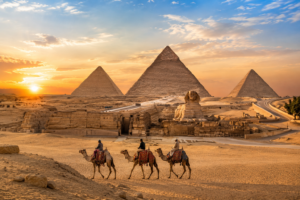
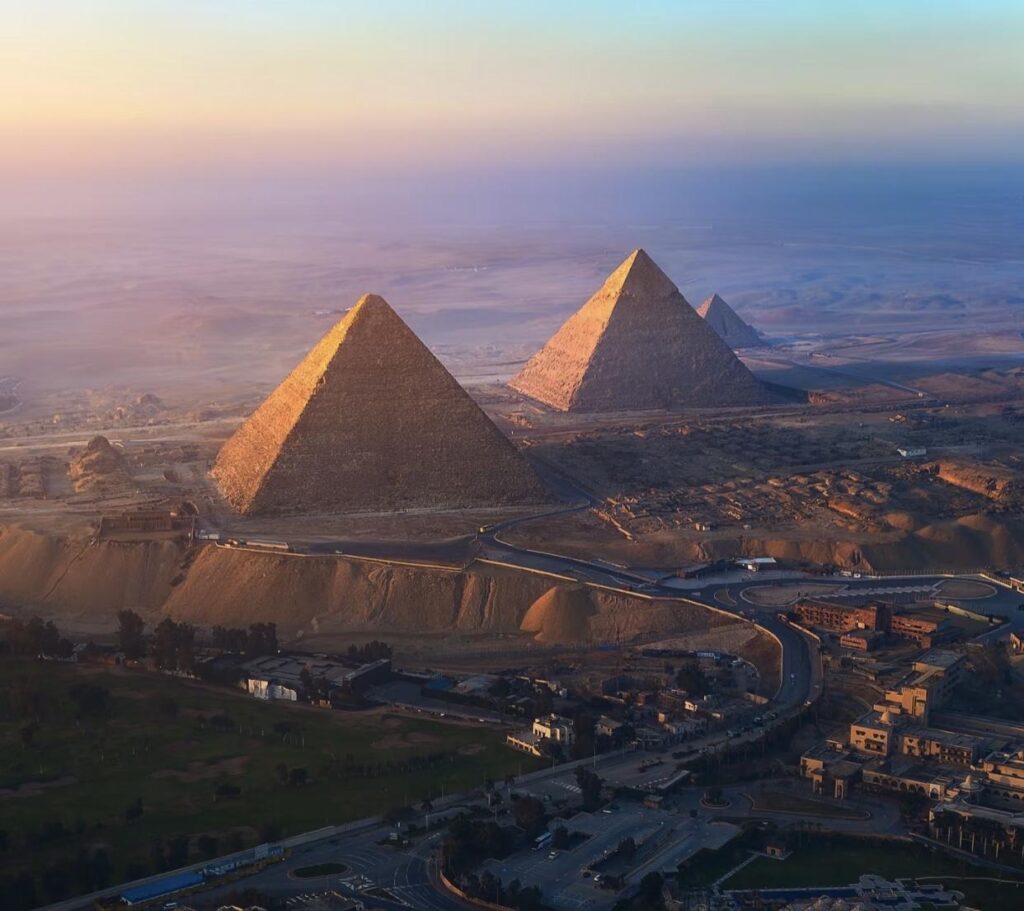
At the edge of modern Cairo, where the city meets the Western Desert, the Giza Pyramids Complex rises from a limestone plateau like a monumental record of ancient Egyptian ambition. The Great Pyramid of Khufu may command the skyline, but it is only the largest element of a much broader sacred landscape. Around it stand the pyramids of Khafre and Menkaure, the Great Sphinx, queens’ pyramids, mastaba tombs, mortuary temples, valley temples, causeways, boat pits, quarries, and the remains of the community that supported the builders.
Understanding this wider landscape changes the experience completely. The pyramids of Giza were not isolated monuments placed randomly in the desert. Each royal pyramid formed the center of an organized funerary complex designed to preserve the king’s memory, sustain his cult, and assist his transformation in the afterlife. Together, the monuments reveal how architecture, religion, government, engineering, and the natural geography of the Nile Valley worked as one system more than 4,500 years ago.
This complete guide explores the history and layout of the Giza Plateau, explains who built the Great Pyramid of Giza and what the evidence tells us about its construction, and provides practical information about the pyramids of Giza tickets, entrance, map, opening hours, and the best way to visit.
Giza Pyramids Complex at a Glance
| Essential fact | Details |
|---|---|
| Location | Giza Plateau, west of the Nile in Greater Cairo, Egypt |
| Main building period | Fourth Dynasty of the Old Kingdom, approximately 26th to 25th centuries BCE |
| Three royal pyramids | Khufu, Khafre, and Menkaure |
| Most famous monument | Great Pyramid of Khufu, the last surviving Wonder of the Ancient World |
| Other major features | Great Sphinx, temples, causeways, queens’ pyramids, mastaba cemeteries, boat pits, workers’ town and cemetery |
| UNESCO status | Part of “Memphis and its Necropolis – the Pyramid Fields from Giza to Dahshur,” inscribed in 1979 |
| Recommended visit time | At least 3–4 hours; a full day for a detailed visit or when combining Giza with the Grand Egyptian Museum |
| Best general time | Early morning, especially during warmer months |
What Is the Giza Pyramids Complex?
The Giza Pyramids Complex—also called the Giza Necropolis or Giza Plateau—is a royal cemetery constructed primarily for the kings and elite families of Egypt’s Fourth Dynasty. It occupies the desert plateau west of the Nile, close to the ancient capital of Memphis and directly beside today’s dense urban neighborhoods of Giza.
Most photographs reduce the site to three triangular silhouettes, but each pyramid belonged to a complete architectural program. A typical royal pyramid complex included the pyramid itself, a mortuary temple beside it, a long causeway, and a valley temple near the edge of the ancient floodplain. Smaller pyramids, boat burials, storerooms, priests’ quarters, and cemeteries for royal relatives and officials expanded the sacred landscape around the king.
The location was practical as well as symbolic. The strong limestone bedrock provided a stable foundation and a major source of building stone. Nearby waterways connected the plateau to the Nile, allowing supplies and stone to move by boat. Religiously, the west—where the sun disappeared each evening—was associated with death, renewal, and the realm of the dead. Giza therefore joined geology, transportation, royal authority, and beliefs about rebirth in one carefully chosen setting.
The plateau also forms the northern end of a much larger pyramid landscape extending through Abu Sir, Saqqara, and Dahshur. Travelers who want to understand how pyramid architecture developed before Giza should continue south with our Saqqara Egypt Guide and learn about Imhotep, the architect traditionally associated with Djoser’s Step Pyramid.
When Were the Pyramids of Giza Built?
The three principal pyramids were built during Egypt’s Old Kingdom, within the Fourth Dynasty. Exact chronologies differ slightly because ancient regnal dates are still reconstructed from incomplete evidence, but the accepted sequence is clear:
| Monument | Pharaoh | Approximate period | Original height |
|---|---|---|---|
| Great Pyramid | Khufu, also called Cheops | Reign c. 2589–2566 BCE | About 146.5 m / 481 ft |
| Second Pyramid | Khafre, also called Chephren | Reign c. 2558–2532 BCE | About 143.5 m / 471 ft |
| Third Pyramid | Menkaure, also called Mykerinos | Reign c. 2532–2503 BCE | About 65 m / 213 ft |
Khufu initiated the first and largest royal complex at Giza. His son Khafre constructed the second pyramid on higher ground, which is why it can appear taller from certain viewpoints even though the Great Pyramid is larger. Menkaure, probably Khafre’s son and Khufu’s grandson, built the smallest of the three principal pyramids.
These projects were part of a longer architectural evolution rather than a sudden invention. More than a century earlier, builders at Saqqara had transformed the rectangular mastaba tomb into Djoser’s Step Pyramid. During the reign of Sneferu, Khufu’s father, experiments at Meidum and Dahshur produced the Bent Pyramid and the Red Pyramid. By the time construction began at Giza, Egyptian planners had accumulated generations of experience in quarrying, surveying, structural design, labor organization, and royal monument building.
Why Were the Giza Pyramids Built?
The main pyramids were royal tombs, but calling them tombs alone understates their role. Ancient Egyptian kingship did not end with the pharaoh’s death. Through burial rituals, offerings, images, texts, and continued temple service, the deceased king was expected to enter a transformed state and participate in the divine order.
The pyramid protected and monumentalized the royal burial. The mortuary temple provided a place for ceremonies and offerings. The causeway connected it to the valley temple, which marked the ceremonial approach from the lowlands. Priests and administrators maintained the king’s cult long after the funeral. The surrounding burials placed relatives and important officials close to royal power in the next world as they had been in life.
The pyramid’s form may also have carried solar and creation symbolism. Scholars have connected it with the primeval mound that emerged from the waters of creation and with the rays of the sun, although ancient religious meanings developed over time and cannot always be reduced to a single explanation. What is certain is that the complexes combined burial, ritual, royal ideology, and the promise of renewal on an unprecedented scale.
No intact royal mummy or original burial treasure has survived inside the three great pyramids. This absence does not mean they were never tombs. Stone sarcophagi, funerary temples, offering spaces, boat pits, royal cemeteries, and the long Egyptian tradition of pyramid burial all identify the site as a royal necropolis. Looting, reuse, and stone removal over thousands of years explain why so much of the original equipment has disappeared.
Map and Layout of the Giza Pyramids Complex
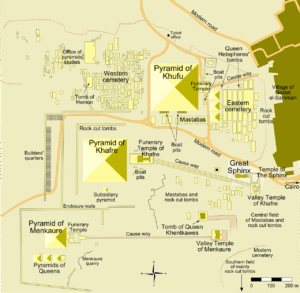
A useful pyramids of Giza map should show more than the three largest structures. The plateau is best understood as three adjoining royal complexes surrounded by satellite monuments and working areas
Northern Zone: Khufu’s Complex
The Great Pyramid occupies the northern part of the main archaeological area. On its eastern side are the remains of Khufu’s mortuary temple, three smaller queens’ pyramids, and the Eastern Cemetery, where members of the royal family were buried. The Western Cemetery spreads across the opposite side and contains orderly fields of mastaba tombs belonging to high officials. Boat pits were cut around the pyramid, including those that held the famous Khufu ships.
Central Zone: Khafre’s Complex and the Great Sphinx
Khafre’s pyramid stands southwest of Khufu’s. Its mortuary temple connects through a long causeway to one of the best-preserved valley temples of the Old Kingdom. Beside the lower end of this ceremonial route lies the Great Sphinx and its adjacent temple. This close physical relationship is one of the main reasons most Egyptologists associate the Sphinx with Khafre’s reign.
Southern Zone: Menkaure’s Complex
Menkaure’s pyramid is the smallest and southernmost of the three great pyramids. Three subsidiary pyramids stand beside it. Its temples reveal an interesting construction history: Menkaure died before the complete program was finished, and parts were completed more rapidly in mudbrick. The lower exterior of the main pyramid used red granite from Aswan, creating a striking contrast with the limestone employed higher up.
Southeast: Builders’ Settlement and Cemeteries
Southeast of the main monuments, archaeology has revealed settlement and burial areas connected to the people who supported the pyramid projects. These remains include houses, galleries, bakeries, storage areas, administration buildings, animal bones, and workers’ tombs. They offer a rare human perspective on the immense organization behind the royal monuments.
For navigation, use the Giza Pyramids location on Google Maps as a general reference, but follow the instructions provided with your ticket or tour because traffic management and the active visitor entrance can change. The current visitor system uses the Great Gate area on Al-Fayoum Desert Road and internal shuttle transportation rather than the former access pattern near Mena House.
The Great Pyramid of Khufu
The Great Pyramid is the oldest and largest pyramid at Giza and the only surviving member of the traditional Seven Wonders of the Ancient World. It originally rose to approximately 146.5 meters. The loss of its capstone and most of its polished outer casing reduced its present height, but the scale remains astonishing: each side of the base measures roughly 230 meters, enclosing an area large enough to contain several city blocks.
The structure consists mainly of locally quarried limestone. Fine white limestone from Tura covered the exterior, producing smooth faces that would have reflected the intense Egyptian sunlight. Granite transported from Aswan was used in the King’s Chamber and other structurally important internal areas. Estimates often suggest around 2.3 million blocks, although individual blocks vary greatly in size and the exact total remains an approximation.
The base is remarkably level and the sides are aligned extremely closely with the cardinal directions. This precision shows the ability of ancient surveyors to observe the sky, establish true north, control large right angles, and transfer measurements across a vast construction site. It does not require lost technology; it demonstrates disciplined measurement, repeatable techniques, and highly trained teams.
What Is Inside the Great Pyramid?
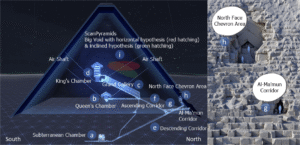
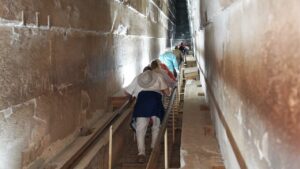
Visitors who purchase a separate Great Pyramid ticket enter through a passage on the north face. The internal route is physically demanding and very different from the decorated tombs of the Valley of the Kings. The walls are mostly bare stone, the passages can be narrow and steep, and heat can build quickly.
The principal known spaces include:
- The Descending Passage, which leads toward an unfinished chamber cut into the bedrock.
- The Ascending Passage, branching upward into the body of the pyramid.
- The Grand Gallery, a high, corbelled passage and one of the most impressive surviving spaces in ancient architecture.
- The so-called Queen’s Chamber, a traditional modern name; there is no evidence that a queen was buried there.
- The King’s Chamber, constructed from Aswan granite and containing a plain stone sarcophagus.
- Relieving chambers above the King’s Chamber, designed to manage the immense structural loads overhead.
- Narrow shafts extending from the upper chambers, whose practical and symbolic functions continue to be debated.
Entering the Great Pyramid is memorable because of its architecture and atmosphere, not because it contains inscriptions, treasure, or elaborate wall decoration. Travelers with claustrophobia, knee problems, respiratory conditions, or limited mobility may enjoy the exterior more and use their time for the Sphinx, temples, viewpoints, and nearby tombs.
The Khufu Boats
Boat pits were discovered beside the Great Pyramid. One contained an extraordinarily well-preserved wooden vessel that was reconstructed after excavation. Such boats may have been associated with the royal funeral, the king’s journey with the sun god, or both. The reconstructed Khufu ship has been moved from its former museum beside the pyramid to the Grand Egyptian Museum, where it can be conserved and interpreted in a modern setting.
The Pyramid Complex of Khafre
Khafre’s pyramid is the second largest at Giza. Because it stands on higher bedrock and retains casing near its summit, many first-time visitors mistakenly identify it as the Great Pyramid. Its original height was approximately 143.5 meters, only slightly shorter than Khufu’s monument.
The surviving cap of smooth Tura limestone gives us the clearest impression of how the pyramids once appeared. Instead of the stepped blocks visible today, much of each monument originally presented a continuous polished surface.
Khafre’s wider complex is particularly important. Its large mortuary temple, long causeway, and granite-lined valley temple preserve the sequence of spaces through which royal ceremonies moved. The valley temple contains immense limestone blocks faced with granite and a hall once filled with statues of the king. Its restrained geometry and enormous stones create one of the most powerful architectural interiors on the plateau.
The Great Sphinx of Giza
The Great Sphinx lies beside Khafre’s valley temple, facing east toward the rising sun. Carved largely from a natural limestone outcrop, it combines the body of a lion with the head of a royal figure wearing the nemes headdress. The monument is approximately 73 meters long and about 20 meters high, making it one of the largest surviving sculptures of the ancient world.
Most scholars date the Sphinx to the Fourth Dynasty and associate it with Khafre, although questions about its precise commission and original meaning remain open. The lion’s body expressed strength, while the royal head embodied intelligence, authority, and divine kingship. Its eastward orientation also gave the monument a powerful solar connection.
Wind, moisture, salt, changes in the groundwater environment, and the variable quality of the plateau’s limestone have all contributed to erosion. The Sphinx has undergone numerous ancient and modern restorations. Between its paws stands the Dream Stela erected by Thutmose IV more than a thousand years after Khafre. Its inscription recounts how the young prince encountered the sand-covered Sphinx in a dream and was promised kingship if he cleared the monument.
The Pyramid Complex of Menkaure
At around 65 meters in original height, Menkaure’s pyramid is less than half as tall as the other two main pyramids, but its material choices make it architecturally distinctive. Courses near the base were faced with red granite brought from Aswan, more than 800 kilometers to the south. Some surviving casing blocks remain rough, indicating that final dressing took place after the stones were positioned and that work stopped before every surface was finished.
Three smaller pyramids stand beside the main monument. These are generally associated with royal women or subsidiary ritual functions. Menkaure’s mortuary and valley temples were completed partly in mudbrick after his death, evidence that royal monuments could change according to time, resources, and succession rather than following an inflexible master plan.
A large vertical scar on the north face records a much later attempt to dismantle the pyramid. In the 12th century CE, workers acting for al-Aziz Uthman reportedly tried to demolish the monument. The difficulty and expense of removing even a small section demonstrated the extraordinary mass and stability of the ancient structure.
Queens’ Pyramids, Mastaba Tombs, and Temples
The Giza Plateau is not only a landscape of kings. Smaller pyramids near Khufu and Menkaure are associated with queens and other members of the royal household. The Eastern and Western Cemeteries contain hundreds of mastabas—rectangular tomb superstructures built above burial chambers—for princes, princesses, officials, priests, and administrators.
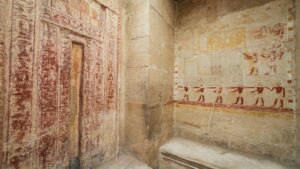
These tombs are essential to understanding Old Kingdom society. Their inscriptions and reliefs preserve titles, family relationships, offering rituals, food production, craft activities, farming, fishing, transport, and estate management. The beautifully decorated Tomb of Meresankh III, when open, offers a particularly vivid view of elite life and funerary belief.
The temples are equally important. A royal pyramid was intended to remain active after burial. Offerings of food, drink, incense, clothing, and ritual objects supported the deceased king’s cult. Priests performed ceremonies, administrators managed property, and generations of personnel worked around monuments that modern visitors often imagine as silent and abandoned.
Who Built the Great Pyramid of Giza?
The Great Pyramid was commissioned for Pharaoh Khufu. Ancient evidence identifies Khufu as its owner, while the high official Hemiunu is often considered the project’s leading administrator or architect because of his position and enormous tomb near the pyramid. However, no surviving document provides a modern-style list of designers and engineers.
The people who physically built and supplied the pyramids were Egyptian workers—not a mass of foreign slaves. Archaeology at Giza has uncovered workers’ settlements, food-production areas, animal remains, administrative spaces, and cemeteries. Skeletons with healed injuries indicate that at least some workers received treatment. Crew names and work-gang marks found within the Great Pyramid connect organized teams directly to Khufu’s project.
Harvard’s Digital Giza project summarizes modern estimates of roughly 20,000 to 30,000 workers, though the workforce would have included different groups at different times: permanent specialists, quarry workers, stone haulers, craftsmen, surveyors, boat crews, cooks, brewers, bakers, scribes, supervisors, and seasonal laborers. Ancient Egypt did not yet use coined money, so workers could be compensated through rations and state provisions, including bread and beer.
The real achievement was therefore not only lifting stone. It was coordinating food, housing, tools, transport, schedules, quality control, labor divisions, and religious ceremonies across many years. The Giza pyramids are monuments to administrative capacity as much as royal power.
How Were the Pyramids of Giza Built?
No surviving ancient manual explains the entire construction process, and archaeologists continue to debate the precise lifting system used at the highest levels. Still, the major stages are supported by strong physical and documentary evidence.
1. Surveying and Preparing the Plateau
Builders selected solid limestone bedrock, established the cardinal directions, laid out a square base, and created a level foundation. They could cut down higher areas of rock and incorporate remaining bedrock into the pyramid’s core, reducing the amount of stone that needed to be moved.
2. Quarrying the Stone
Much of the core limestone came from quarries on or near the Giza Plateau. Fine casing limestone came from Tura, across the Nile, while granite for chambers and other critical elements traveled from Aswan. Copper tools could work the softer limestone; hard stone required pounding stones and abrasive sand as well as patient, repeated labor.
3. Moving Materials by Water
The Diary of Merer, part of the Wadi el-Jarf papyri, provides rare first-person administrative evidence from late in Khufu’s reign. It describes a crew transporting high-quality limestone from the Tura quarries toward Khufu’s pyramid project by boat. Waterways, canals, basins, and harbor facilities brought heavy cargo closer to the construction zone than the modern desert setting might suggest.
4. Hauling Blocks Across Land
Workers likely moved large stones on wooden sledges. Egyptian imagery from other sites shows teams pulling heavy loads while liquid is poured in front of the sledge; experiments demonstrate that properly dampened sand can reduce resistance. Roads, tracks, levers, rollers in specific contexts, and carefully organized pulling teams may all have contributed.
5. Raising the Pyramid
Ramps remain the broadest accepted explanation for moving blocks upward, but their exact configuration is uncertain. Straight ramps, side ramps, zigzag systems, wrapping ramps, and combinations used at different stages have all been proposed. Levers may have assisted near the top. The most responsible conclusion is not that one fashionable theory has solved the pyramid, but that builders probably adapted several methods as height, space, block size, and construction phase changed.
6. Positioning and Finishing
Teams placed courses, controlled corners and slopes, adjusted blocks, and dressed the exterior casing to create smooth faces. The finished Great Pyramid would have looked very different from the rugged monument seen today: a brilliant geometric form covered in pale polished limestone.
Engineering Precision Without Pseudoscience
The pyramid builders achieved extraordinary accuracy, but their success becomes more—not less—impressive when it is understood as human knowledge. Egyptian surveyors had generations of practical experience, access to simple but precise instruments, careful observations of the sun and stars, and the administrative power to repeat measurements until they were correct.
Several sensational claims should be treated cautiously:
| Claim | What the evidence supports |
|---|---|
| “The pyramids were built by slaves” | Settlement, burial, ration, and crew evidence points to an organized Egyptian workforce that included specialists and laborers. |
| “Aliens built the pyramids” | No archaeological evidence supports extraterrestrial involvement; the monuments fit a visible Egyptian sequence of architectural development. |
| “We know the exact ramp design” | Ramps and hauling are strongly supported, but the full configuration used at every stage remains debated. |
| “The three pyramids exactly reproduce Orion’s Belt” | Astronomical symbolism mattered in Egyptian religion, but the popular Orion-correlation theory is not established fact. |
| “A vast underground city has been proven beneath Giza” | Archaeologists know of shafts, chambers, tombs, and subterranean features, but viral claims of an enormous hidden city are unverified. |
| “Nothing is known about the builders” | Archaeology has revealed settlements, cemeteries, team names, food supply, administration, tools, and transport records. |
Separating evidence from speculation strengthens the story. The known achievement—created with stone, wood, rope, water transport, observation, mathematics, organization, and human endurance—is already one of history’s greatest accomplishments.
Hidden Spaces and Modern Discoveries
Non-invasive technology continues to reveal new information inside the Great Pyramid. The ScanPyramids project used cosmic-ray muon imaging to identify a large void above the Grand Gallery in 2017. Its minimum length is about 30 meters, but its purpose, exact shape, and accessibility remain unknown.
In 2023, researchers precisely characterized a corridor behind the chevron-shaped stones on the north face. The North Face Corridor is approximately nine meters long. Like the larger void, it may relate to construction, structural load management, or an unknown architectural feature; evidence does not yet justify a dramatic conclusion.
These discoveries show why careful language matters. Scientists can detect a low-density space and estimate its dimensions without immediately knowing what it was for. A void is not automatically a treasure chamber, secret tomb, or proof of an alternative civilization. At Giza, the most exciting discoveries often begin with a precise question rather than a sensational answer.
Giza Pyramid Tickets and Entrance Prices in 2026
Visitors need a general Giza Plateau admission ticket. Entering the interior of a pyramid or certain tombs requires a separate ticket, and availability can rotate for conservation or operational reasons.
As checked against the Egyptian Ministry of Tourism and Antiquities pages on 30 August 2026, the listed foreign-visitor prices include:
| Ticket | Foreign adult | Foreign student | Important note |
|---|---|---|---|
| Giza Plateau area entry | EGP 700 | EGP 350 | Does not include entry inside the principal pyramids or separately ticketed tombs |
| Interior of the Great Pyramid of Khufu | EGP 1,500 | EGP 750 | General area ticket is also required |
| Interior of the Pyramid of Menkaure | EGP 280 | EGP 140 | General area ticket is also required; opening can change |
| Tomb of Queen Meresankh III | EGP 200 | EGP 100 | General area ticket is also required; subject to opening status |
Ticket prices, accessible interiors, and visitor procedures can change without much notice. Check the official Egyptian monuments ticket platform shortly before visiting. Students should bring an accepted physical student ID and confirm eligibility at purchase. It is wise to buy desired interior tickets early because daily access may be limited.
Where Is the Giza Pyramid Ticket Office?
The visitor-arrival system has changed from older guidebooks and blog posts. The main access now operates through the Great Gate area on Al-Fayoum Desert Road, with ticketing and internal transport organized from the visitor zone. Do not automatically ask a driver for the old Mena House gate or follow an outdated pin. Use the location specified on the official ticket platform or your confirmed tour instructions.
Buying official Giza pyramid tickets online reduces uncertainty and helps visitors avoid unofficial sellers. A legitimate guide or tour operator should clearly distinguish government admission from guiding, transportation, camel rides, meals, and other services.
Giza Pyramids Opening Hours
Official Egyptian pages are not perfectly synchronized: the Ministry’s Giza Plateau information page currently displays 8:00 AM to 4:00 PM, while the official online ticket platform lists a 7:00 AM opening with last entry at 4:00 PM. Individual pyramid pages may show wider monument hours, but access still depends on the main site operation.
For this reason, verify the hours shown for your exact visit date before leaving. Ramadan schedules, public holidays, special events, conservation work, and summer operations can affect access. Arriving early remains the best strategy for softer light, more comfortable temperatures, and additional time if security or shuttle queues develop.
How to Visit the Giza Pyramids Complex
A Practical Half-Day Route
For a first visit of three to four hours, use this sequence:
- Begin with the Great Pyramid of Khufu while energy levels and temperatures are favorable.
- Visit the Eastern Cemetery and queens’ pyramids if accessible.
- Continue toward Khafre’s pyramid and observe its surviving casing stones.
- Stop at the panoramic viewpoint for the classic alignment of the three main pyramids and smaller subsidiary pyramids.
- Continue to Menkaure’s complex if time and mobility permit.
- Finish at Khafre’s valley temple and the Great Sphinx, where the ceremonial relationship between pyramid, causeway, temple, and guardian sculpture becomes clear.
The active internal transport plan may determine the order of stops, so adapt this route to current shuttle circulation and staff instructions.
A Full-Day Giza Experience
Travelers with a full day can explore the plateau more carefully, enter one pyramid, visit an open mastaba tomb, spend time at the panoramic viewpoint, and continue to the Grand Egyptian Museum. This combination connects monumental architecture with the objects, royal collections, and Khufu boat that give the site a more human scale.
If Giza is part of a wider stay, our Cairo Travel Guide helps connect the plateau with the Grand Egyptian Museum, Egyptian Museum, Islamic Cairo, Coptic Cairo, and the city’s major cultural districts.
Best Time to Visit the Pyramids of Giza
October through April generally offers more comfortable daytime conditions than the hottest summer months. December and January can be pleasantly cool, though mornings may feel cold and haze can affect long-distance views. Spring sometimes brings dusty winds, while summer requires much stronger heat planning.
Whatever the season, early morning is usually the most rewarding time. The stone colors are warmer, the heat is lower, and the experience feels calmer before the busiest part of the day. Late-afternoon light can be beautiful, but a late arrival leaves little margin for ticketing, internal transport, walking, or a pyramid interior.
Wear breathable clothing, sturdy closed or supportive shoes, sun protection, and a hat. Carry water, but avoid overpacking because security screening and repeated movement around the site make heavy bags inconvenient.
Should You Go Inside the Great Pyramid?
Go inside if you are comfortable with steep, narrow passages and want to experience the engineering of the Grand Gallery and King’s Chamber. It is one of the rare opportunities to enter the core of an Ancient Wonder.
Skip the interior if you expect decorated chambers, treasure, or an easy walk. The route is enclosed, humid, physically strenuous, and may involve passing other visitors in confined spaces. The plateau’s temples, Sphinx, viewpoints, cemeteries, and exterior architecture can provide a richer experience for travelers who prefer open spaces.
If choosing only one paid extra, base the decision on your interests rather than the fame of the Great Pyramid. Architecture enthusiasts may prioritize the interior; art and social-history enthusiasts may prefer a decorated mastaba such as Meresankh III when open.

Visiting with Children, Seniors, or Limited Mobility
The plateau covers a large, exposed area with uneven ground, slopes, dust, and limited shade. Families should plan shorter walking stages, regular water breaks, and a clear meeting point. Young children often enjoy the panoramic viewpoint and Sphinx more than a hot, confined pyramid passage.
Older travelers and visitors with limited mobility benefit from private transportation to the main entrance, assistance with the active shuttle system, and an itinerary focused on the most accessible viewpoints. Entering a pyramid is not essential to appreciate Giza. A knowledgeable Egyptologist can bring the landscape to life from carefully chosen stops without requiring the longest walks.
Photography, Camels, and Visitor Etiquette
Personal photography is generally allowed outdoors. The Egyptian Tourism Authority states that personal photos and videos are permitted at archaeological sites without a permit, but flash should not be used indoors. Commercial photography, large equipment, and drones are governed by different rules and may require authorization.
For camel or horse experiences, agree on the full price, route, duration, and whether the amount covers mounting, dismounting, photos, and return transport before beginning. Use operators working in authorized areas and prioritize animal welfare. A private guide can help manage these arrangements, but visitors are never required to take an animal ride to see the monuments.
Do not climb the pyramids, touch fragile reliefs, cross barriers, remove stones, or enter closed areas. The plateau is not only a photo backdrop; it is an active archaeological landscape and a UNESCO World Heritage property.
How to Make the Visit More Meaningful
The best Giza visit is not necessarily the one with the longest checklist. It is the one that reveals connections: the position of temples east of the pyramids, the route of a causeway, the difference between local limestone and imported granite, the reason Khafre looks taller, the administrative titles in nearby tombs, and the evidence left by workers.
A licensed Egyptologist can turn these features into a coherent story and help visitors distinguish established evidence from popular mythology. Private guiding is especially valuable for families, photographers, senior travelers, and anyone combining the plateau with the Grand Egyptian Museum or Saqqara in one carefully timed day.
Delta Tours Egypt has arranged private journeys across Egypt since 1974. Travelers can explore flexible Egypt tours, compare classic Egypt tours and budget Egypt tours, or request a privately guided experience through our luxury Egypt tours. The purpose is not simply to arrive at the pyramids, but to experience them with the right timing, context, pace, and level of comfort.
Frequently Asked Questions About the Giza Pyramids
Where are the pyramids of Giza?
The pyramids stand on the Giza Plateau on the western side of Greater Cairo, Egypt. They are beside the modern city of Giza, not in a remote desert far from Cairo. Use the Giza Pyramids Complex Google Maps result as a general location, then confirm the current visitor entrance before departure.
When were the pyramids of Giza built?
The three principal pyramids were constructed during Egypt’s Fourth Dynasty, broadly in the 26th and 25th centuries BCE. Khufu’s Great Pyramid came first, followed by Khafre’s and Menkaure’s pyramids.
Who built the Great Pyramid of Giza?
Khufu commissioned the Great Pyramid, and Hemiunu is often identified as its senior project administrator or architect. The physical work was completed by organized Egyptian crews that included skilled craftsmen, permanent workers, boat crews, administrators, and laborers—not by aliens or a mass workforce of foreign slaves.
How many pyramids are in the Giza Pyramids Complex?
There are three principal royal pyramids, but the full site includes several smaller queens’ and subsidiary pyramids. The exact number someone gives can vary depending on whether ruined or disputed satellite structures are counted.
Which is the largest pyramid at Giza?
The Great Pyramid of Khufu is the largest. Khafre’s pyramid can look taller because it occupies higher ground and retains casing near its top.
Can you enter the pyramids of Giza?
Visitors can normally enter selected pyramids with separate tickets, but availability may change because of conservation, maintenance, crowd control, or rotating openings. A general plateau ticket alone does not include pyramid interiors.
How much are the pyramids of Giza tickets?
On 30 August 2026, the Ministry website listed foreign-adult general admission at EGP 700 and foreign-student admission at EGP 350. The Great Pyramid interior was listed separately at EGP 1,000 for foreign adults and EGP 500 for foreign students. Always verify current prices through the official ticket platform.
How long should I spend at the Giza Pyramids?
Allow at least three to four hours for the principal monuments and Sphinx. Plan a full day if you want a pyramid interior, tombs, unhurried photography, detailed guiding, or a combined visit with the Grand Egyptian Museum.
Is the Great Sphinx included in the Giza Plateau visit?
The Sphinx precinct forms part of the main archaeological visit. Special events or restricted areas may operate differently, but ordinary viewing is part of the plateau experience.
Are the Giza Pyramids close to the Grand Egyptian Museum?
Yes. The Grand Egyptian Museum stands close to the Giza Plateau, making the two sites a natural full-day combination. Allow enough time for both; each deserves several hours.
Is a guided Giza Pyramids tour worth it?
Yes, especially for a first visit. A qualified Egyptologist explains the site’s layout, chronology, religious purpose, engineering evidence, and less obvious tombs and temples while helping manage tickets, timing, transport, and current entrance procedures.
Why the Giza Pyramids Still Matter
The lasting power of Giza comes from scale, but also from detail. The plateau records the decisions of kings, the measurements of surveyors, the journeys of boat crews, the strength of stone haulers, the calculations of builders, the rituals of priests, and the hopes of families who prepared for eternity.
The Great Pyramid is often described as mysterious, yet the evidence makes it deeply human. Its remaining questions do not erase what archaeology has revealed. They invite us to look more carefully at how knowledge, labor, landscape, and belief came together in one of the most complex building programs of the ancient world.
Whether you arrive as a history enthusiast, a family introducing children to Egypt, a solo traveler fulfilling a lifelong dream, or a guest seeking a privately guided luxury experience, the Giza Pyramids Complex is more rewarding when seen as a complete landscape. Stand beneath the Great Pyramid, follow Khafre’s causeway toward the Sphinx, look back across the plateau, and the famous skyline becomes what it was always meant to be: a carefully ordered vision of kingship, memory, and eternal life.