Visiting the Giza Pyramids and Sphinx Privately: What to Expect
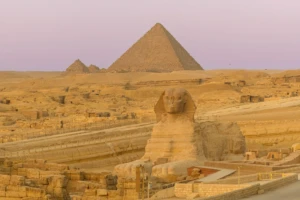
There is a moment at Giza when scale stops being an abstract idea. You stand below the Great Pyramid, look up along its immense limestone face, and realize that the horizon itself seems to have been redesigned. A little later, at the eastern edge of the plateau, the body of a lion and the head of a king emerge from the bedrock: the Great Sphinx, silent before the temples and causeway of Khafre.
A private visit to the Giza Pyramids and Sphinx gives you time to understand that landscape rather than simply photograph it. With your own Egyptologist and private transport, you can shape the route around your interests, spend longer at the monuments that matter to you, and move at a pace that suits couples, families, photographers, history enthusiasts, or travelers who prefer a more comfortable day.
Yet “private” can describe several very different experiences. A private guide does not make the Giza Plateau itself private. Entering the Great Pyramid requires a separate interior ticket. Walking down into the restricted Sphinx enclosure requires advance governmental permission. A complete private opening outside ordinary public access is a further level of authorization.
That distinction matters. It helps you choose the right experience, understand the price you are quoted, and avoid a common misunderstanding behind searches such as inside Sphinx or great Sphinx inside. The rare special-access experience usually brings approved guests into the enclosure around the monument—potentially close to the forepaws and the Dream Stela. It does not mean entering a tourist chamber inside the Sphinx’s body.
Important access notice: Restricted Sphinx-enclosure visits and private site openings are subject to advance written approval, conservation requirements, security decisions, official fees, and availability. Timing, group size, permit conditions, and access routes can change. No special access should be described as confirmed until the responsible authority has approved it in writing.
Private Giza Visit at a Glance
| Experience | What is private? | What you can normally see | Advance approval |
|---|---|---|---|
| Privately guided visit during public hours | Your guide, vehicle, pace, and itinerary | Public areas of the Giza Plateau, the pyramids, panorama points, public Sphinx viewing area, and accessible temples | Tour booking required; ordinary site tickets apply |
| Pyramid-interior visit | Your guiding arrangement remains private, but the passage may be shared with other ticket holders | The interior route of an open pyramid, subject to the ticket purchased and daily access | Separate dated ticket; capacity and closures may apply |
| Authorized Sphinx-enclosure access | Entry to a normally restricted zone is arranged for the approved party under stated conditions | A much closer perspective within the enclosure, subject to the permit and on-site direction | Yes—governmental authorization and special fees |
| Full private opening | An authorized monument or site is opened for the approved group under special conditions | Only the areas named in the permission | Yes—higher-level coordination, opening fees, and final written confirmation |
For most travelers, the best-value choice is a privately guided Giza Plateau tour during public hours, with the option to add a pyramid-interior ticket. Permit-based Sphinx access is designed for those seeking an unusually close archaeological experience and who have enough flexibility to accommodate the approval process.
What Makes a Private Giza Pyramids and Sphinx Tour Different?
Giza is not one monument. It is a vast royal necropolis containing pyramids, temples, causeways, tombs, ancient quarries, and traces of the communities that supported the building projects. UNESCO includes Giza within the World Heritage property “Memphis and its Necropolis – the Pyramid Fields from Giza to Dahshur,” whose remains document the evolution of Egyptian royal burial architecture. The Great Pyramid of Khufu is the only surviving Wonder of the Ancient World.
A rushed group route can reduce this connected landscape to three photo stops. A well-designed private tour restores the connections. Your Egyptologist can explain why Khafre’s pyramid appears taller despite being smaller than Khufu’s, where the original polished casing survives, how temple and causeway architecture framed royal ritual, and why the Sphinx belongs in a wider architectural conversation rather than in isolation.
Private travel also creates practical advantages:
-
A flexible pace: Spend more time discussing construction, religion, art, or archaeology and less time waiting for a large group.
-
Smarter sequencing: Adapt the route to heat, visibility, crowds, mobility, ticket times, and any confirmed special-access appointment.
-
Personal interpretation: Ask detailed questions and separate established evidence from attractive but unsupported theories.
-
Comfort: Travel between plateau stops in a private air-conditioned vehicle where permitted, with hotel pickup and drop-off if included in your proposal.
-
Better fit for families: Build in shade, rest stops, and age-appropriate explanations rather than forcing children through a fixed lecture.
-
Clearer access planning: Coordinate ordinary admission, optional pyramid entry, and permit-dependent elements as separate items.
A private tour is therefore not simply a luxury upgrade. It can be the most efficient way to make a complex archaeological site intelligible.
Four Experiences Travelers Often Confuse
1. A private guide at a public archaeological site
This is the standard form of a private tour in Egypt. You have a private Egyptologist, vehicle, and itinerary, but you visit while the Giza Plateau is open to other ticket holders. You will still encounter other travelers at major viewpoints, near pyramid entrances, and around the public Sphinx viewing zone.
The advantage is control. Your party chooses the pace and focus, and the route can be adjusted as conditions change. This is the right option for the great majority of visitors.
2. Going inside one of the pyramids
Yes, you can go inside selected pyramids when their interiors are open and the appropriate separate ticket is available. The Great Pyramid experience usually involves steep or confined passageways, warm conditions, and bending or climbing. It is physically memorable, but the route is not lined with painted reliefs or glittering treasure. The architectural achievement is the point.
An interior ticket is not automatically included in general Giza Plateau admission. It is also unrelated to Sphinx-enclosure authorization. Ask your tour planner to name the exact pyramid, ticket category, and access conditions in the quotation.
3. Entering the restricted Sphinx enclosure
Most visitors view the Sphinx of Egypt from the designated public route near the valley-temple area. A specially authorized visit may allow an approved party to enter the lower enclosure around the monument and see the Sphinx from a dramatically closer perspective.
This is sometimes marketed as going “inside the Sphinx,” but that phrase is misleading. You may be inside the restricted Sphinx area or enclosure; you are not walking into a public chamber within the sculpture.
The precise route is controlled on site. Approval may specify the date, time, group, duration, and conduct. Conservation and security instructions take priority over any advertised itinerary. Never assume that close access includes permission to touch the monument.
4. A complete private opening
A full private opening is not merely a quiet time slot. It requires official arrangements to open a named area for an approved group under special conditions. It may involve site-opening charges in addition to normal tickets, guiding, transport, and administrative costs.
Operators sometimes advertise early-morning schedules, but no hour should be treated as universal. Site operations, seasonal timetables, official events, conservation work, and security can affect what is possible. A responsible proposal will identify the requested access level, state that it is subject to approval, and provide a clear alternative if permission is unavailable.
A Thoughtfully Paced Private Giza Itinerary
The following route is a model, not a promise of restricted access. Your actual sequence should reflect official opening conditions, ticket availability, weather, traffic, your mobility, and any approved appointment.
Hotel pickup and arrival at Giza
Your guide meets you at your Cairo or Giza hotel at the confirmed time. On the drive, an Egyptologist can establish the historical setting: the Fourth Dynasty of the Old Kingdom, the royal families behind the three principal pyramids, and the administrative capacity required to quarry, transport, organize, and place stone on an extraordinary scale.
Arriving near opening time often offers cooler conditions and a calmer start, although crowd patterns are never guaranteed. Keep your passport or requested identification accessible if your booking documents require it.
The Great Pyramid of Khufu
Begin with the monument that transformed the plateau. Built for King Khufu in the 26th century BCE, the Great Pyramid originally rose to roughly 146.6 meters and remains the largest pyramid at Giza. Most of its fine outer casing has disappeared, exposing the stepped core masonry familiar today.
Standing at the base, your guide can draw attention to the scale of individual blocks, the leveled bedrock, the surrounding boat pits, subsidiary monuments, and the remains of the wider pyramid complex. This is also the moment to discuss construction evidence responsibly. Archaeologists continue to debate details of ramps, hauling systems, work organization, and construction sequence, but the surviving site and excavated workers’ settlement demonstrate an organized Egyptian labor force—not a lost civilization or supernatural intervention.
If you have purchased an interior ticket and are comfortable with confined spaces, this is often where you enter the pyramid. Allow enough time to move safely. The passage can feel strenuous even for fit visitors, and there is little benefit in rushing.
Khafre’s pyramid and the high plateau
Khafre’s pyramid stands on slightly higher ground and retains a cap of smooth limestone casing near its summit. This creates the optical illusion that it exceeds Khufu’s pyramid, although it was originally lower.
The surrounding complex is crucial to understanding the Sphinx. Khafre’s upper pyramid temple connected by a causeway to the valley temple near the eastern edge of the plateau. Archaeological and geological relationships between the Sphinx, its enclosure, the Sphinx Temple, and Khafre’s complex make Khafre the most widely accepted builder associated with most of the Great Sphinx, though the evidence is contextual rather than a surviving foundation inscription that says plainly, “Khafre built the Sphinx.”
This nuance is one reason an Egyptologist-led tour is valuable. The best interpretation acknowledges where evidence is strong and where an ancient question remains open.
Menkaure’s pyramid and the queens’ monuments
The third principal pyramid belonged to Menkaure. Smaller in scale, it rewards a closer look at materials and changing ambitions. Granite casing survives around part of its lower courses, some left unfinished and revealing stages of stone dressing.
Nearby subsidiary pyramids and temple remains turn the stop into more than a size comparison. They help explain the royal cemetery as an interconnected landscape of kings, queens, cult practice, and long-term commemoration.
The panoramic viewpoint
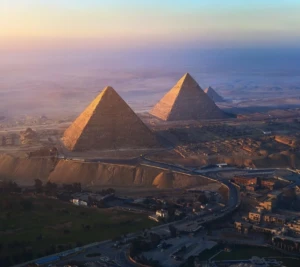
A panorama stop gathers the three principal pyramids into a single desert composition. The famous alignment changes as you move, so a private vehicle and flexible timing make photography easier. Haze, season, sun angle, and wind all affect visibility; no tour can guarantee a perfectly clear skyline.
Camel or horse activities may be available through local providers, but welfare and safety standards vary. If you want to ride, request a vetted provider in advance and confirm duration and price before beginning.
Khafre’s valley temple
Near the Sphinx, massive limestone and granite architecture reveals the ceremonial end of Khafre’s causeway. The valley temple is often treated as a corridor to a photo platform, yet it deserves attention in its own right. Its stonework and plan offer essential context for the royal cult and the monuments around it.
Conditions sometimes change the exact visitor route. Follow barriers and on-site instructions rather than assuming every chamber or passage will be open.
The Great Sphinx of Giza
The Great Sphinx faces east, carved largely from a limestone mass left when ancient workers cut the surrounding ditch. Its lion body and royal human head made it an enduring symbol of power and guardianship, though the name “Sphinx” is Greek and later than the monument itself.
From the public route, your Egyptologist can explain the monument’s geology, restoration history, missing features, temple setting, and changing religious significance. Between the forepaws stands the Dream Stela of Thutmose IV, installed more than a millennium after the Sphinx was created. Its text recounts a royal encounter with the monument and records its renewed importance in the New Kingdom.
If your party has received written authorization for enclosure access, you will proceed only as directed by the officials responsible for the site. The special value is not a theatrical secret room. It is the change in viewpoint: the immense paws, the height of the chest, the strata in the bedrock, the later masonry repairs, and the relationship between statue and temples become far more legible at close range.
That is the real privilege—an archaeological landscape seen from a normally restricted perspective.
Can You Go Inside the Sphinx?
No public visitor route leads into a chamber inside the Great Sphinx. When a tour advertises the chance to go inside the Sphinx of Giza, it usually means authorized entry into the restricted enclosure around the statue, not entry into its body.
The distinction can be stated simply:
-
Inside the Sphinx enclosure: Sometimes possible with advance official permission.
-
Inside the body of the Great Sphinx: Not a normal tourist experience and not part of an ordinary or special enclosure visit.
-
Inside a pyramid: Possible for selected open pyramids with a separate ticket, subject to daily access and capacity.
This answer addresses several common searches—can you go inside the Sphinx, can you go inside the Great Sphinx, and Sphinx Egypt inside—without creating a false promise.
What’s inside the Sphinx?
The monument is primarily a colossal sculpture carved from the natural limestone bedrock, with extensive masonry repairs added over time. Archaeological mapping has documented the geology, restoration phases, and a known passage associated with the monument. Modern teams have also used survey methods including ground-penetrating radar around the Sphinx area.
That evidence is not the same as a verified, visitor-ready Hall of Records, treasure chamber, or network of secret rooms. Popular stories often turn natural fissures, documented cuttings, or survey anomalies into certainty. Responsible archaeology does not. As of this writing, there is no authenticated hidden library beneath the Sphinx that travelers can book a tour to enter.
Who Built the Great Sphinx—and Why?
The Great Sphinx is generally dated to Egypt’s Fourth Dynasty, around the period when the main Giza pyramid complexes were created. Most Egyptologists associate the monument primarily with Khafre because of its physical and architectural relationship to his causeway, valley temple, and the adjacent Sphinx Temple.
AERA’s archaeological work strengthens that connection. Researchers mapped geological layers in the Sphinx and traced matching limestone blocks into the Sphinx Temple, showing that cutting the enclosure and building the temple belonged to the same quarry-and-construction process. Mark Lehner concludes that the case for Khafre is strong, though not absolute; a possible earlier beginning under Khufu remains a hypothesis rather than established fact.
The monument’s original ancient name is not securely known. Its later roles changed across Egyptian history. New Kingdom rulers honored it as a solar deity, and Thutmose IV’s Dream Stela helped reshape its royal meaning. Sand repeatedly buried much of the body, while successive clearing and restoration campaigns altered what visitors could see.
Several sensational claims circulate online, from a date thousands of years before dynastic Egypt to hidden chambers containing lost knowledge. These ideas remain outside the archaeological consensus because they do not explain the monument’s quarry, temple, architectural context, and material sequence more convincingly than the Fourth-Dynasty evidence does.
Mystery is part of the Sphinx’s appeal, but good history becomes more fascinating—not less—when questions are labeled honestly.
Can You Go Inside the Pyramids?
Yes, subject to opening status and the correct ticket. Travelers most often ask about the Great Pyramid, but access policies may rotate between monuments or change for conservation and operational reasons.
What the Great Pyramid interior is like
The route normally involves an ascending passage and confined sections before reaching the chamber area open to visitors. Expect stone surfaces, humidity or warmth, other visitors moving in both directions, and physical exertion. Do not expect hieroglyph-covered walls, a mummy, or artifacts left in place.
Entry may not suit travelers with claustrophobia, significant knee or back problems, heart or respiratory concerns, balance difficulties, or limited mobility. When in doubt, discuss the physical demands with a medical professional and your tour planner. Staying outside does not diminish the experience; the pyramid’s exterior, complex, and surrounding archaeology contain far more context than the interior passage alone.
Ticketing matters
General Giza admission and pyramid-interior entry are separate products. At the time of checking on September 2, 2026, Egypt’s official ticket portal listed general adult admission for other nationalities to the Giza Plateau at EGP 700, with a student ticket of EGP 350, opening at 7:00 a.m. and last entry at 4:00 p.m. Prices, hours, available pyramid interiors, and ticket categories can change without this page being updated, so confirm directly on the official Egyptian monuments ticket portal immediately before booking.
Restricted Sphinx access is not included in ordinary Giza admission. Its fee and conditions should be stated separately in a written proposal once the requested permission has been assessed.
How Permit-Based Sphinx Access Is Arranged
A genuine special-access request involves more than selecting an add-on at checkout. The exact administrative path can vary, but a responsible planning process should look like this:
-
Define the experience. State whether you want a private guide during public hours, entry to a pyramid, restricted Sphinx-enclosure access, or a complete private opening. These are not interchangeable.
-
Provide the requested details. The organizer may need your preferred date, alternative dates, party size, nationalities, and passport information. Supply sensitive information only through the company’s secure booking process.
-
Allow time for authorization. Apply well in advance. There is no universal lead time that guarantees approval, and last-minute requests may not be feasible.
-
Wait for written confirmation. A sales description or provisional itinerary is not an official permit. Your booking should specify when access becomes confirmed and which fees become non-refundable.
-
Review the exact conditions. Confirm the approved time, duration, named area, identity requirements, photography rules, and any restrictions on equipment or conduct.
-
Keep a strong alternative. If approval is declined, delayed, or changed, proceed with an expertly guided public visit and any separately confirmed pyramid ticket rather than losing the entire day.
The Ministry of Tourism and Antiquities has previously published ticket documentation identifying the Sphinx as available for “private visits only” with a site-opening fee. That establishes the category, but an older fee sheet should never be treated as a current quotation. Ask for a fresh, itemized price tied to your requested date and access level.
What Should a Private-Tour Proposal Include?
Because inclusions differ among Egypt private tours, never rely on the word “private” alone. A clear proposal should identify:
-
Private hotel pickup and return, including the covered pickup zone
-
Vehicle type and whether it remains available throughout the Giza visit
-
A qualified private Egyptologist and the language requested
-
General Giza Plateau admission
-
The exact pyramid-interior ticket, if requested
-
Special-access application and official charges, if requested
-
Whether special access is pending or confirmed
-
Meals, bottled water, gratuities, and optional activities
-
Photography or professional-equipment permissions where relevant
-
Cancellation terms for both ordinary and permit-based services
-
The alternative itinerary if authorities change or decline access
Do not assume that “VIP,” “exclusive,” or “private opening” has a standardized meaning. The name of the approved area and the written conditions matter more than the marketing label.
Choosing the Right Giza Experience for Your Travel Style
Luxury travelers and special occasions
Prioritize a high-quality guide, a comfortable vehicle, unhurried timing, and seamless coordination. Permit-based enclosure access may add meaning to a milestone journey, proposal, anniversary, or serious archaeological interest, but only if you accept that authorization remains outside the tour company’s direct control.
Travelers building a wider premium itinerary can explore Egypt luxury tours that connect Cairo with the Nile Valley while keeping private guiding and transport consistent.
Families
A private guide can translate the Giza story into vivid, age-appropriate ideas: how a pyramid was planned, what ancient workers ate, why the Sphinx combines human and animal forms, and what archaeologists learn from a quarry. A three- or four-hour focused visit is often more successful than an overloaded day.
For younger children, prioritize shade, hydration, bathrooms, and safe walking over pyramid-interior entry. Narrow passages may be uncomfortable, and strollers are not practical across many archaeological surfaces.
Solo travelers
A private tour offers dependable transport, an expert companion, and freedom to ask detailed questions. It also simplifies movement across a plateau where major monuments are spread out. Solo pricing may be higher per person because guiding and transport costs are not shared, so ask for an itemized quote.
Travelers on a classic itinerary
Combine Giza with Cairo’s major museum collections or another necropolis. A full day can pair the plateau with the Grand Egyptian Museum when your desired galleries and admission are available, while a second day at Saqqara shows how pyramid architecture developed before Giza. Read the Saqqara guide for planning context.
Budget-conscious travelers
Spend on the elements that materially improve the visit: a good Egyptologist and efficient private transport. Skip special-access fees if they strain the budget; the public Giza route remains extraordinary. Compare broader Egypt budget tours if you want to spread private experiences selectively across a longer trip.
Half-Day or Full-Day Giza Tour?
Half-day private Giza tour
A focused half day can cover the three main pyramids, a panorama stop, the valley-temple area, and the public Sphinx viewpoint. Add a pyramid interior only if your pace allows. This format suits short Cairo stays, families, and travelers who prefer one major archaeological experience at a time.
If specially authorized Sphinx access is the central purpose of your visit, protect the schedule around the approved appointment rather than adding too many stops.
Full-day Giza and museum tour
Pair the monuments with museum displays that restore sculpture, royal imagery, and material culture to the architectural landscape. Exact museum access, opening times, and ticketing should be checked for your date. Keep expectations realistic: a serious Giza visit plus an enormous museum can be mentally and physically demanding.
Full-day Giza and Saqqara tour
This is the strongest archaeological narrative. Saqqara introduces earlier experiments in monumental stone building, including Djoser’s Step Pyramid complex, while Giza shows the mature royal pyramid landscape of the Fourth Dynasty. It answers not only “What are the pyramids?” but “How did Egyptian pyramid building develop?”
For more local planning, accommodation ideas, and city logistics, use the Cairo travel guide.
Practical Tips for Visiting Giza Privately
Best time of day
Earlier entry usually means cooler air and more usable time, but special-access appointments may determine your schedule. Winter offers milder temperatures and higher visitor demand. Summer visits require serious heat planning. Clear views depend on atmospheric conditions and cannot be guaranteed.
What to wear
Choose breathable clothing, sun protection, and closed shoes with reliable grip. Giza’s surfaces include sand, uneven stone, slopes, and polished or worn areas. A light layer can help in cooler winter mornings. Egypt is accustomed to international visitors, but comfortable, respectful clothing is the most practical choice.
What to carry
Bring water, sunscreen, a hat, sunglasses, necessary medication, a small amount of cash, and the identification specified in your booking. Keep bags compact, especially if entering a pyramid. Rules for tripods, drones, commercial filming, and professional equipment differ from ordinary personal photography and may require separate permission. Never fly a drone without explicit legal authorization.
Accessibility
The scale and terrain make parts of the Giza Plateau challenging for wheelchair users and travelers with limited mobility. Private transport can reduce walking between major zones, but it cannot remove steps, sand, narrow passages, or uneven ancient surfaces. Ask for a route based on your exact needs before payment. Pyramid interiors are generally unsuitable for wheelchair access and many mobility limitations.
Conservation etiquette
The monuments have survived for millennia but remain vulnerable. Do not climb, scratch, lean on fragile surfaces, remove stone, cross barriers, or touch the Sphinx unless an official instruction explicitly allows contact—which should never be assumed. Special access is a responsibility as much as a privilege.
Touts and optional services
Private guiding reduces uncertainty, but independent vendors may still approach visitors. Agree on the full price, currency, duration, and inclusions before any ride, photograph, or purchase. A polite, firm refusal is sufficient when you are not interested.
Our private Pyramids Day Tour and Grand Egyptian Museum and Pyramids tour start from Cairo and Giza hotels; see all our Cairo day tours or our private Egypt tours.
Frequently Asked Questions
Is a private Giza Pyramids and Sphinx tour completely crowd-free?
Not during ordinary public hours. Your guide, vehicle, and itinerary are private, but the archaeological site is open to other visitors. A specially authorized opening may offer a more exclusive setting, yet its scope and timing depend on the permit.
Can you go inside the Sphinx?
Not in the sense of entering a visitor chamber within its body. With advance permission, an approved party may be able to enter the normally restricted enclosure around the Great Sphinx.
Can you go inside the Sphinx of Giza during a normal ticketed visit?
No. Ordinary admission gives access to designated public visitor routes. Restricted enclosure entry is a separate, permit-based arrangement.
What’s inside the Sphinx?
The Sphinx is carved primarily from limestone bedrock and has undergone extensive masonry repair. Researchers have documented geological fissures, survey features, and a passage, but there is no verified public treasure chamber or Hall of Records that tourists can enter.
Can you go inside the pyramids?
Yes, when a selected pyramid is open and you hold the correct separate ticket. Capacity, closures, and the open monument can change.
Is the Great Pyramid interior decorated?
No. Visitors go for the architecture and physical experience rather than painted walls or artifacts. The open route is confined and can be strenuous.
Does a private tour include Great Pyramid tickets?
Only if the proposal names that ticket explicitly. General plateau admission, pyramid-interior entry, and restricted Sphinx permission are different charges.
How far in advance should I request private Sphinx access?
As early as practical. There is no fixed lead time that guarantees approval. Provide alternative dates and do not make non-refundable travel decisions until you understand the confirmation and cancellation terms.
Is touching the Sphinx allowed during private access?
Do not assume so. Follow the written conditions, barriers, and on-site official instructions. Conservation rules can limit contact even when enclosure entry is approved.
Who built the Great Sphinx?
Most Egyptologists associate most of its creation with Khafre in the Fourth Dynasty because of the monument’s geological and architectural relationship to his complex. The case is strong but not based on a surviving inscription naming him as builder.
How long should a private Giza visit take?
Allow roughly three to five hours for a thoughtful plateau visit, depending on walking pace, pyramid entry, traffic within the site, and time spent at each monument. A museum or Saqqara extension normally turns it into a full day.
Is the tour suitable for children?
Yes, especially with a private guide who can adapt the story and pace. Consider heat, walking distances, and whether confined pyramid passages suit each child.
Can I book a Giza Pyramids and Sphinx tour from Cairo?
Yes. Most private arrangements begin and end at a Cairo or Giza hotel, subject to the pickup area stated in the quote. Review Egypt tours if Giza will be part of a wider itinerary.
Are special openings always available?
No. Official events, security, conservation work, operating decisions, and permit availability can affect access. A responsible organizer will state this clearly and prepare an alternative.
Is a private Giza tour worth it?
For travelers who value interpretation, efficient transport, flexible pacing, or family comfort, usually yes. Restricted access can be memorable, but an excellent Egyptologist-led public visit delivers the greatest improvement for most travelers.
Plan Your Private Visit with Confidence
The most rewarding private visit to the Giza Pyramids and Sphinx is not the one with the most extravagant label. It is the one that tells you exactly what is included, places archaeological evidence above sensational claims, respects the monuments, and designs the day around your interests and physical comfort.
Delta Tours Egypt has planned private and tailor-made journeys since 1974. Ask for an Egyptologist-led Giza itinerary shaped around your travel style—luxury, classic, family, solo, or value-conscious—and specify whether you want ordinary public access, a pyramid-interior ticket, or an application for the restricted Sphinx enclosure.
For any permit-dependent experience, the promise should be precise: Our published Giza tours cover the public areas of the plateau; if you want to explore a permit-based request, ask our team first, as final access depends on written governmental approval. If permission is not granted, a carefully planned public Egypt tour of the pyramids still brings you face to face with the only surviving Ancient Wonder and one of the most powerful monuments ever carved from stone.