The Ramesseum: Ramesses II’s Temple and the Fallen Colossus
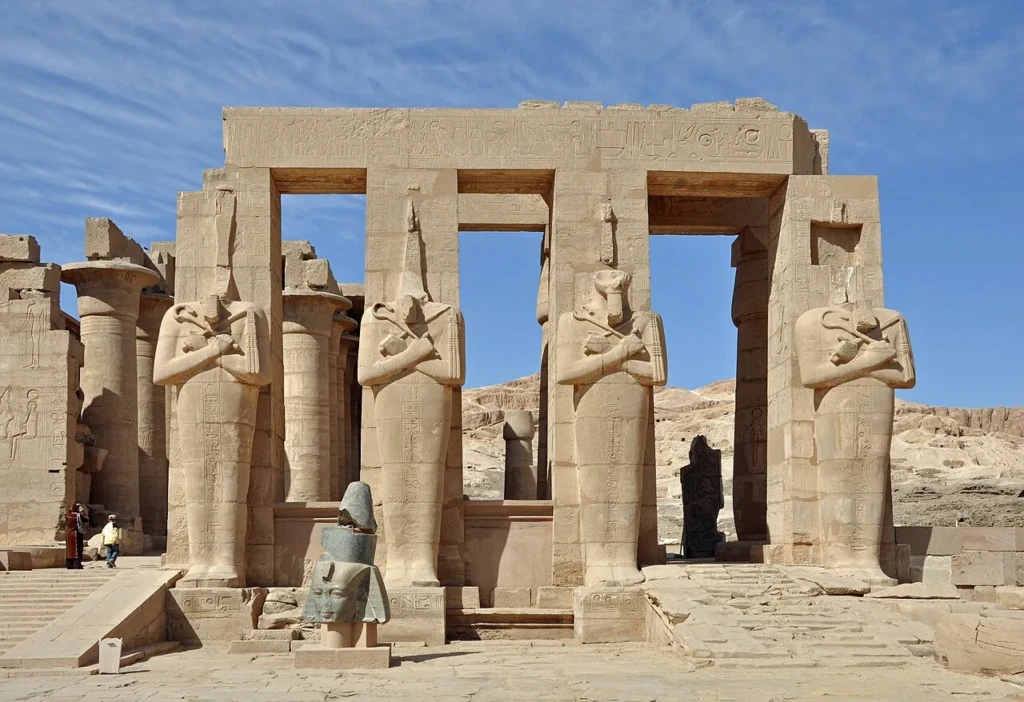
Ramesses II built the Ramesseum on Luxor’s West Bank as his “temple of millions of years,” the place where his cult would continue after his death. Today it is a half-ruined sandstone temple with battle reliefs, a forest of columns and the shattered pieces of a giant granite statue of the king. It is quieter than the big-name West Bank sites, and it fits easily into a morning there.
This guide covers what the temple was for, the fallen colossus that inspired Shelley’s “Ozymandias,” what to see in walking order, and the current ticket and opening details.
The Ramesseum: Quick Facts
| Fact | Details |
|---|---|
| Location | West Bank of the Nile, Luxor (ancient Thebes), within the Theban Necropolis |
| Built by | Ramesses II (reigned c. 1279–1213 BC), 19th Dynasty, New Kingdom |
| Purpose | Mortuary (“millions of years”) temple for the king’s cult, in the domain of the god Amun |
| Building period | Work began early in the reign and continued for about 20 years |
| Main highlights | Battle of Kadesh reliefs, fallen colossus, Osiride pillars, hypostyle hall, astronomical ceiling, mud-brick storerooms |
| World Heritage status | Part of “Ancient Thebes and its Necropolis,” UNESCO World Heritage List |
| Opening hours | 6:00 AM to 5:00 PM daily (official listing, October 2026) |
| Foreigner ticket | EGP 220 adult, EGP 110 student (official listing, October 2026) |
| Time needed | Our planning suggestion: 45 to 75 minutes |
What Is the Ramesseum?
Kings of the New Kingdom were buried in hidden rock-cut tombs in the Valley of the Kings. Their offerings and rituals, however, took place in large temples on the edge of the cultivated land. Each of these temples kept the king’s cult alive, in theory for “millions of years.”
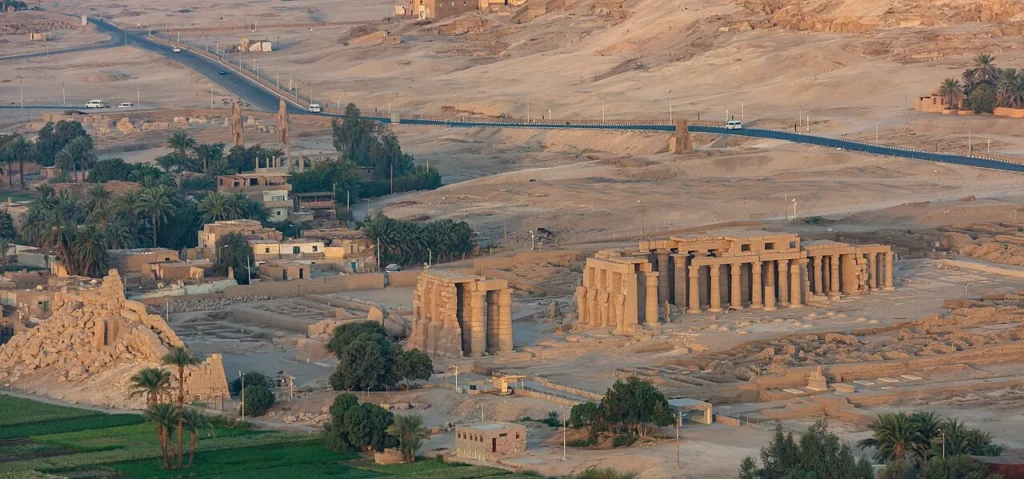
The Ramesseum was Ramesses II’s version. Its ancient name translates roughly as “House of millions of years of Usermaatra-setepenra that unites with Thebes-the-city in the domain of Amun.” Usermaatra-setepenra was the king’s throne name, and it matters later in this story.
The Ministry of Tourism and Antiquities describes the temple as a model that later kings copied. You can see that influence a short drive south, at Medinet Habu, where Ramesses III built a temple on a very similar plan.
Where the name comes from
“Ramesseum” is a modern label. The temple drew little attention from Europeans until the 18th century, when the Danish traveler Frederick Ludwig Norden described its ruins. Scholars with Napoleon’s expedition recorded it between 1798 and 1801 and linked it to the “Tomb of Ozymandias” described by the Greek historian Diodorus of Sicily. Jean-François Champollion, who deciphered hieroglyphs, visited in 1829 and gave the site the French name “Rhamesséion.” English speakers adapted it to Ramesseum.
Why Is It Linked to Ozymandias?
The temple once held an enormous seated granite statue of Ramesses II. According to the Ministry of Tourism and Antiquities, it stood more than 17 meters (56 feet) tall and weighed about 1,000 tons. It was moved roughly 220 km (137 miles) from its quarry to Thebes.
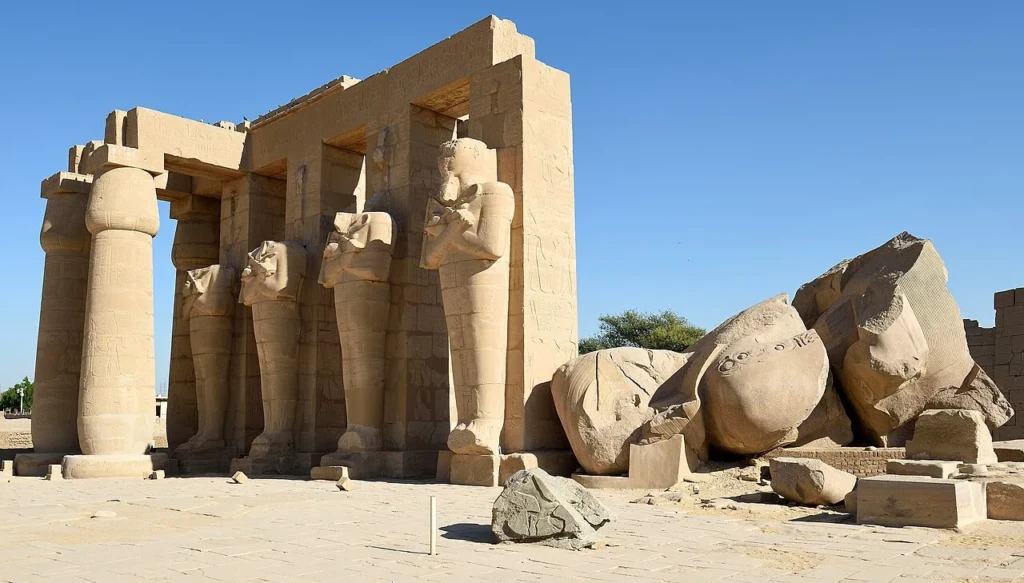
Today the statue lies broken near the second pylon. You can still make out parts of the torso and the base. A cartouche on the shoulder carries the king’s throne name, Usermaatra-setepenra. Diodorus rendered that name in Greek as “Ozymandias.”
That is the link to Percy Bysshe Shelley’s sonnet “Ozymandias,” with its “vast and trunkless legs of stone” and a shattered face half-buried in sand. The poem is about the fading of power. Standing beside the fallen giant, the point is hard to miss.
The “Younger Memnon” in London
A second, smaller granite statue of the king also stood here. Its upper part, a head and shoulders weighing about 7 tons, was removed by the Italian adventurer Giovanni Belzoni for the British consul Henry Salt. It reached London in 1818 and is now in the British Museum, where it is known as the “Younger Memnon.”
What to See at the Ramesseum, in Visiting Order
The temple runs from east to west, from the river side toward the desert hills. Much of the front half is ruined, so the visit becomes clearer as you move deeper inside. This order follows the ancient route.
1. The first pylon and the Battle of Kadesh
The first pylon, the huge gateway at the front, is about 60 meters (200 feet) wide. Its inner face carries scenes of the Battle of Kadesh, fought around 1274 BC against the Hittites in what is now Syria. Ramesses II promoted this battle as a great personal victory, and versions of it appear on several of his temples.
Look for the chaos of chariots, horses and fleeing soldiers. Ask your guide to point out the king in his chariot and the fortified city of Kadesh beside the Orontes River.
2. The first courtyard and the fallen colossus
The first court is largely destroyed. According to the Ministry, it once had two rows of columns on its south side and a row of Osiride pillars on the north side. The fragments of the giant statue lie at the west end of this court, near the second pylon.
Take your time here. Walk around the pieces to judge the scale. The width of the shoulders and the size of a single foot give a better sense of the original statue than any measurement.
3. The second courtyard and the Osiride pillars
The second court sits slightly higher than the first. Its best-preserved feature is a row of Osiride pillars: square pillars fronted by standing figures of the king in the form of Osiris, god of the dead, with arms crossed over the chest. These are the most photographed part of the temple.
A recent find in the area of the second gate of the pylon is a granite lintel fragment showing Ramesses II as a god before Amun-Ra, as reported by the Ministry.
4. The hypostyle hall
Beyond the second court is a large columned hall, about 41 by 31 meters (135 by 100 feet). It originally held 48 columns. Thirty-nine still stand, and the taller central rows give the hall its height.
5. The astronomical ceiling
Past the hall, the temple continued with three rooms leading to the sanctuary. Only part of the first room survives. Look up: its ceiling carries astronomical scenes, with gold stars on a blue ground. It is one of the less obvious highlights, so ask your guide to show you where to stand.
6. The storerooms, granaries and workshops
Around the stone temple stand long mud-brick buildings. These were storerooms, granaries, kitchens and workshops. Some of them use true vaulted arches, among the oldest standing examples in Egypt, dating to around 1300 BC.
These buildings remind you that a temple like this was also an economic center. It held grain, oil and wine, and it employed priests, scribes, bakers and craftsmen.
7. The small temple of Tuya and Nefertari
North of the hypostyle hall are the remains of a small temple to the king’s mother, Tuya, and his chief wife, Nefertari. Little survives above the foundations, but it shows how Ramesses honored the royal women of his family. You can see Nefertari’s painted tomb in the Valley of the Queens, covered in our Valley of the Queens visitor guide.
What Archaeologists Are Finding Now
A joint French-Egyptian mission has been studying and restoring the Ramesseum and its surroundings since 1991. In 2025 the Ministry of Tourism and Antiquities announced new results from that work.
- A “House of Life,” a school attached to the temple, with traces of drawings and school games. It is the first evidence of a school inside the Ramesseum.
- Kitchens, bakeries and weaving and stonework workshops.
- Cellars for olive oil, honey and fats, and wine cellars with many jar labels.
- Buildings on the east side that were probably administrative offices.
- A group of later tombs from the Third Intermediate Period, with canopic jars, nested coffins and 401 pottery ushabti figurines.
These finds back up what the mud-brick buildings already suggest. The temple was a working institution as much as a monument.
Why Is So Much of the Ramesseum in Ruins?
Three things worked against it. First, it stands at the edge of the old Nile floodplain, and the yearly flood slowly weakened its foundations. Second, later builders took its stone for their own projects, a common practice in ancient Egypt. Third, in the early Christian period, part of the temple was used as a church, which brought more changes.
The result is a site that rewards a little imagination. Your guide can help you picture the full temple from the surviving pieces.
How to Get to the Ramesseum
The Ramesseum is on the West Bank, across the Nile from Luxor’s main hotels and cruise moorings on the East Bank. It lies on the edge of the old floodplain, close to the other royal temples and tombs of the necropolis.
Most visitors arrive by private car with a driver and guide as part of a West Bank day. Drive times depend on where you start and on which sites you see first. Your driver or guide will confirm timing when you plan the day.
Opening Hours and Ticket Prices
As listed on the official Ministry of Tourism and Antiquities Ramesseum page in October 2026; check before you go:
| Item | Details |
|---|---|
| Opening hours | 6:00 AM to 5:00 PM, every day of the week |
| Foreign adult | EGP 220 |
| Foreign student | EGP 110 |
The Ramesseum has its own ticket. It is not included in the Valley of the Kings entry. If you plan to visit several West Bank sites in one day, budget for each ticket separately.
Best Time to Visit
Go early. The site opens at 6:00 AM, and shade is limited once you leave the hypostyle hall. Morning is also when the West Bank is coolest, which matters for most of the year.
Many tour groups head first to the Valley of the Kings and the Temple of Hatshepsut. That often leaves the Ramesseum quiet, especially later in the morning. For the cooler months and the wider seasonal picture, see our month-by-month guide to the best time to visit Egypt.
Practical tips
- Wear closed shoes. The ground is uneven, with loose stones and fallen blocks.
- Carry water, a hat and sunscreen. There is little shade outside the columned hall.
- Read Shelley’s “Ozymandias” before you go. It takes a minute and makes the fallen statue far more memorable.
- Ask your guide to show you the Kadesh reliefs and the astronomical ceiling. Both are easy to walk past.
How to Combine the Ramesseum With Nearby Sites
The Ramesseum sits in the middle of the West Bank monument zone, so it slots into most routes. Here are the pairings that work best.
- Medinet Habu. Ramesses III’s temple follows a similar plan and is far better preserved. Seeing both in one day shows you the ruin and the complete version. Our Medinet Habu guide covers it.
- Valley of the Kings. Ramesses II’s own tomb is there, along with those of his father and successors. Use our Valley of the Kings guide to pick your tombs.
- Temple of Hatshepsut. The terraced temple at Deir el-Bahari is another mortuary temple, built about two centuries earlier. Read our Hatshepsut Temple visitor guide.
- Valley of the Queens. Visit Nefertari’s tomb after seeing her temple here, if it is open during your visit.
On the East Bank, Ramesses II added a courtyard and pylon to Luxor Temple and built at Karnak. Our Luxor Temple guide and Karnak Temple guide show where to find his work. For hotels and a full plan, start with the Luxor travel guide.
Visit With Delta Tours Egypt
We do not run a fixed Ramesseum tour, but we can arrange a private visit on request, with your own Egyptologist and driver. Tell us what you want to see through our tailor-made Egypt tours page, and we will build the day around it.
If you would rather start from a ready-made day, our West Bank of the Nile tour is from $150 per person, and the Luxor East and West Banks tour is from $128 per person. Ask us about adding the Ramesseum when you book. Traveling from Cairo? The Luxor day trip by air is from $490 per person.
Frequently Asked Questions
Who built the Ramesseum?
Ramesses II of the 19th Dynasty built it as his mortuary temple on Luxor’s West Bank. Work began early in his reign, which ran from about 1279 to 1213 BC, and continued for around 20 years.
How much is the Ramesseum ticket?
The official Ministry of Tourism and Antiquities site listed EGP 220 for foreign adults and EGP 110 for foreign students in October 2026. Check the official page before you go, as prices change.
What are the Ramesseum opening hours?
The official listing showed 6:00 AM to 5:00 PM every day in October 2026. Arriving early gives you cooler air and fewer people.
Is the Ramesseum the Ozymandias temple?
Yes. Diodorus of Sicily called Ramesses II “Ozymandias,” a Greek version of his throne name. The fallen colossus at the Ramesseum is the statue most closely linked to Shelley’s poem.
Is the Ramesseum worth visiting?
Yes, if you have time beyond the main West Bank sites. It combines a famous fallen statue, battle reliefs and Osiride pillars, and it is usually much less crowded.
How long do I need at the Ramesseum?
Our planning suggestion is 45 to 75 minutes. That is enough to walk from the first pylon to the hypostyle hall and look at the storerooms.
Want a quieter West Bank day built around Ramesses II? Browse our private Luxor tours and excursions, and we will help you choose the right mix of temples and tombs.
Featured image: Luxor Ramesseum. Photo: Marc Ryckaert / Wikimedia Commons, CC BY 3.0