Tomb of Seti I (KV17): The Finest Tomb in the Valley of the Kings
If you pay for one extra tomb in the Valley of the Kings, make it the tomb of Seti I (KV17). It was the first royal tomb in the valley to be decorated from end to end, and its painted reliefs are among the finest of the New Kingdom. Entry needs a separate ticket of EGP 2,000 for foreign visitors, on top of the general valley ticket.
This guide focuses on KV17 alone: who Seti I was, how the tomb is laid out, what to look for as you walk down, and how to fit it into a West Bank day. For the valley as a whole, including the standard ticket and other tombs, read our Valley of the Kings guide.
Tomb of Seti I: Quick Facts
| Item | Details |
|---|---|
| Location | Valley of the Kings, West Bank of Luxor |
| Tomb number | KV17, also called “Belzoni’s tomb” |
| Built for | Seti I (c. 1294–1279 BC), second king of the 19th Dynasty and father of Ramesses II |
| Discovered | October 16, 1817, by Giovanni Battista Belzoni |
| Known for | First fully decorated tomb in the valley; first vaulted burial chamber; astronomical ceiling |
| Hours | Daily, 6:00 AM to 5:00 PM |
| Foreigner ticket | EGP 2,000 (adult and student), plus the Valley of the Kings ticket |
| Time needed | Our planning suggestion: 30 to 45 minutes inside |
Hours and prices are as listed on the official Ministry of Tourism and Antiquities site in October 2026; check before you go.
Who Was Seti I?
Seti I ruled Egypt for around 15 years at the start of the 19th Dynasty. The ministry dates his reign to about 1294–1279 BC. He is often overshadowed by his son, Ramesses II, but his reign set the standard for the art that followed.
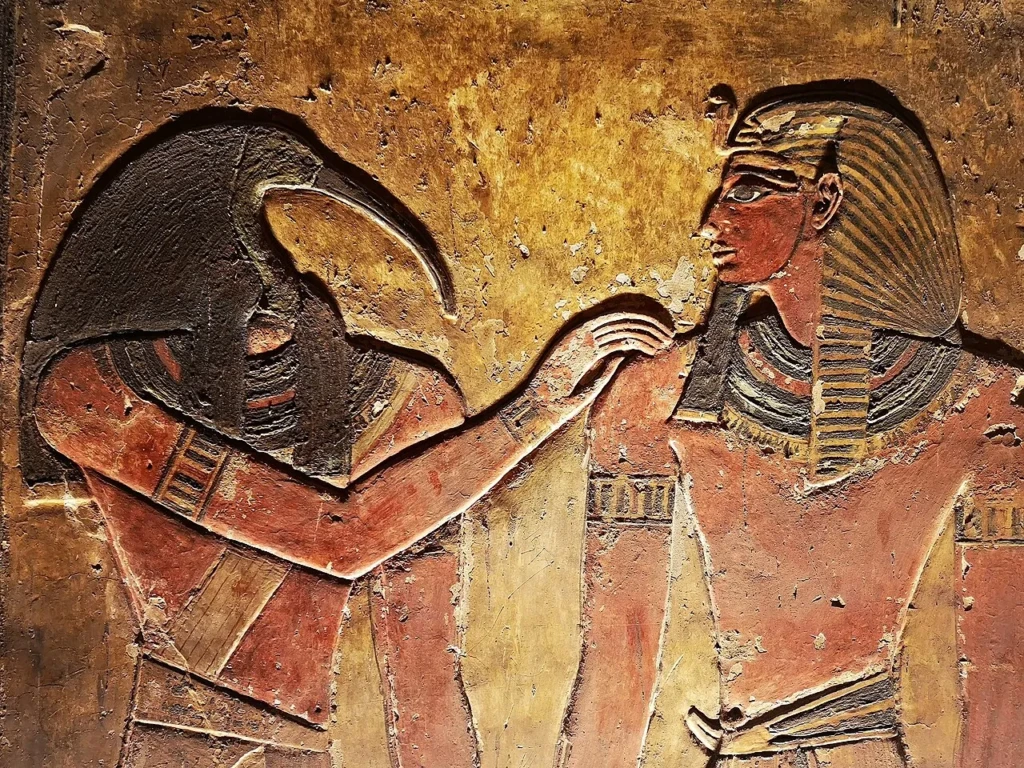
The quality of carving and painting under Seti I is famous among Egyptologists. His tomb shows that style in its most complete form, because every part of it was decorated.
His mummy was not in the tomb when Belzoni entered it. It had been moved in antiquity and was later found in the royal cache at Deir el-Bahari (DB320) with many other royal mummies. In 2021, Seti I was among the kings transferred to the National Museum of Egyptian Civilization in Cairo, according to the museum’s own page. Our article on the Pharaohs’ Golden Parade explains that move.
Why KV17 Is Considered the Finest Tomb in the Valley
The ministry’s page on the tomb of Sety I calls it one of the longest, deepest and most beautifully decorated tombs in the Valley of the Kings. Three things set it apart.
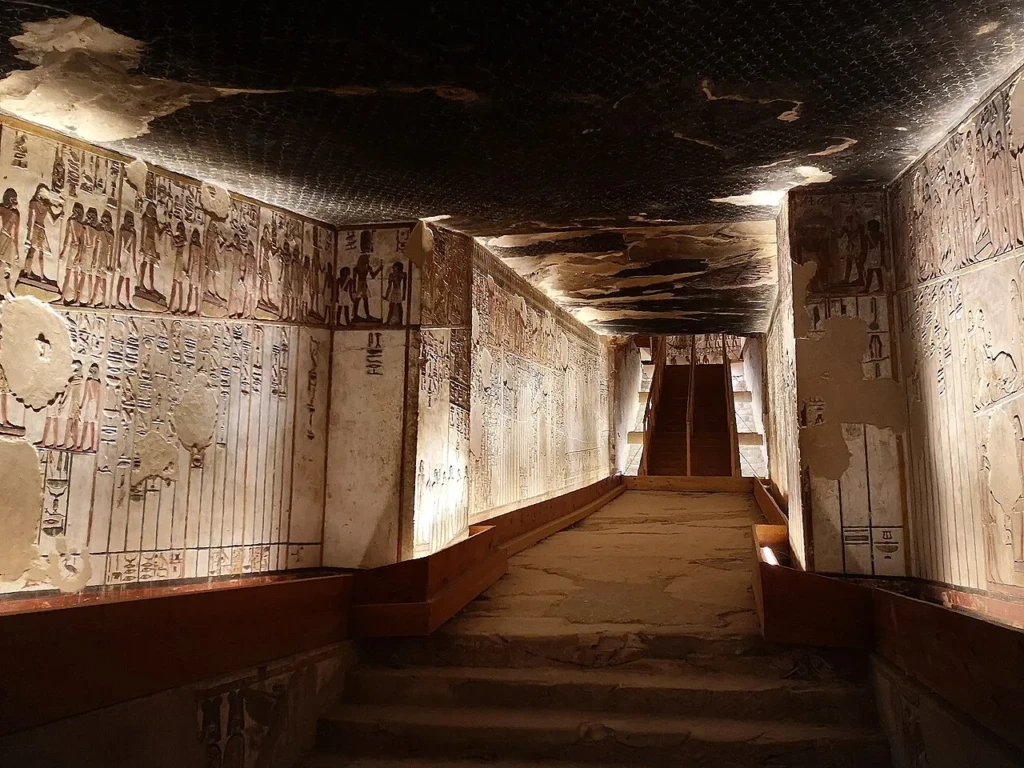
- Complete decoration. It was the first tomb in the valley to be decorated throughout, not just in selected rooms.
- Quality. The painted reliefs are carved, then colored, with fine detail in faces, jewelry and hieroglyphs.
- Architecture. It introduced the first vaulted burial chamber in the valley, along with a mysterious tunnel cut deep beneath it.
The Layout: How the Tomb Works
KV17 follows what the ministry calls a “joggled axis.” Its corridors descend in a line, then shift sideways before continuing down. Understanding this plan helps you make sense of the walk.
A series of corridors and sloping passages leads down to a first pillared hall. In the far wall of that hall, but off to one side, another set of passages is cut into the floor. These lead down to the burial chamber.
The ministry points out a clever detail. Straight ahead from the first corridors, a doorway opens into a single room. It may have been meant to fool robbers into thinking they had found the burial chamber.
What to See in the Tomb of Seti I, in Visiting Order
Which rooms are open can change, and some areas may be roped off for conservation. Your guide will confirm the current route. The highlights below follow the order in which you meet them as you descend.
1. The entrance corridors
The first corridors carry texts and images of the king with the gods. Wikipedia notes symbols of Ma’at, the principle of cosmic order, and lists of royal names. Among the tomb’s funerary texts, the ministry names the Litany of Re, a hymn to the sun god.
Look at the colors close to eye level. Even in the upper corridors, the blues, yellows and reds remain strong.
2. The well shaft room
Further down, you reach a chamber with a deep shaft cut into its floor. Wikipedia identifies it as room E.
3. The first pillared hall and the Book of Gates
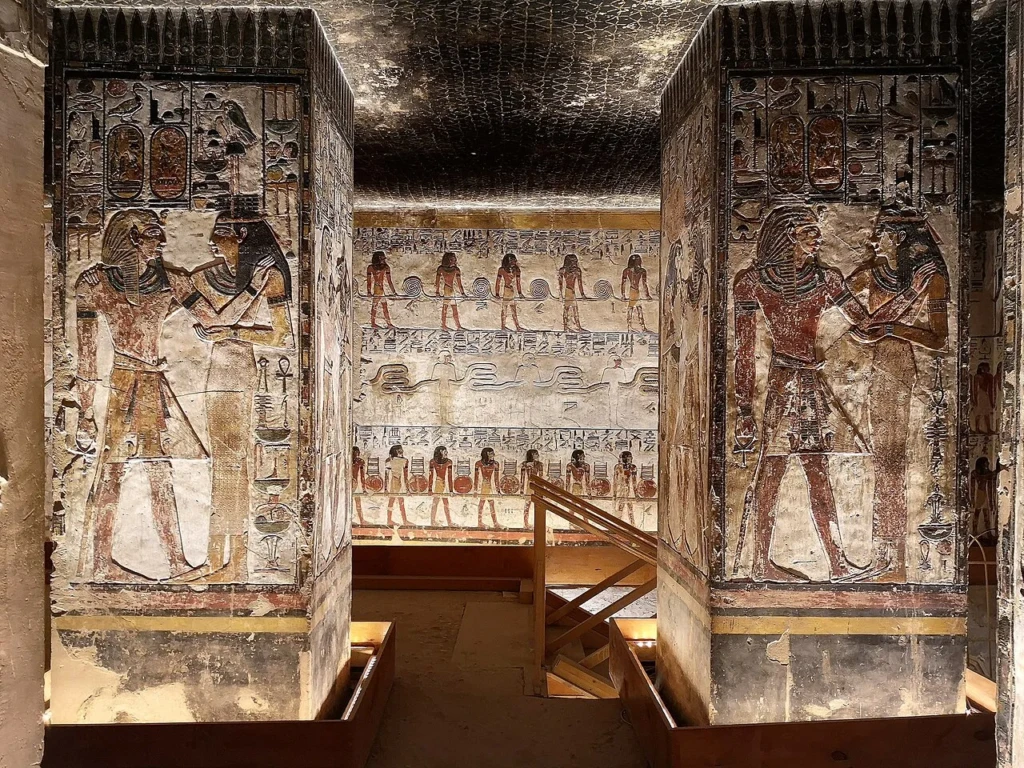
The first pillared hall shows the king with gods including Hathor, Horus and Neith. Wikipedia also notes a well-preserved section of the Book of Gates here. This text follows the sun god’s night journey through the underworld, hour by hour, past guarded gates.
Take time with the pillars. Each face shows the king standing before a deity, and the detail is remarkable up close.
4. The Opening of the Mouth scenes
As the passages descend again, look for the Opening of the Mouth ceremony, which Wikipedia places in one of the tomb’s chambers. This ritual was meant to restore the senses of the dead king so he could eat, speak and breathe in the afterlife.
5. The vaulted burial chamber and its astronomical ceiling
The burial chamber is the high point of the visit. It was the first in the valley built with a vaulted ceiling. That ceiling is painted with constellations and star figures on a deep blue ground, representing the night sky.
Wikipedia notes that a side chamber carries the Amduat, another guide to the underworld, under its own star ceiling. The ministry also lists the Book of the Divine Cow among the tomb’s texts. Wikipedia notes that a mummified bull was found in one side room, which led early visitors to call KV17 the “Tomb of Apis.”
6. The tunnel beneath the burial chamber
From the floor of the burial chamber, a passage descends even deeper into the rock. The ministry suggests it was meant to connect the king symbolically with the life-giving forces of the underworld.
According to Wikipedia, excavators cleared nearly 136 meters of it in 1960 before stopping because the rock was unsafe. A second excavation by Egypt’s Supreme Council of Antiquities ran from 2007 to 2010. It found two staircases, with the tunnel ending abruptly at the bottom of the second, for a total length of 174 meters. Visitors do not enter this tunnel.
Where Are the Missing Pieces?
Some of the tomb’s finest objects and panels are now in Europe. Knowing where they went adds context to what you see on site.
The alabaster sarcophagus in London
Seti I’s sarcophagus is made of alabaster with Egyptian blue infill. Belzoni removed it, and the British Museum declined to buy it at his asking price. Sir John Soane bought it in 1824 for £2,000. It has stood in Sir John Soane’s Museum in London ever since. UK travelers can see it there before or after an Egypt trip.
Removed wall panels
Wikipedia records that Jean-François Champollion removed a wall panel during his 1828–29 expedition. Other sections were removed by later expeditions. Pieces from the tomb are now in the Louvre in Paris, the Egyptian Museum in Florence and the Neues Museum in Berlin. You will notice gaps in some walls where these sections once sat.
Damage and conservation
Belzoni also harmed the tomb in other ways. He made wet “squeezes” against the reliefs to copy them, which pulled away paint. Clearing debris allowed flood water to enter and damage the lower walls. Later work in the late 1950s and 1960s changed moisture levels in the rock and caused cracking.
In 1821, Belzoni displayed painted recreations of several rooms at the Egyptian Hall in Piccadilly, London. The ministry credits this show with helping spark popular interest in ancient Egypt. In 2017, the Factum Foundation produced facsimiles of two of the tomb’s rooms from detailed scans, according to Wikipedia.
Opening Hours and Ticket Prices
As listed on the official Ministry of Tourism and Antiquities site in October 2026, the tomb of Seti I opens daily from 6:00 AM to 5:00 PM. Check before you go, as hours and prices change.
| Ticket | Foreign adult | Foreign student |
|---|---|---|
| Tomb of Seti I (KV17) | EGP 2,000 | EGP 2,000 |
| Valley of the Kings general ticket | EGP 750 | EGP 375 |
Note that the ministry lists no student discount for KV17. The Seti I ticket is an add-on, so you need the general valley ticket as well. Your guide can advise on where tickets are currently sold.
Is the extra ticket worth it?
For most travelers with a real interest in ancient Egyptian art, yes. It is the most complete and refined royal tomb open in the valley. If you can only afford one premium ticket and must choose, think about what matters to you. Tutankhamun’s tomb is famous for its story and its mummy. Seti I’s tomb is the stronger choice for art and architecture.
How to Get There and How Long It Takes
The Valley of the Kings lies on the West Bank of Luxor, in the desert hills behind the river plain. Most visitors reach it by car from their hotel or cruise ship. Driving time depends on where you start, so your driver or guide will confirm timing.
At the site, the tomb entrances are spread along the valley floor. Allow time to walk between the visitor area and KV17, and plan for steps and sloping ramps inside.
Best Time to Visit and Practical Tips
- Go early. The site opens at 6:00 AM. Early starts beat the heat and the largest groups.
- Pace yourself. KV17 goes deep. The descent is easy, but the climb back up can feel long in warm air.
- Bring water and a hat. The valley has little shade between tombs.
- Wear good shoes. Expect ramps, steps and uneven surfaces.
- Look up. Many visitors focus on the walls and miss the painted ceilings, including the star ceiling in the burial chamber.
We could not confirm current photography rules for KV17 from an official source. Ask your guide on the day. For weather by month, see our best time to visit Egypt guide.
How to Combine KV17 With Other West Bank Sites
KV17 fits into a standard West Bank morning. Most travelers pair the Valley of the Kings with the Temple of Hatshepsut and the Colossi of Memnon. With more time, add the Valley of the Queens or Medinet Habu.
Delta’s West Bank of the Nile private tour, from $150 per person, covers the Valley of the Kings, the Temple of Hatshepsut and the Colossi of Memnon. The Seti I ticket is not part of its published inclusions, so tell us if you want it. Our Luxor East and West Banks tour, from $128 per person, adds Karnak and Luxor temples. Early risers can start with a Luxor hot air balloon flight, from $120 per person.
For a complete picture of the city, our Luxor travel guide covers both banks, hotels and how many days you need.
Visit With Delta Tours Egypt
We do not sell a dedicated tour of Seti I’s tomb. We can arrange a private West Bank day built around it on request, with an Egyptologist guide who will plan the route and timing. Share your dates on our tailor-made tours page. You can also browse our private Luxor day tours.
Frequently Asked Questions
How much is the ticket for the tomb of Seti I?
Foreign visitors pay EGP 2,000, with no student discount listed. This is in addition to the EGP 750 Valley of the Kings ticket. These are the prices on the official ministry site in October 2026, so check before you go.
Is the tomb of Seti I open to visitors?
The ministry lists daily opening hours of 6:00 AM to 5:00 PM, and Wikipedia notes the tomb was open as of 2025. Access has been restricted at times for conservation, so confirm with your guide before your visit.
Why is it called Belzoni’s tomb?
Giovanni Battista Belzoni, an Italian explorer, found the tomb on October 16, 1817. His name became attached to it. He also exhibited painted copies of its rooms in London in 1821.
Where is Seti I’s mummy now?
The mummy was moved in antiquity to the royal cache at Deir el-Bahari. In 2021 it was among the royal mummies transferred to the National Museum of Egyptian Civilization in Cairo.
Where is Seti I’s sarcophagus?
The alabaster sarcophagus is in Sir John Soane’s Museum in London. Soane bought it in 1824 after the British Museum declined Belzoni’s price.
Seti I or Tutankhamun: which tomb should I choose?
Choose Seti I for art and architecture. It is far larger and decorated throughout. Tutankhamun’s tomb is small, but it holds the king’s mummy and a famous story.
The tomb of Seti I shows Egyptian royal art at its most complete, from the first corridor to the star ceiling. To see it with a private Egyptologist at an unhurried pace, start planning on our tailor-made tours page.
Featured image: Painted pillared hall in the tomb of Seti I (KV17). Photo: Carole Raddato from Frankfurt, Germany / Wikimedia Commons, CC BY-SA 2.0