National Museum of Egyptian Civilization: Royal Mummies Guide
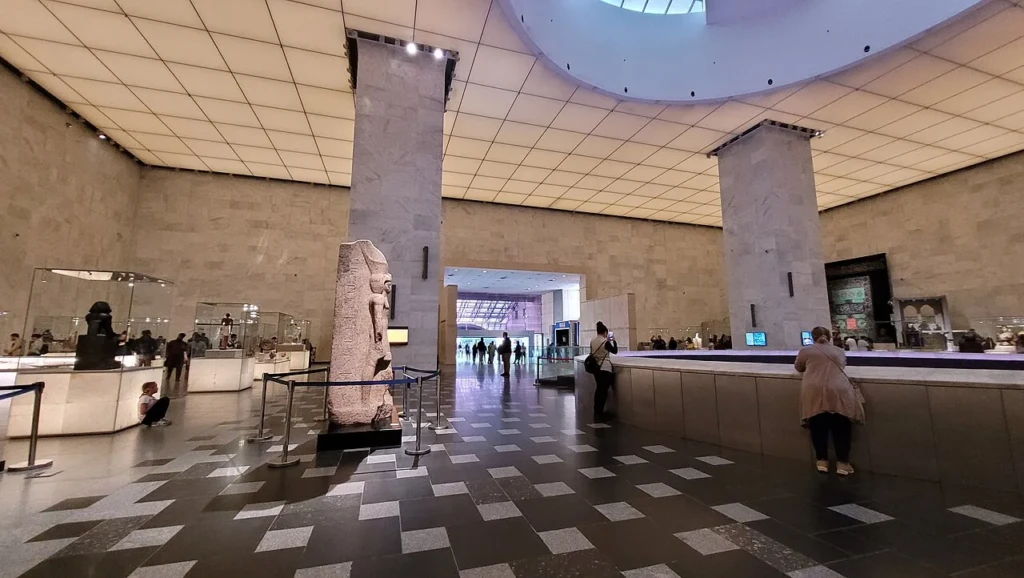
The National Museum of Egyptian Civilization (NMEC) is a museum in Fustat, Old Cairo, that tells Egypt’s story from prehistory to the present day. Its best-known room is the Royal Mummies Gallery, where the official museum site lists the mummies of 17 kings and 3 queens, including Ramesses II and Hatshepsut. Plan on two to three hours for a full visit.
This guide covers what is in each gallery, how the mummies hall works, current hours and foreigner ticket prices, and how NMEC fits alongside Cairo’s other big museums.
NMEC: Quick Facts
| Fact | Details |
|---|---|
| Location | El-Fustat Road, Ain el-Sira, Old Cairo |
| Nearest metro station | Mar Girgis |
| Opened | First hall opened in 2017; officially inaugurated on 3 April 2021 with the arrival of the royal mummies |
| Coverage | Egyptian civilization from prehistoric times to the modern era |
| Collection size | About 50,000 artifacts |
| Main draw | The Royal Mummies Gallery (17 kings and 3 queens, per the museum) |
| Foreigner ticket | EGP 550 adult / EGP 300 student (see hours and tickets below) |
| Time needed | Our planning suggestion: 2 to 3 hours |
What Is the National Museum of Egyptian Civilization?
The Ministry of Tourism and Antiquities describes NMEC as the first museum of its kind in Egypt and the Arab world. It sets out to show the whole span of life in Egypt, from prehistoric times to the present day. Pharaonic, Greco-Roman, Coptic, Islamic and modern objects share the same building.
The idea is old. According to the museum, UNESCO launched an international campaign in 1982, at Egypt’s request, to create two museums: the Nubia Museum in Aswan and NMEC in Cairo. The design came from an Egyptian architect who won an international competition. The Fustat site was chosen in 1999, and the foundation stone was laid in 2002.
The location carries its own meaning. Fustat was Egypt’s capital before the walled city of Cairo was founded in the 10th century. Archaeologists excavated parts of the museum grounds during construction, and one of their finds is now on display (see the Dye House below).
From a crafts hall to a national museum
NMEC opened in stages. In 2017 a 1,000-square-meter temporary exhibition hall opened, focused on pottery, wood, textiles and jewelry across the ages. The museum was officially inaugurated on 3 April 2021. That evening, 22 royal mummies traveled across Cairo from the Egyptian Museum in Tahrir Square in a televised procession.
We cover that night in detail in our article on the Pharaohs’ Golden Parade and where the royal mummies are now. This guide focuses on visiting the museum today.
The Royal Mummies Gallery
This is why most international travelers come. The museum describes the gallery as displaying the mummies of 17 kings and 3 queens of ancient Egypt. Its design is meant to feel like walking down the Valley of the Kings, where most of these rulers were first buried.
Each mummy lies in its own case, with information about the ruler’s reign. Expect a slower pace than in the main gallery.
Rulers you can see
The mummies come from the 17th to the 20th Dynasties, roughly the age of Egypt’s empire. Names to look for include:
- Seqenenre Tao, the Theban king whose wounded skull links him to the war against the Hyksos
- Ahmose-Nefertari, royal wife and mother, later honored as a goddess at Thebes
- Thutmose III, often called Egypt’s greatest military king
- Hatshepsut, the female pharaoh behind the terraced temple at Deir el-Bahari
- Amenhotep III and Queen Tiye, the couple honored by the Colossi of Memnon in Luxor
- Seti I and his son Ramesses II, two of the most famous kings of the 19th Dynasty
- Ramesses III, builder of Medinet Habu
Tutankhamun is not here. His mummy remains in his tomb in the Valley of the Kings.
Objects to notice in the mummies hall
The gallery holds more than bodies. The museum highlights the outer coffin of Queen Ahmose-Nefertari and a coffin of King Thutmose with traces of its gilding. Look also for the canopic chest of Amenhotep II, which held the jars for his internal organs, and faience jars from the burial of Thutmose IV.
One piece stands out. The museum describes a mummy of King Amenhotep as one of very few intact, undisturbed royal mummies, still wearing its mask and flower garlands. Ask your guide to show you where it is.
How to approach the mummies hall
Some visitors find the room unsettling. If you are visiting with children, prepare them before you go in. The museum asks visitors to keep their voices down and to move through without blocking others.
The Main Gallery: Egypt From Prehistory to Today
The main gallery runs in time order. It starts in prehistory and moves through the Pharaonic, Greek, Coptic and Islamic periods to the modern era. It ends with folk heritage, the traditions modern Egyptians inherited. Here are the pieces the museum itself highlights, in roughly the order you meet them.
Prehistory: the Nazlet Khater skeleton
This skeleton is about 35,000 years old. The museum calls it the second-oldest Egyptian skeleton ever found. It is a good place to start, because it reminds you how long people have lived in the Nile Valley.
Ancient Egypt: daily life and death
- The Tent of Purification of Queen Isetemkheb II. A leather tent from around 1000 BC, used during the ritual washing of the body before mummification.
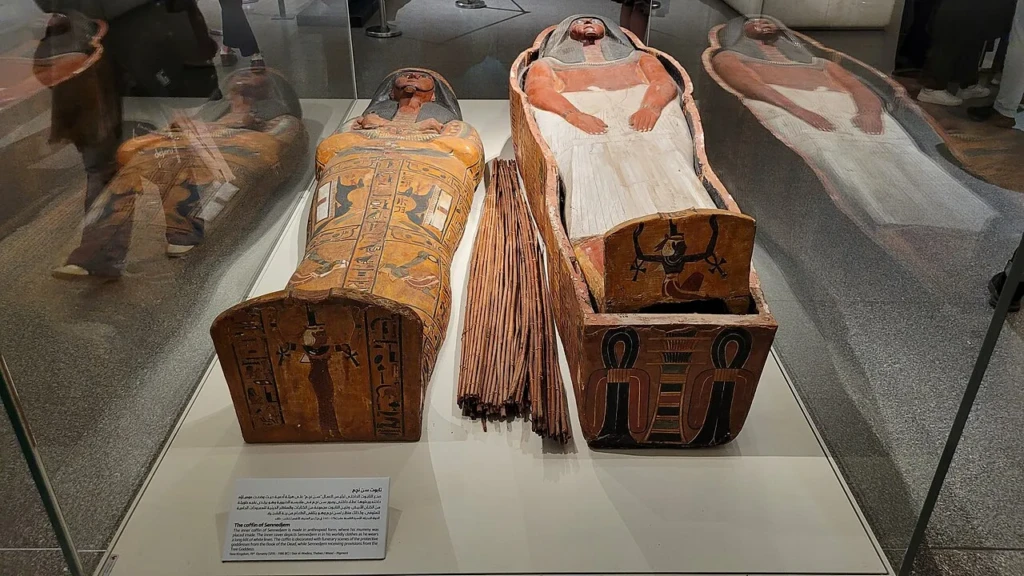
- The coffin of Sennedjem. Sennedjem was a craftsman from Deir el-Medina who worked on royal tombs in the Valley of the Kings in the 19th Dynasty. His coffin shows him in everyday white linen.
- The chariot of Thutmose IV. A gilded wooden chariot made for a king.
- A prosthetic toe. Made for a woman from Luxor around 1000 BC, it shows that ancient Egyptians fitted artificial body parts.
- The water clock of Amenhotep III. An alabaster vessel inscribed with astronomical scenes and used to measure time.
- A pillar statue of Akhenaten. From his temple at Karnak, around 1300 BC.
Greco-Roman and Coptic Egypt
The Roman statue of Nilos personifies the river. He leans on a hippopotamus and is surrounded by 16 children, a reference to the ideal height of the annual flood. Nearby are the Dush treasure, found at a desert fortress and dated to about 300 AD, and a Coptic dome from the monastic site of Bawit.
Islamic and modern Egypt
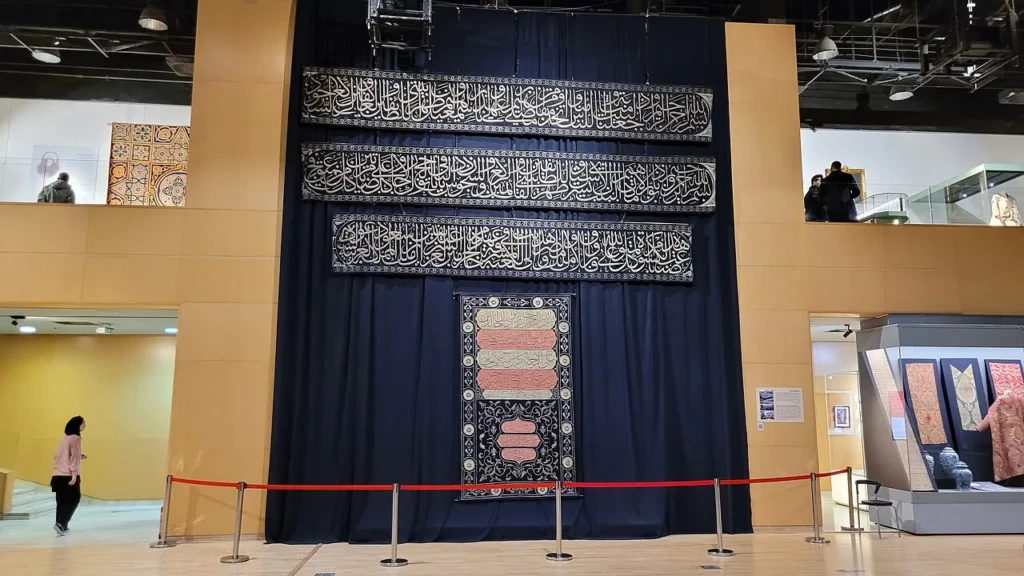
The Islamic section includes the wooden minbar, or pulpit, from the mosque of Abu Bakr ibn Mizhar. The modern era includes a mahmal from the reign of King Farouk. This was the decorated litter carried by the lead camel when Egypt sent the Kaaba covering to Mecca. The gallery closes with Mahmoud Mokhtar’s statue of a peasant woman, a tribute to Egyptian women.
The Textile Gallery and the Dye House
The Textile Gallery holds about 600 objects and traces Egyptian cloth and dress across thousands of years. Look for:
- Greco-Roman Tanagra figures, small clay statues that show how people dressed
- A section of the Kaaba covering from Bab al-Tawba, the inner door of the Kaaba, dated 1941
- A red silk prayer rug with gold and silver thread, a wedding gift from Muhammad Ali to his daughter Zeinab
- Uniforms of the footmen and coachmen who served the Muhammad Ali dynasty’s carriages
The Dye House is an archaeological find rather than a gallery. It dates back at least to the first century of Fatimid rule, which began in 969 AD. The museum says it is the only surviving evidence of Cairo’s historic dye houses.
Opening Hours and Tickets
The hours below are as listed on the official NMEC website, and the foreigner ticket prices as listed on the official Ministry of Tourism and Antiquities site, in October 2026. Check both before you go, since prices and hours can change.
| Item | Details |
|---|---|
| Saturday to Thursday | 9:00 am to 5:00 pm (last ticket 4:00 pm) |
| Friday | 9:00 am to 5:00 pm (last ticket 4:00 pm), plus an evening session 6:00 pm to 9:00 pm (last ticket 8:00 pm) |
| Ramadan hours | 9:00 am to 4:00 pm (ticket window closes 3:00 pm), per the Ministry site |
| Foreign adult | EGP 550 |
| Foreign student | EGP 300 |
| Children under 6 | Free |
The museum’s website also has a ticket-buying option. You can see the current details on the official NMEC opening hours page and the Ministry of Tourism and Antiquities NMEC page.
Photography and museum rules
According to the museum’s visitor policies, personal photos and video are allowed only after you pay the photography fee. Flash, tripods and monopods are not allowed. Please do not photograph other visitors or staff.
- Bags, backpacks or parcels larger than 40 x 40 cm go to the cloakroom. Umbrellas and sharp items do too.
- Food and drinks are not allowed in the galleries, except small water bottles.
- Appropriate dress is requested. Smoking is not allowed anywhere in the museum.
- Children must stay with an adult at all times.
The Ministry lists on-site services including toilets, parking, an elevator, an ATM, a café, a ramped entrance, a library and a gift shop.
How to Get to NMEC
The museum is in Fustat, in the Old Cairo district, on El-Fustat Road in the Ain el-Sira area. The nearest metro station is Mar Girgis, which also serves Coptic Cairo. By car, the Ministry suggests taking the Giza road and crossing Abbas Bridge toward El-Malek El-Saleh.
Most international visitors come by private car with a guide, often as part of a day in Old Cairo. Drive times across Cairo vary widely with traffic, so your driver or guide will confirm timing.
Best Time to Visit and Practical Tips
- Arrive soon after opening, or use the Friday evening session. An early start gives you the most time before the 4:00 pm ticket cutoff. The Friday evening session helps if your days are full.
- Do the mummies hall when you are fresh. It is the highlight, and it rewards a slow visit.
- Keep the 4:00 pm cutoff in mind. Last tickets are sold an hour before closing.
- Pack light. A small bag saves you a stop at the cloakroom.
- Look outside too. The museum sits beside Ain el-Sira lake, an area redeveloped with gardens and places to eat.
For clothing advice for Cairo’s museums and religious sites, see our guide on what to pack and wear in Egypt.
NMEC vs the Grand Egyptian Museum vs the Egyptian Museum
Cairo now has three major museums, and many travelers ask which to choose. They do different jobs.
| Museum | Best for | Where |
|---|---|---|
| National Museum of Egyptian Civilization | The royal mummies and the full story of Egypt up to modern times | Fustat, Old Cairo |
| Grand Egyptian Museum | The Tutankhamun collection | Near the Giza pyramids |
| Egyptian Museum (Tahrir) | The historic collection in its original 1902 building | Downtown Cairo |
If you have time for only one, pick by interest. For Tutankhamun, read our Grand Egyptian Museum guide. For the classic Tahrir collection, see our Egyptian Museum Cairo guide. If seeing the pharaohs themselves matters most, NMEC is the one.
How to Combine NMEC With Nearby Sites
NMEC fits naturally into a day in Old Cairo. The Coptic churches share the same metro stop, and the Citadel of Saladin and Khan el-Khalili bazaar are common additions on a full day. Our Cairo travel guide has ideas for building the rest of your stay.
If your trip continues to Luxor, the mummies hall makes a good first chapter. Many of these rulers were first buried on Luxor’s West Bank, in and around the Valley of the Kings.
Visit With Delta Tours Egypt
Our Taste of Egypt 4 Day Cairo tour includes a day that opens at the National Museum of Egyptian Civilization before moving on to Old Cairo. It is from $535 per person. For a single day in the historic city, the private Old Cairo and Citadel tour is from $100 per person, and we can discuss adding NMEC when you book.
To pair two museums, the Grand Egyptian Museum and pyramids tour is from $95 per person. If you also want Luxor, the 4 Day Cairo and Luxor tour is from $570 per person.
Frequently Asked Questions
How many royal mummies are in the National Museum of Egyptian Civilization?
The museum’s official site says the Royal Mummies Gallery displays 17 kings and 3 queens. In total, 22 royal mummies were moved to NMEC in April 2021.
How much is the NMEC ticket for foreigners?
As listed on the official Ministry of Tourism and Antiquities site in October 2026, a foreign adult ticket is EGP 550 and a foreign student ticket is EGP 300. Children under 6 enter free. Check before you go.
Is the mummies hall included in the NMEC ticket?
The Ministry lists one foreigner ticket for the museum and does not list a separate mummies hall fee. Photography has its own fee, so confirm current details at the ticket office.
Can you take photos inside NMEC?
Yes, after paying the photography fee, according to the museum’s visitor policies. Flash, tripods and monopods are not allowed.
How long do you need at the National Museum of Egyptian Civilization?
Our planning suggestion is two to three hours. That allows time for the main gallery, the textile gallery and an unhurried visit to the mummies hall.
Is Tutankhamun’s mummy at NMEC?
No. Tutankhamun’s mummy remains in his tomb in the Valley of the Kings, and his treasures are at the Grand Egyptian Museum near Giza.
Want NMEC, the pyramids and Old Cairo in one well-paced plan? Browse our private Cairo day tours and we will build the day around the museums you care about most.
Featured image: Main hall of the National Museum of Egyptian Civilization. Photo: Nabbegat / Wikimedia Commons, CC BY 4.0