15 Best Things to Do in Saqqara, Egypt (2026)
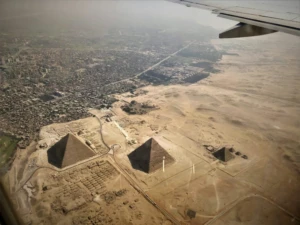
When most travelers think about ancient Egypt, they imagine the majestic Pyramids of Giza rising above the desert. Yet just a short drive south of Cairo lies a destination that many historians consider even more significant—Saqqara.
Known as the vast necropolis of ancient Memphis, Saqqara is home to the Step Pyramid of Djoser, the world’s first pyramid and the earliest monumental stone building ever constructed. But this extraordinary archaeological site offers much more than a single monument. Stretching across several kilometers of desert, Saqqara preserves royal pyramids, beautifully decorated tombs, underground galleries, museums, ceremonial courtyards, and archaeological discoveries that span more than three thousand years of Egyptian history.
Unlike many of Egypt’s more crowded attractions, Saqqara rewards visitors with space to explore, time to appreciate the details, and the opportunity to experience ancient history in a more relaxed atmosphere. Every corner of the site reveals another story—from the genius of Imhotep and the birth of pyramid architecture to sacred animal burials and colorful reliefs depicting everyday life in the Old Kingdom.
Whether you’re planning a day trip from Cairo or combining Saqqara with Memphis and Dahshur, this guide highlights the very best experiences the site has to offer.
Why Visit Saqqara?
Saqqara is far more than a stop between Cairo and Dahshur.
It is the place where Egypt’s pyramid-building tradition began and where archaeologists continue to make discoveries that reshape our understanding of the ancient world.
A visit to Saqqara allows you to:
- Stand before the world’s first pyramid.
- Explore one of the oldest stone architectural complexes ever built.
- Descend into ancient underground galleries.
- Discover beautifully decorated tombs of nobles and officials.
- Learn about Imhotep, history’s first known architect.
- Experience a UNESCO World Heritage Site with fewer crowds than Giza.
- Combine several world-class archaeological sites in one unforgettable day.
If you’re passionate about history, architecture, or archaeology, Saqqara is one of the most rewarding destinations in Egypt.
1. Visit the Step Pyramid of Djoser
No attraction in Saqqara is more iconic than the Step Pyramid of Djoser.
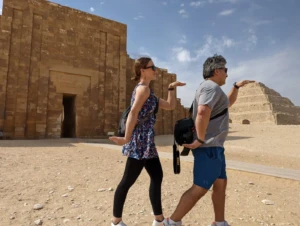
Built around 2670 BC for King Djoser and designed by the legendary architect Imhotep, this revolutionary monument transformed the history of architecture. Rising approximately 60 meters above the desert floor, it introduced the concept of pyramid construction that later evolved into the smooth-sided pyramids of Dahshur and Giza.
Take time to walk around the pyramid, admire its six distinctive levels, and, when access is available, descend inside to experience one of the oldest monumental buildings ever created.
Recommended Time: 60–90 minutes
➡️ Read our complete guide: The Step Pyramid of Djoser
2. Explore the Serapeum of Saqqara
Hidden beneath the desert lies one of Egypt’s most mysterious archaeological sites—the Serapeum.
This vast underground complex served as the burial place of the sacred Apis Bulls, animals revered as living manifestations of the god Ptah. Visitors can walk through long limestone galleries lined with enormous stone sarcophagi, cut from granite and other hard stones and weighing roughly 40 tons each.
The engineering required to transport and position these massive stone coffins continues to fascinate historians and archaeologists today.
The atmosphere inside the Serapeum is unlike anywhere else in Egypt and offers one of the most memorable experiences at Saqqara.
Recommended Time: 45–60 minutes
➡️ Read our complete guide: The Serapeum of Saqqara
3. Discover the Pyramid of Unas
Although modest in appearance, the Pyramid of Unas contains one of the greatest treasures of ancient Egypt.
Its burial chamber preserves the Pyramid Texts, the oldest known body of Egyptian religious texts. These hieroglyphic inscriptions were intended to guide the deceased king safely into the afterlife and later influenced the Coffin Texts and the famous Book of the Dead.
Stepping inside the pyramid allows visitors to stand among some of the earliest surviving Egyptian sacred texts.
Recommended Time: 20–30 minutes
4. Visit the Mastaba of Mereruka
Among the hundreds of tombs scattered across Saqqara, the Mastaba of Mereruka stands out as one of the finest examples of Old Kingdom funerary art.
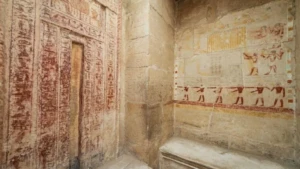
Mereruka served as the vizier, the highest-ranking official after the pharaoh, during the reign of King Teti. His impressive tomb contains more than 30 chambers, each decorated with beautifully carved reliefs that provide a remarkable insight into everyday life in ancient Egypt.
As you walk through the tomb, you’ll see scenes of:
- Farmers harvesting crops.
- Fishermen casting their nets into the Nile.
- Craftsmen producing furniture and jewelry.
- Musicians entertaining guests.
- Hunting expeditions through the marshes.
- Religious ceremonies and offerings.
Unlike royal pyramids, which focus on kingship and the afterlife, Mereruka’s tomb offers a fascinating glimpse into how Egypt’s elite lived and worked more than four thousand years ago.
For many visitors, these detailed carvings become one of the highlights of Saqqara.
Recommended Time: 30–40 minutes
➡️ Read our complete guide: Mastaba of Mereruka
5. Explore the Mastaba of Ti
Just a short distance away lies another remarkable masterpiece—the Mastaba of Ti.
Ti was an influential royal official during Egypt’s Fifth Dynasty, and his tomb is celebrated for some of the most beautifully preserved reliefs in all of Egypt.
The artwork is exceptionally detailed.
Visitors can admire scenes showing:
- Cattle crossing rivers.
- Boat builders at work.
- Bakers preparing bread.
- Sailors navigating the Nile.
- Families enjoying banquets.
- Farmers tending their livestock.
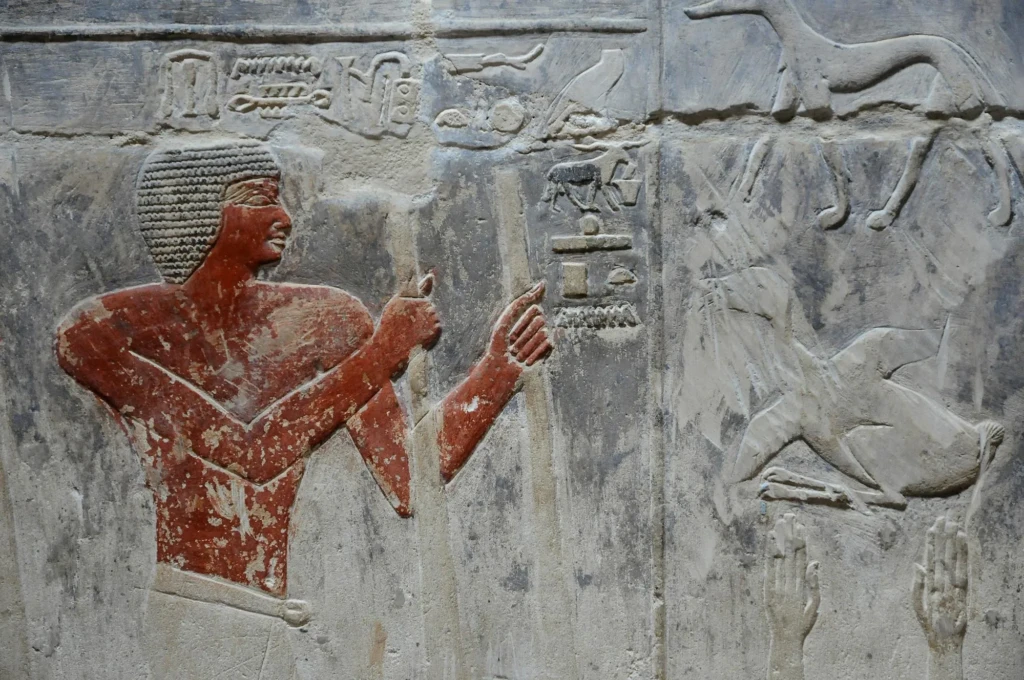
These carvings are more than artistic decorations—they are historical records that reveal how ordinary Egyptians worked, celebrated, and lived during the Old Kingdom.
Because of their exceptional preservation, many Egyptologists regard the Mastaba of Ti as one of Egypt’s most important private tombs.
Recommended Time: 25–30 minutes
6. Visit the Imhotep Museum
Before leaving Saqqara, make time for the Imhotep Museum, one of the site’s most valuable yet often overlooked attractions.
Named after the legendary architect who designed the Step Pyramid, the museum introduces visitors to the remarkable discoveries made throughout the necropolis over the past century.
Inside, you’ll find:
- Ancient statues.
- Excavated reliefs.
- Stone vessels.
- Funerary equipment.
- Architectural fragments.
- Models of the Step Pyramid Complex.
- Archaeological discoveries from recent excavations.
Although relatively small, the museum provides excellent context for everything you’ve seen throughout Saqqara.
Many visitors find that understanding the history behind the monuments greatly enriches the rest of their visit.
Recommended Time: 30–45 minutes
7. Walk Through the Entrance Colonnade
Your journey into the Step Pyramid Complex begins with one of ancient Egypt’s earliest architectural masterpieces—the Entrance Colonnade.
This elegant limestone corridor consists of 40 fluted columns, carefully carved to resemble bundles of papyrus reeds.
What makes these columns so remarkable is that they imitate wooden construction while being carved entirely from stone.
It may seem like a small detail today, but over 4,600 years ago this represented a revolutionary leap in architectural thinking.
Walking through the colonnade, it’s easy to imagine priests, nobles, and members of the royal court entering the sacred complex during ceremonies honoring King Djoser.
The repeating columns also create one of the most photogenic locations in Saqqara.
Recommended Time: 15–20 minutes
8. Explore the Heb-Sed Court
Beyond the Entrance Colonnade lies the vast Heb-Sed Court, one of the most important ceremonial spaces within the Step Pyramid Complex.
The Heb-Sed Festival was a royal jubilee celebrated after a pharaoh had ruled for thirty years. During the festival, the king performed symbolic rituals that renewed his strength and reaffirmed his divine right to rule.
Although historians cannot confirm whether Djoser celebrated this festival during his lifetime, the court was designed so he could continue performing these ceremonies forever in the afterlife.
Today, the open courtyard provides one of the best panoramic views of the Step Pyramid and allows visitors to appreciate the scale of the entire complex.
It is also an excellent place to pause and imagine the grandeur of ancient religious celebrations that once took place here.
Recommended Time: 15–20 minutes
9. Visit the Pyramid of Teti
Although its exterior appears modest today, the Pyramid of Teti is one of the most rewarding monuments to explore in Saqqara.
Built for King Teti, the founder of Egypt’s Sixth Dynasty, this pyramid contains beautifully preserved Pyramid Texts, carved a generation after the first ones in the nearby Pyramid of Unas.
Unlike many pyramids that can only be admired from outside, visitors are often able to descend through a narrow passage into the burial chamber, where hieroglyphic inscriptions still cover the walls after more than four thousand years.
Standing beneath the pyramid while reading these ancient texts creates one of the most memorable experiences in Saqqara.
Recommended Time: 20–30 minutes
➡️ Read our complete guide: The Pyramid of Teti
10. Discover the South Tomb
Located inside Djoser’s pyramid complex, the South Tomb remains one of Saqqara’s greatest mysteries.
Although Djoser’s actual burial chamber lies beneath the Step Pyramid, archaeologists believe this separate monument played an important symbolic role in royal funerary rituals.
The underground chambers contain beautiful blue faience tiles, carefully arranged to imitate woven reed mats found inside royal palaces.
Even today, historians continue debating the tomb’s exact purpose.
Some believe it represented the king’s connection with Upper Egypt.
Others think it served as a symbolic royal burial or ceremonial shrine.
Whatever its original function, the South Tomb provides another fascinating glimpse into the complexity of Old Kingdom beliefs.
Recommended Time: 15–20 minutes
11. Explore the Sacred Animal Necropolis
Religion played an essential role in ancient Egyptian life, and nowhere is this more evident than the Sacred Animal Necropolis.
For centuries, animals associated with Egyptian gods were carefully mummified and buried within underground galleries at Saqqara.
Among them were:
- Sacred ibises dedicated to Thoth.
- Baboons associated with wisdom.
- Falcons representing Horus.
- Cats connected with Bastet.
- Sacred Apis Bulls linked to Ptah.
These burials demonstrate the deep spiritual relationship between religion and everyday life in ancient Egypt.
Recent excavations continue to uncover thousands of beautifully preserved animal mummies, making this one of the most active archaeological areas within the necropolis.
Recommended Time: 20–30 minutes
12. See the Latest Archaeological Discoveries
Unlike many ancient monuments, Saqqara is far from fully excavated.
Almost every year, international headlines announce remarkable new discoveries from beneath its desert sands.
Recent finds include:
- Hundreds of sealed coffins.
- Colorfully painted sarcophagi.
- Bronze statues.
- Wooden funerary masks.
- Ancient workshops used for mummification.
- Previously unknown tombs.
- Jewelry and ceremonial objects.
- Burial shafts untouched for thousands of years.
These discoveries continue to reshape historians’ understanding of ancient Egyptian religion, burial customs, and society.
For visitors, this means Saqqara is not simply a historical site—it is a living archaeological landscape where history continues to unfold.
13. Enjoy the Best Photography Locations
Saqqara offers some of the finest photography opportunities in Egypt.
Unlike the busy Giza Plateau, visitors usually have more space to compose unique images without large crowds.
Some of the best photography spots include:
Step Pyramid Panorama
Capture the pyramid from the western side for an unobstructed view of all six levels.
Entrance Colonnade
The repeating limestone columns create beautiful symmetrical compositions.
Heb-Sed Court
One of the best locations for wide-angle photographs with the pyramid rising behind the ceremonial courtyard.
Desert Viewpoints
Several elevated locations reveal the vast scale of the Saqqara Necropolis stretching toward Dahshur and the fertile Nile Valley.
Ancient Reliefs
The tombs of Mereruka and Ti provide exceptional opportunities for close-up photography of remarkably preserved carvings.
Photography Tip: Early morning provides softer light, cooler temperatures, and fewer visitors.
14. Combine Saqqara with Memphis
Only a few minutes from Saqqara lies Memphis, the first capital of unified Egypt.
Although little remains of the ancient city itself, its open-air museum contains several impressive monuments, including:
- The colossal statue of Ramses II.
- The Alabaster Sphinx.
- Temple remains.
- Ancient sculptures.
Visiting Memphis helps place Saqqara in its historical context, showing how the royal necropolis served Egypt’s political and religious capital for thousands of years.
Most travelers visit both sites on the same day.
Recommended Time: 45–60 minutes
15. Continue to Dahshur
No visit to Saqqara is complete without exploring nearby Dahshur, located just 15 minutes away by car.
Dahshur is home to two of Egypt’s most important pyramids:
Bent Pyramid
Built for Pharaoh Sneferu, the Bent Pyramid represents Egypt’s first attempt at constructing a smooth-sided pyramid. Its distinctive change in angle makes it one of the country’s most recognizable monuments.
Red Pyramid
Often considered the first successful true pyramid, the Red Pyramid served as the direct architectural predecessor of the Great Pyramid of Giza.
Visitors can descend into its impressive interior and appreciate how Egyptian engineers refined the lessons first learned at Saqqara.
Together, Saqqara, Memphis, and Dahshur tell the complete story of pyramid evolution—from the earliest experiments to the foundations of Egypt’s greatest architectural achievements.
Suggested Route Through Saqqara
To make the most of your visit, follow this route:
| Stop | Approximate Time |
|---|---|
| Entrance Colonnade | 15 min |
| Step Pyramid | 60 min |
| Heb-Sed Court | 15 min |
| South Tomb | 20 min |
| Serapeum | 45 min |
| Mastaba of Mereruka | 30 min |
| Mastaba of Ti | 30 min |
| Pyramid of Teti | 25 min |
| Imhotep Museum | 40 min |
Total Recommended Time: 4–5 hours
Why Saqqara Is More Than a Day Trip
Many travelers arrive expecting to see a single pyramid.
Instead, they discover an archaeological landscape that spans more than 3,000 years of Egyptian history.
From the revolutionary Step Pyramid and beautifully decorated tombs to underground galleries and ongoing archaeological excavations, Saqqara offers one of the richest historical experiences anywhere in Egypt.
Whether you’re visiting for a few hours or spending a full day exploring its monuments, Saqqara rewards curiosity with stories, discoveries, and architectural achievements found nowhere else in the world.
Planning Your Visit to Saqqara
Saqqara is open daily from 8:00 AM to 4:00 PM all year, and the cooler months from October to April are the most comfortable time to explore; in summer, arrive before 9:00 AM. Foreign visitors pay EGP 600 for the site ticket, and some monuments, including the Serapeum and the Step Pyramid interior, need separate tickets (as listed on the official Egyptian Ministry of Tourism and Antiquities site in October 2026; prices change, so check before you go). For the full ticket list, transport options and what to bring, see our Saqqara visitor guide.
Suggested One-Day Itinerary
| Time | Activity |
|---|---|
| 08:00 | Leave Cairo |
| 09:00 | Step Pyramid |
| 10:15 | Heb-Sed Court |
| 10:45 | Serapeum |
| 11:45 | Mastaba of Mereruka |
| 12:30 | Mastaba of Ti |
| 01:15 | Imhotep Museum |
| 02:00 | Lunch |
| 03:00 | Memphis |
| 04:00 | Dahshur |
| 06:00 | Return to Cairo |
Is Saqqara Suitable for Children?
Absolutely.
Children who enjoy history, adventure, or exploring ancient monuments usually find Saqqara fascinating.
The wide-open spaces, underground galleries, and impressive pyramids create an engaging experience for families.
Accessibility
Visitors should note that Saqqara includes uneven desert terrain and some monuments require climbing steps or descending narrow passages.
However, many highlights can still be enjoyed by visitors with limited mobility, especially when traveling by private vehicle.
Nearby Attractions
Saqqara is perfectly positioned to combine with several world-famous sites.
| Attraction | Distance | Recommended |
|---|---|---|
| Memphis | 6 km | ⭐⭐⭐⭐⭐ |
| Dahshur | 10 km | ⭐⭐⭐⭐⭐ |
| Giza Pyramids | 17 km | ⭐⭐⭐⭐⭐ |
| Grand Egyptian Museum | 25 km | ⭐⭐⭐⭐ |
| NMEC | 30 km | ⭐⭐⭐⭐ |
The easiest way to see these sites in one day is our private Giza, Saqqara and Dahshur tour, which adds the Bent and Red Pyramids; for more depth on the site itself, read our Saqqara visitor guide.
Frequently Asked Questions
Is Saqqara worth visiting?
Yes. Saqqara is one of Egypt’s most important archaeological sites and offers a unique opportunity to explore the birthplace of pyramid architecture, remarkable tombs, and ongoing archaeological discoveries.
How many hours do you need in Saqqara?
Most visitors spend 4–5 hours exploring the main attractions. If you’re combining Saqqara with Memphis and Dahshur, plan for a full-day excursion.
Can you enter the Step Pyramid?
Yes, when access is permitted. Entry depends on conservation work and current regulations from the Egyptian authorities.
Is Saqqara older than the Giza Pyramids?
Yes. The Step Pyramid of Djoser predates the Great Pyramid of Giza by several decades and represents the first stage in the evolution of pyramid construction.
Can I visit Saqqara without a guide?
Yes, but a licensed Egyptologist will help you understand the significance of the monuments, hieroglyphs, and ancient rituals, making the experience much more rewarding.
Is Saqqara included in Egypt tour packages?
Many comprehensive Egypt itineraries include Saqqara, especially those focusing on archaeology and history. It is often combined with Memphis and Dahshur as a full-day excursion from Cairo.
Why Explore Saqqara with Delta Tours Egypt?
Saqqara is much more than a collection of ancient monuments—it’s where one of humanity’s greatest architectural achievements began.
At Delta Tours Egypt, we believe every visitor deserves more than a standard sightseeing experience. Our private tours are led by licensed Egyptologists who bring the stories of Saqqara to life, helping you understand the people, innovations, and beliefs that shaped ancient Egypt.
Our Saqqara experiences include:
- Private hotel pickup and drop-off.
- Modern air-conditioned transportation.
- Flexible itineraries tailored to your interests.
- Licensed Egyptologist guides.
- Optional visits to Memphis and Dahshur.
- Plenty of time for photography and exploration.
Whether you’re visiting Egypt for the first time or returning to discover more of its incredible history, we’ll help you experience Saqqara in comfort and at your own pace.
Continue Exploring Egypt
To deepen your understanding of ancient Egypt, continue with these guides:
- Saqqara Egypt Travel Guide
- Step Pyramid of Djoser
- Serapeum of Saqqara
- Pyramid of Unas
- Pyramid of Teti
- Mastaba of Mereruka
- Giza Pyramids Complex Guide
- Cairo Travel Guide
- Grand Egyptian Museum Guide
Final Thoughts
Saqqara is one of the most extraordinary archaeological destinations in the world. While many travelers focus on the famous pyramids of Giza, those who visit Saqqara discover where the story of pyramid building truly began.
From the revolutionary Step Pyramid of Djoser and the mysterious Serapeum to beautifully decorated tombs and remarkable archaeological discoveries, every corner of the necropolis offers a deeper understanding of ancient Egyptian civilization.
Whether you’re fascinated by history, architecture, photography, or simply looking for one of the most rewarding day trips from Cairo, Saqqara deserves a place on your itinerary.
Take your time, explore beyond the main attractions, and you’ll quickly understand why Saqqara continues to captivate archaeologists and travelers from around the world.
Nearby, Dahshur’s Bent and Red Pyramids and Memphis fit into the same day.