Wadi Al Hitan: The UNESCO Valley of the Whales
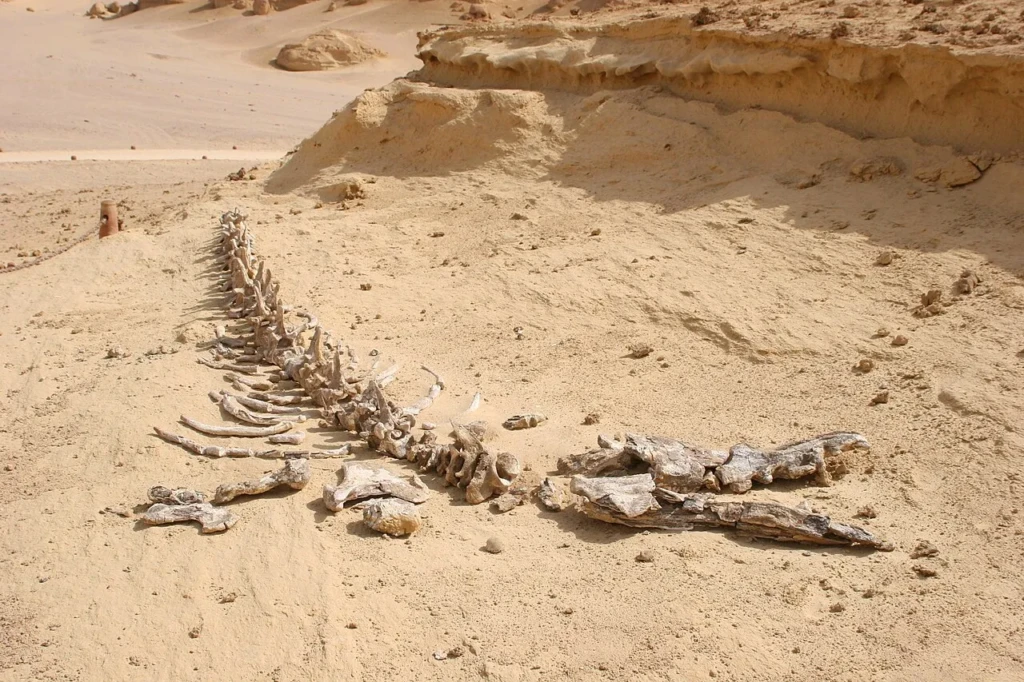
In a sandstone valley about 150 km (93 miles) southwest of Cairo, the skeletons of early whales lie where they died some 40 million years ago, when this desert was a shallow sea. Wadi Al-Hitan, the Valley of the Whales, sits inside the Wadi El Rayan Protected Area in Faiyum Governorate and has been a UNESCO World Heritage Site since 2005. Visitors walk a marked trail past exposed fossils on a full-day trip from Cairo, with a four-wheel-drive vehicle for the final desert stretch.
Below you will find what the fossils are, why scientists value them, what you see along the trail, how the trip from Cairo works, and what we could and could not confirm about fees and opening times in October 2026.
Wadi Al-Hitan at a Glance
| Fact | Details |
|---|---|
| Location | Western Desert, Faiyum Governorate, within the Wadi El Rayan Protected Area |
| Distance from Cairo | About 150 km (93 miles) southwest, per Wikipedia |
| Age of the fossils | Middle to Late Eocene, roughly 40 million years old |
| What you see | Skeletons of archaeocete (early) whales, sea cows, sharks’ teeth, a sawfish snout and fossil shells |
| Protected status | Part of Wadi El Rayan, declared a protectorate in 1989; UNESCO World Heritage Site since July 2005 |
| Managed by | Egyptian Environmental Affairs Agency (Ministry of Environment) |
| Time needed | Our planning suggestion: 2 to 3 hours on site, as part of a full day from Cairo |
| Access | Organized visits by 4×4 on a prescribed route |
What Is Wadi Al-Hitan?
The Arabic name means “Valley of the Whales.” It is a paleontological site, not an archaeological one. Nothing here was built by people. What makes it special is a dense concentration of fossil whales from a time when these animals still carried small hind legs.
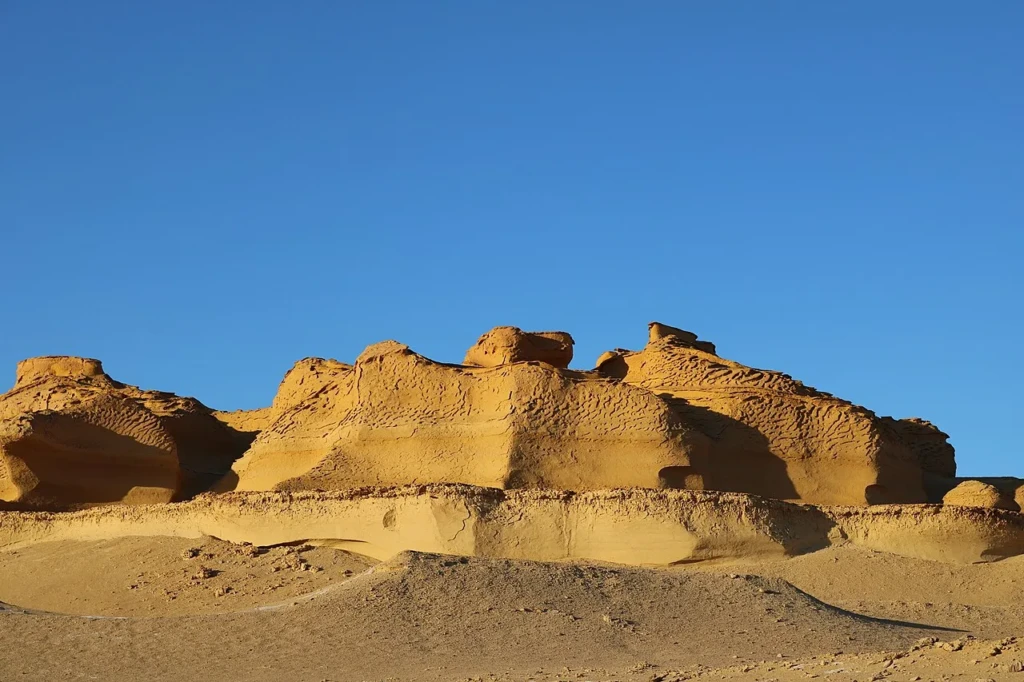
Around 40 million years ago, this part of Egypt lay under a sea. Whales, sea cows, sharks, crocodiles and turtles lived in its coastal waters. When they died, sand and mud buried their bones, and those sediments later hardened into the sandstone and mudstone of today’s cliffs. Wind and water now wear the soft rock away and slowly expose the skeletons.
Why scientists care about it
The fossils record one of the clearest steps in the evolution of whales: the move from land mammals to fully marine animals. According to Wikipedia’s summary of the UNESCO listing, no other site matches Wadi Al-Hitan for the number, concentration and quality of these fossils, or for how easy they are to see in their original setting. Some skeletons are complete enough to preserve stomach contents.
The whales already had streamlined bodies and flippers, yet they kept small hind limbs with feet and toes. Their skulls and teeth still looked like those of meat-eating land mammals. That mix of features is why the valley became Egypt’s first natural World Heritage Site, as the Egyptian Environmental Affairs Agency notes in its management plan for Wadi El Rayan.
A short history of the finds
The first whale skeletons here were found in the winter of 1902 to 1903. In 1904, Hugh Beadnell, then head of the Geological Survey of Egypt, named one of the large species Zeuglodon isis from bones collected at Wadi Al-Hitan; it is now classed as Basilosaurus. For decades few people came, because the valley was so hard to reach.
Interest returned in the 1980s, when four-wheel-drive vehicles became common. Fossil collectors came too, and bones disappeared. That loss led to stronger protection. Wadi El Rayan was declared a protectorate in 1989, and the whale valley was added to the UNESCO list in 2005. Research continues: Wikipedia reports that the oldest known pelican fossil was identified here in 2021. In 2023, scientists described Tutcetus rayanensis, a small whale about 2.5 meters long, from the wider Wadi El Rayan area.
The Whales of Wadi Al-Hitan
Two kinds of whale dominate the site. Knowing them before you go makes the trail far more interesting.
- Basilosaurus. A long, serpent-like predator. Wikipedia notes that the largest skeleton found in the valley reached about 21 meters. Bite marks on young Dorudon skulls found here suggest Basilosaurus hunted them.
- Dorudon. A smaller whale of about 3 to 5 meters. Young Dorudon remains found here have led researchers to suggest that mothers came to these waters to give birth.
Alongside the whales, the rocks hold three species of sea cow, the early elephant relative Moeritherium, crocodiles, sea turtles, and countless shark and ray teeth. You do not need to be a scientist to enjoy them. The scale of a whale skeleton lying in open desert is striking on its own.
What to See Along the Trail
Visits follow a set route, and the management plan limits visitors to guided tours on a prescribed trail. The public part of the valley works as an open-air museum, with walkways between the main fossils and small shade shelters. Wikivoyage counts about 30 fossil sites along the track. Here is what you will meet, roughly in the order a typical walk unfolds.
The entrance area
A sign marks the entrance to the protected site. Near the start you will find basic facilities. Wikivoyage mentions a small café and a shop selling locally made goods, books and hats, but advises bringing your own food and water. Use the facilities before you set out.
The whale skeletons
The heart of the visit is a series of partial skeletons laid out where they were found. Some are mostly exposed. Others show only a line of vertebrae emerging from the sand. Stay on the path and do not touch the bones; the rock around them is soft and breaks easily.
The sawfish and the shipworm log
Two smaller finds catch many visitors by surprise. One is a sawfish snout about 1.8 meters long, laid out in the park. The other is a fossil log riddled with tube-shaped holes made by shipworms, a reminder that wood once drifted in this sea.
Shells and sandstone cliffs
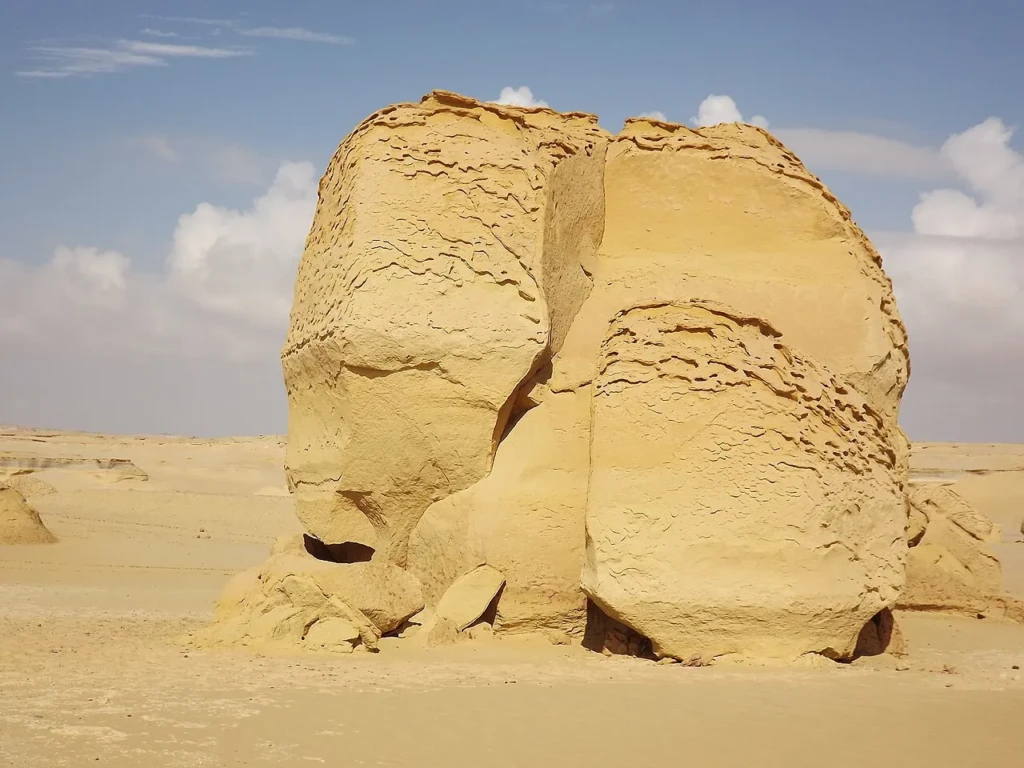
Look down as you walk. Disc-shaped fossils called nummulites coat the ground in places, and fallen blocks are packed with shells. The yellow sandstone cliffs and pillars around you formed in shallow coastal water. A pale band in the cliffs holds fossil burrows once mistaken for mangrove roots.
Garet Gohannam and the view
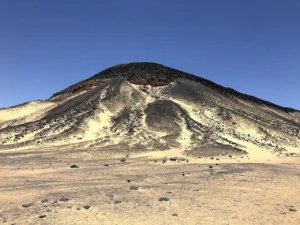
The valley sits behind a hill known as Garet Gohannam, “the Mountain of Hell,” which glows red in the low evening light. Wikivoyage notes that you can climb some of the low hills for a view over the whole valley. Ask your guide which slopes are allowed.
How to Get to Wadi Al-Hitan
Wadi Al-Hitan lies about 150 km southwest of Cairo, beyond the lakes of Wadi El Rayan. The first part of the trip runs on paved roads through Faiyum. The final section has long been described as an unpaved desert track, and Wikivoyage advises a vehicle built for rough ground. Plan on a four-wheel-drive vehicle with a driver who knows the route.
We do not give a fixed drive time. It depends on your hotel, traffic leaving Cairo and the state of the desert track. Your driver or guide will confirm timing. In practice, treat Wadi Al-Hitan as a full-day outing from Cairo or Giza, leaving early in the morning.
The UK FCDO’s safety page advises anyone traveling off road in Egypt to use a qualified guide and obtain a permit from the Ministry of Interior. A licensed local operator normally arranges this for you. Driving yourself into the desert is not a sensible option here.
Opening Hours and Entry Fees
Wadi Al-Hitan is a natural protectorate run by the Egyptian Environmental Affairs Agency, not an antiquities site. It does not appear on the Ministry of Tourism and Antiquities ticket list. We could not find a current official entry fee or published opening hours in October 2026, so we do not quote any. The only fee figures we found date from a 2007 planning document and are clearly out of date.
Plan to arrive and leave in daylight. If you book through an operator, ask whether protectorate fees are included in the price.
Is It Safe to Visit Wadi Al-Hitan?
The UK FCDO advises against all but essential travel to most of Egypt’s Western Desert, but it lists the whole of Faiyum Governorate as an exception, as of its advice updated in August 2026. Wadi Al-Hitan is in Faiyum, so it falls outside that warning. Always check the live FCDO warnings page before you travel, and US travelers should read the State Department’s Egypt advisory.
The main practical risks are heat, sun and getting stuck in sand. Wikivoyage also reminds visitors to watch for scorpions. For a wider view of current conditions, see our guide on whether it is safe to travel to Egypt right now.
Best Time to Visit
Visit between late autumn and early spring if you can. The valley has almost no shade beyond the small shelters, and summer days in the Western Desert are very hot. Wikipedia notes that most visitors are foreigners who come in winter, often at weekends. Start early for cooler walking, or aim for late afternoon if you want the warm light on Garet Gohannam. Our month-by-month guide to the best time to visit Egypt explains the seasons in more detail.
Practical Tips for Your Visit
- Carry water and food. Facilities are basic, so bring more water than you think you need and a packed lunch.
- Wear closed shoes. The trail crosses sand and loose stone.
- Cover up from the sun. A wide hat, sunglasses and sunscreen matter more here than at most Egyptian sites.
- Leave every fossil where it is. Do not pick up shells, teeth or bone fragments, even small ones.
- Stay on marked paths. Vehicle tracks and footprints scar the desert for years.
- Bring a light layer. Winter mornings and evenings in the desert can be cold.
- Camping is possible. Wikivoyage reports a small campsite with tents; fennec foxes often visit it at night. Ask your operator about current rules before planning an overnight stay.
Our Egypt packing and dress guide has a fuller checklist.
Combining Wadi Al-Hitan With Other Sights
The obvious pairing is Wadi El Rayan itself. The protectorate’s two lakes formed after 1973 from agricultural drainage water, and the small waterfalls between them are its best-known attraction. Most whale valley trips stop there on the way in or out. The farmland, lake and archaeological sites of Faiyum are also on the same road, though trying to see everything in one day makes for a rushed visit.
Many travelers fit Wadi Al-Hitan around a stay in Cairo and Giza. Before or after the desert, you could spend a day at the pyramids and a day with the collections that explain them:
- Our Giza Pyramids complex guide and Grand Egyptian Museum guide cover the essential Cairo days.
- The Saqqara visitor guide and our guide to the Bent and Red Pyramids at Dahshur cover the older pyramid fields south of the city, which lie in the same general direction as Faiyum.
- Our Cairo travel guide helps you choose a base.
Our Cairo day tours do not include Wadi Al-Hitan, but they fill the days around a desert outing well:
- Giza, Saqqara and Dahshur pyramids day tour, 1 Day, from $105 per person
- Grand Egyptian Museum private tour with the Giza Pyramids, 1 Day, from $95 per person
- Private Giza Pyramids tour with guide and car, 1 Day, from $55 per person
- Taste of Egypt: 4-day Cairo tour, 04 Days / 03 Nights, from $535 per person
You can browse more options on our private Cairo day tours page.
Visit With Delta Tours Egypt
We do not sell a fixed Wadi Al-Hitan tour. On request, we can arrange a private visit with a licensed driver, a suitable 4×4 for the desert section and a guide, built into a longer Cairo stay. Tell us your dates, your group and how much walking you enjoy through our tailor-made Egypt tours page, and we will suggest a realistic plan. If you prefer an Egyptologist with you throughout your trip, see our private tours with your own guide and driver.
Frequently Asked Questions
Where is Wadi Al-Hitan?
It lies in the Western Desert in Faiyum Governorate, about 150 km southwest of Cairo. The valley is part of the Wadi El Rayan Protected Area. The nearest town of any size is Faiyum city.
Why is it called the Valley of the Whales?
Hundreds of fossil whale skeletons, about 40 million years old, are preserved in its rocks. Many lie exposed on the surface. The Arabic name, Wadi Al-Hitan, means exactly that.
Can I visit Wadi Al-Hitan as a day trip from Cairo?
Yes. Most visitors go on a full day from Cairo or Giza, leaving early. The last part of the route crosses desert, so plan on a 4×4 and a driver who knows the track.
How much time do I need at the site?
Our planning suggestion is 2 to 3 hours on the trail, more if you are keen on fossils or photography. Add time for Wadi El Rayan’s lakes and waterfalls on the same day.
Is there an entry fee?
There is a protectorate fee, but we could not confirm the current amount from an official source in October 2026. Ask your operator whether it is included. We prefer to leave the figure out rather than quote an old one.
Is Wadi Al-Hitan suitable for children?
Children who like dinosaurs and fossils usually enjoy it. The walk is on flat to gently sloping ground, but there is little shade. Bring plenty of water and plan the visit for the cooler months.
Wadi Al-Hitan is one of the few places on Earth where you can stand beside a whale skeleton in open desert. If you would like to add it to a Cairo stay, start with our tailor-made tours and we will work out the timing with you.
Featured image: Fossil whale skeleton at Wadi Al-Hitan. Photo: Clr202 (Christoph Rohner) at de.wikipedia / Wikimedia Commons, CC BY-SA 3.0