Bahariya Oasis: Golden Mummies, Hot Springs and Desert Trips
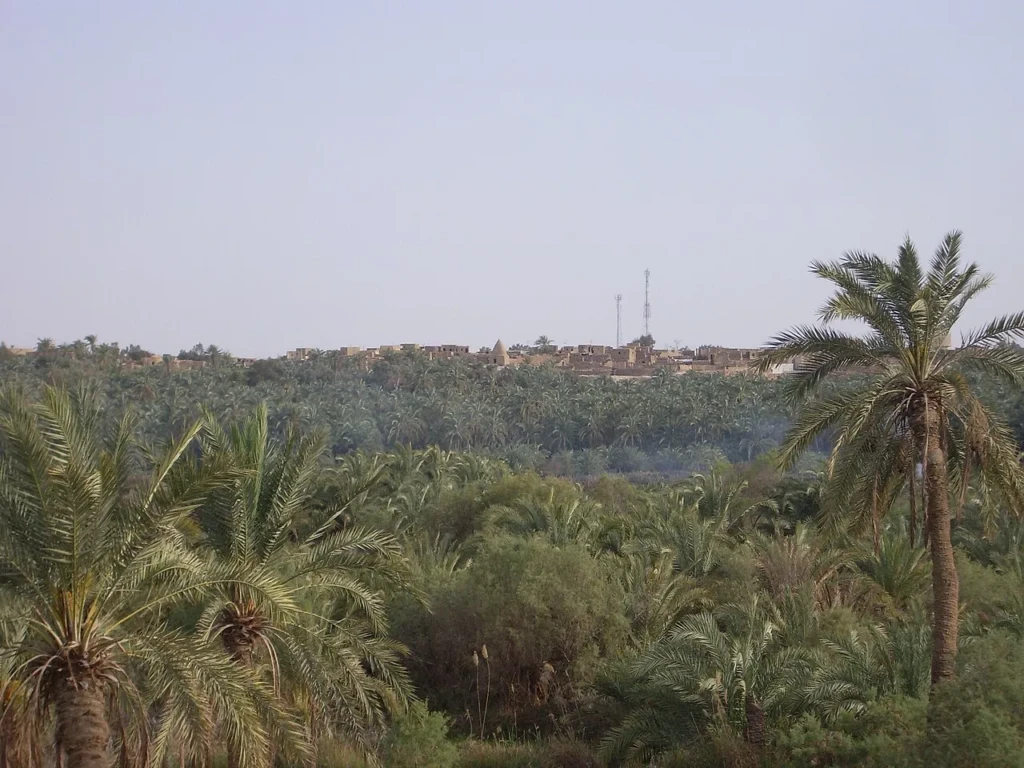
Bahariya Oasis is a green depression in Egypt’s Western Desert, about 370 km (230 miles) from Cairo, and the usual starting point for trips to the Black Desert and the White Desert. It is best known for the Greco-Roman burials nicknamed the Golden Mummies, for decorated tombs around the town of Bawiti, and for warm mineral springs. Plan at least two days, because the drive is long and the desert is the real highlight.
This guide covers what there is to see in and around Bahariya, the official ticket and opening hours, the permits and safety advice that apply to the Western Desert, and how to fit the oasis into a wider Egypt trip.
| Quick facts | Details |
|---|---|
| Location | Western Desert, Giza Governorate; main town El Bawiti |
| Distance from Cairo | About 370 km (230 miles) |
| Size | An oval valley about 94 km long and up to 42 km wide, covering roughly 2,000 square kilometers |
| Main periods | New Kingdom and 26th Dynasty tombs, Greco-Roman cemeteries and temples, early Christian monastic sites |
| Best known for | The Valley of the Golden Mummies, painted 26th Dynasty tombs, hot springs, and access to the Black and White Deserts |
| Official antiquities ticket | EGP 100 for foreign adults, 8:00 am to 4:00 pm (official list, October 2026) |
| Time needed | Our planning suggestion: two days with one night as a minimum; three days if you want to camp in the White Desert |
What is Bahariya Oasis?
The name means “the northern oases” in Arabic. Bahariya is a natural hollow in the desert floor, ringed by hills and fed by numerous springs. Unlike Fayoum, it has no Nile canal. Its water comes from the ground. Several villages share the valley. El Bawiti is the largest and the administrative center, and the older village of El Qasr has grown into it. Mandishah, El Zabu and Harrah lie to the east, and the satellite oasis of El Heiz sits about 50 km to the south.
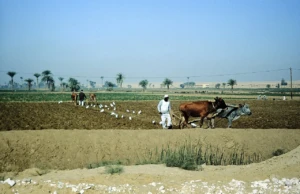
Today the local economy rests on farming, iron ore mining and tourism. Palm groves, olive trees, guavas and mangoes grow around the springs. The people of the oasis, known as Wahati, have their own music and dress traditions, though Cairo’s influence has grown since the asphalt road arrived in the early 1970s.
A short history of the oasis
People have lived in Bahariya since the Neolithic. Its ancient Egyptian name was Djesdjes, and King Kamose occupied it during his war against the Hyksos. A governor named Amenhotep Huy was buried here at the end of the 18th Dynasty. The oasis flourished in the 26th Dynasty, when local merchants built painted tombs and chapels.
The Greco-Roman period was another time of wealth. A temple to Amun bearing the name of Alexander the Great stands west of Bawiti, and some Egyptologists believe Alexander may have passed through Bahariya on his way back from the oracle at Siwa. Wine made from dates and grapes is thought to have been a main source of the oasis’s prosperity in Roman times. Later, Christian monks settled here. In recent seasons, archaeologists have uncovered rock-cut rooms and churches from around the 5th century AD at Qasr Al-Agouz, as reported by the Ministry of Tourism and Antiquities.
The Golden Mummies of Bahariya
The Valley of the Golden Mummies is a large Greco-Roman cemetery near Bawiti. It came to light in the mid-1990s, and excavations led by Zahi Hawass from 1999 recovered around 250 mummies about 2,000 years old over several seasons. The excavator estimated that the cemetery may hold more than 10,000 burials in total.
The mummies were prepared in four main styles. About sixty wore gilded masks and gilded chest covers showing gods and goddesses. Others were covered in painted cartonnage with scenes of Anubis, placed in pottery coffins shaped like a human body, or simply wrapped in linen. Jewelry, food trays, wine jars and Ptolemaic coins were buried with them.
The burial ground is an excavation area rather than an open monument, so visitors see the finds in Bawiti rather than walking the cemetery itself. Ask your guide which halls and mummies are on view when you visit, as displays change.
What to see in Bahariya, in visiting order
Most sights are strung along the main road through Bawiti and a few kilometers to the west. A sensible order is to start in town, work outward to the tombs and temple, then finish the day at a spring before heading into the desert the next morning.
1. The antiquities in and around Bawiti
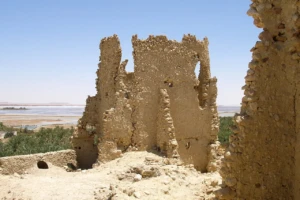
Start at the small museum in Bawiti, where you can ask staff which monuments your ticket covers that day. From there, the tombs of Qarat Qasr Salim are a short distance away on a low ridge above the town. Two 26th Dynasty tombs belong to a wealthy merchant, Zed-Amun-ef-Ankh, and his son Banentiu. Each has a columned inner court and side chambers. Zed-Amun-ef-Ankh’s tomb shows gods performing funeral rites under a ceiling painted as a starry sky. Banentiu’s tomb has painted columns, a winged sun disk and scenes of the journeys of the sun and moon.
2. The tomb of Amenhotep Huy
At Qarat Hilwah, the tomb of the governor Amenhotep Huy dates to the late 18th Dynasty. It is one of the oldest decorated monuments in the oasis and shows how far Egyptian state control reached into the desert during the New Kingdom.
3. The chapels of Ain el-Muftilla and the Temple of Alexander
West of Bawiti, the 26th Dynasty chapels at Ain el-Muftilla preserve faded but still readable relief decoration. Farther out, at Qasr el-Miqisba, are the ruins of the temple dedicated to Amun in Alexander the Great’s name. It is a modest ruin of sandstone chambers, so manage your expectations, but the link to Alexander makes it a popular stop.
4. The hot springs
Bahariya has many springs, and several reach 40°C (104°F) or more and carry a strong mineral content. The best-known lie northeast of Bawiti, including Bir el-Matar, a sulfur spring about 7 km from town. Do not expect a spa: there is no resort industry around them. Dress modestly if you bathe, since local people use the springs too.
5. The Black Desert
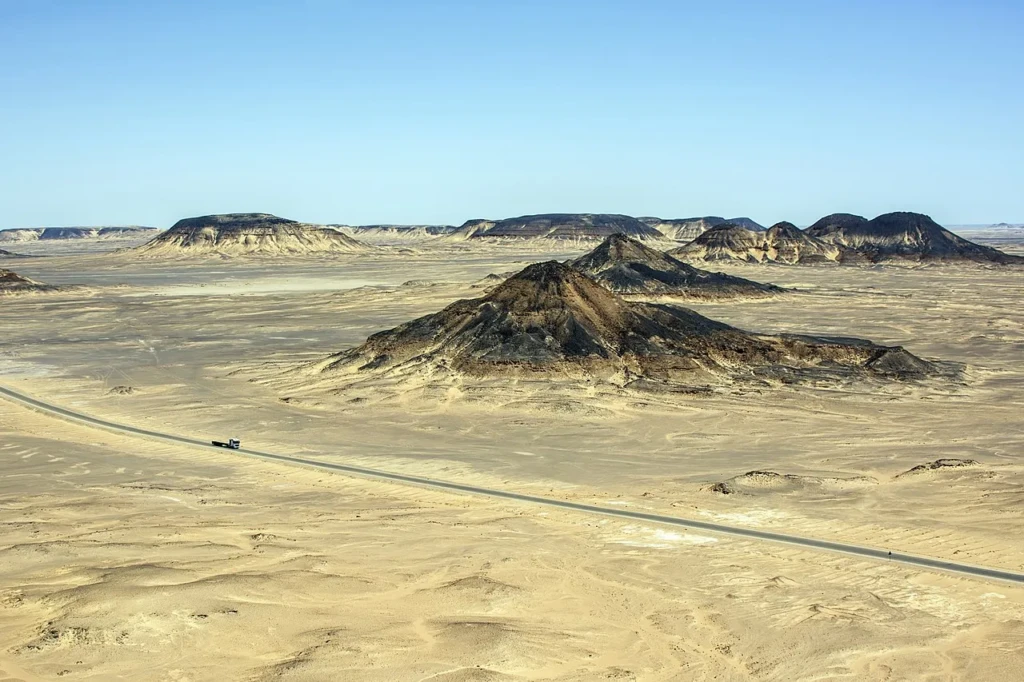
Southwest of Bawiti, on the road toward Farafra, the ground turns to a field of cone-shaped hills capped with dark volcanic rock. The contrast between the dark stone and the pale sand makes this one of the most photographed stretches of the road. The area between Bahariya and Farafra saw volcanic activity in the geological past, which explains the dark rock.
6. Crystal Mountain
Farther along the same road is Crystal Mountain, a rock ridge and natural arch studded with calcite crystals. It is a quick stop. The crystals are soft, so do not scratch or remove them.
7. The White Desert
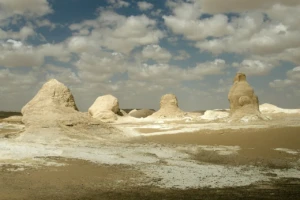
The White Desert, or Sahara el Beyda, is not in Bahariya itself. It lies in the Farafra depression, about 45 km north of the town of Qasr al-Farafra, in New Valley Governorate. Egypt declared it a protected area in 2002, covering about 3,133 square kilometers. Wind and sand have carved its white chalk into mushroom shapes, pillars and ridges. Many trips from Bahariya drive through the Black Desert and Crystal Mountain, reach the White Desert in the afternoon, and camp overnight among the formations.
For fossil fans: Bahariya’s dinosaurs
The rock layers of Bahariya are famous among paleontologists. From the 1910s onward, German scientist Ernst Stromer described Spinosaurus, Bahariasaurus and Aegyptosaurus from fossils found here, about 100 to 95 million years old. Those original specimens were destroyed in the bombing of Munich in 1944. A later American-led expedition found the giant plant-eater Paralititan. There is no fossil site set up for visitors, but the story adds depth to the landscape you drive through.
How to get to Bahariya Oasis
Bahariya is reached by an asphalt road from Giza. Buses and private cars use it, and most travelers go by private vehicle with a driver and guide, then switch to a 4×4 for the desert. The distance is about 370 km, and actual driving time depends on road conditions, checkpoints and stops, so your driver or guide will confirm timing before you set off.
Permits and official guides
The UK government says tourists who enter the Western Desert areas of Bahariya Oasis, Farafra, the White Desert and the Black Desert must apply for permits in advance and use an official guide. A reputable local operator will arrange this for you. Allow time for the paperwork when you plan the trip.
Bahariya ticket price and opening hours
The Ministry of Tourism and Antiquities lists a single Bahariya Oasis antiquities ticket at EGP 100 for foreign adults and EGP 50 for foreign students, with visiting hours from 8:00 am to 4:00 pm, as listed on the official Ministry of Tourism and Antiquities ticket price list in October 2026; check before you go. The list does not break down which monuments the ticket covers, so confirm with the antiquities office in Bawiti on the day.
We could not find an official current fee for entering the White Desert protected area, so we do not quote one. Your operator should include any protectorate fees in the trip price, and you can ask them to show the breakdown.
Is Bahariya safe to visit?
The UK Foreign, Commonwealth and Development Office advises against all but essential travel to most of the Western Desert. Its list of exceptions includes the oasis towns of Bahariya and Farafra, the White Desert and Black Desert, and the road between Giza and Farafra with 50 km either side of it, as checked on the FCDO regional risks page in October 2026.
Two points matter for planning. First, the FCDO advises against all but essential travel on the road between Bawiti and Siwa, including desert areas near the start of that road in Bahariya. It says the road is closed and there are military checkpoints. Second, phone reception is limited and medical facilities are poor in these areas, so travel with an experienced guide and follow local instructions. Check the latest UK and US government advice before booking, and read our overview on whether it is safe to travel to Egypt right now.
Best time to visit Bahariya and the White Desert
The cooler months, roughly October to April, suit a desert trip best. Days are comfortable for walking and climbing the Black Desert hills. Pack a warm layer for nights in the open desert and ask your operator what bedding is provided at camp. Summer heat makes long walks hard and turns the White Desert glare intense at midday. See our guide to the best season to visit Egypt for month-by-month conditions.
Practical tips for a Bahariya trip
- Keep your passport with you. Your guide needs it for permits, and the desert roads have checkpoints.
- Bring enough cash in Egyptian pounds for tickets, tips and small purchases.
- Pack a headlamp, sunglasses, sunscreen, a hat and a warm jacket for desert nights.
- Wear sturdy shoes for the tombs at Qarat Qasr Salim and the rocky Black Desert hills.
- Pack a modest swimsuit or T-shirt and shorts to wear over it for the hot springs.
- Leave no trace in the White Desert. Do not climb on or break the chalk formations.
- Ask before photographing local people, and do not photograph children.
- Download maps and music before you leave, since phone reception is limited.
How to combine Bahariya with the rest of Egypt
Most travelers add Bahariya to a Cairo stay. Two nights out of the city is enough for the oasis and one desert night. A few ideas for the days around it:
- Museums before the desert: see Egypt’s great pharaonic collections on our Grand Egyptian Museum and pyramids tour (from $95 per person), then compare them with the much later Greco-Roman burials of Bahariya. Our Egyptian Museum in Tahrir guide is also useful background.
- Pyramids on the way back: join the Pyramids Day Tour (from $55 per person) on the day before you leave or after you return.
- Old Cairo: the Old Cairo and Citadel tour (from $100 per person) covers the city’s Christian and Islamic heritage.
- A longer trip: our 7, 10 and 14-day Egypt itineraries show where a desert detour fits around a Nile cruise.
Before you pack, read what to pack and wear for Egypt and our Cairo travel guide.
Visit Bahariya with Delta Tours Egypt
Delta Tours Egypt does not currently offer a fixed Bahariya or White Desert package. We can arrange a private trip to the oasis on request through our tailor-made tours service, including the official guide and desert permits the authorities require. It can be added to a Cairo stay such as the Taste of Egypt 4-day Cairo tour (from $535 per person). Share your dates and how many nights you can spare, and our Cairo team will tell you what is possible.
Frequently Asked Questions
How far is Bahariya Oasis from Cairo?
Bahariya is about 370 km (230 miles) from Cairo by road. Driving time varies with conditions and checkpoints, so confirm it with your driver or operator before you set off.
Can I see the Golden Mummies?
The Valley of the Golden Mummies is an excavation area, so visitors see a selection of finds in Bawiti rather than the cemetery itself. Displays can change, so ask your guide what is on view when you book.
Is the White Desert part of Bahariya?
No. The White Desert protected area lies in the Farafra depression, about 45 km north of Qasr al-Farafra. Most trips start in Bahariya and drive south through the Black Desert to reach it.
Do I need a permit to visit Bahariya and the White Desert?
Yes. According to the UK government, tourists entering Bahariya, Farafra, the White Desert and the Black Desert must apply for permits in advance and use an official guide. A licensed operator handles this for you.
How much is the entrance ticket in Bahariya?
The official Ministry list shows a Bahariya Oasis ticket at EGP 100 for foreign adults and EGP 50 for foreign students, from 8:00 am to 4:00 pm, as of October 2026. Protectorate fees for the White Desert are separate.
How many days do I need for Bahariya Oasis?
Two days and one night is the minimum for the oasis sites and a hot spring. Three days lets you camp in the White Desert without rushing the drive back to Cairo.
Bahariya is a real journey into the desert, and it works best when the logistics are handled well. If you would like a private trip with permits, guide and camp arranged, start with our tailor-made Egypt tours.
Featured image: Palm groves of Bahariya Oasis. Photo: Neil Carey / Wikimedia Commons, CC BY-SA 2.0