Black Desert Egypt and Crystal Mountain on the Bahariya Route
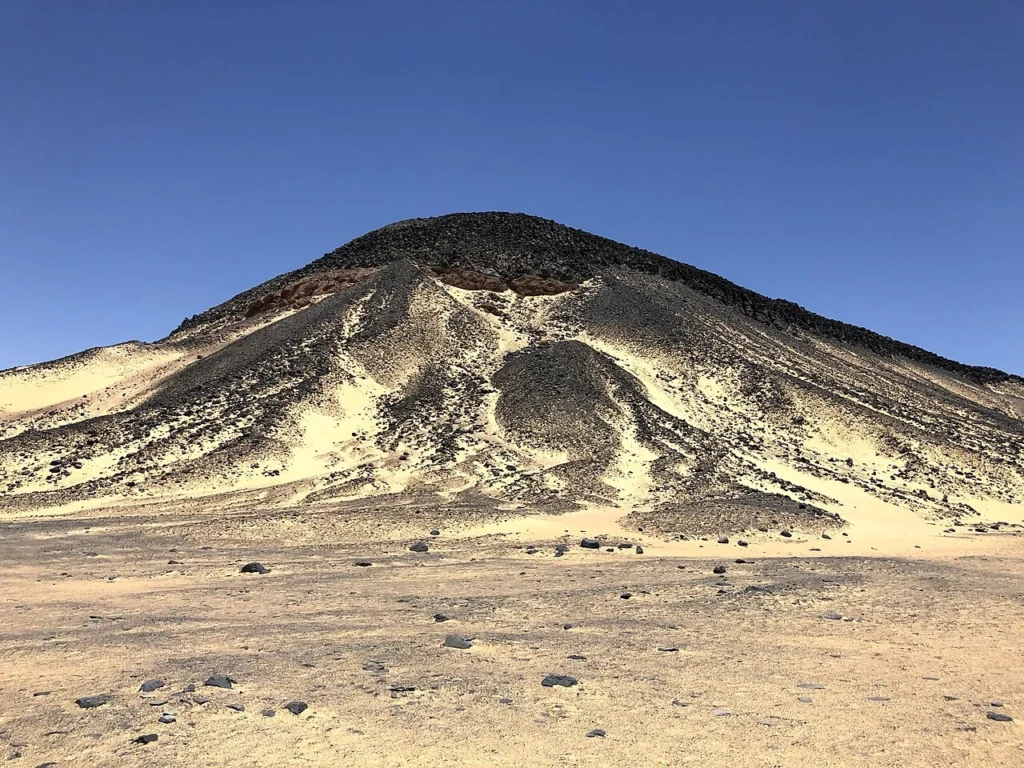
Drive south from Bahariya Oasis and the pale sand of the Western Desert suddenly fills with dark, cone-shaped hills. This is the Black Desert of Egypt, a stretch of about 30 km (19 miles) between Bahariya and the White Desert where the mounds are capped with black volcanic rock. A little farther south, right beside the highway, Crystal Mountain is a low ridge with a natural arch lined with calcite crystals. Both are short, easy stops on the road from Bahariya to the White Desert.
This guide explains what the Black Desert and Crystal Mountain are, what each stop involves, how they fit into a Western Desert trip from Cairo, and what official UK travel advice says about the route in October 2026.
The Black Desert and Crystal Mountain at a Glance
| Fact | Details |
|---|---|
| Location | Western Desert, on the road south from Bahariya Oasis toward Farafra |
| Extent of the Black Desert | About 30 km (19 miles), between Bahariya and the White Desert, per Wikipedia |
| Height of the mounds | Up to about 100 meters (328 feet) |
| Crystal Mountain | A natural arch lined with calcite crystals, just east of the Bahariya to Farafra highway |
| Base town | Bawiti, the main town of Bahariya Oasis, about 370 km (230 miles) from Cairo |
| Vehicle needed | A standard car reaches both roadside stops; 4×4 is needed only for the White Desert tracks beyond |
| Time needed | Our planning suggestion: 1 to 1.5 hours for the Black Desert, 20 to 30 minutes at Crystal Mountain |
What Is the Black Desert?
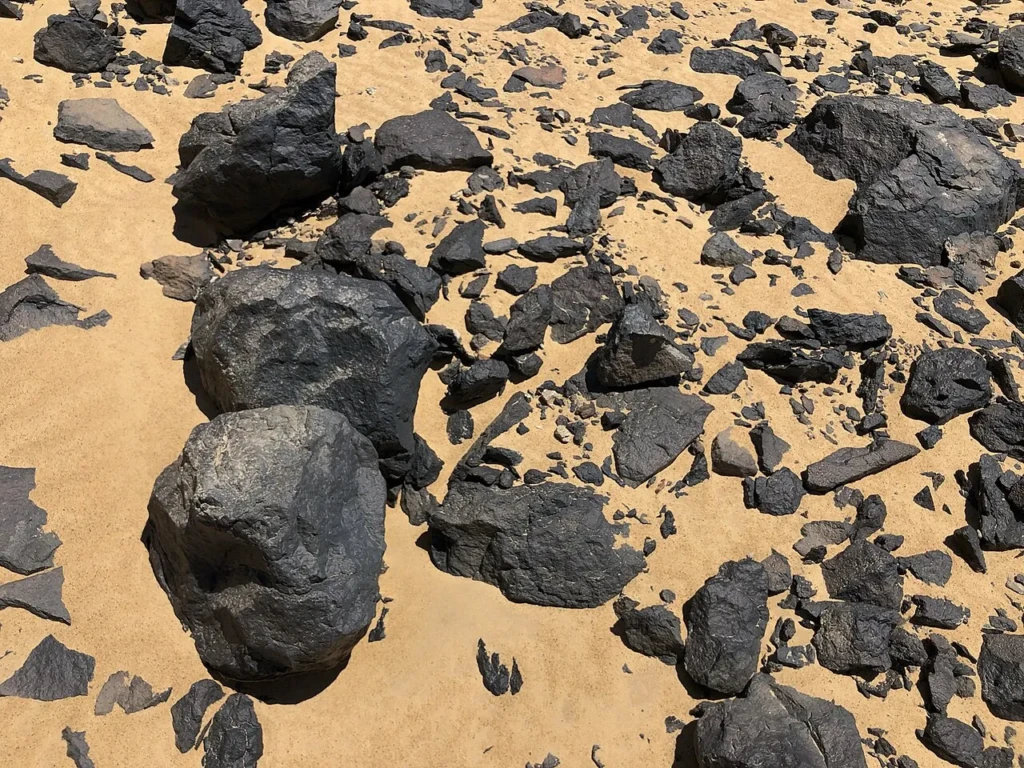
The Black Desert is not black sand. It is a landscape of widely spaced, volcano-shaped mounds rising from orange-brown desert. Most of the mounds are topped with a layer of dark basalt, and the broken pieces of that cap have rolled down their slopes and scattered across the ground. From a distance, the hills look as if someone dusted them with soot.
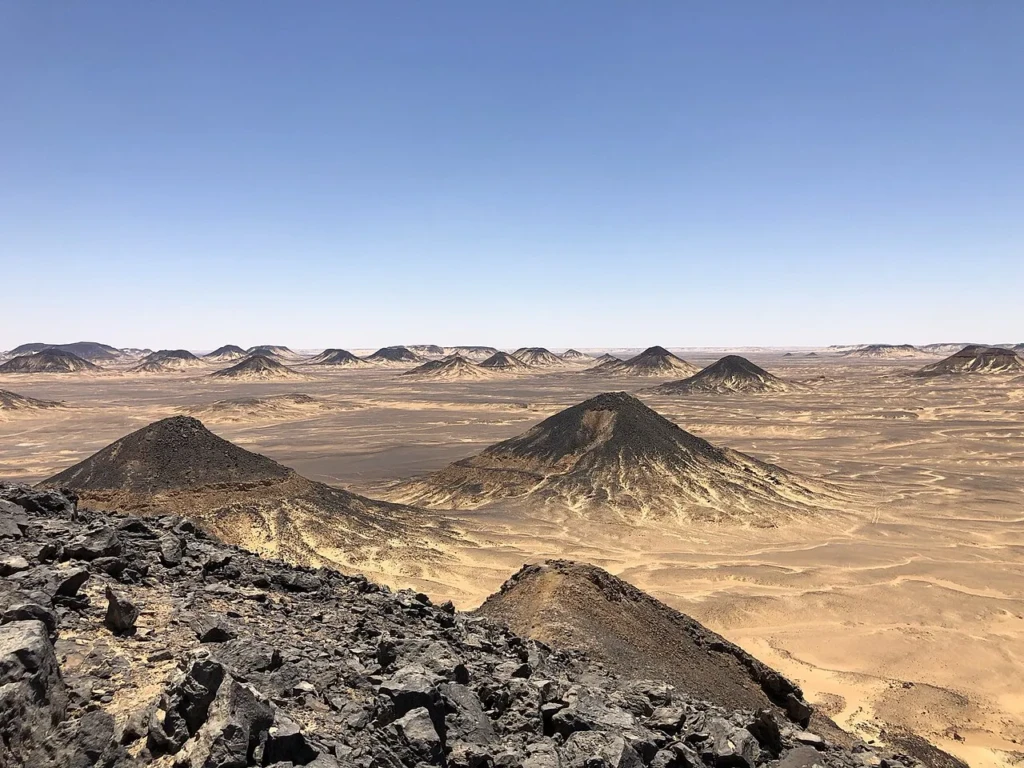
Up close, the rock varies. According to Wikipedia, some mounds are dark iron quartzite, while others are reddish, with surface rocks of iron-rich sandstone. Volcanic dolerite appears on the outskirts of the area. Remains of shrubs and fossil wood have also been found, a sign that plants once grew here.
How the Black Desert fits into the oasis landscape
The Black Desert lies between two very different places. To the north is Bahariya, a green depression of palm groves and springs centered on the town of Bawiti. To the south is the White Desert, whose chalk and limestone have been carved by wind into pale towers and mushroom shapes. Driving from one to the other, you pass from dark volcanic hills to white rock in a single afternoon. That contrast is the main reason people stop.
Wikivoyage notes that the Black Desert also separates Bawiti from the small southern oasis of El Heiz, and names Gebel el-Marsus as one of its most striking formations.
What Is Crystal Mountain?
Crystal Mountain, sometimes called Gebel el-Kristal, is a small rocky ridge just east of the highway between Bahariya and Farafra. Its draw is a natural arch whose surfaces glitter with crystals. Wikivoyage describes the crystals as calcite and makes a fair point: calcite is soft and scratches easily, so look and photograph, but do not chip or collect.
Crystal Mountain sits at the northern end of the White Desert area. Wikivoyage describes the White Desert sanctuary as running roughly from Crystal Mountain in the north to Table Mountain in the south. For many travelers, it is the last stop before the chalk formations begin.
What to See, in the Order You Reach It
Most trips run north to south, leaving Bawiti after breakfast and reaching the White Desert by mid-afternoon. Here is the usual sequence.
1. The first black hills
Not far out of Bawiti, the first dark-capped mounds appear beside the road. Your driver will choose a pull-off where you can walk among them. The scattered black stones underfoot are the broken caps of the hills.
2. A climb for the view
The classic Black Desert stop is a short climb up one of the cones. From the top, you see dozens of dark peaks spread across the plain. The slope is loose and stony, so take it slowly. Fifteen to twenty minutes is enough for most people to get up and back.
3. Crystal Mountain
Farther south, Crystal Mountain is a quick roadside stop. Walk to the arch, look closely at the crystal-lined rock, and step back for photos of the formation against the sky. The surfaces are sharp in places, so keep a hand on younger children.
4. The descent toward the White Desert
South of Crystal Mountain, the road continues into the Farafra depression. Wikivoyage notes that the White Desert’s northernmost entrance lies south of the Aqabat Pass. From here, the dark hills give way to pale chalk, and the next part of your trip begins.
How to Get to the Black Desert and Crystal Mountain
Bahariya Oasis is about 370 km (230 miles) from Cairo by an asphalt road, according to Wikipedia. Most visitors drive from Cairo to Bawiti, spend a night in the oasis, then continue south through the Black Desert. Wikivoyage puts the White Desert roughly 100 km beyond Bahariya.
We do not quote drive times, because they depend on your starting point, stops and road conditions. Your driver or guide will confirm timing. For a sense of scale, Wikivoyage put the public bus from Cairo to Bawiti at about 6 hours in 2020, including a rest break. Plan at least two nights for a trip that includes the Black Desert and the White Desert.
The Black Desert and Crystal Mountain sit beside the main road, and Wikivoyage notes that a standard car is enough for everything in this area except the White Desert’s own tracks. If you plan to continue into the White Desert or camp there, you will need a four-wheel-drive vehicle and an experienced local driver. The UK FCDO advises anyone traveling off road in Egypt to use a qualified guide and get a permit from the Ministry of Interior.
Entry Fees and Opening Hours
The Black Desert and Crystal Mountain are natural landscapes beside a public road. Neither appears on the Ministry of Tourism and Antiquities ticket list, and we found no official entry fee or opening hours for them in October 2026. We do not quote any. Plan to visit in daylight.
The White Desert is a declared protectorate, and the Egyptian Environmental Affairs Agency lists it as established in 2002. We could not confirm its current entry fee from an official source, so ask your operator whether any protectorate fees are included in your trip. Separately, Ahram Online reported in July 2026 that ticket prices for archaeological sites in Bahariya Oasis would rise on 1 October 2026, with foreign adults paying EGP 400. If you plan to visit the oasis museum or tombs, check the current price on arrival.
Is It Safe to Visit the Black Desert?
The UK FCDO advises against all but essential travel to most of Egypt’s Western Desert. However, its advice lists several exceptions, including the White Desert and Black Desert, the oasis town of Bahariya, and the road between Giza and Farafra plus 50 km either side of it. The Black Desert and Crystal Mountain fall within those exceptions, as of FCDO advice updated in August 2026. The FCDO still advises against all but essential travel on the road between Bahariya and Siwa.
Read the live FCDO warnings page before you book, and US travelers should check the State Department’s Egypt advisory. Our guide on whether it is safe to travel to Egypt right now gives the wider picture.
Best Time to Visit
The cooler months, from late autumn to early spring, are the most comfortable for the Western Desert. Wikivoyage describes Bahariya’s climate as reaching 40°C (104°F) and above in summer, with winter temperatures around 10°C (50°F). Desert nights in winter can feel much colder, which matters if you plan to camp in the White Desert afterward.
For the Black Desert itself, late afternoon light brings out the contrast between dark rock and golden sand. A morning departure from Bawiti, with the Black Desert and Crystal Mountain on the way, usually puts you in the White Desert for sunset. See our guide to the best time to visit Egypt for month-by-month conditions.
Practical Tips
- Wear shoes with grip. The black cones are covered in loose stones that roll underfoot.
- Bring water and snacks. There are no facilities at either stop.
- Protect yourself from the sun. There is no shade on the cones or at Crystal Mountain.
- Do not take crystals or rocks. Leave the landscape as you found it. Wikivoyage asks White Desert visitors to take nothing and leave nothing, and the same courtesy applies here.
- Pack a warm layer. Even after a hot day, desert evenings in winter turn cold quickly.
- Carry your passport. Keep ID with you on any long road journey in Egypt.
Our Egypt packing and dress guide has a complete checklist.
Combining the Black Desert With the Rest of Your Trip
The Black Desert is almost always part of a longer Western Desert route: Bahariya first, then the Black Desert and Crystal Mountain, then a night or more in the White Desert.
Because the desert takes at least two or three days, it usually sits next to a Cairo stay. Our Cairo travel guide and Giza travel guide help you plan the city days before or after. If time is short and you are weighing the desert against a Nile cruise, our 7, 10 and 14 day Egypt itinerary guide shows how the days add up.
Our packaged tours do not include the Western Desert, but these Cairo options pair well with a desert extension arranged separately:
- Taste of Egypt: 4-day Cairo tour, 04 Days / 03 Nights, from $535 per person
- Giza, Saqqara and Dahshur pyramids day tour, 1 Day, from $105 per person
- Grand Egyptian Museum private tour with the Giza Pyramids, 1 Day, from $95 per person
For a fully private trip with your own Egyptologist, see our private Egypt tours with a guide and driver.
Visit With Delta Tours Egypt
We do not sell a fixed Black Desert tour. On request, we can arrange a private trip from Cairo through Bahariya, the Black Desert and Crystal Mountain, with licensed drivers and a 4×4 for any White Desert section. Share your dates, group size and whether you would like to camp through our tailor-made Egypt tours page, and we will check current advice and permits before suggesting a plan.
Frequently Asked Questions
Where is the Black Desert in Egypt?
It is in the Western Desert, south of Bahariya Oasis, on the road toward the White Desert and Farafra. The area stretches about 30 km. Bawiti, about 370 km from Cairo, is the usual base.
Why is the Black Desert black?
Most of its hills are capped with dark basalt, and fragments of that cap cover their slopes and the ground around them. Some mounds are dark iron quartzite instead. The sand between the hills is not black.
What is Crystal Mountain made of?
It is a rocky ridge with a natural arch lined with crystals, which Wikivoyage identifies as calcite. Calcite is soft and scratches easily. Please do not break off or take any pieces.
Can I visit the Black Desert as a day trip from Cairo?
It is not practical. Bahariya alone is about 370 km from Cairo, so most visitors stay at least one night in the oasis. Combining it with the White Desert usually needs two or three days.
Do I need a 4×4 for the Black Desert?
Not for the roadside stops. A standard vehicle can reach the Black Desert and Crystal Mountain. You need a 4×4 and an experienced driver only if you continue onto the White Desert’s tracks.
Is the Black Desert covered by travel warnings?
As of August 2026, the UK FCDO lists the White Desert, the Black Desert and Bahariya town among the exceptions to its Western Desert advice. Check the live advice before you go. The road from Bahariya to Siwa remains under an all-but-essential warning.
The Black Desert and Crystal Mountain turn a long desert drive into a series of memorable stops. To build them into your Egypt trip, start with our tailor-made tours and we will take care of the details.
Featured image: Volcanic-capped hills in the Black Desert. Photo: Viktor Lazić / Wikimedia Commons, CC BY-SA 4.0