Tutankhamun’s Tomb (KV62): What You See Inside & Is It Worth It?
Tutankhamun’s tomb, KV62, is a small four-chamber tomb in the Valley of the Kings in Luxor, found almost intact by Howard Carter in 1922. Inside you see a short corridor, the painted burial chamber with the king’s stone sarcophagus, and Tutankhamun’s mummy in a climate-controlled glass case. The famous gold treasures are no longer there; they are now in the Grand Egyptian Museum in Giza. The tomb needs a separate ticket of EGP 700 for foreign adults, on top of the Valley of the Kings entry.
This guide explains what you actually see inside, why the tomb is so small, what the extra ticket buys you, and how to decide whether it is worth it on your visit to Luxor’s West Bank.
Tutankhamun’s Tomb at a Glance
| Fact | Details |
|---|---|
| Location | East Valley of the Kings, West Bank of Luxor |
| Tomb number | KV62 |
| Built for | Tutankhamun, 18th Dynasty king (c. 1336–1327 BC per the Ministry of Tourism and Antiquities) |
| Discovered | 4 November 1922, by Howard Carter’s team, funded by Lord Carnarvon |
| Layout | Entrance stairway, corridor, antechamber, annex, burial chamber and treasury |
| Decorated room | Burial chamber only |
| On display in the tomb | The king’s mummy (in a glass case) and the stone sarcophagus |
| Opening hours | Daily, 6:00 AM to 5:00 PM (official listing, October 2026) |
| Foreign adult ticket | EGP 700 (student EGP 350), separate from Valley of the Kings entry |
| Time inside | Our planning suggestion: 15 to 20 minutes |
Why Is Tutankhamun’s Tomb So Famous?
Because it was found nearly complete. The Ministry of Tourism and Antiquities describes KV62 as the only royal tomb in the Valley of the Kings discovered relatively intact. Every other king’s tomb in the valley had been emptied in antiquity.
Tutankhamun’s tomb survived for a simple reason. It was cut low in the valley floor. Flood debris, and later the rubble and workers’ huts from cutting the tomb of Ramesses V and VI (KV9) nearby, buried its entrance. By the time organized robbers stripped the valley at the end of the New Kingdom, nobody knew where Tutankhamun’s tomb was.
It was not untouched, though. Wikipedia notes that robbers broke in twice within a few years of the burial. Officials repaired the damage and resealed the tomb each time, and the mummy and most of the goods stayed in place.
When Carter’s team uncovered the first step on 4 November 1922, they found around 5,000 objects packed into the rooms. Wikipedia counts the total at 5,398. The find made headlines around the world and turned a young, little-known king into the most famous pharaoh in history.
Who Was Tutankhamun?
Tutankhamun came to the throne as a child, after the reign of Akhenaten, who was probably his father. Akhenaten had pushed Egypt toward the worship of a single god, the Aten. Tutankhamun’s reign brought back the traditional gods. Even his name changed, from Tutankhaten to Tutankhamun, honoring Amun.
He ruled for only about nine years and died young. Later kings tried to erase the Amarna-era rulers from the record, and Tutankhamun’s name was left out of later king lists. As the Ministry puts it, it is one of history’s ironies that this minor king now outshines the greatest pharaohs in fame.
Why Is the Tomb So Small?
Compared with tombs like that of Seti I or Ramesses VI, KV62 is modest in size and decoration. The most common explanation is that it was never meant to be a king’s tomb.
Both the Ministry and Wikipedia describe the leading theory. Tutankhamun probably started a full royal tomb early in his reign, but he died before it was ready. His successor, the official Ay, may have taken that larger tomb for himself (Ay was buried in a tomb in the West Valley), and Tutankhamun was placed in a smaller tomb that was enlarged at short notice. Wikipedia suggests KV62 may first have been cut for a non-royal person, possibly Ay himself.
That rush shows in the space. Thousands of objects had to be stacked tightly into rooms only a few meters across.
What You See Inside KV62, in Visiting Order
The tomb is short and the route is simple. Here is what you will pass, using the room names Egyptologists use.
1. The Entrance Stairway
You go down a steep stairway cut into the bedrock of the valley floor. According to Wikipedia, it originally had sixteen steps. This is the same stairway Carter’s workers cleared in November 1922.
2. The Descending Corridor
A sloping corridor about 8 meters long and 1.7 meters wide leads to the first room. After the first ancient robbery, officials filled this corridor with limestone chips to block it. The second set of robbers tunneled through that fill anyway.
3. The Antechamber and Tutankhamun’s Mummy
The antechamber is about 7.9 meters by 3.6 meters. In 1922 it was crowded with furniture, dismantled chariots, funerary beds and two life-size guardian statues of the king. Today it is empty of those objects.
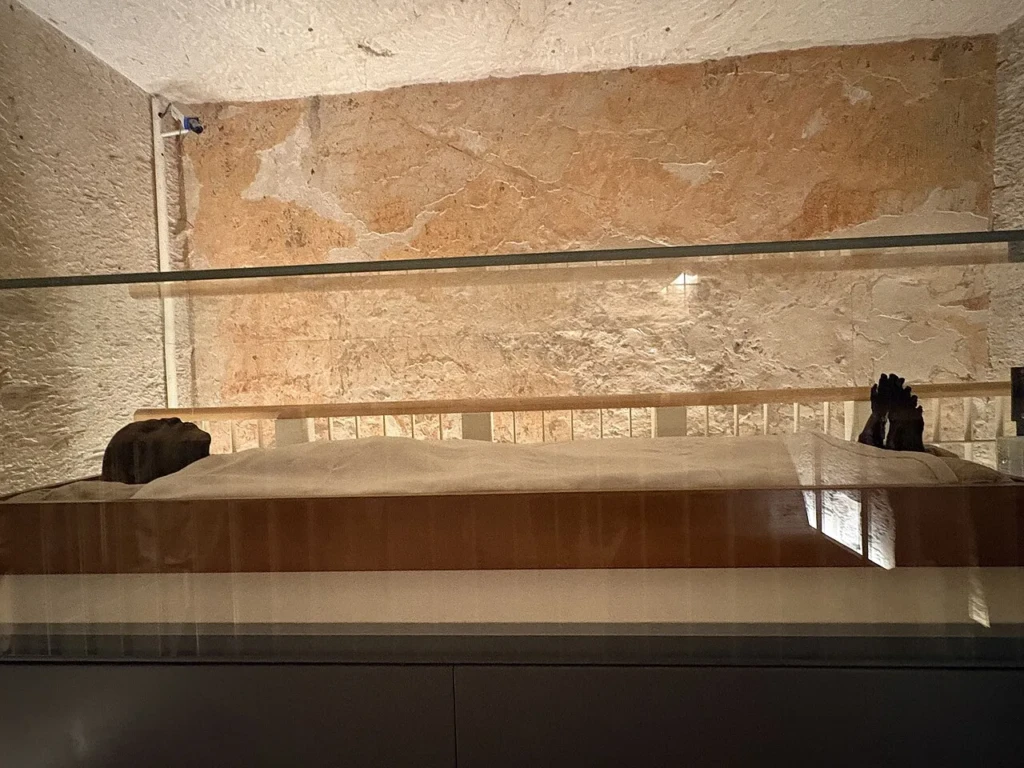
What it holds now is the main reason many people buy the ticket. Since 2007, Tutankhamun’s mummy has rested here in a climate-controlled glass display case, according to Wikipedia. The case protects the body from humidity and mold while still letting visitors see the king. The Grand Egyptian Museum’s description also notes that the mummy stays in the Valley of the Kings and will not be moved.
4. The Annex
A small side room off the antechamber, about 4.4 by 2.6 meters, once held more than 2,000 objects: food, wine and oil jars, model boats, weapons, games and toys. Like the other side rooms, it was left undecorated.
5. The Burial Chamber
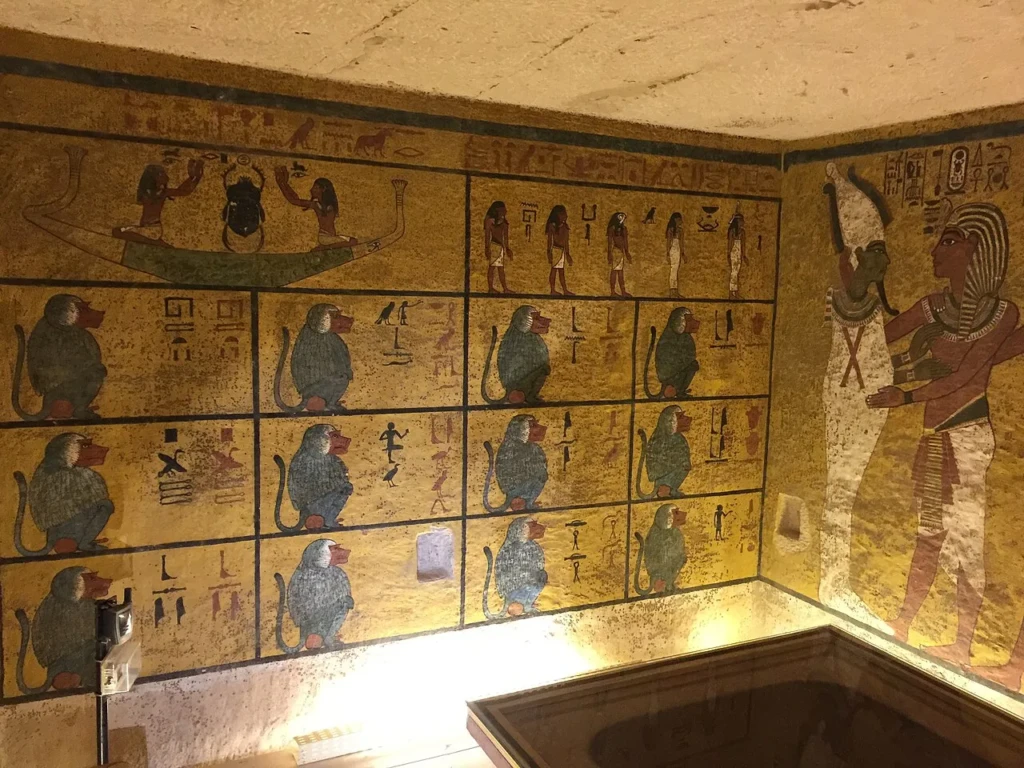
This is the only painted room in the tomb, and the highlight of the visit. It sits slightly lower than the antechamber and measures about 6.4 by 4 meters. The stone sarcophagus remains in the chamber. Wikipedia says it is made of quartzite with a red granite lid painted to match. Four protective goddesses are carved at its corners: Isis, Nephthys, Neith and Serqet.
The walls are painted on a yellow background. Look for these scenes:
- North wall. Ay, the next king, performs the Opening of the Mouth ritual on Tutankhamun’s mummy. This scene showed Ay as the rightful heir. Next to it, Tutankhamun greets the sky goddess Nut and then embraces Osiris, god of the dead.
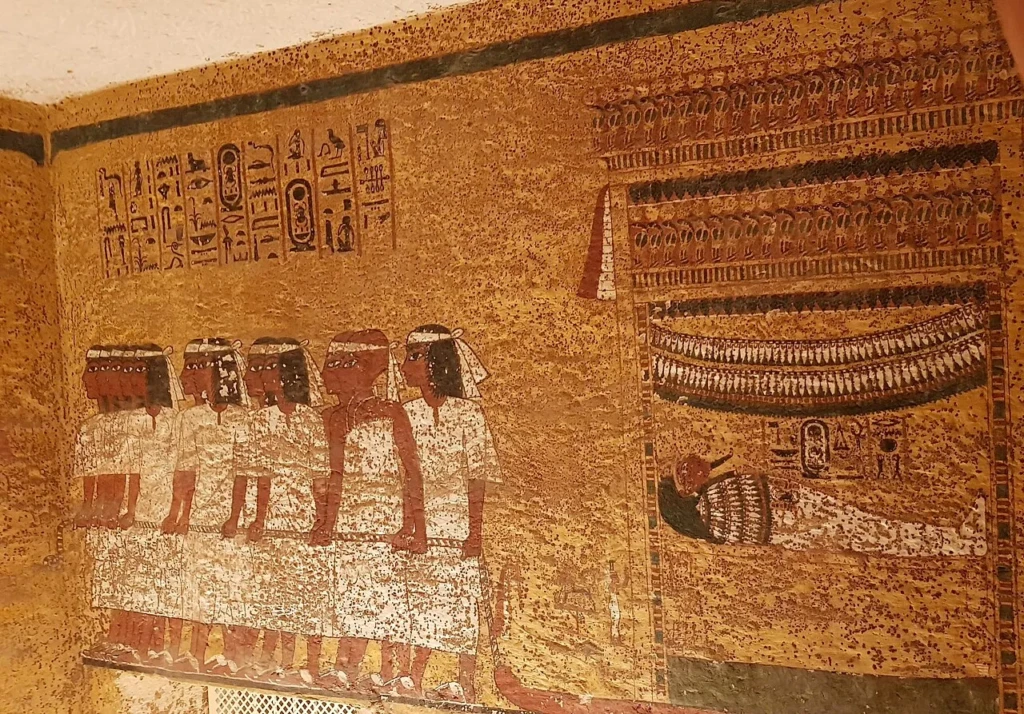
- East wall. Officials drag the king’s mummy on a sledge in his funeral procession. Wikipedia notes this type of scene is common in private tombs but not found in any other royal tomb.
- South wall. The king with the goddess Hathor and the god Anubis. Part of this wall was painted on a partition that Carter had to remove to get the shrines out.
- West wall. Twelve baboons from the first hour of the Amduat, the book describing the sun god’s night journey through the underworld. The Ministry points out that this is the only Amduat scene in the tomb.
Three of the walls show figures with the softer, elongated proportions of Amarna-period art, a reminder of the era Tutankhamun grew up in.
6. The Treasury
Off the burial chamber is a small room Carter called the treasury. It once held the gilded canopic shrine and a statue of the jackal god Anubis on a carrying shrine. Like the annex, it is undecorated, and its contents are now in Giza.
Where Are Tutankhamun’s Treasures Now?
Almost everything Carter found left the tomb long ago. Most objects went first to the Egyptian Museum in Tahrir, Cairo. Today they are at the Grand Egyptian Museum (GEM) in Giza, which Wikipedia says was fully inaugurated on 1 November 2025.
Two of the GEM’s main halls are devoted to Tutankhamun. According to Wikipedia, they display the whole collection of 5,398 objects together for the first time, including the gold mask, the solid-gold inner coffin and the golden throne. Read our Grand Egyptian Museum guide to plan that visit.
So the honest picture is this: in Luxor you see the place, the paintings and the king himself. In Giza you see what was buried with him. Many travelers find the two visits mean more together.
Opening Hours and Ticket Prices
The Valley of the Kings and Tutankhamun’s tomb are both open daily from 6:00 AM to 5:00 PM. Tutankhamun’s tomb is not covered by the general valley ticket. You need a separate ticket for KV62. The figures below are as listed on the official Ministry of Tourism and Antiquities site in October 2026; check before you go.
| Ticket | Foreign adult | Foreign student |
|---|---|---|
| Valley of the Kings (general entry) | EGP 750 | EGP 375 |
| Tomb of Tutankhamun (KV62) | EGP 700 | EGP 350 |
| Howard Carter’s House (with the KV62 replica) | EGP 220 | EGP 110 |
You can check the current figures on the official Tomb of Tutankhamun page and the official Valley of the Kings page. The official pages do not state which other tombs are open on a given day or how many the general ticket covers, so your guide will confirm that on the day.
Is Tutankhamun’s Tomb Worth the Ticket?
It depends on what you hope to see. Here is a fair way to decide.
Buy the Ticket If
- You want to see Tutankhamun himself. The mummy is in the tomb, and nowhere else.
- The story of 1922 matters to you. Standing in the rooms Carter first saw is the point of the visit.
- You like wall painting. The burial chamber scenes, including Ay’s Opening of the Mouth and the twelve baboons, are well preserved and unusual.
- This may be your only trip to Luxor. Many visitors would regret skipping it.
You Might Skip It If
- You expect gold and treasure. The rooms are empty apart from the sarcophagus and mummy. The treasures are at the GEM.
- You want long, fully decorated corridors. Other royal tombs in the valley are much larger and more richly painted. The Ministry describes Seti I’s tomb as one of the longest, deepest and most beautifully decorated in the valley.
- You are watching your budget. At EGP 700, the ticket costs nearly as much as the general valley entry, for a short visit.
Our view: if Tutankhamun is part of why you came to Egypt, buy it. The visit is short, but seeing the king in the tomb where he was found is something no museum can give you. If you care more about art and architecture, put the money toward one of the larger decorated tombs instead.
The KV62 Replica at Howard Carter’s House
To reduce wear on the original, an exact replica of the tomb was made. The Ministry says the replica, made and donated by Factum Arte, was installed in 2014 in the grounds of Howard Carter’s House on the West Bank. Carter built the mudbrick house in 1910 and used it as his Luxor base. It became a museum in 2009 and was restored in 2022 for the discovery’s centenary.
The replica is a good option for travelers who want time to study the paintings closely without the pressure of the queue in the real tomb. It is also a useful add-on for anyone interested in how the discovery unfolded.
Preservation and the “Hidden Chamber” Question
The tomb is fragile. Wikipedia notes that a rainstorm on New Year’s Day 1991 flooded the burial chamber through a fault in the ceiling, and that breath and touch from visitors harm the paint. The Getty Conservation Institute worked with the Egyptian authorities on a long-term conservation project that began in 2009 and was completed in 2019. On busy days, up to 1,000 people pass through the tomb, according to Wikipedia.
You may have read that a hidden chamber, possibly Nefertiti’s tomb, lies behind the burial chamber walls. In 2015 the Egyptologist Nicholas Reeves proposed this from scans of the walls. Radar surveys in 2016 and 2018 concluded there were no hidden voids. Wikipedia reports that a 2026 study using microgravity measurements argued the question is still open. For now, it remains a debate, not a discovery.
Practical Tips for Visiting
- Go early. The valley opens at 6:00 AM. Early visits are cooler and usually quieter.
- Plan the KV62 ticket in advance. It is separate from general entry, so decide before you arrive and let your guide confirm where it is sold.
- Keep your voice down and hands off. Breath and touch damage the paint.
- Check photography rules on the day. The official pages do not set out current camera rules for KV62, so ask at the ticket office or your guide.
- Bring water and sun protection. The valley is open desert with strong sun.
How to Combine Tutankhamun’s Tomb with Nearby Sites
KV62 is one stop in a West Bank day. Our Valley of the Kings guide covers the other tombs and how the valley works. Nearby sites that pair well include:
- Hatshepsut Temple at Deir el-Bahari, the mortuary temple of the queen, also on the West Bank.
- Valley of the Queens, home to the tombs of royal wives and princes.
- Medinet Habu, the mortuary temple of Ramesses III.
For the East Bank temples and practical advice on staying in the city, see our Luxor travel guide.
Visit with Delta Tours Egypt
Our West Bank of the Nile day tour, from $150 per person, covers the Luxor West Bank, home of the Valley of the Kings. Ask us when booking which tombs, including KV62, fit your plan. If you have only one day in Luxor, the Luxor East And West Banks tour is from $128 per person. To see the tomb and the treasures on one trip, consider Tut Treasure – 6 Days (Cairo & Luxor), from $1,565 per person, or King Treasure – 6 Days (Cairo & Luxor), from $840 per person. In Giza, the Grand Egyptian Museum and Pyramids tour, from $95 per person, covers the Tutankhamun galleries.
Frequently Asked Questions
Is Tutankhamun’s mummy still in his tomb?
Yes. According to Wikipedia, the mummy has been displayed since 2007 in a climate-controlled glass case in the tomb’s antechamber. The Grand Egyptian Museum’s plans also state that the mummy will remain in the Valley of the Kings.
Is Tutankhamun’s tomb included in the Valley of the Kings ticket?
No. It needs a separate ticket. As listed on the official Ministry site in October 2026, the KV62 ticket costs EGP 700 for foreign adults and EGP 350 for foreign students, on top of the EGP 750 general entry.
Are Tutankhamun’s treasures in the tomb?
No. The treasures, including the gold mask and coffins, are at the Grand Egyptian Museum in Giza. Only the stone sarcophagus and the mummy remain in KV62.
How long does it take to visit Tutankhamun’s tomb?
Our planning suggestion is 15 to 20 minutes inside. The tomb is short, with a stairway, a corridor and a few small rooms. Allow extra time if there is a queue.
What is the replica of Tutankhamun’s tomb?
It is an exact copy of the tomb made by Factum Arte and installed in 2014 at Howard Carter’s House on the West Bank. The Ministry lists the foreign adult ticket for Carter’s House at EGP 220.
Is there a hidden chamber in Tutankhamun’s tomb?
Radar surveys in 2016 and 2018 found no hidden voids behind the burial chamber walls. A 2026 microgravity study argued the idea is still possible, so the question remains open.
Tutankhamun’s tomb is small, but it holds the king himself and the scenes painted for his journey to the afterlife. To see it with a guide and plan the rest of your West Bank day, explore our Luxor tours and excursions.
Featured image: Inside Pharaoh Tutankhamun's tomb, 18th dynasty. Photo: EditorfromMars / Wikimedia Commons, CC BY-SA 4.0