Dakhla Oasis and Kharga: Visiting Egypt’s Far Western Desert
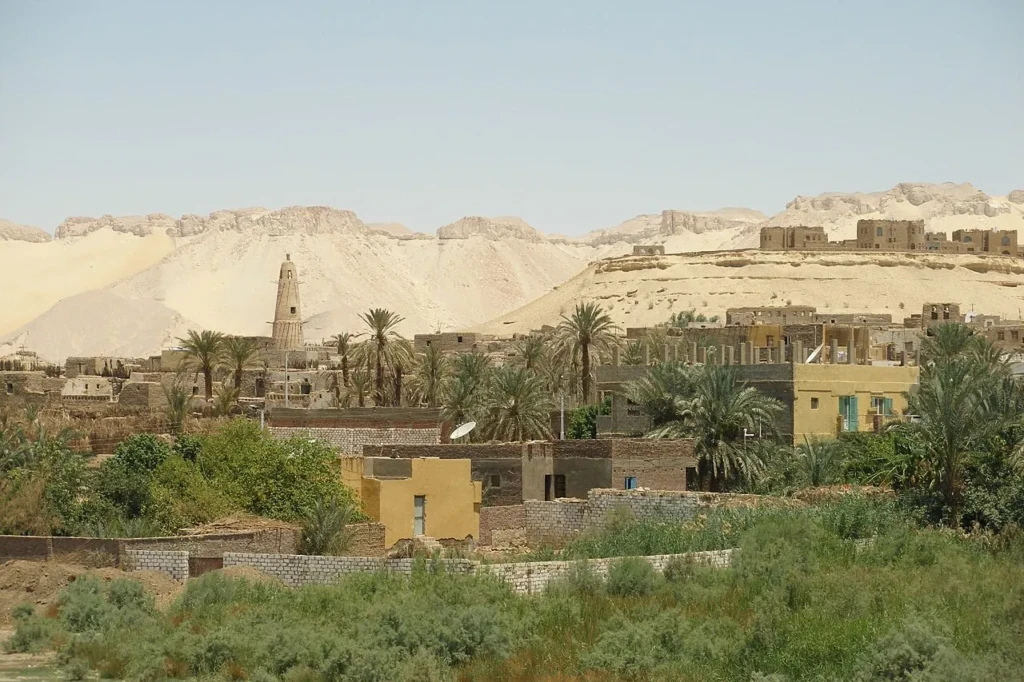
Some 350 km west of the Nile, in Egypt’s New Valley Governorate, Dakhla Oasis is a chain of farming villages best known for the medieval mud-brick town of Al-Qasr and a Roman temple at Deir el-Hagar. Most travelers pair it with Kharga Oasis, its eastern neighbor and the regional capital, where the Temple of Hibis and the early Christian cemetery of Bagawat stand. Together they make a slow, uncrowded journey for travelers who have already seen the Nile Valley.
Below you will find what makes each oasis worth the trip, the sites in a sensible order, official ticket prices, what the current UK travel advice says about the roads, and how to plan the journey from Luxor.
Dakhla and Kharga at a Glance
| Fact | Details |
|---|---|
| Location | New Valley Governorate, Western Desert of Egypt |
| Distance from the Nile | Dakhla: about 350 km; Kharga: about 200 km west of the Nile Valley |
| Main towns | Mut and Al-Qasr in Dakhla; El Kharga, the governorate capital |
| Key periods | Old Kingdom (Ain Asil), Persian and Late Period (Hibis), Roman (Deir el-Hagar), early Christian (Bagawat), Ayyubid to Ottoman (Al-Qasr) |
| Size | Dakhla: roughly 80 km east to west; Kharga’s depression: about 160 km long |
| Ticket range | EGP 100 to EGP 180 per site for foreign adults (official list, October 2026) |
| Time needed | Our planning suggestion: at least 4 nights for both oases, including travel days |
Where Are Dakhla and Kharga, and Why Go?
Egypt’s Western Desert holds a string of oases fed by groundwater from one of the world’s largest aquifers. Dakhla and Kharga sit at the southern end of that string, in the New Valley Governorate. Kharga lies closer to the Nile. Dakhla lies farther west, between Kharga and Farafra.
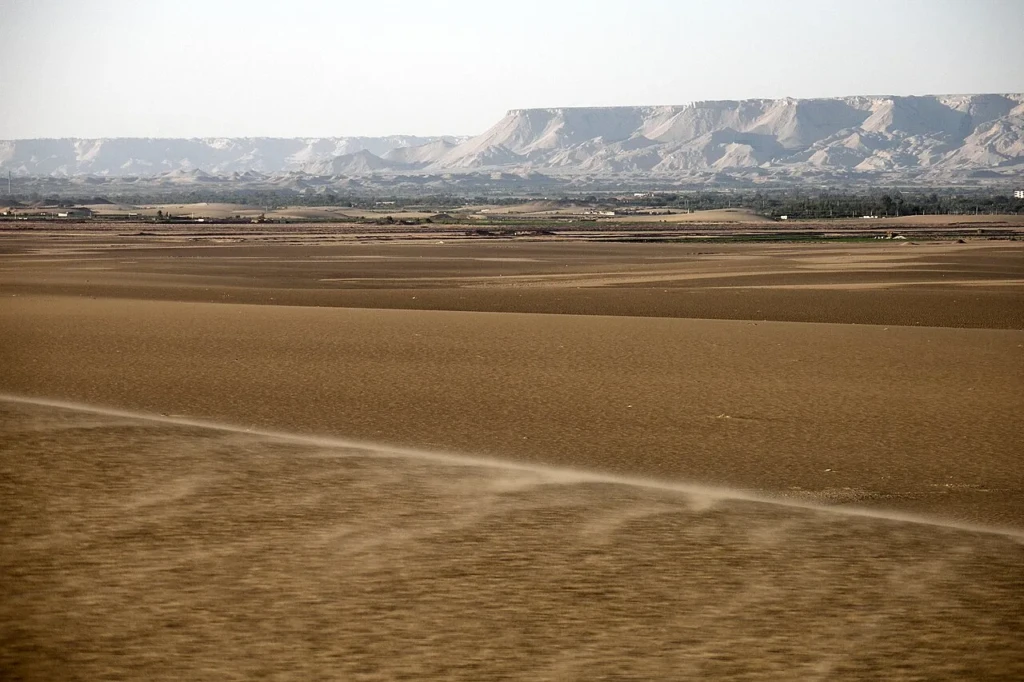
Their names describe that position. Dakhla means “the inner oasis” in Arabic. Kharga means “the outer one.” The Romans called Kharga Oasis Magna, the Great Oasis, because it is the largest in the region.
People have lived here for a very long time. Nomadic groups camped by ancient lakes during wetter phases of the Sahara, and some began to settle in Dakhla around 12,000 years ago. Contact with the pharaohs began around 2550 BC. Later, Kharga became a stop on the Darb el-Arba’in, the “Forty Days Road,” a caravan route linking Asyut on the Nile with Darfur in Sudan.
Why go today? Because these oases show sides of Egypt that the Nile Valley does not: an Old Kingdom governor’s town, a Persian-era temple, painted Christian tombs and a lived-in medieval village, all set among palm groves and dunes. You will share them with very few other visitors.
What to See in Dakhla Oasis
Dakhla runs as a line of villages along the foot of a desert escarpment. Mut is the main town and a practical base. Your guide will order the sites below to suit opening times and the light.
Ain Asil and Balat
Near the village of Balat lies Ain Asil, the seat of Dakhla’s governors in the Old Kingdom. French archaeologists from the Institut Français d’Archéologie Orientale have worked here for decades. In the governor’s palace they found about 500 clay tablets from the late 6th Dynasty. Scribes incised them in hieratic script, much like cuneiform, because papyrus was scarce so far from the Nile. The tablets record accounts, lists of names and around 50 letters.
The official ticket list groups Ain Asil with the nearby site of Qila al-Dabba under one entry.
Bashendi
Ezbet Bashendi, a village site in the oasis, appears as a separate ticketed entry on the Ministry of Tourism and Antiquities list. Ask your guide to include it if you have time.
Mut and the Bir esh-Shaghala tombs
Mut, the ancient Mothis, has been Dakhla’s main town since around 1500 BC. On its edge, at Bir esh-Shaghala, a Ministry mission has excavated Roman tombs. Two of them, with a staircase entrance and painted scenes of the deceased’s mummification, were announced on the Ministry’s official site. These are research sites, so ask your guide whether any part is open when you visit.
Al-Muzawwaqa tombs
The tombs of al-Muzawwaqa are another ticketed site on the official list. Your guide can confirm which chambers are open on the day.
Al-Qasr
Al-Qasr, meaning “the fortress,” is the highlight of Dakhla for most visitors. The Ayyubids built this fortified town in the 12th century on the remains of a Roman fort. Its narrow, shaded lanes are lined with mud-brick houses of up to four stories, most from the Mamluk and Ottoman periods.
Look closely at the doorways and walls. Some buildings reuse stone blocks carved with hieroglyphs. Those blocks came from a ruined temple of the god Thoth at nearby Amheida. Al-Qasr is listed by the Ministry under its Islamic, Coptic and Jewish antiquities.
Deir el-Hagar
About 10 km from Al-Qasr, on the western edge of the oasis, stands Deir el-Hagar, the “Monastery of Stone.” Despite the name, it is a Roman temple in sandstone. Building began under the emperor Nero, and decoration continued under Vespasian, Titus and Domitian. It honored the Theban triad of Amun-Ra, Mut and Khonsu, along with Seth, the main god of the region.
What to See in Kharga Oasis
Kharga is the most modern of the western oases. The town has full services and little old architecture, so its interest lies in the sites just outside it.
Temple of Hibis
About 2 km north of town, in a palm grove, stands the Temple of Hibis. It is the largest and best-preserved temple in the oasis. It is also the only building in Egypt from the Saite-Persian era, between 664 and 404 BC, that survives in relatively good condition.
Work probably began under Psamtik II of the 26th Dynasty. The Persian king Darius I later took an active role and is credited with decorating its walls. Inside, one relief shows the god Seth spearing the serpent Apep. The sanctuary carries nine registers of almost 700 divine and royal figures. Rising groundwater has threatened the foundations for decades, so restoration work may affect access.
Bagawat Cemetery
Just beyond Hibis lies Bagawat, one of the oldest Christian cemeteries in Egypt. According to the Ministry, it has 263 known mud-brick funerary chapels, from single rooms to large family tombs, and it began in the 3rd century AD. Mummification continued here long after it had stopped in the Nile Valley.
Two chapels are the stars. The Chapel of the Exodus has a dome painted in bands of Old Testament scenes: Moses leading the Israelites as Pharaoh’s army chases them, Adam and Eve, Noah’s Ark, Daniel and Jonah. The Chapel of Peace shows the Annunciation, vines, peacocks and figures captioned in Greek. Later visitors left Arabic graffiti, some by Turkish soldiers believed to have been posted here in the late 18th century.
The southern temples and Roman forts
South of town, smaller sites include the temples of Qasr el-Ghuweita, Qasr el-Zayyan and Dush. Dush, in the southernmost part of the oasis, also has a Greco-Roman fortified site. Across the depression, the Romans built a chain of forts to guard the caravan road. Visiting these requires extra time and a vehicle suited to desert tracks.
Opening Hours and Ticket Prices
The figures below are as listed on the official Ministry of Tourism and Antiquities site and its published ticket list in October 2026. Check before you go, as prices change.
| Site | Foreign adult | Foreign student | Hours |
|---|---|---|---|
| Temple of Hibis (Kharga) | EGP 180 | EGP 90 | 8:00 AM to 5:00 PM |
| Bagawat Cemetery (Kharga) | EGP 120 | EGP 60 | 9:00 AM to 4:00 PM on the Ministry’s site page |
| Qasr el-Ghuweita, Qasr el-Zayyan, Dush (each) | EGP 100 | EGP 50 | 8:00 AM to 5:00 PM |
| New Valley Museum | EGP 150 | EGP 75 | 9:00 AM to 3:00 PM |
| Al-Qasr (Dakhla) | EGP 100 | EGP 50 | 8:00 AM to 5:00 PM |
| Deir el-Hagar (Dakhla) | EGP 100 | EGP 50 | 8:00 AM to 5:00 PM |
| Al-Muzawwaqa tombs (Dakhla) | EGP 100 | EGP 50 | 8:00 AM to 5:00 PM |
| Qila al-Dabba and Ain Asil (Dakhla) | EGP 100 | EGP 50 | 8:00 AM to 5:00 PM |
| Ezbet Bashendi (Dakhla) | EGP 100 | EGP 50 | 8:00 AM to 5:00 PM |
The Ministry’s printed list shows longer hours for Bagawat than its site page does, so plan to arrive in the morning. Carry cash in Egyptian pounds for remote ticket offices.
What Does the Travel Advice Say?
This matters more here than in most of Egypt. The UK Foreign, Commonwealth and Development Office advises against all but essential travel to most of the area west of the Nile Valley. Its listed exceptions include the oasis towns of Dakhla (Mut) and Kharga. They also include the road between Farafra, Dakhla and Kharga, the road between Kharga and Baris, and the road between Baris and Luxor, along with the desert between those roads and the Nile.
The same advice warns of limited phone signal and poor medical facilities in the Western Desert. It also says permits and an official guide are needed for Bahariya, Farafra and the White and Black Deserts. Read the live FCDO page and the US State Department advisory before booking, and make sure your insurance covers your route. Our overview of safety for travelers in Egypt right now puts this in context.
How to Get to Dakhla and Kharga
Given the travel advice, the most straightforward approach is overland from Luxor, via Baris to Kharga, then west to Dakhla. That keeps you on roads the FCDO lists as exceptions. A private car with an experienced driver is the realistic option for most visitors.
Distances are long and checkpoints can add time, so we do not quote a fixed drive time. Your driver or guide will confirm timing and the current road conditions before you set off. Plan a full day for each long leg, with no sightseeing pressure.
Best Time to Visit
Both oases have a hot desert climate with almost no rain. Climate data for Kharga from 2000 to 2020 shows average highs of about 23°C in January and 41°C in July. Dakhla is similar, with averages of about 22°C in January and 39°C in July.
That makes November to February the most comfortable window. Mornings and nights can be cool, so pack a warm layer. Avoid the summer months unless you are used to extreme heat. Our month-by-month guide to visiting Egypt helps you match the oases with the rest of your trip.
Practical Tips
- Bring your passport every day. Police check ID regularly, according to the FCDO.
- Dress modestly. These are conservative farming communities, and modest dress is advised in rural areas.
- Ask before photographing people. Ministry rules require permission, and photographing children is not allowed.
- Carry water, sun protection and basic medicines, since pharmacies and clinics are limited outside the towns.
- Download offline maps and expect weak mobile signal between towns.
- See our guide to what to pack and wear in Egypt for more.
Combining the Oases With Luxor
Because the advised route runs through Luxor, the oases fit naturally before or after a few days there. The Temple of Hibis makes more sense once you have seen the great Theban temples it echoes, such as Karnak Temple and Hatshepsut’s temple at Deir el-Bahari. Our Luxor travel guide covers where to stay and what to see.
Delta Tours Egypt programs and day tours that work well around an oasis extension include:
- Luxor East and West Banks, from $128 per person.
- West Bank of the Nile, from $150 per person.
- Dendara and Abydos Temples Day Tour from Luxor, from $150 per person.
- King Treasure, 6 Days in Cairo and Luxor, from $840 per person.
Visit With Delta Tours Egypt
We do not offer a fixed Dakhla and Kharga package. On request, we can look at a private extension to the oases from Luxor, with a driver, accommodation and a guide, planned around the current official travel advice for each road. Share your dates and interests through our tailor-made Egypt tours page, and we will tell you honestly what is practical for your trip.
Frequently Asked Questions
Is Dakhla Oasis safe to visit?
The UK FCDO lists the oasis town of Dakhla (Mut), Kharga and the connecting roads to Luxor as exceptions to its Western Desert warning. Areas off those routes fall under its advice against all but essential travel. Check the live advice before you book.
What is the difference between Dakhla and Kharga?
Kharga is closer to the Nile, larger and more modern, with the Temple of Hibis and Bagawat nearby. Dakhla is farther west and more rural, with the old fortified town of Al-Qasr. Most travelers visit both.
How many days do I need for Dakhla and Kharga?
Our planning suggestion is at least four nights, including the drive from Luxor and back. That gives you a full day in each oasis. Add a night if you want to see the southern temples of Kharga.
How much are tickets at the oasis sites?
Foreign adult tickets run from EGP 100 to EGP 180 per site, as listed by the Ministry of Tourism and Antiquities in October 2026. The Temple of Hibis is the most expensive. Students pay half.
What is Al-Qasr in Dakhla?
It is a fortified mud-brick town founded by the Ayyubids in the 12th century on a Roman fort. Its multi-story houses and carved doorways are among the best examples of traditional oasis architecture in Egypt.
When is the best time to visit the oases?
November to February is the most comfortable period, with average January highs in the low 20s Celsius. Summer averages climb to about 40°C. Pack warm clothes for cool desert nights.
Dakhla and Kharga reward travelers who want history without the crowds and are happy to spend time on the road. If they suit your plans, our team will help you weigh the route and timing through our tailor-made tours service.
Featured image: Village and palms in Dakhla Oasis. Photo: Vyacheslav Argenberg / Wikimedia Commons, CC BY 2.0