Beni Hassan Tombs in Minya: History, Highlights and Tickets
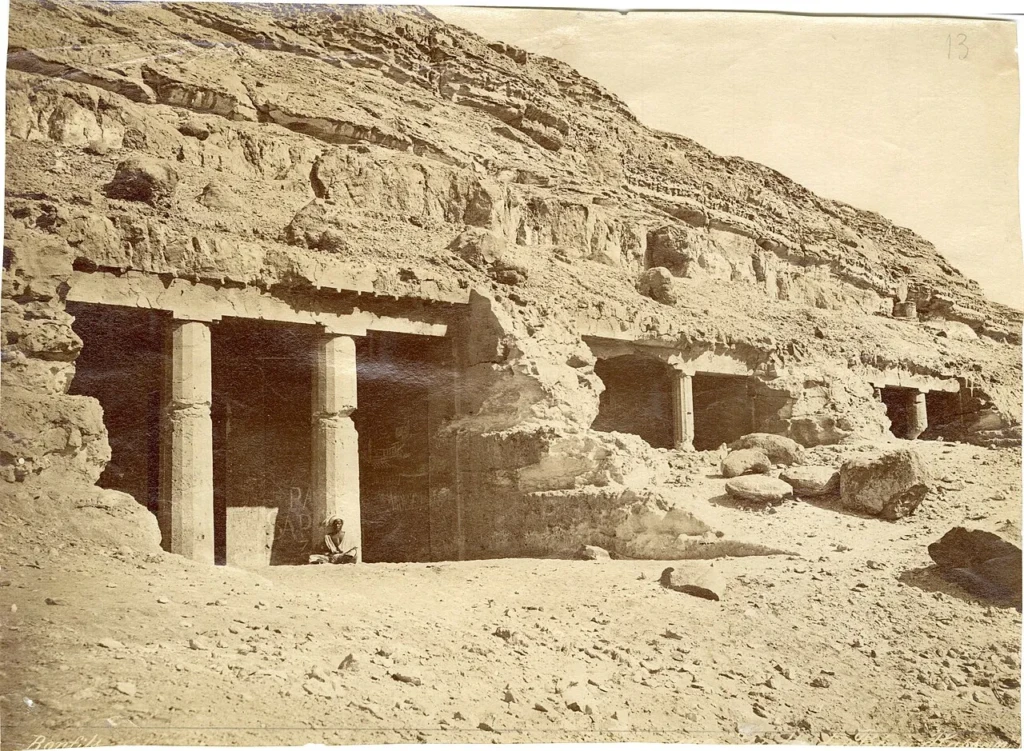
The Beni Hassan tombs are a row of rock-cut tombs carved for the provincial governors of Middle Egypt about 4,000 years ago, high in the cliffs on the Nile’s east bank roughly 20 km south of Minya. Their painted walls show wrestlers, hunters, craftsmen and a famous caravan of foreign visitors, making them one of the best records of daily life in the Middle Kingdom. A visit takes a half day from Minya, which is about 245 km south of Cairo.
This guide explains who built the tombs, which ones the Ministry of Tourism and Antiquities highlights and what to look for inside each, along with official hours and prices, travel advice and how to plan a Middle Egypt trip.
Beni Hassan Tombs at a Glance
| Fact | Details |
|---|---|
| Location | East bank of the Nile, Minya Governorate, about 20 km south of Minya city |
| Period | Mainly 11th and 12th Dynasties, Middle Kingdom (c. 2055 to 1795 BC) |
| Built for | Governors (nomarchs) and senior officials of the 16th Upper Egyptian province, the Oryx nome |
| Upper cemetery | 39 rock-cut tombs, 12 with painted decoration |
| Distance from Cairo | Minya lies about 245 km south of Cairo |
| Opening hours | Daily, 8:00 AM to 5:00 PM (official listing, October 2026) |
| Foreign adult ticket | EGP 200 (student EGP 100) |
| Time on site | Our planning suggestion: 2 to 2.5 hours, plus time for the nearby Speos Artemidos |
Who Built the Beni Hassan Tombs?
In ancient Egypt, the country was divided into provinces called nomes. Beni Hassan was the main cemetery of the 16th nome of Upper Egypt, known as the Oryx nome after the desert antelope. Its capital, Hebenu, is identified with Zawyet Sultan, a few kilometers south of modern Minya.
The men who ran this province held the title of nomarch. During the First Intermediate Period, when royal power was weak, the Oryx nome’s rulers grew rich and largely independent. They later sided with the Theban kings who reunited Egypt. That alliance paid off. The same families stayed in charge into the 12th Dynasty, and names such as Baqet, Khety and Khnumhotep repeat across generations.
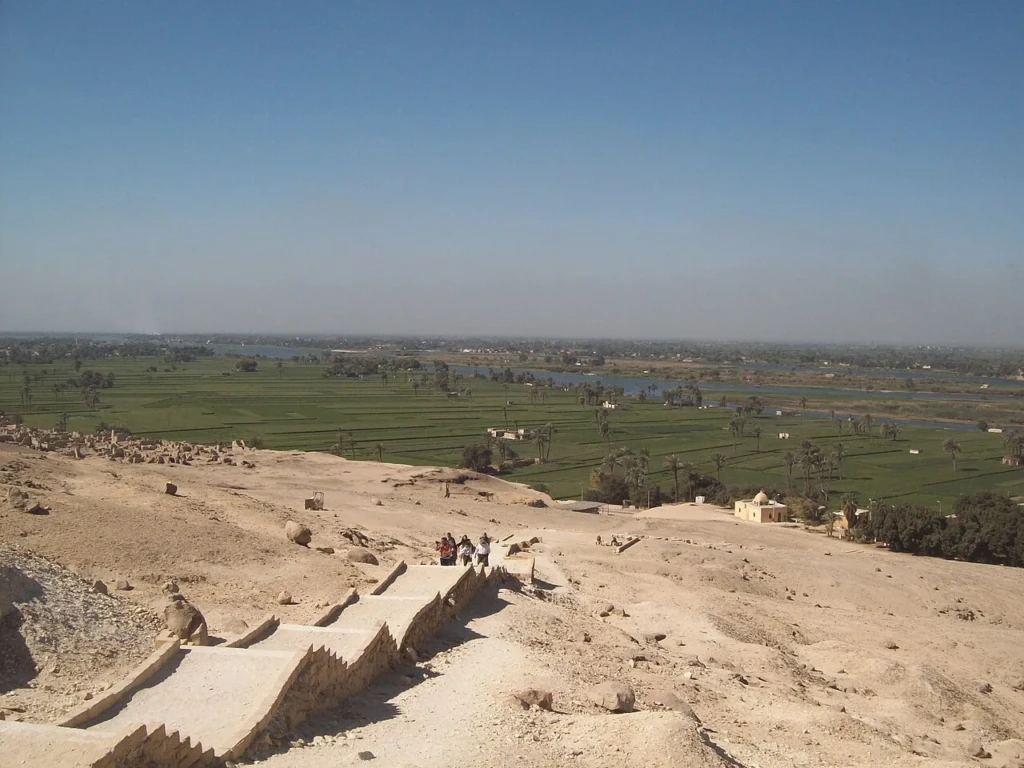
These governors could not build pyramids, but they could cut their own tombs into the limestone cliff above the Nile. They chose a spot about halfway up the slope, looking out over the green valley. The result is a gallery of private tombs that tells us more about ordinary life than most royal monuments do.
Two cemeteries on one hillside
The site has two parts. The upper cemetery holds the 39 large tombs cut horizontally into the cliff. The lower cemetery, farther down the slope, contains several hundred simpler shaft graves. The Ministry counts around 800 there, and the 1902 to 1904 excavation recorded 888. They range from the late Old Kingdom to the Middle Kingdom.
Rediscovery and research
Early travelers noted the tombs, and Percy Newberry recorded them in the 1890s. John Garstang excavated the lower cemetery in 1902 to 1904. Since 2010, an Australian team from Macquarie University led by Naguib Kanawati has carried out new recording work.
What to See at Beni Hassan
The Ministry of Tourism and Antiquities profiles four tombs in particular: those of Amenemhat, Khnumhotep II, Baqet III and Khety. Which tombs are open can change, so your guide will set the order on the day.
Tomb of Amenemhat
Amenemhat was the last man to hold the title of nomarch of the Oryx nome. He served for about 25 years under King Senusret I of the 12th Dynasty. His tomb has a two-column portico set in a forecourt, once reached by a causeway up the hill. You can still trace that path by the boulders along its edges.
Inside, a shrine facing the doorway holds statues of Amenemhat, his wife Hetepet and his mother Henu. The Ministry ranks this tomb’s decoration among the finest at Beni Hassan. Look for farming, fishing and fowling scenes, and for craftsmen making furniture, sandals, pottery, bows and arrows. Then look up. The ceiling is painted to imitate wooden beams and woven matting, in bright yellow and red patterns.
Tomb of Khnumhotep II
Khnumhotep II served as Overseer of the Eastern Desert under Senusret II. His tomb, numbered BH3, is the most famous at the site. Its portico has two fluted columns in a style often called proto-Doric, because it looks like the much later Greek Doric order.
Khnumhotep’s life story runs across the lower walls in 222 columns of text. The best-known scene is on the north wall, left of the entrance. A group of 37 people called the Aamu, from lands east and northeast of Egypt, arrive in colorful clothes bringing eye paint. Their leader is named Abisha and described as a “ruler of a foreign land.” In Egyptian that phrase is heqa khaset, the earliest known example of the term later rendered in Greek as Hyksos.
Do not miss a lighter detail on the west wall, just inside on the left. Three monkeys help workers pick figs from a tree. Near the statue shrine, Khnumhotep is shown fishing and fowling in the marshes.
Tomb of Baqet III
Baqet III, son of Remushen, governed the Oryx nome early in the Middle Kingdom. His tomb has a forecourt, a chapel and a small shrine added in one corner, with a false door and an offering platform.
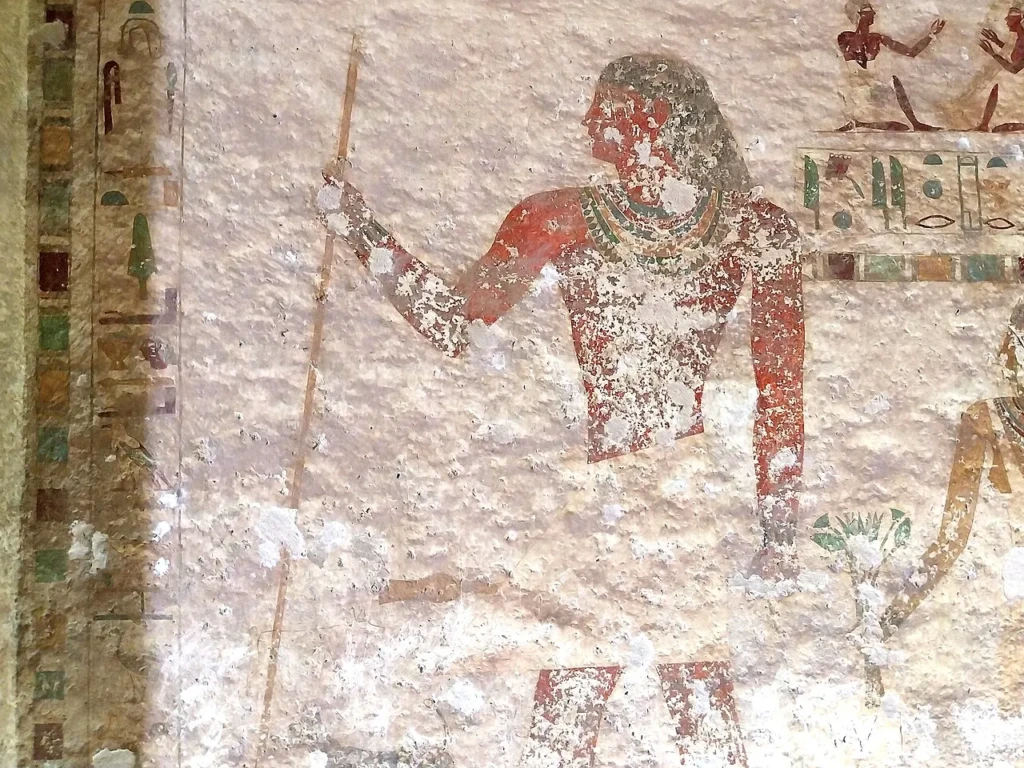
The decoration is full of life. On the north wall you will see desert hunting, then barbers, sandal makers, goldsmiths, spinners and weavers. One scene shows tax collection, with defaulters dragged before a scribe. The lowest register shows fish, birds and even bats. On the south wall, a cat faces a mouse, and a female monkey carries her baby on her back.
The east wall is the showpiece. It shows a battle, a besieged fortress and 220 pairs of wrestlers. In every pair, one man is painted red and the other dark brown, so you can follow each hold.
Tomb of Khety
Khety, another governor of the same period, built a tomb that once had two rows of three columns with lotus capitals. Only one column in each row still stands intact.
Walk in and face the east wall. Here, 122 pairs of wrestlers grapple in five registers, and no two pairs share the same pose. Below them, defenders hold a fortress against attackers. The north wall adds desert hunting, carpentry, sculptors at work on a statue of Khety and his wife, funeral rites, board games, and young women juggling and doing acrobatics. The south wall shows winemaking, music and sports.
Speos Artemidos
About 2 km south of the tombs, in a side valley, lies the Speos Artemidos. This rock-cut temple was made by Queen Hatshepsut for Pakhet, a local goddess whom the Greeks linked with Artemis. Above its portico, a long inscription records Hatshepsut condemning the Hyksos and restoring what they had damaged. Seti I later carved his own name over parts of her work. If you enjoy this site, our guide to Hatshepsut’s temple in Luxor tells the rest of her story.
Opening Hours and Ticket Prices
As listed on the official Ministry of Tourism and Antiquities site in October 2026, Beni Hassan is open every day from 8:00 AM to 5:00 PM. The foreign adult ticket is EGP 200, and foreign students pay EGP 100. Check before you go, as prices and hours can change.
We could not find a separate official ticket for the Speos Artemidos, so ask at the ticket office whether it is open and included. Photography rules inside the tombs can also change, so follow the guards’ instructions on the day.
How to Get to Beni Hassan
Most visitors base themselves in Minya, the governorate capital, on the west bank of the Nile. The tombs lie on the east bank, about 20 km to the south. Minya itself is roughly 245 km south of Cairo. From there, the last stretch to the site is by car.
We have not quoted a drive time, because it depends on your route, the river crossing and local checkpoints. Your driver or guide will confirm timing in advance. A private car with a driver is the simplest way to combine the tombs with other Minya sites in one day.
Best Time to Visit
Arrive soon after opening, before the heat builds on the open hillside. The cooler months are the most comfortable time for the climb. For a fuller picture, see our month-by-month guide to the best time to visit Egypt.
Is Minya Safe for Tourists?
The UK Foreign, Commonwealth and Development Office does not list the Minya Governorate among the areas where it advises against travel. Its general advice for Egypt still applies, including carrying ID, dressing modestly in rural areas and following local authorities. Check the live FCDO page and the US State Department advisory before you book, and read our article on whether it is safe to travel to Egypt right now.
Practical Tips for Your Visit
- Wear sturdy shoes. The upper cemetery sits partway up a cliff.
- Bring a small flashlight. It helps you pick out detail in darker corners.
- Carry water and a hat. There is little shade on the slope.
- Do not touch the painted walls. Skin oils damage pigments that have survived for four millennia.
- Dress modestly, as you would anywhere in rural Egypt. Our Egypt packing and dress guide has details.
Combining Beni Hassan With Other Minya Sites
Minya Governorate has several more sites on the official ticket list, which makes a two-day stay worthwhile. These prices are as listed by the Ministry of Tourism and Antiquities in October 2026:
- Tell el-Amarna: EGP 200, 8:00 AM to 5:00 PM.
- Tuna el-Gebel: EGP 200, 8:00 AM to 5:00 PM.
- Zawyet Sultan, site of the Oryx nome’s capital: EGP 100, 8:00 AM to 5:00 PM.
- Mallawi Museum: EGP 120, 9:00 AM to 3:00 PM.
Many travelers add Middle Egypt to a Cairo stay or link it with Upper Egypt on the way south. Our Egypt travel guide helps you weigh the options.
Delta Tours Egypt programs that pair well with a Minya extension include:
- Taste of Egypt, 4 Days in Cairo, from $535 per person.
- Egypt Unveiled, 5 Day Luxury Journey, from $1,103 per person.
- King Treasure, 6 Days in Cairo and Luxor, from $840 per person.
- Dendara and Abydos Temples Day Tour from Luxor, from $150 per person.
Visit With Delta Tours Egypt
We do not run a scheduled Beni Hassan tour. We can arrange a private visit to Minya on request, with a driver and an Egyptologist guide, as an add-on to a Cairo or Luxor itinerary. Tell us how many days you have and which Middle Egypt sites interest you, and we will plan a realistic route. Start on our tailor-made Egypt tours page, or see how our private Egyptologist-guided tours work.
Frequently Asked Questions
What are the Beni Hassan tombs famous for?
They are known for vivid painted scenes of everyday life in the Middle Kingdom. Highlights include hundreds of wrestling pairs, craftsmen at work, and the arrival of the Aamu in the tomb of Khnumhotep II. The proto-Doric columns of some porticoes are also admired.
How many tombs are there at Beni Hassan?
The upper cemetery has 39 rock-cut tombs, and 12 of them carry painted decoration. The lower cemetery holds several hundred shaft graves. Visitors see a selection of the decorated upper tombs.
How much is the Beni Hassan ticket?
The foreign adult ticket is EGP 200 and the foreign student ticket is EGP 100, as listed by the Ministry of Tourism and Antiquities in October 2026. The site is open daily from 8:00 AM to 5:00 PM.
Is Beni Hassan the same as Beni Hasan?
Yes. The name is also written Bani Hasan or Beni-Hassan. All of them refer to the same village and necropolis south of Minya.
Can I visit Beni Hassan as a day trip from Cairo?
It is possible but long, since Minya is about 245 km south of Cairo. An overnight in Minya is more relaxed. It also lets you add Tell el-Amarna or Tuna el-Gebel the next day.
What does the Aamu scene show?
It shows 37 men, women and children from lands east of Egypt bringing eye paint to Khnumhotep II. Their leader, Abisha, is called a “ruler of a foreign land.” That title is the earliest known use of the term that became Hyksos.
Beni Hassan is one of the most rewarding stops in Middle Egypt for travelers who like their history personal and colorful. If you want to add it to your trip, our team will build the route with you through our tailor-made tours service.
Featured image: Rock-cut tomb facades at Beni Hassan (historic photograph). Photo: Félix Bonfils / Wikimedia Commons, public domain