Egypt Travel Guide: Everything You Need to Know Before Visiting Egypt (2026)
This Egypt travel guide gives you everything you need to plan a first trip: how many days to allow, sample itineraries for 7, 10 and 14 days, the regions worth your time, visas, costs, transport and safety. In short, most first-time visitors need 7 to 10 days to see Cairo, Luxor and Aswan properly, ideally with a Nile cruise in the middle, and the most comfortable months to go are October to April.
We have arranged trips in Egypt from our base in Cairo since 1974, so the advice below reflects how itineraries work on the ground: which sites pair well on the same day, where the long journeys are, and where travelers most often wish they had allowed more time.
Egypt Trip Planning at a Glance
| Question | Short answer |
|---|---|
| How many days? | 7 to 10 days for Cairo, Luxor and Aswan; 12 to 14 if you add the Red Sea or Alexandria |
| Best time to go | October to April; November and March are the most balanced months |
| Visa for US and UK citizens | Required; available online before travel or on arrival at the airport |
| Passport | Valid for at least six months after arrival, with a blank page |
| Currency | Egyptian pound (EGP); cards accepted in hotels, cash useful for tips and small purchases |
| Getting around | Domestic flights or the overnight sleeper train between Cairo and Upper Egypt; Nile cruise between Luxor and Aswan |
| Typical package cost | About $1,250 to $2,850 per person for 8 to 9 days with a Nile cruise, depending on the level of hotel and ship |
How Many Days Do You Need in Egypt?
Egypt is a long country, and its main sights sit at either end of the Nile Valley: the Pyramids and museums around Cairo in the north, and the temples and tombs of Luxor and Aswan, roughly 500 and 700 km to the south as the crow flies, with Abu Simbel further still. Every itinerary has to bridge that gap, usually with a flight or an overnight train, which is why short trips feel rushed.
| Trip length | What you can cover | Pace |
|---|---|---|
| 4 to 5 days | Cairo and Giza, plus Luxor by air | Fast; no time for the Nile or Aswan |
| 7 days | Cairo, Luxor, Aswan and Abu Simbel | Full days, but covers the essentials |
| 8 to 9 days | Cairo plus a three- or four-night Nile cruise | The classic first trip; comfortable |
| 10 to 11 days | Cairo, Nile cruise or hotels in Luxor and Aswan, Abu Simbel, a free day | Relaxed, with room for extras |
| 14 days | All of the above plus a Red Sea stay or Alexandria | Unhurried; ends with rest |
If you can only manage a long weekend, focus on Cairo and Giza and save the south for another trip. If you have a week or more, the Nile Valley is where Egypt’s ancient history is most concentrated, and it deserves at least three nights.
Egypt Itinerary: 7 Days
A week is enough to see the highlights if you fly between cities. This plan follows our Treasures of the Pharaohs 7-day tour, which uses hotels rather than a ship so that it fits in Abu Simbel.
- Day 1, Cairo: arrive and transfer to your hotel near the Pyramids.
- Day 2, Giza: the Pyramids of Giza and the Sphinx in the morning, then the Grand Egyptian Museum, which opened fully in November 2025 and now displays the complete Tutankhamun collection.
- Day 3, Luxor: fly south early for the Valley of the Kings, the Temple of Hatshepsut and the Colossi of Memnon, then cross to the East Bank for Karnak.
- Day 4, Luxor to Aswan by road: stop at the temples of Edfu and Kom Ombo on the way.
- Day 5, Abu Simbel: a day trip to the temples of Ramses II and Nefertari.
- Day 6, Aswan: Philae Temple and the High Dam, then fly back to Cairo.
- Day 7: departure.
The trade-off is pace: there is little free time, and you will not sail on the Nile. If you would rather slow down, drop Abu Simbel and take a cruise instead, or choose one of the 8- to 9-day cruise itineraries below. Our 7 day Egypt tours page compares every one-week package we run.
Egypt Itinerary: 8 to 9 Days with a Nile Cruise
For most first-time visitors, this is the right length. You spend three or four nights in Cairo and three or four on a ship between Luxor and Aswan, which takes care of transport and most meals in the south.
- King Tut, 9 days: Giza and the Grand Egyptian Museum, a four-night cruise from Luxor to Aswan, then a day in Old Cairo and the National Museum of Egyptian Civilization. It uses the first-class sleeper train between Cairo and Upper Egypt, with flights available as an upgrade. From $1,460 per person sharing, October to April.
- Hathor, 8 days: a more comfortable version with the Marriott Mena House in Cairo, flights to Aswan, and a three-night cruise north to Luxor. From $2,850 per person sharing, October to April.
Our Luxor to Aswan cruise guide explains the difference between the three- and four-night routes.
Egypt Itinerary: 10 Days
Ten days lets you add Abu Simbel and a free day without rushing. This plan follows our Sun Ray 10-day tour.
- Day 1, Cairo: arrival.
- Day 2, Giza and Saqqara: the Pyramids, the Sphinx and the Step Pyramid of Djoser at Saqqara.
- Day 3, Luxor: fly to Luxor, visit Karnak and Luxor Temple, and board your Nile cruise.
- Day 4, West Bank: the Valley of the Kings, the Temple of Hatshepsut and the Colossi of Memnon.
- Day 5, Edfu and Kom Ombo: two temples on the way south.
- Day 6, Abu Simbel: excursion from Aswan.
- Day 7, Aswan: Philae Temple, then fly to Cairo.
- Day 8, Cairo: the Grand Egyptian Museum, Old Cairo and the Khan el-Khalili bazaar.
- Day 9, Cairo: a free day, or an optional trip such as Alexandria.
- Day 10: departure.
If you prefer hotels to a ship, our Timeless Egypt 11-day tour covers similar ground with three nights in Luxor, two in Aswan and five in Cairo, which gives you more time in each city. All our tours of this length are compared on 10 day Egypt tours.
Egypt Itinerary: 14 Days
Two weeks lets you see the ancient sites at a gentle pace and finish with a few days by the sea. This plan follows our Royal Egypt Tour.
- Days 1 to 3, Cairo: Giza and Saqqara, the Grand Egyptian Museum and Khan el-Khalili, staying at the Four Seasons Nile Plaza.
- Day 4, Luxor: travel south and visit Luxor Temple.
- Days 5 to 8, Nile cruise: the West Bank, Karnak, Edfu and Kom Ombo, then Philae, the High Dam and the Unfinished Obelisk in Aswan.
- Day 9, Abu Simbel: by air from Aswan.
- Days 10 to 13, Sharm el-Sheikh: fly to the Red Sea for four nights of rest by the sea.
- Day 14: fly home via Cairo.
There is also a 14-day family tour that follows a similar route. See 14 day Egypt tours for both two-week programs and how to extend a shorter one.
Egypt’s Main Regions
Cairo and Giza
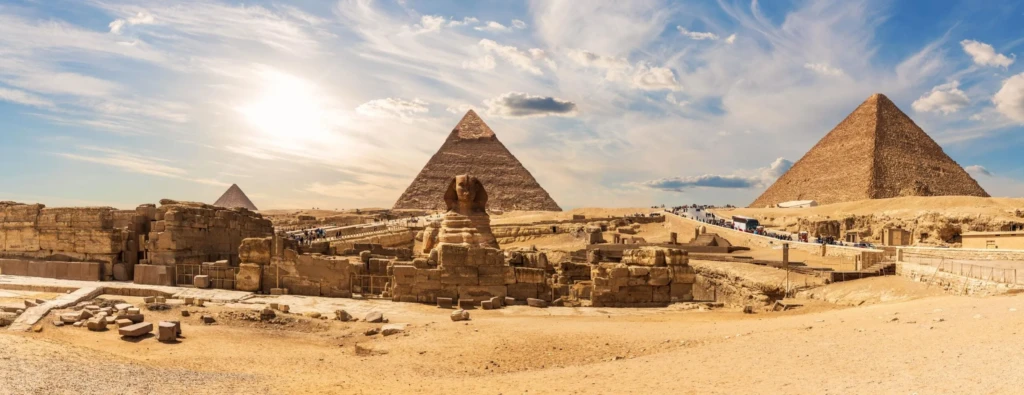
Almost every trip starts here. Giza holds the three great pyramids, the Sphinx and, a short drive away, the Grand Egyptian Museum. Across the city are Islamic Cairo, the Citadel, the churches of Coptic Cairo and the Khan el-Khalili market. South of the city, Saqqara and Dahshur show how pyramid building developed. Allow at least two full days.
Luxor
Ancient Thebes has the greatest concentration of monuments in Egypt. The East Bank holds Karnak and Luxor Temple; the West Bank holds the Valley of the Kings, the Valley of the Queens, the Temple of Hatshepsut and Medinet Habu. Two days is the minimum, three is better. See our Luxor travel guide.
Aswan and Abu Simbel
Aswan is Egypt’s southern city, quieter than Luxor, with granite islands, Nubian villages and Philae Temple. Abu Simbel lies about 280 km further south near the Sudanese border and is visited as a day trip, by road or by air.
The Nile between Luxor and Aswan
The temples of Esna, Edfu and Kom Ombo line the river between the two cities. A cruise links them while you sleep, which is why it remains the most practical way to travel in the south.
Alexandria
Egypt’s Mediterranean city, about three hours by road from Cairo, has Greco-Roman sites, the modern Bibliotheca Alexandrina and a seafront promenade. It makes a good day trip or overnight stop.
The Red Sea
Hurghada and Sharm el-Sheikh are Egypt’s main resort areas, with coral reefs close to shore. They work well as a rest at the end of a sightseeing trip.
When to Visit Egypt
October to April is the most comfortable time for sightseeing, when afternoons in Luxor and Aswan stay below about 36°C (97°F) and drop to the low 20s Celsius (70s Fahrenheit) in midwinter. May to September is hotter, often above 40°C (104°F) in the south, but quieter and cheaper. Christmas, New Year and Easter are the busiest weeks. Our guide to the best time to visit Egypt has a month-by-month table and the holiday dates for 2026 and 2027.
Visas for Egypt
US and UK citizens need a visa to visit Egypt. There are two main ways to get a tourist visa:
- e-Visa before you travel: apply on the Egyptian government’s official visa portal. This is the simplest option and means you arrive with the visa already approved.
- Visa on arrival: available at the main international airports. According to UK and US government travel advice, the standard single-entry visa costs $30 in cash, and at Cairo International Airport a card-paid digital visa on arrival is also available for $36.
Your passport should be valid for at least six months after the date you arrive and have at least one blank page. Travelers flying directly into Sharm el-Sheikh for a stay of up to 15 days in the South Sinai resorts can enter on a free permit, but a full visa is needed to travel beyond those resorts, for example to Cairo or Luxor. Rules and fees change, so check the official UK or US travel advice shortly before you book.
What an Egypt Trip Costs
The biggest costs are international flights, hotels or a Nile ship, and guiding. Package prices give a fair picture of the overall cost because they include accommodation, internal travel, guides and entrance fees. These are our own published prices per person for two people sharing:
| Level | Example trip | October to April | May to September |
|---|---|---|---|
| Budget | Ptah, 9 days, Cairo and Nile cruise | $1,250 | $1,200 |
| Classic | King Tut, 9 days, Cairo and Nile cruise | $1,460 | $1,401 |
| Luxury | Hathor, 8 days, Cairo and Nile cruise | $2,850 | $2,630 |
| Luxury, with Abu Simbel | Sun Ray, 10 days | $3,965 | $3,180 |
| Luxury, with the Red Sea | Royal Egypt Tour, 14 days | From $7,597 | |
Budget and classic packages use simpler hotels or ships and the sleeper train; luxury packages use landmark hotels, domestic flights and higher-end ships. On top of a package, allow for international flights, your visa, drinks, tips, and any optional extras such as a hot air balloon flight in Luxor or extra tomb tickets. You can compare every level side by side on our Egypt tours page, and our guide to how much an Egypt tour costs breaks prices down by length, season and cruise class.
Tipping
Tipping is a normal part of travel in Egypt. Guides, drivers, cruise crews, hotel porters and restroom attendants at sites all expect a small tip, so keep a supply of small Egyptian pound notes. On a Nile cruise, crew tips are usually collected at the end of the trip.
Getting Around Egypt
- Domestic flights: Cairo to Luxor or Aswan takes roughly an hour to an hour and a half and is the fastest way to reach the south. Aswan to Abu Simbel is a short flight.
- Sleeper train: the overnight train between Cairo, Luxor and Aswan saves a hotel night and suits budget trips. Expect a basic but private two-berth cabin.
- Nile cruise: the usual way to travel between Luxor and Aswan, combining transport, accommodation and sightseeing. See our Nile river cruises.
- Private car and driver: best for Cairo, where traffic is heavy and sites are spread out, and for road journeys such as Luxor to Aswan or Cairo to Alexandria.
On our packages, transfers and sightseeing are in a private air-conditioned vehicle with an English-speaking guide, an Egyptologist on our luxury tours, and our team is on WhatsApp throughout the trip.
Safety and Practical Tips
Millions of visitors travel to Egypt’s main tourist areas each year, and the Nile Valley, Cairo and the Red Sea resorts have a visible security presence. Government travel advice does warn against travel to some border regions and parts of the Sinai away from the resorts, so read the current UK or US advice before you go. Our article on whether it is safe to travel to Egypt right now covers the details.
- Dress: light, loose clothing that covers shoulders and knees is comfortable and respectful, and essential for mosques and churches. Women visiting mosques will need a headscarf.
- Sun: a hat, sunglasses and sunscreen are needed in every season. Carry bottled water.
- Money: cards work in hotels and larger shops; cash is better for markets, taxis and tips.
- Photography: ask before photographing people, and check the rules at each site, as some tombs restrict photography.
- Hassle: vendors at the major sites can be persistent. A polite, firm “no, thank you” is usually enough.
For a longer checklist, read what you need to know before your trip to Egypt.
FAQ
How many days do you need in Egypt?
Seven to ten days covers Cairo, Luxor and Aswan, with a Nile cruise if you allow eight or nine. Add three or four days for the Red Sea or Alexandria.
Is 7 days enough for Egypt?
Yes, if you fly between cities. A week covers Giza, the Grand Egyptian Museum, Luxor, Edfu, Kom Ombo, Aswan and Abu Simbel, though the days are full.
Is it better to take a Nile cruise or stay in hotels?
A cruise is the easiest way to travel between Luxor and Aswan and see the temples in between. Hotels give you more time in each city and more choice of where to eat.
Do US and UK citizens need a visa for Egypt?
Yes. You can apply for an e-Visa online before travel or get a visa on arrival at the main airports. Your passport needs six months’ validity.
How much does a trip to Egypt cost?
Our 8- to 9-day packages with a Nile cruise cost from $1,250 per person on a budget, $1,460 for a classic trip and $2,850 for luxury, sharing a room, plus international flights.
What is the best time to visit Egypt?
October to April, with November and March offering the best balance of weather and crowds.
Can I plan my own itinerary?
Yes. Every trip we arrange can be adjusted, from adding a night in Luxor to building a route from scratch around your dates and interests.
The sample itineraries above are starting points. If none fits exactly, tell us how many days you have and what matters most to you, and we will put together a tailor-made Egypt tour around it.