
Valley of the Queens: Stories Beneath Luxor’s Cliffs
The morning light reaches the cliffs before it reaches the tombs.
On Luxor’s West Bank, the road passes fields still green from the Nile, then leaves the cultivated land behind. The air dries. The color drains from the landscape until almost everything becomes pale limestone, dust, and sky. Farther north, buses are already moving toward the Valley of the Kings. Here, in a smaller wadi surrounded by broken cliffs, the atmosphere is quieter.
This is the Valley of the Queens.
Its modern name suggests a cemetery created only for the wives of pharaohs, but the valley holds a more complicated—and more human—story. Queens were buried here, certainly. So were princesses, royal sons, and selected members of the court. Some tombs belonged to women who stood beside Egypt’s most powerful rulers. Others were made for children who never lived long enough to inherit the titles painted beside their names.
The desert above them appears severe and empty. Below ground, the world changes. Queens meet Isis and Hathor. A father takes his young son by the hand and presents him to the gods. Blue ceilings fill with golden stars. Protective cobras spread their wings over royal names, while painted gates open toward an afterlife where death is not an ending, but a passage.
No tomb expresses that hope more beautifully than QV66, created for Queen Nefertari, the Great Royal Wife of Ramesses II. Its colors are so rich and its figures so graceful that the tomb has come to define the entire valley. Yet Nefertari is only one voice in this landscape. To understand the Valley of Queens in Egypt, you must listen for the others too.
Where Is the Valley of the Queens?
The Luxor Valley of the Queens lies on the west bank of the Nile within the Theban Necropolis, southwest of the Valley of the Kings and close to Deir el-Medina and Medinet Habu. It belongs to the wider UNESCO World Heritage property of Ancient Thebes with its Necropolis.
The main wadi is accompanied by smaller branches and nearby burial areas, including the Valley of Prince Ahmose, the Valley of the Rope, the Valley of the Three Pits, and the Valley of the Dolmen. Together, they contain more than 90 identified tombs and burial structures, although only a small selection is accessible to ordinary visitors at any one time.
To the ancient Egyptians, the western side of the Nile was associated with the setting sun and the realm of the dead. But sunset also carried a promise. The sun disappeared each evening, traveled through darkness, and rose again. A royal burial on the western desert edge therefore belonged to a cycle of death, transformation, and rebirth.
The valley’s ancient name was Ta Set Neferu. It is commonly translated as “The Place of Beauty” or “The Place of the Beautiful Ones.” Some scholars have also connected the name with royal children. That second interpretation is especially fitting because the cemetery eventually became the resting place of several princes and princesses as well as queens.
Before It Was a Valley of Queens
The first burials appeared during the 18th Dynasty, near the beginning of Egypt’s New Kingdom. These early tombs were often simpler shafts and chambers rather than the richly painted suites that visitors associate with the valley today. Royal children, court officials, and other privileged individuals were buried in and around the wadis.
One of the early royal burials is associated with Princess Ahmose, a daughter of Seqenenre Tao and Queen Sitdjehuti. Her tomb belongs to a generation shaped by the struggle that reunited Egypt and opened the New Kingdom. Yet the most important queens of the early 18th Dynasty were not consistently buried here. The identity of the valley was still forming.
That changed during the 19th Dynasty.
As rulers such as Seti I and Ramesses II reshaped Egypt’s temples and royal image, the tombs of royal women became larger, more carefully planned, and more elaborately decorated. The valley was no longer simply one burial area among many. It became a stage on which a queen’s transformation into an eternal, divine being could be expressed in color and sacred text.
By the 20th Dynasty, the story expanded again. The wives and sons of Ramesses III received tombs here. In their painted corridors, the pharaoh himself appears as a father and ritual guide, leading young princes before the gods. The valley became a family necropolis whose walls preserve not only rank and religion, but tenderness, loss, and the royal hope that a life cut short could continue beyond death.
The People Who Made Eternity
The tombs did not emerge from the cliffs by magic. Their creators lived nearby at Deir el-Medina, the settlement of the craftsmen responsible for the royal burials of the Theban west bank.
Imagine the daily journey. Before the desert became hot, teams of stonecutters, plasterers, draftsmen, painters, and scribes crossed the ridges from their village. They carried tools, lamps, pigments, water, and food. Inside the tomb, stonecutters shaped corridors while plasterers prepared the walls. Draftsmen established proportions and traced figures in red, with corrections often made in black. Painters then gave bodies, clothing, jewelry, hieroglyphs, and gods their final color.
The work demanded accuracy because the images were not merely decorative. A wrongly drawn symbol could disturb meaning. A missing name or spell could weaken the protection intended for the deceased. Every figure belonged to a ritual sequence that would continue after the entrance was sealed and human footsteps disappeared.
The workers knew royal power from close range, yet their surviving records also reveal ordinary concerns: delayed rations, illness, family disputes, religious festivals, and absences from work. When you look at a queen standing before Osiris, you are also looking at the labor of a community whose names and private lives survived on ostraca, scraps of limestone, and papyrus.
Nefertari Enters the Story
Nefertari lived in the 13th century BCE and was one of the most prominent women of Ramesses II’s reign. Her full name, Nefertari Meritmut, can be understood as “The most beautiful of them, beloved of Mut.” She carried major titles, appeared beside the king on monuments, and participated in the ceremonial and diplomatic life of the court.
At Abu Simbel, Ramesses II dedicated the smaller rock-cut temple to the goddess Hathor and to Nefertari. Statues of the queen stand on a scale unusual for a royal wife, nearly matching the king. Her importance was therefore visible far beyond Luxor.
But it is in QV66 that her story becomes intimate.
The tomb was discovered in 1904 by an Italian mission led by Ernesto Schiaparelli. Robbers had entered it in antiquity, and its rich burial equipment was largely gone. The great surprise was not a chamber filled with gold. It was the walls.
More than three millennia after the painters left, Nefertari still moved through an afterlife of brilliant white garments, red and gold jewelry, blue ceilings, green gods, and black hieroglyphs. Roughly 5,200 square feet of painted surface survived in good condition. The tomb’s true treasure was not portable, and that helped save it.
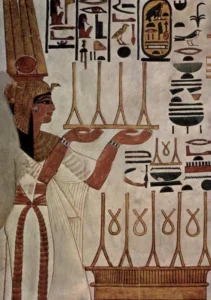
Walking with Nefertari Through QV66
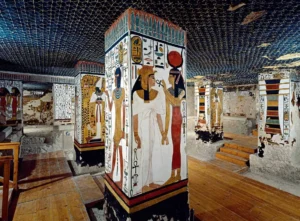
The journey begins by descending from the desert into a world designed as its opposite. The ceiling becomes the night sky, dark blue and scattered with five-pointed stars. The floor represents the earth. The deepest chamber belongs symbolically to Osiris, lord of the underworld and judge of the dead.
In the upper rooms, Nefertari appears playing senet, the ancient board game linked with passage and fate. Nearby, her ba—a human-headed bird representing one aspect of the person—waits with the power to leave the tomb by day and return at night. Elsewhere, the queen makes offerings, recites sacred knowledge, and approaches divine beings who control the gates of the next world.
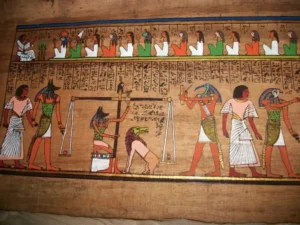
The paintings are based on spells and ideas from the Book of the Dead. These were not a biography of Nefertari’s earthly life. They were instructions for what came next.
At the stairway, protective figures surround the queen’s name. Isis, Nephthys, Maat, and a winged cobra guard her passage. Anubis watches over the tomb. Farther below, four pillars define the burial chamber beneath a star-filled ceiling. Images of Osiris and protective goddesses transform the room into a sacred domain where the queen can become eternal.
The movement is carefully structured. Nefertari descends into the kingdom of Osiris, overcomes its gates, and then rises symbolically toward Re, the sun god. Darkness leads toward dawn. Death leads toward “going forth by day.”
This is what makes QV66 greater than a collection of beautiful paintings. Every wall participates in one continuous story: Nefertari learns, offers, passes, transforms, and returns to light.
What Happened to Nefertari’s Tomb?
The same paintings that survived for thousands of years became vulnerable once the tomb returned to the open air. Ancient flooding, salt movement, unstable plaster, biological growth, and changing humidity had already damaged parts of the decoration. Modern visitors introduced additional heat, moisture, dust, and carbon dioxide.
In the late 20th century, the Egyptian Antiquities Organization and the Getty Conservation Institute undertook a major conservation program. Specialists studied the tomb’s environment, stabilized fragile plaster, cleaned painted surfaces, and developed strategies for long-term protection. The work preserved the art but also demonstrated why unrestricted access could not continue.
QV66 has therefore opened, closed, and reopened under different visitor limits and ticket systems. Older travel articles may describe a separate ticket and a short timed visit as though access were guaranteed.
It is not.
As of September 20, 2026, the official Egyptian ticket platform lists general admission to the Valley of the Queens but does not offer a separate QV66 ticket. Travelers should treat the Tomb of Nefertari as unavailable to ordinary visitors unless the official platform or the Ministry of Tourism and Antiquities confirms a reopening. Do not pay an unofficial seller who promises entry that the authorities do not currently offer.
The closure can be disappointing, but it reflects the central truth of conservation: a masterpiece cannot remain open today if doing so destroys what future generations hope to see tomorrow.
The Prince Who Walks Beside His Father: QV55
In the tomb of Prince Amenherkhepshef, QV55, the emotional focus shifts from a queen’s independent journey to a father guiding a son.
Amenherkhepshef was a son of Ramesses III and died young. He appears with the side-lock of youth, a hairstyle that immediately identifies him as a child or adolescent. In scene after scene, the pharaoh leads him toward the gods. The prince is not shown wandering through the underworld alone; royal authority and paternal care accompany him.
Ramesses presents his son to Ptah, Thoth, and other divine beings. The figures are formal, as Egyptian religious art required, yet the repeated pairing gives the tomb an intimacy rarely felt in royal monuments. A king remembered for battles and monumental inscriptions becomes, here, a father ensuring that his child is received safely into eternity.
QV55 also helps explain why “Valley of the Queens” is an incomplete name. This was a cemetery of the royal household, and some of its most moving images were made for princes who never became kings.
Prince Khaemwaset and the Painted Gates: QV44
QV44 belonged to Khaemwaset, another son of Ramesses III. Like Amenherkhepshef, he appears with his father and before the gods. The scenes emphasize protection, presentation, and passage through guarded regions of the afterlife.
The tomb’s surviving colors reward close attention. Look beyond the central figures to the smaller details: the pattern of a kilt, the curve of a divine beard, the hieroglyphs naming a gatekeeper, and the careful contrast between yellow backgrounds, white clothing, and the darker bodies of gods associated with fertility and renewal.
QV44 was reused in later periods, as were several tombs in the valley. That reuse may seem like damage from a modern perspective, but it is also part of the site’s history. The valley did not freeze when the New Kingdom ended. Later Egyptians returned, buried their own dead, adapted chambers, and reinterpreted spaces created centuries earlier.
Queen Tyti and the Questions That Remain: QV52
The tomb of Queen Tyti, QV52, preserves a different kind of story: one in which archaeology has not resolved every question.
Tyti held significant royal titles and belonged to the Ramesside court, but her precise family relationships and chronology remain debated. Older accounts often present one identification with complete confidence. A more accurate approach is to admit where inscriptions, titles, and family connections leave room for interpretation.
The tomb contains corridors, side chambers, and painted scenes in which the queen approaches protective deities. Its later reuse added more burials and material from different periods. Visitors therefore encounter not one sealed historical moment, but layers of use.
This uncertainty is valuable. Egyptology is not a finished book in which every name has found its correct page. It is an ongoing reconstruction built from texts, art, architecture, human remains, objects, and context. QV52 reminds us that a royal tomb can preserve both answers and questions.
Other Women in the Valley
Nefertari’s fame can make the Valley of the Queen appear to belong to one woman, yet other royal tombs broaden the history of Egypt’s court.
QV38 was prepared for Satre, associated with the beginning of the 19th Dynasty and the family of Ramesses I and Seti I. QV71 belonged to Bintanath, a daughter of Ramesses II who later held the title Great Royal Wife. QV75 was made for Henutmire, while QV80 belonged to Tuya, the mother of Ramesses II. Other tombs preserve the names of queens, princesses, and royal family members whose public monuments were far less extensive.
Many of these tombs are closed, damaged, undecorated, or inaccessible. Their importance is not measured by whether a visitor can enter them. Together, they reveal how the royal cemetery changed across generations and how rank, gender, family, and funerary religion shaped burial on the Theban West Bank.
Why the Valley of the Queens Feels Different
The Valley of the Kings is larger, more famous, and usually busier. Its royal tombs often create an overwhelming impression of kingship: long axes, monumental burial chambers, vast stone sarcophagi, and complex books of the underworld.
The Valley of the Queens tombs feel more personal. The spaces are often smaller. The royal family is more visible. A father leads a child. A queen stands alone before the gods. The scenes communicate the same ancient concern with rebirth, but they do so at a scale that brings the figures closer.
The site is also frequently calmer. That does not mean it should be treated as an optional substitute when there is spare time. Its quieter setting is part of its value. With fewer tombs open, visitors can slow down, compare how queens and princes were represented, and notice artistic details that disappear when a day becomes a race through monuments.
If the Valley of the Kings tells the public story of pharaohs facing eternity, the Valley of the Queens often feels like the story of the family that followed them into it.
Which Tombs Can You Visit?
Open tombs rotate for conservation and operational reasons. QV44, QV52, and QV55 are among the tombs most commonly associated with general visitor access, but none should be promised for a future date without checking current conditions.
| Tomb | Story and visual character | Planning note |
|---|---|---|
| QV55 — Amenherkhepshef | Ramesses III guides his young son before the gods; moving images of royal childhood and protection. | Often one of the most rewarding generally accessible tombs when open. |
| QV44 — Khaemwaset | Another son of Ramesses III travels through painted gates with his father and divine guardians. | A strong choice for color and afterlife symbolism when open. |
| QV52 — Tyti | A queen appears before protective gods in a tomb later reused for additional burials. | Valuable for discussing royal identity, reuse, and unresolved history. |
| QV66 — Nefertari | The valley’s artistic masterpiece and a complete painted journey from death to rebirth. | Not offered on the official ticket platform at the time of checking; do not assume access. |
Check the board at the entrance before buying your ticket, and ask which chambers are actually admitting visitors that day. An Egyptologist can explain the history outside the tombs, then point out the figures, colors, and symbols worth finding inside.
Valley of the Queens Tickets and Opening Hours
The following details were checked on September 20, 2026 using Egypt’s official monuments ticket platform.
| Visitor information | Current official details |
|---|---|
| Foreign adult ticket | EGP 220 |
| Foreign student ticket | EGP 110 |
| Egyptian adult ticket | EGP 30 |
| Egyptian student ticket | EGP 10 |
| Summer opening hours | From 6:00 AM; last entry at 5:00 PM |
| Winter opening hours | From 6:00 AM; last entry at 4:00 PM |
| Ramadan hours | May follow a separate schedule; verify shortly before visiting |
| Nefertari’s QV66 | No separate public ticket was offered on the official platform when checked |
General admission covers the tombs designated for standard entry on the day. Because conservation needs can change the open selection, the ticket should not be understood as a guarantee that every commonly listed tomb will be available.
Prices, payment procedures, opening hours, and access rules may change. Recheck the official Valley of the Queens ticket page before publication and again shortly before travel.
The Best Valley of the Queens Itineraries
A focused two-hour visit
Go directly to the Valley of the Queens near opening time. Confirm the tomb list, enter the available standard tombs, and spend time comparing how a queen and two princes are represented. This option works well for travelers who have already visited the other major West Bank sites.
A story-led half-day
Begin at Deir el-Medina, where the artists and craftsmen lived. Then visit the Valley of the Queens and recognize their work on the walls. Finish at Medinet Habu, the mortuary temple of Ramesses III, whose sons appear in QV44 and QV55. The three places create one connected narrative: the workers, the royal family, and the king’s monumental temple.
A complete West Bank day
Start early at the Valley of the Kings, continue to Hatshepsut’s temple, pause for lunch, and dedicate the afternoon to the Valley of the Queens and Medinet Habu. This route is rich but demanding, so private transportation and careful timing make a noticeable difference.
The valley also fits naturally before or after a Nile River cruise departing from Luxor. Travelers planning a longer private journey can connect it with Cairo, Aswan, and Abu Simbel through a tailored Egypt tour rather than treating Luxor as a single rushed excursion.
Practical Advice Before Entering the Tombs
Wear secure, comfortable shoes
The site includes exposed paths, uneven surfaces, steps, and sloping corridors. Shoes with reliable grip are more useful than loose sandals.
Protect yourself from the sun
Carry water, sunscreen, and a hat. Drink outside the tombs and keep food and beverages away from decorated interiors.
Never touch a painted wall
The colors may look permanent, but the plaster and pigments are fragile. Skin oils, moisture, dust, and physical contact accumulate into real damage.
Myths, Names, and Important Distinctions
Nefertari was not Nefertiti
The names are similar, but they belonged to different women. Nefertiti was the queen of Akhenaten during the 18th Dynasty. Nefertari was the Great Royal Wife of Ramesses II during the 19th Dynasty, roughly a century later.
Hatshepsut was not buried in the Valley of the Queens
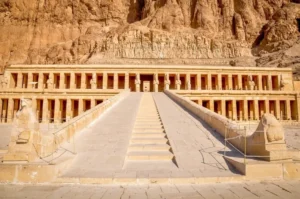
Hatshepsut ruled as pharaoh and had a royal tomb associated with the Valley of the Kings. Her famous terraced monument at Deir el-Bahari is a mortuary temple, not the Valley of the Queens.
The valley was not exclusively for queens
Its occupants included princes, princesses, and selected high-status individuals. The tombs of Ramesses III’s sons are among its most important monuments.
“Place of Beauty” is not the only interpretation
Ta Set Neferu is commonly rendered as “The Place of Beauty” or “Place of the Beautiful Ones,” but the ancient name has also been linked to royal children. Translation should be presented as interpretation rather than a perfectly fixed label.
The most famous tomb may not be open
QV66 defines the valley in books and photographs, but conservation requirements determine access. The Valley of the Queens remains worth visiting for QV44, QV52, QV55, and the wider story of the royal family even when Nefertari’s tomb is closed.
Frequently Asked Questions
What is the Valley of the Queens?
The Valley of the Queens is a New Kingdom royal cemetery on Luxor’s West Bank. It contains more than 90 known tombs and burial structures associated with queens, princes, princesses, and selected elite individuals.
Where is the Valley of the Queens in Egypt?
It lies within the Theban Necropolis west of the Nile at Luxor, southwest of the Valley of the Kings and near Deir el-Medina and Medinet Habu.
Who is buried in the Valley of the Queens?
Known tomb owners include Queen Nefertari, Queen Tyti, Queen Satre, Queen Tuya, several daughters of Ramesses II, and sons of Ramesses III such as Amenherkhepshef and Khaemwaset. Other tombs belonged to princesses, officials, or occupants whose identities remain uncertain.
What is the most famous tomb in the Valley of the Queens?
QV66, the Tomb of Queen Nefertari, is the most famous. Its extensive paintings show the queen’s journey through the afterlife and are regarded as a masterpiece of New Kingdom art.
Is Nefertari’s tomb open in 2026?
At the time of checking on September 20, 2026, Egypt’s official ticket platform did not list a public QV66 ticket. Treat the tomb as closed or unavailable unless the Ministry of Tourism and Antiquities or the official booking platform confirms otherwise for your visit date.
Is the Valley of the Queens worth visiting without Nefertari’s tomb?
Yes. The standard tombs reveal the stories of royal women and children, and QV44 and QV55 are particularly memorable for scenes showing Ramesses III guiding his sons before the gods. The quieter setting also complements the Valley of the Kings.
How much is the Valley of the Queens ticket?
As of September 20, 2026, official general admission was EGP 220 for a foreign adult and EGP 110 for a foreign student. Egyptian adult and student tickets were EGP 30 and EGP 10 respectively. Recheck the official platform because prices can change.
How long do you need at the Valley of the Queens?
Most travelers need 60 to 90 minutes for the generally accessible tombs. Allow more time for detailed interpretation, a relaxed pace, or any special-access tomb that may be available.
Which is better: Valley of the Kings or Valley of the Queens?
The Valley of the Kings is the priority for a first visit because it offers more open royal tombs and greater architectural variety. The Valley of the Queens is quieter and more intimate, with exceptional images of queens and royal children. The two sites complement rather than replace each other.
Can children visit the Valley of the Queens?
Yes, but families should visit early, carry water for the outdoor sections, and choose a manageable pace. The images of princes with their father can make the history easier for children to understand.
Do you need a guide?
A guide is not required for entry, but an Egyptologist can explain the sequence of the afterlife scenes, clarify disputed identities, and help connect the valley with Deir el-Medina and Medinet Habu. Explanations may need to take place outside individual tombs under site rules.
When the Valley Becomes Quiet Again
After the last tomb, the sunlight returns all at once.
The cliffs look empty, just as they did on arrival. Yet the silence has changed. It now contains a queen playing senet before her rebirth, a young prince walking beside his father, and generations of artists carrying color into rooms meant to remain dark.
The Valley of the Queens does not tell its story through one ruler or one discovery. It tells it through a family: powerful women, lost children, royal mothers, daughters, craftsmen, and gods who stand at the border between life and eternity.
Nefertari’s tomb may be the valley’s masterpiece, but the valley is larger than QV66. Its deepest impression comes from realizing that ancient Egypt’s vision of the afterlife was not reserved for kings alone. Beneath these quiet Luxor cliffs, queens and children were given painted worlds in which they, too, could meet the gods and rise with the sun.
Delta Tours Egypt can include the valley in a private Luxor program with an Egyptologist guide, coordinated transportation, and enough time to connect it with Deir el-Medina or Medinet Habu. Travelers seeking a more personalized pace can also explore Egypt luxury tours designed around the tombs and historical periods that matter most to them.