Coptic Cairo: Churches, Fortress, Museum & Visiting Guide
Coptic Cairo is the old Christian quarter of Cairo, built inside and around the walls of the Roman Babylon Fortress in the district of Old Cairo. In a compact, walkable area you can see the Hanging Church, the Church of Saints Sergius and Bacchus (Abu Serga), the Ben Ezra Synagogue, the fortress towers and the Coptic Museum. Most travelers cover the highlights in a half day, often paired with the Citadel or Islamic Cairo.
This guide is an area overview. It explains what Coptic Cairo is, why it matters, the order in which to see its main sites, and the practical details you need: official hours, the museum ticket, how to get there and how to dress.
Coptic Cairo at a Glance
| Fact | Details |
|---|---|
| Location | Old Cairo (Misr al-Qadima), on the east bank of the Nile, south of downtown Cairo, inside the historic Fustat area |
| Main sites | Babylon Fortress, Hanging Church, Abu Serga Church, Ben Ezra Synagogue, Coptic Museum, Greek Orthodox Church of St. George |
| Period | Roman fortress built around 300 AD; churches founded from late antiquity onward and rebuilt many times; synagogue building from the 1890s; museum opened in 1910 |
| Built by / dedicated to | Fortress attributed to Emperor Diocletian; churches belong mainly to the Coptic Orthodox Church |
| Nearest metro | Mar Girgis station on Cairo Metro Line 1 |
| Opening hours | Churches and synagogue: daily 9:00 AM to 4:00 PM. Coptic Museum: daily 9:00 AM to 5:00 PM (official listing, October 2026) |
| Foreign adult ticket | Coptic Museum EGP 280 (student EGP 140). No entry ticket is listed for the churches or the synagogue |
| Time needed | Our planning suggestion: 3 to 4 hours, including about 90 minutes in the museum |
What Is Coptic Cairo, and Why Does It Matter?
“Copt” is the word for an Egyptian Christian. The Coptic Orthodox Church traces its origins to Saint Mark, who brought Christianity to Alexandria in the first century AD. Coptic Cairo is where you see that long history most clearly in one place.
The story of the area begins with a fortress. Long before Cairo existed, a settlement called Babylon stood here on the Nile, at the point where an old canal ran east toward the Red Sea. The Romans fortified the spot. The walls and towers you see today are now attributed to Emperor Diocletian, who built a large fortress around 300 AD to guard the canal entrance and the river traffic.
Christian communities grew up inside and around those walls. When Arab armies reached Egypt, the fortress held out for about seven months before it fell in December 640 to the general ‘Amr ibn al-‘As. He then founded a new city, Fustat, just outside the walls. The Ministry of Tourism and Antiquities describes Fustat as Egypt’s first Islamic capital, and its first building was the Mosque of ‘Amr ibn al-‘As, which still stands nearby.
Under early Muslim rule, Copts were allowed to keep and build churches within the old fortress area. Several of the churches you visit today were founded in this period, then damaged, rebuilt and redecorated over the following centuries. In the 11th century the seat of the Coptic patriarch moved from Alexandria to this district, and the Hanging Church became one of its official residences.
There is a third faith here too. The Ben Ezra Synagogue served Cairo’s Jewish community for centuries, and its storeroom preserved one of the most important document collections in Jewish history. Add the mosque of ‘Amr a short walk north, and you have a small district where Christian, Jewish and Muslim history sit side by side.
Christian tradition also links the area to the Holy Family’s flight into Egypt. The crypt beneath Abu Serga Church is traditionally identified as one of the places where Mary, Joseph and the infant Jesus sheltered. For many Christian visitors, that tradition is the main reason to come.
What to See in Coptic Cairo, in Visiting Order
The sites cluster within a few hundred meters of Mar Girgis metro station. The order below follows a natural loop: the fortress and the Hanging Church at the front, then the lanes of the old walled compound, then the museum. Your guide may reverse it to avoid crowds.
1. Babylon Fortress
Start outside, facing the street. The remains of the Roman fortress are the oldest structures in the quarter. In Roman times the canal to the Red Sea passed between two massive round towers and ran through the fortress itself. A wall was later built between the towers to block the canal.
Today the ground level is several meters higher than in Roman times, so much of the masonry sits below you. Look for the bands of stone and brick in the surviving walls. Several of the churches and the Coptic Museum stand inside the fortress’s former enclosure, which is why the whole area feels like a walled village.
2. The Hanging Church (Church of the Virgin Mary)
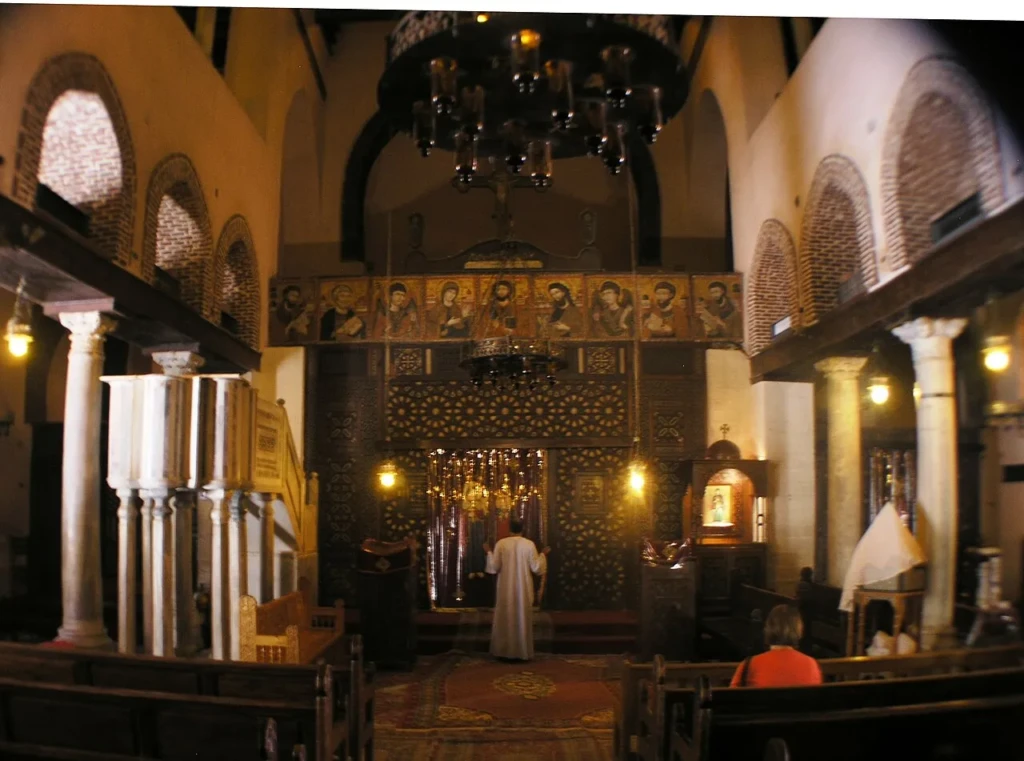
The Hanging Church gets its name because it was built over a gatehouse of the Roman fortress, so its nave is suspended above a passage. You reach it by a flight of 29 steps. Inside, the Ministry describes a hall divided into aisles by rows of marble columns, a wooden vaulted ceiling made to evoke Noah’s Ark, and a marble pulpit carried on slender columns. The pulpit dates to the 11th century.
The church is also known for its icons. According to the Ministry’s page, the oldest dates to the 15th century, while most date to the late 18th century. The church has been restored many times, most recently in a long project completed in 2011.
This is the most famous church in the quarter, and we will publish a separate in-depth guide to it. For a first visit, allow 20 to 30 minutes here.
3. The lanes of the old compound
From the Hanging Church area, a gateway leads down into narrow, stone-paved lanes below street level. This is the heart of the old walled quarter. The lanes connect several churches, including Saint Barbara and Abu Serga, and the Ben Ezra Synagogue. It is quiet, shaded and easy to explore on foot.
4. Church of Saints Sergius and Bacchus (Abu Serga)
Abu Serga is one of the oldest churches in Egypt. It is named after Sergius and Bacchus, two soldier-saints martyred in Syria in the early fourth century. Its exact age is debated. The Ministry notes that some scholars date it to the late fourth or early fifth century, while others favor a much later date. Many historians place its founding in the late seventh century.
The church follows the basilica plan: an entrance hall, a long nave with side aisles, and a raised sanctuary at the far end. Look for the wooden screen inlaid with ivory in geometric patterns, the icons of saints, and the arched wooden ceiling. Below the sanctuary is the crypt traditionally associated with the Holy Family’s stay. For centuries, Coptic patriarchs were elected at this church.
5. Ben Ezra Synagogue
A few steps away stands the Ben Ezra Synagogue, which the Ministry calls the oldest synagogue in Egypt. It is no longer used for regular worship. The building you see dates from the 1890s, but the congregation is much older. Documents found here suggest it predates 882 AD.
Inside, the reading platform (bimah) stands in the center. The Torah ark wall faces the direction of prayer and is decorated in an Arabesque style with mother-of-pearl inlay, carrying the Ten Commandments in Hebrew. The synagogue’s fame comes from its geniza, a storeroom for worn-out texts that could not be thrown away because they might contain the name of God. Documents gathered here over about 850 years. Europeans became aware of the hoard in the late 19th century, and the collection, now known as the Cairo Geniza, is held mainly at Cambridge University Library and other academic libraries.
6. Greek Orthodox Church of St. George
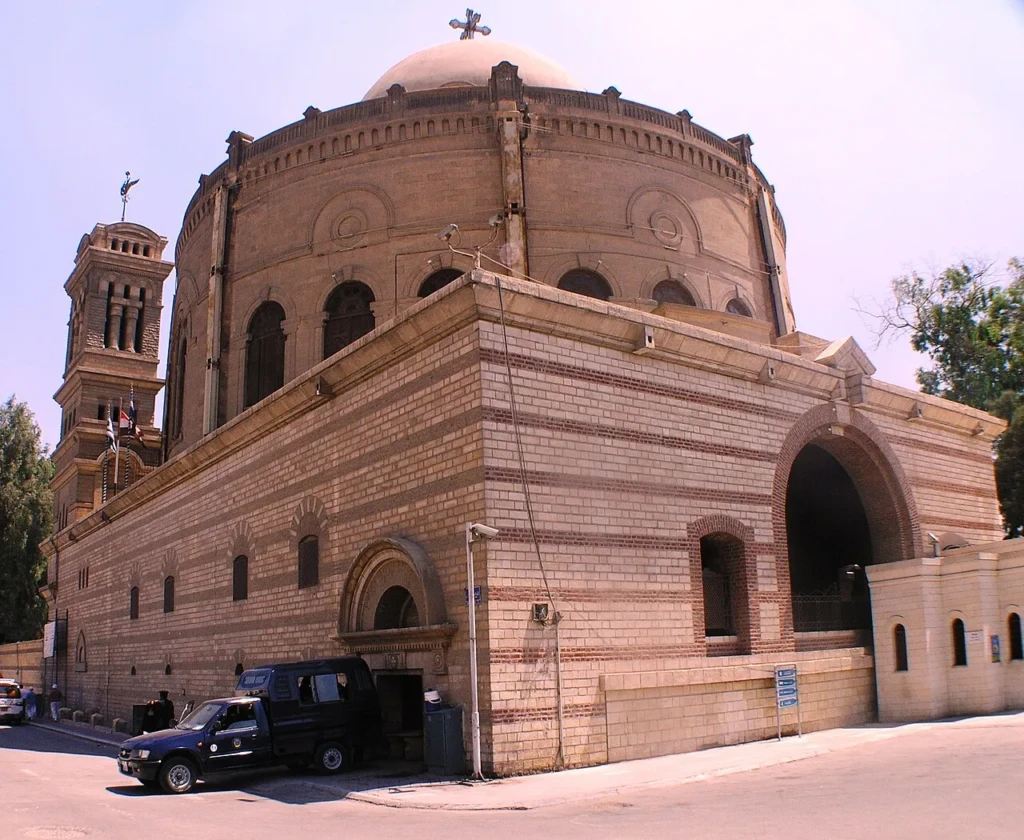
The Greek Orthodox Church of St. George stands within the former fortress enclosure, close to the metro station. It belongs to Cairo’s Greek Orthodox community rather than the Coptic Church, a reminder that several Christian traditions have shared this quarter. Even if you do not go inside, it is worth a look as you pass.
7. The Coptic Museum
Finish at the Coptic Museum, which sits within the old fortress enclosure. It was founded through the efforts of Marcus Simaika Pasha and opened in 1910. The Ministry describes it as home to the largest collection of Coptic artifacts in the world. Its facade was modeled on a 12th-century Cairo mosque, and the interior uses old mashrabiya screens and carved wood.
The collection shows how Christian art in Egypt grew out of Pharaonic, Greek and Roman traditions and later met Byzantine and Islamic influences. Expect stone carvings, painted icons, textiles, woodwork, metalwork and illuminated manuscripts. The famous Nag Hammadi codices are held in the museum’s library, which is open to specialist researchers only.
We will cover the museum gallery by gallery in a separate guide. For an area visit, 60 to 90 minutes gives you the highlights.
Coptic Cairo Opening Hours and Tickets
The figures below are as listed on the official Ministry of Tourism and Antiquities site in October 2026; check before you go, as hours and prices can change.
| Site | Opening hours | Foreign adult | Foreign student |
|---|---|---|---|
| Coptic Museum | Daily, 9:00 AM to 5:00 PM (ticket window closes 4:00 PM) | EGP 280 | EGP 140 |
| Hanging Church | Daily, 9:00 AM to 4:00 PM | No ticket listed | No ticket listed |
| Abu Serga Church | Daily, 9:00 AM to 4:00 PM | No ticket listed | No ticket listed |
| Ben Ezra Synagogue | Daily, 9:00 AM to 4:00 PM | No ticket listed | No ticket listed |
| Mosque of ‘Amr ibn al-‘As | 9:00 AM to 4:00 PM | No ticket listed | No ticket listed |
During Ramadan, the official Coptic Museum page lists shorter hours of 9:00 AM to 3:00 PM, with the ticket window closing at 2:00 PM. The ministry does not publish a separate ticket for the fortress remains. Churches are active places of worship, so access to parts of a church can be limited during services.
How to Get to Coptic Cairo
The simplest public-transport option is Cairo Metro Line 1, which runs between Helwan and El Marg. Get off at Mar Girgis station. The fortress towers and the main entrances are right beside the station. Route planners show the ride from Al Shohadaa (Martyrs) station, near Ramses Square, at roughly 12 to 13 minutes.
By car, Coptic Cairo is a short drive south of downtown along the Nile Corniche. Travel time depends heavily on Cairo traffic, so your driver or guide will confirm timing on the day. From Giza hotels, allow more time, as you cross the city.
On a private tour, your driver drops you at the entrance and collects you afterward, which saves you from navigating traffic and parking.
Best Time to Visit and Practical Tips
When to go
Arrive soon after 9:00 AM. Mornings are cooler and the lanes are quieter before tour groups arrive. From October to April the weather is mild, which suits walking between sites. In summer, the shaded lanes and the museum make Coptic Cairo a reasonable midday choice, but start early anyway. Our Egypt travel planning guides cover the weather month by month.
Sunday is the main day of worship for Coptic Christians, and Friday is busier at the mosque. Visiting on another weekday makes it easier to look around the churches without interrupting services.
What to wear
The churches, the synagogue and the mosque are religious buildings. Cover shoulders and knees, and bring a light scarf. Women will need to cover their hair inside the mosque. The Coptic Museum also asks visitors for appropriate attire. Comfortable flat shoes help on the uneven stone lanes and steps. Our Egypt packing and what-to-wear guide has more detail.
Photography and museum rules
At the Coptic Museum, photography with a mobile phone is free, but flash, tripods and monopods are not allowed. Large bags and umbrellas go to the cloakroom. Food is not allowed in the galleries, apart from small water bottles. Inside the churches, ask before photographing people, and stay quiet during prayers.
Other tips
- Carry small Egyptian pound notes for restroom attendants and any donation boxes.
- Small souvenir and bookshops line the lanes. Browse without pressure, and buy only what you want.
- A guide adds a lot here. Many details, from the fortress walls to the symbols in the icons, are easy to miss without explanation.
- Keep the museum for last if you want to see objects from the churches you have just visited, now in their gallery setting.
How to Combine Coptic Cairo with Nearby Sites
Coptic Cairo fits easily into a full Cairo day. The most common pairing is with the Citadel of Saladin and the Mohamed Ali Mosque, followed by an evening at the Khan el-Khalili bazaar. That route gives you Roman, Christian and Islamic Cairo in one day.
If ancient Egypt is your focus, combine a morning in Coptic Cairo with an afternoon at the Egyptian Museum in Tahrir Square, which is a short metro ride north on the same line. Another option is a day built around the Grand Egyptian Museum and the Giza Pyramids, with Coptic Cairo on a separate half day.
For a wider plan of the city, including where to stay and how many days you need, read our Cairo travel guide.
Visit with Delta Tours Egypt
Our Old Cairo and Citadel private day tour, from $100 per person, covers Coptic Cairo with the Citadel and the bazaar, with your own guide and car. If you want more time in the city, the Taste of Egypt 4-day Cairo tour, from $535 per person, combines the Pyramids, the Grand Egyptian Museum and Old Cairo. For a short Cairo-based break with the Mediterranean coast, there is also our 4-day Cairo and Alexandria tour, from $390 per person; ask us if you would like Coptic Cairo built in through a tailor-made itinerary. Delta Tours Egypt is a family-run operator founded in 1974 and licensed by the Ministry of Tourism (licence No. 121), and our Cairo team can shape the day around church services, museum time or your own interests.
Christmas in Coptic Cairo has a special atmosphere. If you are planning a winter trip, see our Christmas and New Year tours in Egypt.
Frequently Asked Questions
Is Coptic Cairo worth visiting?
Yes, especially if you are interested in history beyond the pharaohs. In a small area you see a Roman fortress, some of Egypt’s oldest churches, a historic synagogue and a major museum. It also adds variety to a trip that otherwise focuses on temples and tombs.
How long do you need in Coptic Cairo?
Our planning suggestion is 3 to 4 hours. That covers the fortress, the Hanging Church, Abu Serga, Ben Ezra and about 90 minutes in the Coptic Museum. With less time, focus on the Hanging Church and the museum.
Do you need a ticket for the churches?
The official Ministry site lists no entry ticket for the Hanging Church, Abu Serga or Ben Ezra Synagogue. The Coptic Museum does charge entry, EGP 280 for foreign adults as listed in October 2026. Check before you go, as prices change.
What is the dress code in Coptic Cairo?
Dress modestly, with shoulders and knees covered, as you are entering working places of worship. A light scarf is useful, and women need one to cover their hair in the nearby mosque. Wear shoes with good grip for the old stone lanes.
Is the Hanging Church the same as Coptic Cairo?
No. The Hanging Church is one building within Coptic Cairo, the wider historic quarter. The area also includes Abu Serga, Ben Ezra Synagogue, the Babylon Fortress, the Coptic Museum and several other churches.
Can you visit Coptic Cairo and the Pyramids on the same day?
It is possible but rushed, because the two sit on opposite sides of a large, busy city. Most travelers enjoy both more on separate days, or pair Coptic Cairo with the Citadel and Khan el-Khalili instead.
Coptic Cairo shows a side of Egypt many visitors miss, and a good guide brings its layers of history to life. Browse our private Cairo day tours to add it to your trip, or ask our team to build it into a tailor-made itinerary.
Featured image: Coptic Cairo, Church of Saint George from outside. Photo: Daniel Mayer / Wikimedia Commons, CC BY-SA 4.0