Karnak Sound and Light Show: Is It Worth It?
The Karnak Sound and Light Show is an evening performance inside Karnak Temple in Luxor. You walk through the lit-up temple while a recorded narration tells its story, then finish in seating beside the Sacred Lake. It is worth it if you enjoy atmosphere and storytelling, but it does not replace a daytime visit with a guide.
This guide covers how the show works, the official schedule and ticket price, who will enjoy it and who may not, and how to fit it into a Luxor itinerary. For the temple itself in daylight, see our full Karnak Temple visitor guide.
| Quick facts | Details |
|---|---|
| Location | Karnak Temple, east bank of the Nile, Luxor |
| Run by | Misr Company for Sound, Light and Tourism Development |
| Running since | 1972, according to the operator |
| Format | Walking section through the temple, then a seated finale by the Sacred Lake |
| Show times | 20:00 English show daily; 21:00 second show (see schedule below) |
| Ticket price | $20 adult, $11 child aged 6 to 12 (official show website, October 2026) |
| Languages | Ten languages offered across the program |
| Time needed | Our planning suggestion: a full evening, including hotel transfers |
| Delta tour | Karnak Sound and Light Show in Luxor, from $80 per person |
What is the Karnak Sound and Light Show?
It is a narrated night program staged inside the Karnak complex, the vast temple city that the ancient Egyptians called Ipet-Sut, “the most select of places.” Floodlights pick out pylons, columns and statues one section at a time. A soundtrack of voices and music tells the story of Thebes, its kings and the god Amun, whose cult was centered here.
The show belongs to a family of similar productions in Egypt. The same state-owned company also stages shows at the Giza Pyramids, Philae Temple in Aswan, Abu Simbel, Edfu and the Qaitbay Citadel in Alexandria. Its own history page dates the Karnak project to 1972, which makes it one of the longest-running night shows in the country.
The narration is theatrical rather than academic. Think of it as an evocative introduction to Karnak’s scale and mood, not a lecture. Your daytime guide explains who built what and why; the night show gives you the feeling of the place after dark.
How does the show work?
Karnak’s show differs from the Pyramids version in one important way: you move through the temple instead of watching from a single grandstand the whole time. Tour operator descriptions, including TUI’s listing for its Karnak evening excursion, outline the same route.
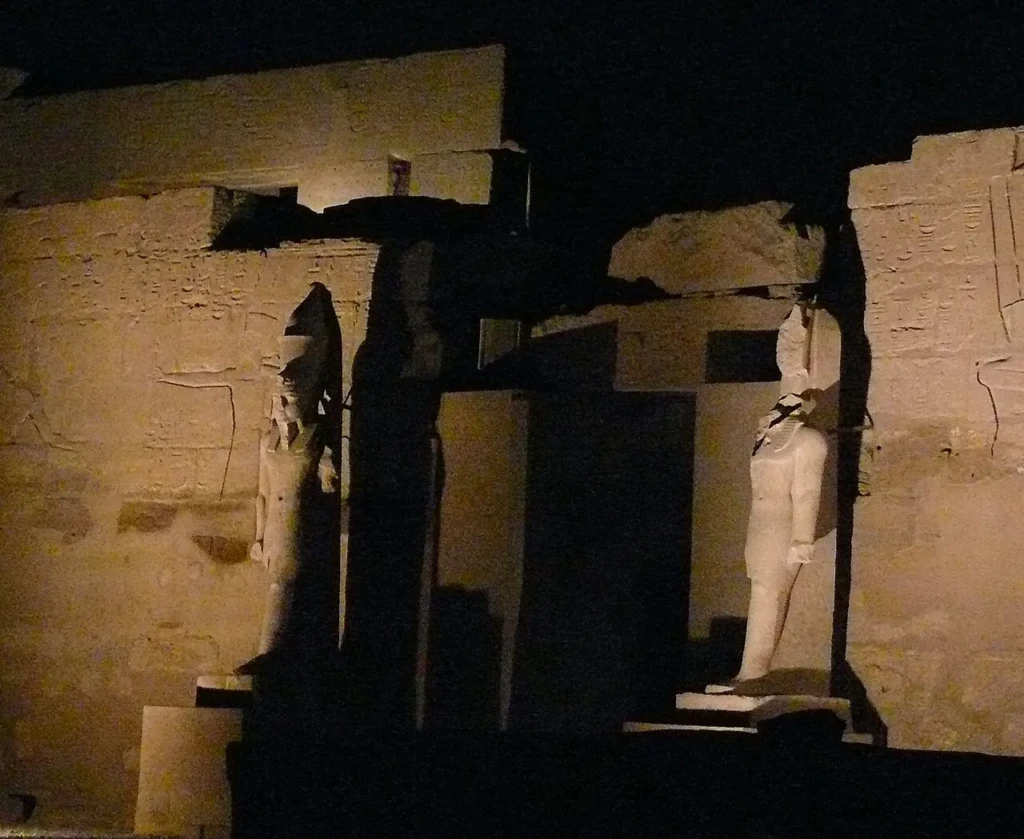
Part one: the walking section
The audience gathers near the avenue of ram-headed sphinxes at the temple’s entrance. As the narration begins, the group walks in stages through the first pylon, into the Great Court and on into the Great Hypostyle Hall. Lights come up on each area as the story reaches it.
The hypostyle hall is the highlight of this part. According to the Ministry of Tourism and Antiquities, it holds 134 columns about 15 meters high, with a central row of twelve that reach 21 meters. Walking between them at night, with the tops lost in shadow, gives a sense of size that photos rarely capture.
Part two: the seated finale at the Sacred Lake
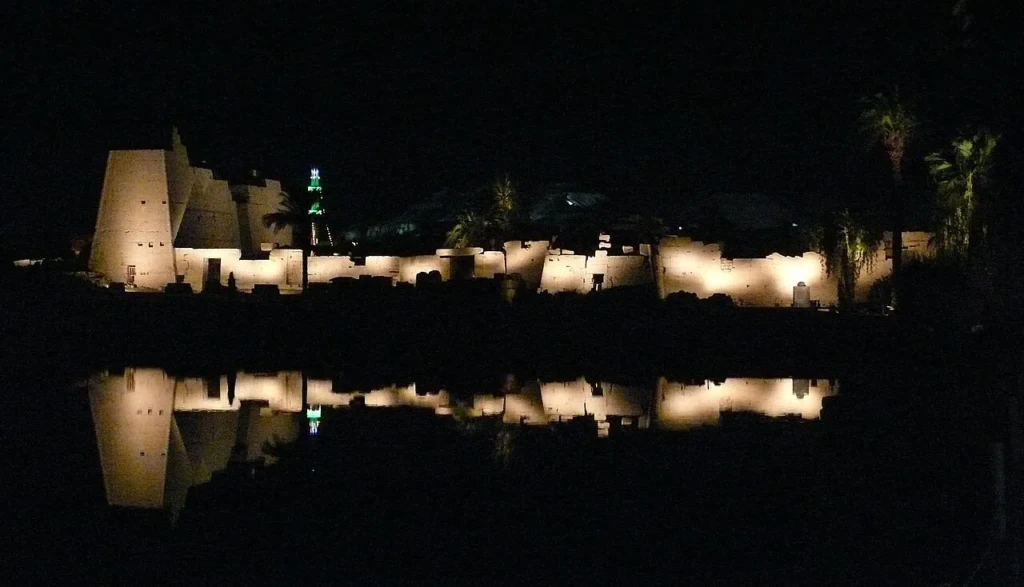
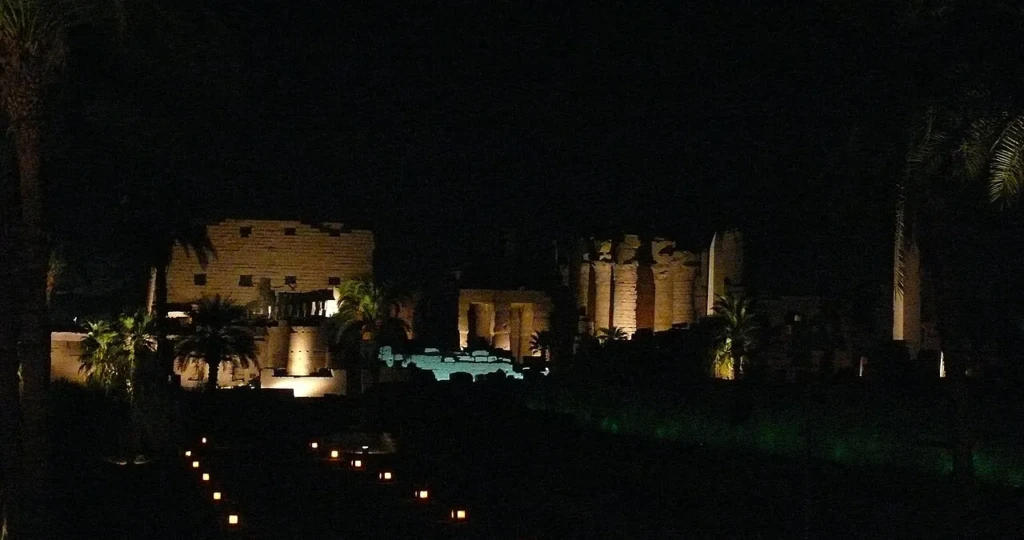
The program ends at a grandstand beside the Sacred Lake, where priests once purified themselves before rituals. From here you watch the final segment as different parts of the complex light up across the water. This is the moment most visitors remember: the still lake, the silhouettes of obelisks and pylons, and the narration building to its close.
The walking section involves standing and moving over uneven ground in low light. Anyone with limited mobility should know this in advance and discuss it with their guide.
Karnak Sound and Light Show schedule
The official show website lists two performances each evening. The first, at 20:00, is in English every day of the week. The second, at 21:00, is marked “All language” on most days, with Thursday’s late show listed in Arabic. These times are as listed on the official Sound and Light website in October 2026; the site itself states that dates are subject to change.
| Day | 20:00 show | 21:00 show |
|---|---|---|
| Saturday to Wednesday | English | All language |
| Thursday | English | Arabic |
| Friday | English | All language |
Two details matter for planning. First, the operator notes that the second show runs only with a minimum of five foreign visitors. Second, the “All language” slot is where headsets or other languages come into play, so English speakers are usually best served by the 20:00 performance. Your guide or Delta’s operations team will confirm the language and time for your date.
How much are tickets?
The official show website lists a regular ticket at $20 and a child ticket at $11 for ages 6 to 12, as listed on the official Sound and Light website in October 2026; check before you go. A VIP ticket appears on the page without a published price.
The show ticket is sold by the show company and is separate from the daytime monument ticket. For comparison, the Ministry of Tourism and Antiquities lists Karnak’s daytime foreigner ticket at EGP 600 for adults and EGP 300 for students, covering Karnak Temple and the Open-Air Museum. The Precinct of Mut has its own ticket at EGP 200 for adults. Daytime opening hours are 6:00 AM to 5:00 PM daily. These figures are as listed on the official Ministry of Tourism and Antiquities site in October 2026; check before you go.
Refunds and rescheduling
The operator’s cancellation policy says all tickets are non-refundable. You can reschedule once to another time or location, subject to availability, if you ask at least 24 hours before the original show. No-shows lose the ticket. If your Luxor dates are uncertain, it makes sense to book through a tour operator who can adjust plans with you.
Is the Karnak Sound and Light Show worth it?
The honest answer depends on what you want from an evening in Luxor. Here is how we would weigh it.
Reasons to go
- Karnak at night is a different place. Floodlit columns and a quiet temple with no daytime crowds feel nothing like a midday visit.
- It suits a first evening in Luxor. The narration sets the scene before you tour the temples properly with a guide.
- It is low effort. No early start, no heat of the day, and a seated finale.
- It is good with older children. Kids often engage more with lights and voices than with a guided explanation of dynasties.
Reasons you might skip it
- The script is dramatic, not detailed. Travelers who want history and context will learn far more from a daytime Egyptologist guide.
- You do not explore freely. You follow the group route and cannot wander off to look at reliefs.
- The schedule is tight on busy days. If you rose before dawn for a hot air balloon flight and spent the day on the West Bank, a 20:00 start can feel long.
- Night photography is limited. Low light and a moving group make sharp photos hard without a tripod.
Our verdict
For most first-time visitors staying two or more nights in Luxor, the show is a worthwhile add-on rather than a must-do. It works best as a complement to a proper daytime visit, not a substitute. If you only have one day in Luxor, spend it on the temples and tombs in daylight and skip the show.
Karnak by day vs Karnak by night
| Daytime guided visit | Sound and Light Show | |
|---|---|---|
| Purpose | Understand the architecture, reliefs and history | Experience the atmosphere and a narrated story |
| Freedom to explore | High; you set the pace with your guide | Low; fixed route and timing |
| Areas covered | As much of the complex as you have time for, plus the Open-Air Museum and Mut precinct if ticketed | Entrance, first pylon, Great Court, Hypostyle Hall, Sacred Lake |
| Ticket | Ministry monument ticket | Show company ticket |
| Best for | Everyone visiting Luxor | Second evening in Luxor, families, atmosphere lovers |
How to get to the show
Karnak Temple sits on the east bank of Luxor, north of Luxor Temple. Most east bank hotels and Nile cruise docks are a short drive away, but traffic and pickup order vary, so your driver or guide will confirm timing on the day. Plan to arrive before the start time, since the walking section begins with the group together at the entrance.
If you are on a Nile cruise, check whether your ship offers the show as an optional excursion and on which evening. Cruise schedules in Luxor are busy, and some itineraries only allow it on the first or last night. Our day-by-day Luxor to Aswan cruise guide shows where an evening in Luxor usually falls.
Practical tips for the evening
- Bring a layer in winter. Desert evenings cool down quickly, and you will be outdoors throughout.
- Wear closed shoes. The ground is uneven and the walking section is dim.
- Carry a small flashlight or use your phone light between lit sections, keeping it pointed down so you do not disturb others.
- Pick the English show. If English is your language, the 20:00 slot is the one listed as English every day.
- Eat before or after, not during. Plan dinner around the show; there is nowhere to eat during the program.
- Read up on Karnak first. Knowing the difference between Amun, Mut and Khonsu makes the narration much easier to follow.
How to combine the show with other Luxor sights
The most natural pairing is a daytime visit to the East Bank followed by the show that evening, or the day after. Our private Karnak and Luxor Temple tour from $70 per person covers both temples in daylight with a guide. Seeing Karnak by day first means you recognize every pylon and column when the lights come on.
If you have a full day, the Luxor East and West Bank tour from $128 per person adds the Valley of the Kings and the West Bank temples. Use our Luxor Temple guide and Luxor travel guide to plan the rest of your stay, and see where to stay in Luxor if you want a hotel close to the East Bank.
Travelers who enjoy the format often see a second show elsewhere. In Aswan, the Philae Temple Sound and Light Show starts from $60 per person; see our Philae Temple guide for the island’s story. In Cairo, the Pyramids Sound and Light Show starts from $53 per person.
Visit with Delta Tours Egypt
Our Karnak Sound and Light Show in Luxor excursion starts from $80 per person. We are a family-run, Ministry-licensed operator (licence No. 121) based in Cairo since 1974, and we can slot the show into a private Luxor stay, a Nile cruise program or a longer tour. Browse all our private Luxor day tours to build your days around it.
Frequently Asked Questions
How long is the Karnak Sound and Light Show?
The operator does not publish a running time for the Karnak show. With hotel transfers, plan on an evening: TUI lists its packaged Karnak show excursion at about three hours including pickup and drop-off.
Is the Karnak Sound and Light Show in English?
Yes. The official schedule lists the 20:00 performance in English every day of the week. The 21:00 slot is marked “All language” on most days and Arabic on Thursdays.
How much does the Karnak Sound and Light Show cost?
The official show website lists $20 for adults and $11 for children aged 6 to 12, as of October 2026. Tickets are non-refundable, but you can reschedule once with at least 24 hours’ notice.
Does my Karnak Temple ticket include the show?
No. The daytime ticket is sold by the Ministry of Tourism and Antiquities, while the night show is sold separately by the Sound and Light company. You need both if you want to see the temple by day and attend the show.
Is the show suitable for children?
Generally yes, especially for children old enough to follow a story. A child ticket covers ages 6 to 12, and the seated finale gives tired legs a rest after the walking section.
Which is better, the Karnak or the Pyramids show?
They suit different moods. At Karnak you walk through the temple before a lakeside finale, while the Giza show is staged in front of the Great Sphinx and the pyramids. If you can only fit one, choose the one in the city where you have a free evening.
Ready to plan your nights as well as your days in Luxor? Explore our private Luxor tours and excursions, and we will fit the Karnak show in where it works best for your trip.
Featured image: Karnak Temple lit at night. Photo: Ad Meskens / Wikimedia Commons, CC BY-SA 3.0