Colossi of Memnon: History, What to See & Visitor Guide
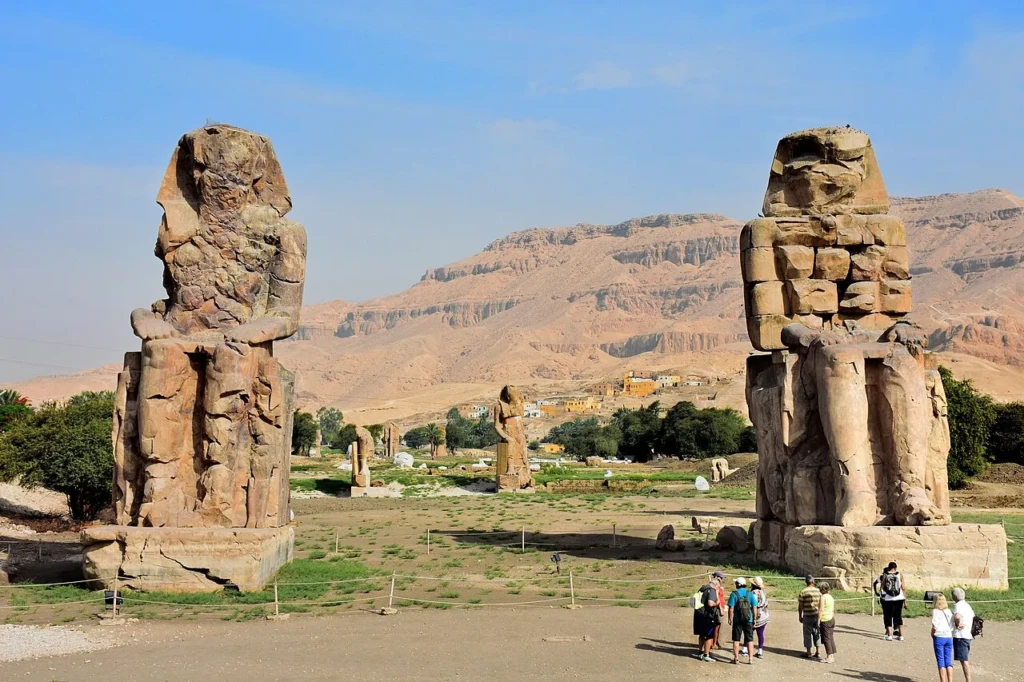
The Colossi of Memnon are two seated stone statues of Pharaoh Amenhotep III on Luxor’s West Bank, carved around 1350 BC to guard the entrance of his mortuary temple. Each stands about 18 meters (roughly 60 feet) tall including its base. They are usually a short stop on a West Bank day, often on the way to or from the Valley of the Kings.
This guide explains who the statues really show, why the Greeks named them after a Trojan War hero, what to look for when you stand in front of them, and how to fit them into a day in Luxor.
Colossi of Memnon: Quick Facts
| Fact | Details |
|---|---|
| Location | West Bank of the Nile, Luxor (ancient Thebes), at the front of the ruined mortuary temple of Amenhotep III, known locally as Kom el-Hettan |
| Date | Around 1350 BC, 18th Dynasty, New Kingdom |
| Who they show | Amenhotep III, seated, with smaller figures of his wife Tiye and his mother Mutemwiya beside his legs |
| Height | About 18 m (60 ft) including the stone platforms, which are about 4 m (13 ft) high |
| Material | Quartzite sandstone quarried at el-Gabal el-Ahmar, near modern Cairo |
| Estimated weight | About 720 tons each |
| World Heritage status | Part of “Ancient Thebes and its Necropolis,” UNESCO World Heritage List, 1979 |
| Time needed | Our planning suggestion: 15 to 30 minutes |
What Are the Colossi of Memnon?
The two statues are portraits of Amenhotep III, one of the wealthiest kings in Egyptian history. He ruled in the 14th century BC, at a high point of New Kingdom power and art. The king sits upright with his hands resting on his knees. Both figures face east-southeast, toward the Nile and the rising sun.
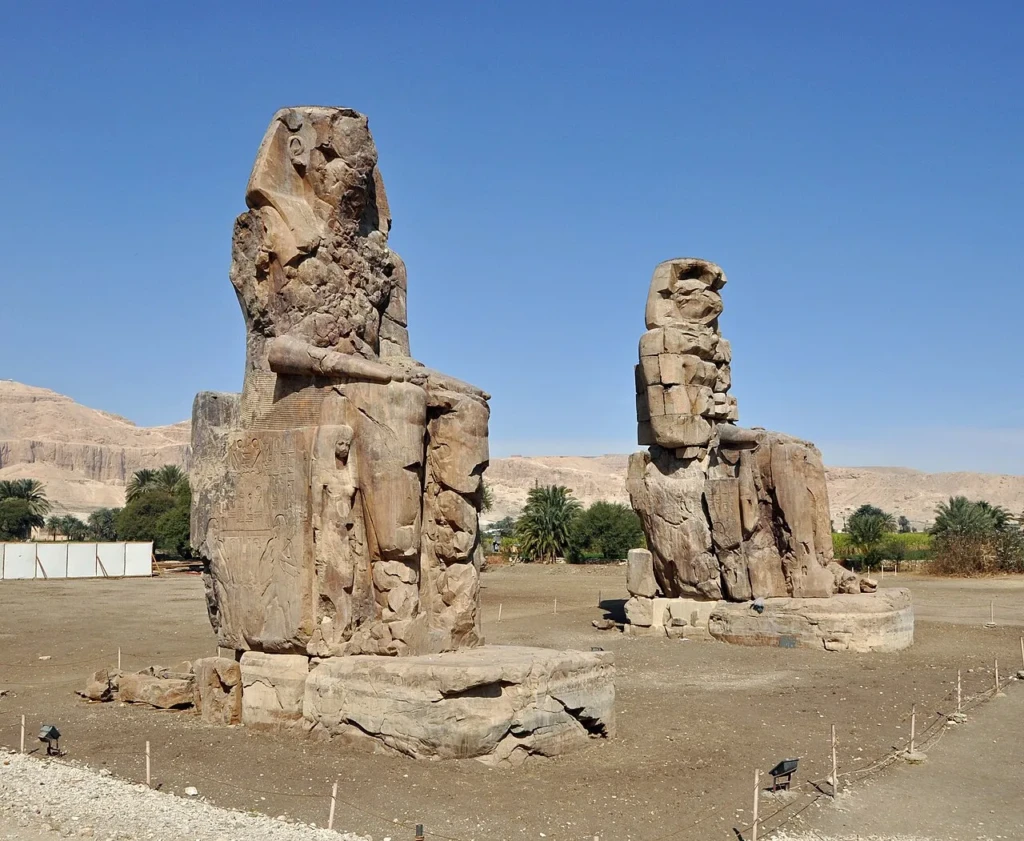
They were never meant to stand alone. They flanked the main gateway of the king’s mortuary temple, a place where offerings were made to him during his life and after his death. In its time this temple covered about 35 hectares (86 acres). That made it larger than any other memorial temple on the West Bank, including the Ramesseum and Medinet Habu.
Almost all of that temple is gone. The statues survived because they were too massive to topple or carry off. Today they rise from open fields, and most visitors only learn about the vanished temple behind them once they arrive.
Why the name “Memnon”?
The name has nothing to do with Amenhotep III. Memnon was a figure from Greek myth, a king of Ethiopia who fought for Troy and was killed by Achilles. His mother was Eos, goddess of the dawn.
Greek and Roman visitors linked the northern statue to Memnon because of a strange sound it made at sunrise (see below). To them, it was a son greeting his mother each morning. The name stuck, and it is still the one on every map. In Arabic the site is called Kom el-Hettan, and older local names for the pair include el-Colossat and es-Salamat.
How Were the Statues Built and Moved?
The colossi are made of quartzite sandstone, a very hard stone. It was cut at el-Gabal el-Ahmar, near modern Cairo, and moved about 675 km (420 miles) to Thebes. Scholars still discuss how. One view holds that the blocks were too heavy to ship upstream and went overland.
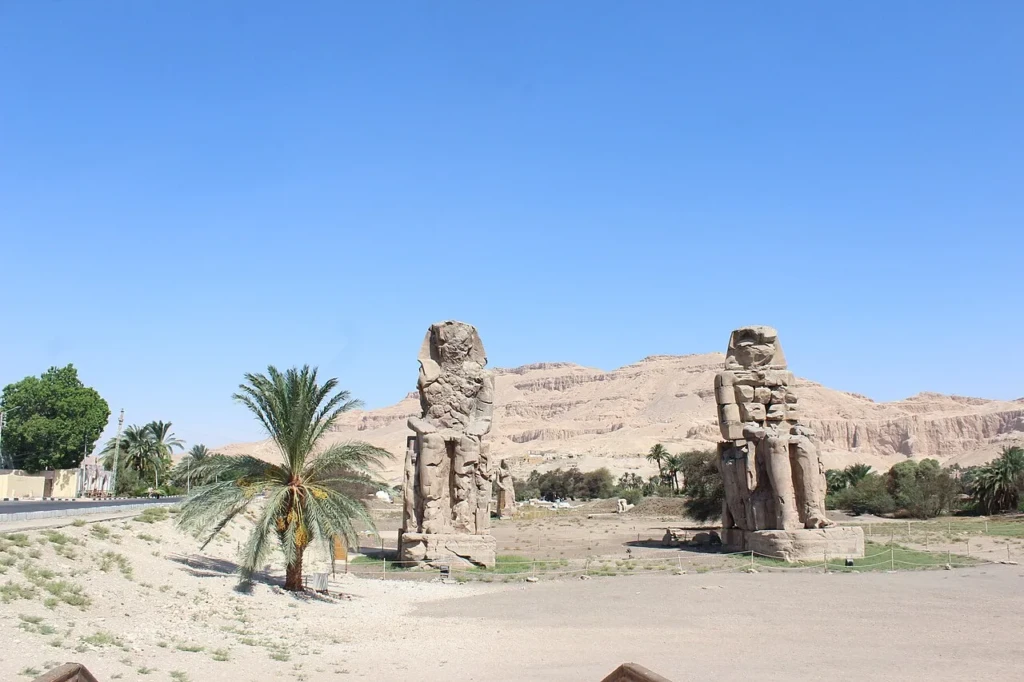
Recent research at the site adds another piece. Geoarchaeologists have identified a former branch of the Nile that ran along the west side of the valley, close to the colossi. It may have given the temple a riverside entrance and could have helped deliver building materials. Each statue is estimated to weigh around 720 tons, so moving them was a major state project either way.
The two figures stand about 15 m (50 ft) apart. On the front of each throne, smaller figures of Queen Tiye and the king’s mother, Mutemwiya, stand beside his legs. A third small figure between the legs, probably a daughter, has been destroyed. The side panels of the thrones show Hapi, the god of the Nile flood.
What Happened to the Temple Behind Them?
The temple sat at the edge of the floodplain. Each year the Nile flood reached into its courts, and the water slowly weakened its foundations. A 19th-century painting by David Roberts even shows the colossi standing in floodwater.
Earthquakes did more damage. Researchers now date a major quake to around 1200 BC. It brought the temple down, leaving the two colossi at the gate still standing. Later kings then reused its stones in their own buildings, a common practice in ancient Egypt.
The restoration project today
Since 1998, an Egyptian-German mission has worked at the site under the Ministry of Tourism and Antiquities and the German Archaeological Institute. It is led by Armenian-German archaeologist Dr. Hourig Sourouzian. Its goal is to protect the remains of the temple and rebuild parts of it.
The finds have been striking. The Ministry has reported black granite busts of the lion goddess Sekhmet and parts of two limestone sphinx statues of the king. The sphinxes are about 8 m (26 ft) long. The mission has also found a 1.85 m (6 ft) black granite statue of the falcon-headed god Horus. Amenhotep III placed many statues of Sekhmet in this temple to protect it and him. Restored pieces are being prepared for return to their original positions.
Whether you can walk into the temple field beyond the colossi depends on the mission’s current work. Your guide will know what is open on the day of your visit.
The “Singing” Statue
The colossi became famous in the Roman world for a sound. An earthquake in 27 BC cracked the northern statue and broke away its upper half. After that, the remaining stone was said to “sing” within an hour or two of sunrise.
Ancient writers described the sound in different ways. The Greek geographer Strabo heard it around 20 BC and compared it to a blow. Pausanias likened it to a snapping lyre string. Strabo admitted he could not tell whether it came from the stone or from someone standing nearby.
Hearing the sound was considered good luck, and visitors came from across the empire. Emperor Hadrian and Empress Sabina visited in November 130 AD. A poet in their party, Julia Balbilla, carved verses about it into the statue’s leg.
The last reliable report of the sound dates to 196 AD. Sometime after that, the broken upper body was rebuilt with tiers of sandstone. Local tradition credits Emperor Septimius Severus, around 199 AD. The statue never sang again. The most common natural explanation is that rising morning heat dried dew inside the cracked, porous stone and made it give off a sound. The added weight of the repair may have stopped that from happening.
What to See at the Colossi of Memnon
The stop is short, but there is more to notice than two large statues. Here is a simple order that works well.
1. The two statues from a distance
Stand back first to take in the scale and the empty plain around them. Picture a huge temple gateway just behind. The southern statue is cut from a single block. The northern one has a deep crack in its lower half, and five tiers of different sandstone above the waist from the Roman repair.
2. The throne figures of Tiye and Mutemwiya
Walk closer to the front of the thrones. The standing queens reach only to the king’s knees, which tells you how ancient artists showed rank. Tiye was a powerful royal wife, and her mummy is now in Cairo.
3. The Nile god Hapi on the side panels
Move to the sides of the thrones. Look for relief carvings of Hapi, the Nile flood god, a common royal symbol of a fertile and united land.
4. Roman-era graffiti on the northern statue
The legs and base of the northern colossus carry 107 inscriptions from Roman visitors, dated between about 20 and 250 AD. Of these, 61 are in Greek, 45 in Latin and one is in both. Many mention Memnon and record whether the writer heard the sound. Ask your guide to point out lines you can still make out.
How to Get to the Colossi of Memnon
The colossi stand on Luxor’s West Bank, across the Nile from the city’s main hotels and the cruise moorings on the East Bank. Most travelers reach them by private car with a driver and guide, as part of a West Bank tour.
We have not printed a drive time here because it depends on where you start and on traffic. Your driver or guide will confirm timing when you plan the day.
Opening Hours and Tickets
The official Ministry of Tourism and Antiquities site did not list separate opening hours or a ticket price for the Colossi of Memnon when we checked in October 2026, so we have not printed one. Confirm the current arrangement with your guide before you go.
If you are building your own West Bank day, the nearby tombs and temples do have their own tickets. Check those details in our Valley of the Kings ticket and tomb guide.
Best Time to Visit
The statues face east-southeast, so morning light falls on their fronts. That makes early morning the best time for photos. It also fits the usual West Bank plan of seeing the tombs before the midday heat.
Late afternoon is the second option, when the light is softer but behind the statues. In the hotter months, an early start matters even more.
Practical tips
- Bring a hat, sunglasses and water. There is little shade around the statues.
- Plan for a short stop, not a long visit. Fifteen to thirty minutes is usually enough.
- Ask your guide for the story of the singing statue on site. It makes the cracks and repairs make sense.
How to Combine It With Nearby Sites
The colossi are easy to pair with the rest of the West Bank. A classic half day covers the royal tombs, a temple and this stop. A full day can add more.
- Valley of the Kings. The royal tombs are the main reason most visitors cross the river. Read our Valley of the Kings guide before you choose which tombs to enter.
- Temple of Hatshepsut. The terraced temple at Deir el-Bahari is the usual second stop. See our Hatshepsut Temple visitor guide.
- Medinet Habu. If you want to see what a West Bank mortuary temple looked like when complete, Ramesses III’s temple is the best surviving example. Our Medinet Habu guide covers it.
- The rest of Luxor. For the East Bank temples, hotels and a full plan, start with our Luxor travel guide.
If you are also visiting Cairo, you can meet Amenhotep III in person. His mummy, and Queen Tiye’s, are displayed at the National Museum of Egyptian Civilization. Our article on the Pharaohs’ Golden Parade and where the royal mummies are now explains how they got there.
Visit With Delta Tours Egypt
Our private West Bank of the Nile tour covers the Valley of the Kings, the Temple of Hatshepsut and the Colossi of Memnon with your own Egyptologist, from $150 per person. To see both banks in one day, the Luxor East and West Banks tour is from $128 per person.
Short on time in Egypt? The Luxor day trip from Cairo by air is from $490 per person. For a longer stay, the 4 Day Cairo and Luxor tour is from $570 per person and pairs the pyramids with Luxor’s West Bank.
Frequently Asked Questions
Who do the Colossi of Memnon represent?
They show Pharaoh Amenhotep III of the 18th Dynasty, not Memnon. Greek and Roman visitors gave them the name of the mythical Trojan War hero because of the sound the northern statue made at dawn.
How tall are the Colossi of Memnon?
Each statue reaches about 18 meters (60 feet) including its stone platform. The platforms alone are about 4 meters high, and each statue is estimated to weigh around 720 tons.
Do the Colossi of Memnon still sing?
No. The last reliable report of the sound dates to 196 AD. After the northern statue was rebuilt with sandstone tiers in the Roman period, the sound stopped.
Do I need a ticket to see the Colossi of Memnon?
The official Ministry of Tourism and Antiquities site did not list a separate ticket or opening hours for the colossi in October 2026. Your guide will confirm the current arrangement on the day.
How long should I spend at the Colossi of Memnon?
Our planning suggestion is 15 to 30 minutes. Most travelers combine the stop with the Valley of the Kings and the Temple of Hatshepsut in a single morning.
Is it worth stopping at the Colossi of Memnon?
Yes, especially since it costs little time on a West Bank day. The statues show the scale of Amenhotep III’s building program, and their Roman graffiti shows that people have come here as tourists for about two thousand years.
Planning your days on the West Bank? Browse our private Luxor day tours and we will shape the route around the sites you most want to see.
Featured image: Colossi of Memnon on the West Bank of Luxor. Photo: MusikAnimal / Wikimedia Commons, CC BY-SA 4.0