Cairo Citadel and the Muhammad Ali Mosque: Visitor Guide
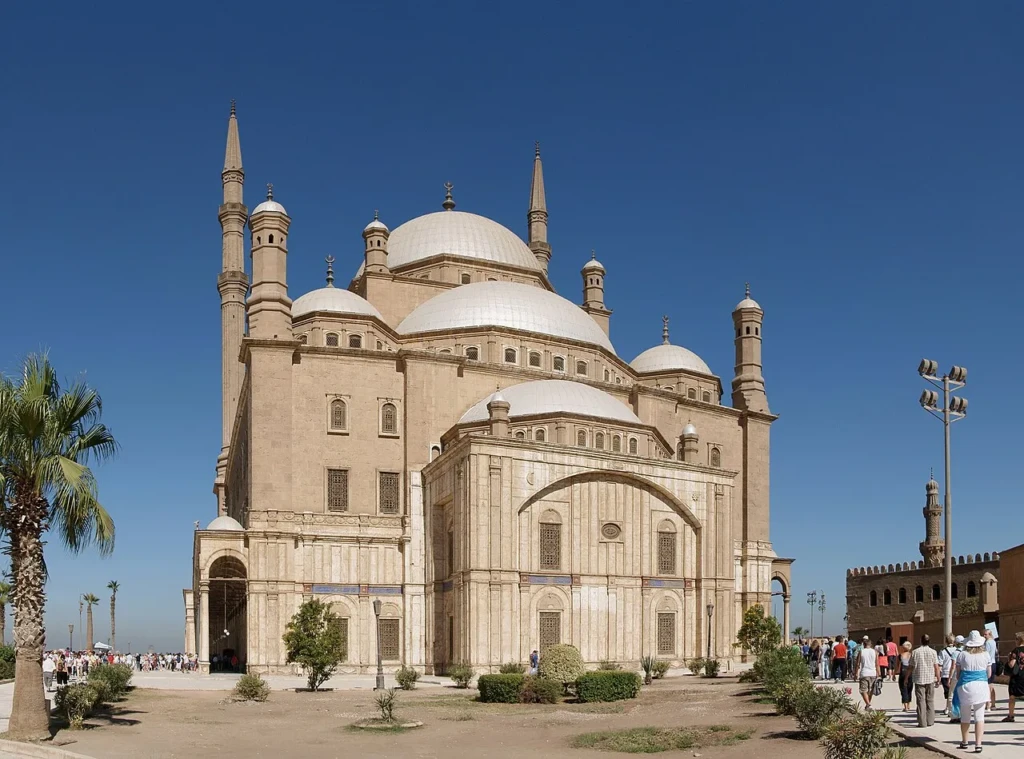
The Cairo Citadel is the hilltop fortress that Saladin began in 1176 to defend the city, and it served as the seat of Egypt’s rulers for roughly 700 years. Its best-known building is the Muhammad Ali Mosque, the “Alabaster Mosque” whose twin minarets dominate Cairo’s skyline. The site opens daily from 8:00 am to 5:00 pm, and the foreign adult ticket is EGP 550, as listed on the official Ministry of Tourism and Antiquities site in October 2026; check before you go.
This guide explains the Citadel’s history in plain language, the order we suggest for seeing its mosques, museums and walls, and how to plan tickets, timing and clothing.
| Quick facts | Details |
|---|---|
| Official name | Citadel of Salah al-Din al-Ayyubi (Saladin) |
| Location | A spur of the Muqattam Hills, on the eastern edge of historic Cairo |
| Founded | 1176 by Sultan Salah al-Din; completed under Sultan al-Kamil in the early 13th century |
| Main landmark | Muhammad Ali Mosque, dated by the Ministry to 1848 |
| World Heritage | Part of the UNESCO-listed Historic Cairo since 1979 |
| Hours | 8:00 am to 5:00 pm daily (official listing) |
| Foreign ticket | Adult EGP 550, student EGP 275 (official listing) |
| Time needed | 2 to 3 hours (our planning suggestion) |
| Delta tour | Old Cairo & Citadel, 1 day, from $100 per person |
What is the Cairo Citadel?
The Citadel is a walled complex of fortifications, mosques, palaces and museums set on a rocky spur above the city. The Ministry of Tourism and Antiquities calls it one of the most impressive defensive fortresses of the Middle Ages. Its height gave defenders a commanding position, and it still gives visitors a wide panorama over Cairo.
The site has two main parts. The Northern Enclosure was the military zone, with most of the surviving towers. The Southern Enclosure held the rulers’ palaces and the royal mosque. Today the Muhammad Ali Mosque, the Mamluk mosque of al-Nasir Muhammad and several museums share the grounds.
A short history of the Citadel
Saladin’s fortress (12th to 13th centuries)
Salah al-Din, known in the West as Saladin, ordered the fortress in 1176. He had recently ended Fatimid rule in Egypt, and Crusader armies were still active in the region. He wanted a secure seat of government and a strongpoint for a wall that would enclose both Cairo and the older capital of Fustat.
His confidant Baha al-Din Qaraqush oversaw the work. Most of the stone came from the Muqattam Hills, but Wikipedia notes that builders also quarried several minor pyramids at Giza for material. Saladin did not live to see it finished. His nephew, Sultan al-Kamil, completed the southern palaces and became the first ruler to live there.
The Mamluk era (13th to 16th centuries)
Under the Mamluk sultans, the Citadel became the permanent royal residence. Sultan al-Nasir Muhammad was its greatest builder in the 14th century, adding palaces, an audience hall and the royal mosque that still stands. Below the walls, the square now called Salah al-Din Square hosted polo, parades, receptions for envoys and the prayers of the two Eid festivals.
Muhammad Ali and the modern Citadel (19th century)
Muhammad Ali, the Ottoman governor who made himself Egypt’s ruler in the early 1800s, gave the Citadel much of its current look. In 1811 he invited the Mamluk leaders to a banquet here, and his troops killed them in the narrow lane leading down to Bab al-Azab. Later he demolished many Mamluk buildings and built new palaces, gates and his great mosque on the summit.
The Citadel stopped being the seat of government in 1874, when Khedive Ismail moved the court to Abdeen Palace downtown. British and then Egyptian forces used it as a garrison for decades. A large part of the site opened to the public in 1983.
What to see at the Cairo Citadel, in visiting order
The route below follows a logical loop from the Southern Enclosure, where most visitors start, into the Northern Enclosure. Your guide may adjust it to avoid crowds.
1. The Muhammad Ali Mosque
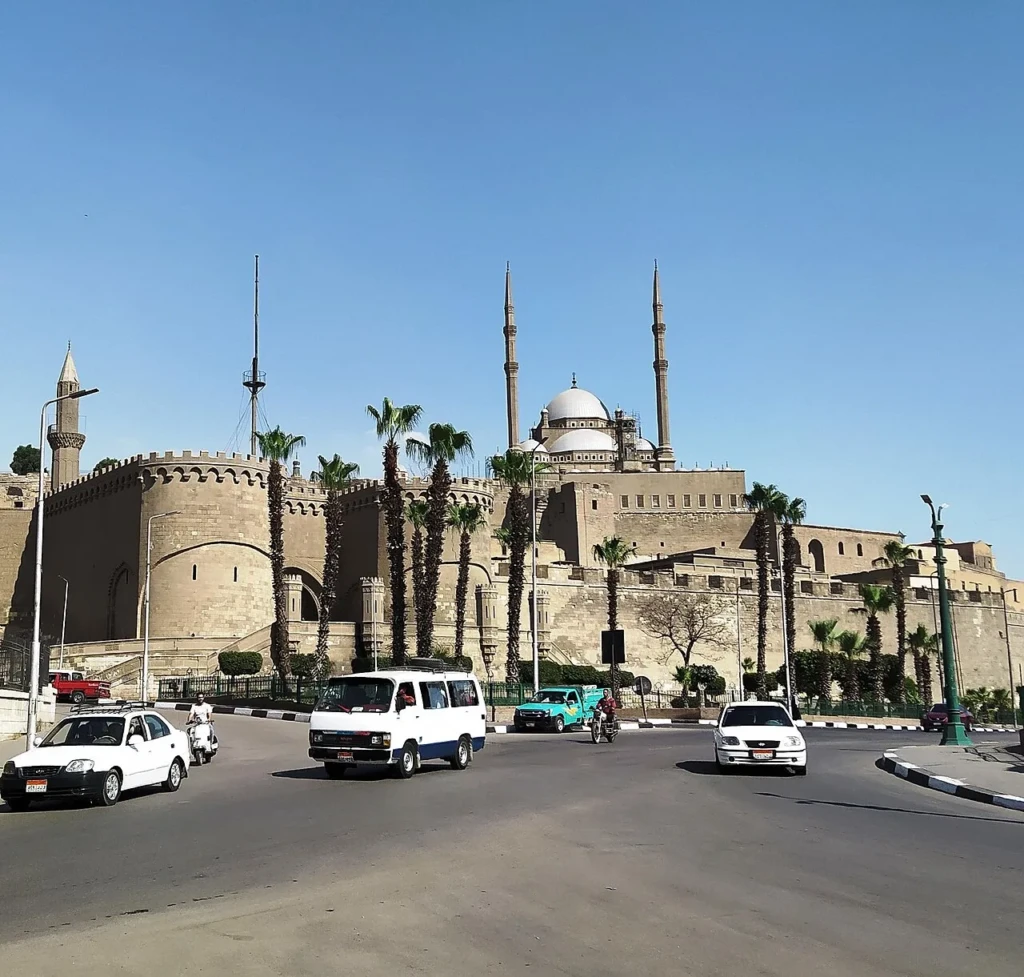
This is the building you have seen in every photo of Cairo’s skyline. The Ministry’s mosque page dates it to 1848, built on the site of former Mamluk palaces. Work began around 1830, and Wikipedia records that its decoration was finished in 1857 under Said Pasha.
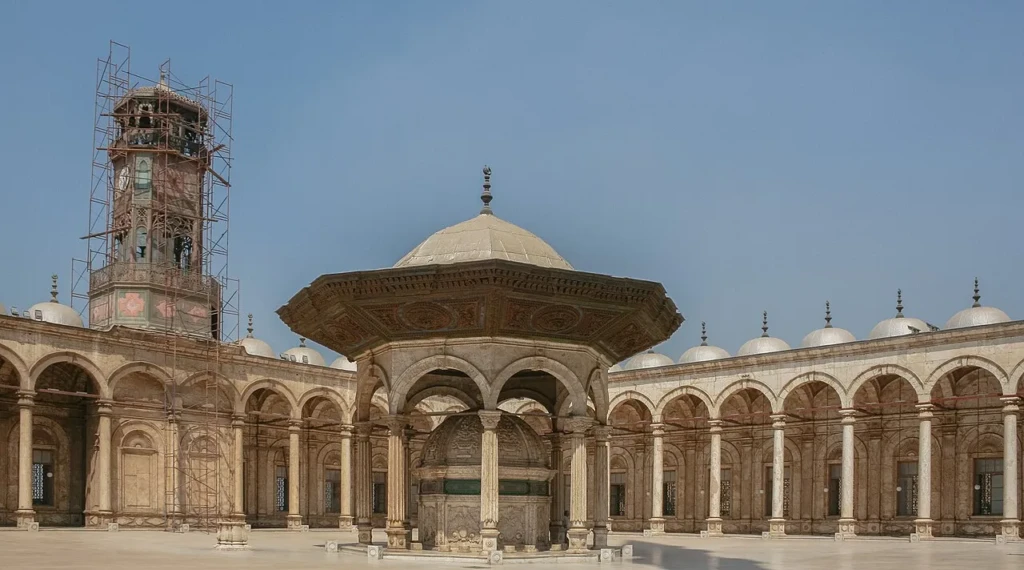
The mosque follows the Ottoman plan of Istanbul’s great imperial mosques. An open courtyard leads to a square prayer hall under a large central dome. Four semi-domes and four smaller corner domes surround it. The nickname “Alabaster Mosque” comes from the alabaster panels covering its walls. Muhammad Ali insisted on the material partly to revive a local industry.
Look up as you leave. The twin pencil minarets reach 84 m (276 ft) each, the tallest in Egypt according to the Ministry.
Inside, you will see two pulpits. The original is wooden and decorated in green. The second, in marble, was added later. Muhammad Ali himself is buried at the mosque, in a tomb carved from Carrara marble. His body was moved here in 1857.
2. The clock tower and the Paris obelisk story
In the courtyard stands a copper clock tower, a gift from King Louis Philippe of France in 1845. Muhammad Ali returned the favor with a far bigger present: one of the two obelisks of Ramesses II that stood in front of Luxor Temple. It now stands in the Place de la Concorde in Paris. When you later visit Luxor Temple, you will see its twin still in place.
3. The panoramic terrace
Beside the mosque, a terrace looks west over the city. Below you lie the domes and minarets of historic Cairo, including the massive mosques of Sultan Hassan and al-Rifa’i on Salah al-Din Square. Morning light is usually clearest for photos.
4. The Mosque of al-Nasir Muhammad
A short walk away stands the royal mosque of the Mamluk sultans. Al-Nasir Muhammad ordered it in 1318 and rebuilt it in 1335. Its two minarets were once topped with green tiles, a style influenced by Persian architecture. Look for the painted geometric ceiling and the band of Qur’anic verses inside the dome. The British used the building as a store and a prison after 1882, and it was restored in 1948.
5. Yusuf’s Well
Saladin needed water that could not be cut off during a siege. Qaraqush cut a shaft into the rock about 90 m (295 ft) deep, with a spiral staircase around it. Oxen turned water wheels on two levels to lift the water. The well is named after Saladin’s birth name, Yusuf.
6. The Mosque of Sulayman Pasha
Crossing into the Northern Enclosure, you reach the first Ottoman-style mosque built in Egypt, completed in 1528. Its slim, pencil-shaped minaret and domed prayer hall set the pattern that Muhammad Ali’s mosque would follow on a vast scale three centuries later. Inside the courtyard is a tomb from the earlier Fatimid mosque that stood on this spot.
7. The National Military Museum
The museum occupies the Harem Palace that Muhammad Ali built in the 19th century. It moved here in 1949 and reopened after renovation in 1993. Displays trace Egypt’s armed forces through artifacts, models and dioramas. Outside, real tanks and aircraft from the October 1973 war are parked in the open.
8. The National Police Museum and Citadel Prison
The Police Museum covers the history of Egypt’s police from ancient times to the modern era. It sits on top of the Lions Tower, the only surviving Mamluk-era tower of the Citadel. Its carved lions point to Sultan al-Zahir Baybars, whose emblem was a lion. Nearby, the former Citadel Prison has a 50 m corridor of cells and wax figures showing how it once operated.
9. The towers and walls
If you have energy left, walk along the northern walls. Semicircular towers date from Saladin’s time, and the rectangular ones from his brother al-Adil. Burg al-Ramla, the “Sand Tower,” stands 20.8 m (68 ft) high. The Ministry notes that this area was developed as an archaeological garden in the 1980s.
The Ministry also lists Al-Jawhara Palace Museum among the places to visit. Ask your guide on the day which halls are open.
Opening hours and tickets
All figures below are as listed on the official Ministry of Tourism and Antiquities site in October 2026; check before you go. Prices are in Egyptian pounds.
| Ticket or area | Hours | Foreign adult | Foreign student |
|---|---|---|---|
| Citadel area entry | 8:00 am to 5:00 pm daily | EGP 550 | EGP 275 |
| Muhammad Ali Mosque | 8:00 am to 4:00 pm | Included in the Citadel ticket | |
| Al-Nasir Muhammad Mosque | 9:00 am to 4:00 pm | Included in the Citadel ticket | |
| National Military Museum | 8:00 am to 4:00 pm | EGP 200 listed on its page | EGP 100 listed on its page |
| National Police Museum | 8:00 am to 5:00 pm | EGP 200 listed on its page | EGP 100 listed on its page |
| On-site cart | During opening hours | EGP 10 | EGP 5 |
The two museum pages describe their EGP 200 fee as an inclusive ticket covering the Citadel and the Police Museum, which does not match the EGP 550 Citadel listing. Ask at the ticket office which combination applies on your visit. The Military Museum page also lists a photography ticket of EGP 50 for foreigners, while the Police Museum allows free phone photography. Flash is not allowed in either museum.
The two mosques close at 4:00 pm, an hour before the Citadel itself. Arrive by early afternoon at the latest if the mosques are your priority.
How do you get to the Cairo Citadel?
The Citadel stands on the eastern edge of historic Cairo, above Salah al-Din Square. Most visitors arrive by car, and the official site lists a parking fee of EGP 25 for a taxi or car. Journey times across Cairo vary a great deal with traffic, so your driver or guide will confirm timing for your hotel.
If you are staying near the pyramids, the Citadel makes a natural pairing with the historic districts east of downtown rather than with Giza. Our Cairo travel guide explains how the city’s main areas fit together.
When is the best time to visit?
Come at opening time, 8:00 am. The light over the city is clearer, the terraces are quieter, and you have time for the mosques before they close at 4:00 pm. Fridays bring midday congregational prayer, so plan your mosque visit away from that time.
The Citadel is mostly outdoors, with long walks between buildings on stone paving. The cooler months are the most comfortable. See our guide to the best time to visit Egypt for a month-by-month view.
Practical tips for visiting
- Dress for a mosque. Cover shoulders and knees. Women may want a light scarf for the hair inside the prayer hall.
- Remove your shoes. You take them off before entering the Muhammad Ali Mosque’s prayer hall. Socks help on cold marble.
- Keep your voice low. The mosques are places of worship, even with visitors inside.
- Carry small notes. Useful for the cart ticket and small purchases.
- Wear comfortable shoes. Expect slopes, steps and uneven stone.
- Leave large bags at the hotel. The museums do not allow bags larger than 40 x 40 cm into the galleries.
For more on clothing across Egypt, read what to pack and wear for Egypt.
How to combine the Citadel with nearby sites
The Citadel anchors a full day in historic Cairo. From its gate you look down on Salah al-Din Square, flanked by the Mosque-Madrasa of Sultan Hassan and the al-Rifa’i Mosque. With an early start, the same day can continue to Coptic Cairo or the Khan el-Khalili bazaar.
Ancient Egypt fits on separate days. Spend one day at the Giza Pyramids complex and another at the Grand Egyptian Museum. Our Grand Egyptian Museum and pyramids tour covers both from $95 per person.
Visit with Delta Tours Egypt
Our Old Cairo & Citadel tour is a one-day excursion from $100 per person, built around this part of the city. Ask us when you book to confirm the exact stops and timing for your date. If you prefer a short package, the Taste of Egypt 4-day Cairo tour starts from $535 per person. On a long layover, look at the Cairo Airport Stop Over, from $180 per person. For pyramids only, the Pyramids Day Tour starts from $55 per person.
Frequently Asked Questions
How much is the Cairo Citadel ticket for foreigners?
The foreign adult ticket is EGP 550 and the student ticket EGP 275, as listed on the official Ministry of Tourism and Antiquities site in October 2026. Entry to the Muhammad Ali Mosque is included. Check before you go, as prices change.
What are the Cairo Citadel opening hours?
The Citadel opens daily from 8:00 am to 5:00 pm. The Muhammad Ali Mosque closes earlier, at 4:00 pm, so visit it first.
How long do you need at the Cairo Citadel?
We suggest two to three hours. That covers the Muhammad Ali Mosque, the terrace, the al-Nasir Muhammad Mosque and one museum.
Why is it called the Alabaster Mosque?
The Muhammad Ali Mosque is clad in alabaster panels on its walls. The Ministry of Tourism and Antiquities uses the same nickname.
Is there a dress code at the Muhammad Ali Mosque?
It is an active mosque, so dress modestly with shoulders and knees covered. You remove your shoes before entering the prayer hall, and a scarf for women is a good idea.
Who built the Cairo Citadel?
Saladin began it in 1176, and his nephew al-Kamil completed it. Later Mamluk sultans and Muhammad Ali Pasha added the mosques, palaces and gates you see today.
The Citadel tells Cairo’s story from the Crusades to the modern state in one hilltop walk. To see it with a private guide alongside Old Cairo, the pyramids or the Grand Egyptian Museum, browse our private Cairo day tours.
Featured image: Muhammad Ali Mosque. Photo: kallerna / Wikimedia Commons, CC BY-SA 3.0