Al-Azhar Mosque, Cairo: History, Dress Code & Visiting Tips
Al-Azhar Mosque is the first mosque built in Fatimid Cairo, begun in 970 CE and opened for Friday prayer in 972. It still functions as a working mosque in the historic heart of the city, and its teaching tradition grew into Al-Azhar University. Visitors of any faith can usually enter outside prayer times if they dress modestly, remove their shoes, and women cover their hair.
This guide explains what you are looking at inside, how the building grew over a thousand years, and how to visit respectfully. It stays focused on the mosque itself. For the wider city, see our Cairo travel guide.
Al-Azhar Mosque at a Glance
| Fact | Details |
|---|---|
| Location | Islamic (historic) Cairo, inside the area UNESCO lists as Historic Cairo |
| Built | Work began in 970 CE; first Friday prayers held in 972 CE |
| Commissioned by | The Fatimid general Jawhar al-Siqilli, acting for Caliph al-Mu’izz li-Din Allah |
| Main building periods | Fatimid core (10th–12th centuries), Mamluk schools and minarets (14th–16th centuries), Ottoman expansion (18th century) |
| Status today | Active mosque; the university now operates as a separate institution |
| Entry | Admission is officially free, according to Frommer’s; the ministry’s monuments site lists no hours or ticket for it |
| Time on site | Our planning suggestion: 45 minutes to 1 hour with a guide |
| Getting there | By car or taxi into the old city; your driver will confirm timing from your hotel |
Why Al-Azhar Matters
When the Fatimid dynasty took Egypt in 969, its general Jawhar al-Siqilli laid out a new royal city northeast of the older capitals. The Ministry of Tourism and Antiquities describes Al-Azhar, commissioned in 970, as the first congregational mosque of that city and the fourth in Islamic Egypt. The city took the name al-Qahira, “the Victorious,” which became Cairo.
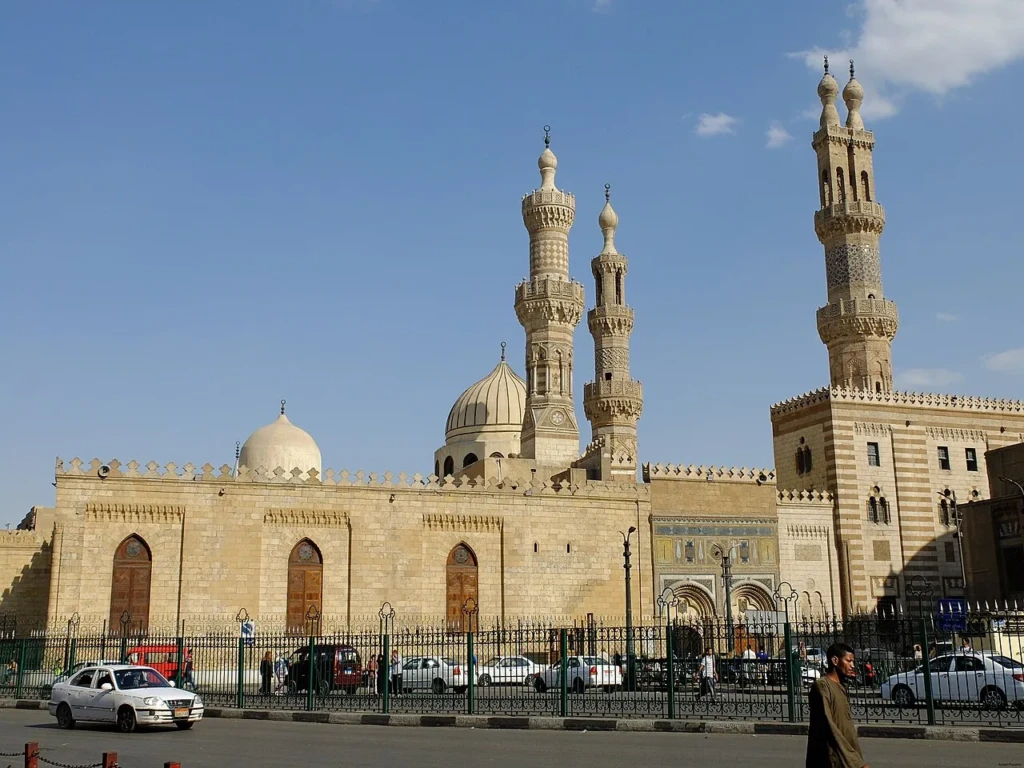
The mosque was built from local limestone and finished in 972. Its name is often linked to al-Zahra, “the radiant one,” a title of the Prophet Muhammad’s daughter Fatima, from whom the Fatimids claimed descent. Historians note that no Arabic source confirms this, and some connect the name instead to the nearby Fatimid palaces.
From Fatimid mosque to Sunni center of learning
The Fatimids followed Isma’ili Shi’a Islam, and Al-Azhar was meant to teach that doctrine. In 988 the vizier Yaqub ibn Killis made it a center for the study of Islamic law, with paid scholars giving lessons. That decision laid the foundation for its later role as a university.
After the Fatimids fell in 1171, Saladin’s Ayyubid rulers distrusted the mosque, and it lost prestige. The Mamluk sultan Baybars restored Friday prayers there in 1266. From then on, Al-Azhar grew into the leading Sunni institution for theology and law. In 1961 its university was formally organized as a separate, modern university, while the mosque kept its religious role.
A building made by many rulers
Almost every major dynasty that ruled Cairo after the Fatimids added something. Mamluk officers built schools against its walls and sultans raised minarets over its gates. In the 18th century the Ottoman official Abd al-Rahman Katkhuda nearly doubled its size. A large restoration funded by Saudi Arabia was completed in 2018. Walking through the building is a lesson in how Cairo’s architecture changed over eight centuries.
What to See Inside, in Visiting Order
The route below follows the usual path from the main courtyard to the prayer hall. Gates in use can change after restoration work, so your guide will show you which entrance is open on the day.
1. The entrance gates
Katkhuda added three gates in the 18th century. The best known is the Bab al-Muzayinin, the Barbers’ Gate, built in 1753 and long the main entrance. Its two doors sit under molded arches, with an Ottoman frieze of cypress trees above. Since the 2018 restoration this gate has been less accessible, so you may enter by another door.
2. The marble courtyard
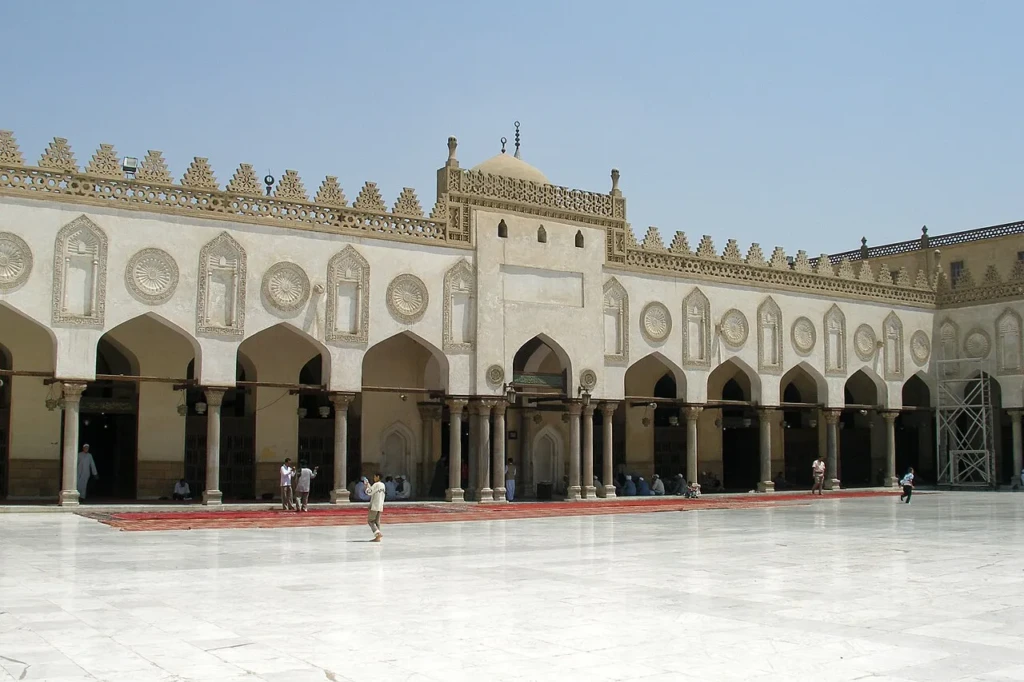
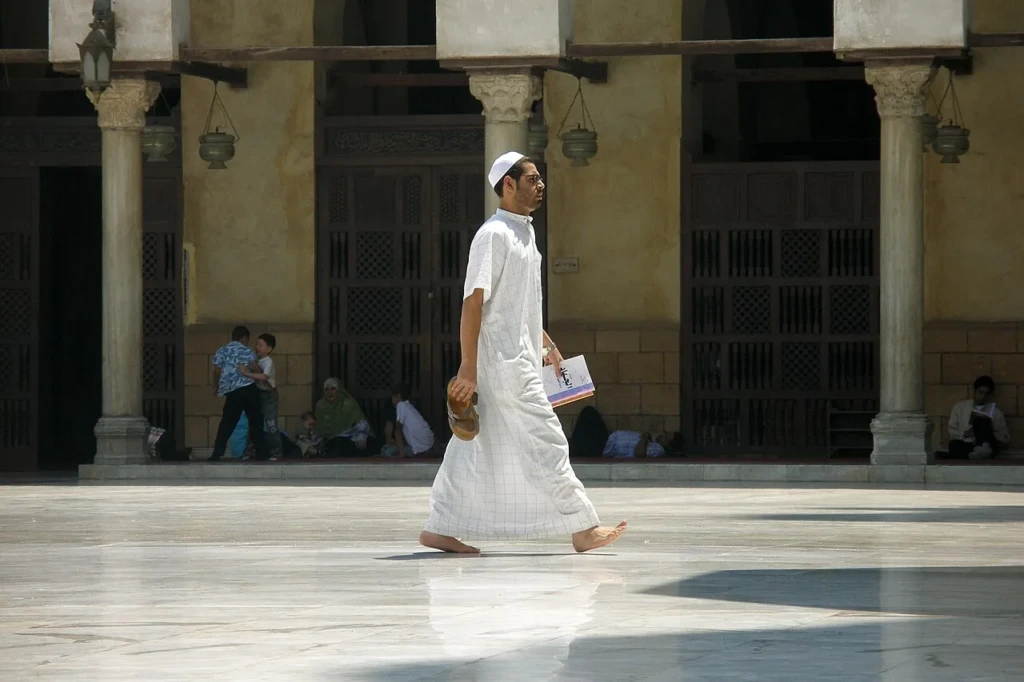
The open courtyard, paved in white marble, is the calmest place to take in the whole building. The surrounding arcades have keel-shaped arches, a pointed profile typical of Fatimid Cairo. They date to a major refurbishment by Caliph al-Hafiz in 1138, though the stucco ornaments were remade in the 1890s. Look for the round medallions above each arch and the small fluted niches between them.
3. The three Mamluk schools
Two madrasas open off the courtyard near the entrance. To one side is the Madrasa al-Aqbughawiyya of 1339, with its original entrance, prayer niches and glass mosaics. To the other is the Madrasa al-Taybarsiyya of 1309, rebuilt in the Ottoman period except for its qibla wall. Its mihrab, framed by porphyry columns and glass mosaics of pomegranate trees, was praised by the architectural historian K. A. C. Creswell as one of the finest in Cairo. The Madrasa Gawhariyya of 1440 has cupboards inlaid with ebony, ivory and mother-of-pearl, and a small carved stone dome.
4. The minarets above the courtyard
From the courtyard you can see three Mamluk minarets in a row. The minaret of Sultan Qaytbay, built in 1483 or 1495, rises in stages from square to octagonal to round, with three balconies on carved muqarnas brackets. Beside it stands the minaret of Sultan Qansuh al-Ghuri, built in 1509. It splits into two rectangular shafts at the top, each with its own bulb-shaped finial, a rare design in Cairo. The minaret of Aqbugha rises behind its dome.
5. The Gate of Qaytbay and the prayer hall
Across the courtyard, the Gate of Qaytbay (built 1495) leads into the prayer hall. Inside, rows of marble columns carry the arches. Many of these columns were reused from older buildings dating from the Pharaonic, Roman and Coptic periods, and builders evened out their heights with bases of different thickness. Walk slowly here and let your eyes adjust: this is a space of prayer and study, not a gallery.
6. The original Fatimid mihrab
The original prayer niche was uncovered in 1933. Its carved stucco half-dome holds Quranic verses, and these inscriptions are the only decoration that scholars can trace with certainty to the Fatimid builders. Beyond it lies the 18th-century extension by Katkhuda, which added a second mihrab and doubled the prayer area.
Visiting Rules: Dress, Shoes and Prayer Times
Al-Azhar is a place of worship first. A few simple habits make the visit comfortable for you and for the people praying around you.
What to wear
- Everyone: The UK government’s travel advice for Egypt asks visitors to dress modestly, especially in mosques. Choose loose clothing that covers shoulders and knees.
- Women: Frommer’s advises covering arms, legs and shoulders, and covering the hair. Bring your own light scarf so you are not relying on whatever is available at the door.
- Men: Long trousers rather than shorts, and a shirt with sleeves.
Our guide to what to wear in Egypt has packing ideas that work for mosques, churches and temples on the same trip.
Shoes
Both men and women remove their shoes before stepping onto the carpets. An attendant usually watches footwear at the entrance, and a small tip is customary. Socks are useful, since the marble courtyard can be hot in summer and cool in winter.
Prayer times and Fridays
Muslims pray five times a day, and the times move with the sun through the year, so there is no fixed visiting schedule to memorize. Plan to arrive between prayers and avoid the midday congregational prayer on Fridays, when the mosque is full. Your guide can check the day’s timetable for you. If the call to prayer sounds while you are inside, step to the side, lower your voice and wait or leave quietly.
Ramadan
Ramadan dates shift each year. The UK advice notes that eating, drinking or smoking in public during daylight hours is culturally insensitive in this month, and that dress codes matter even more. Evenings around the mosque become especially busy.
Behavior and photos
- Keep your voice low and do not walk in front of anyone who is praying.
- Couples should avoid physical affection inside.
- The UK advice says photographing religious buildings can be sensitive, and that Ministry of Tourism rules require an Egyptian citizen’s written permission before you photograph them. Never photograph people praying, and ask your guide or a mosque attendant before taking pictures inside.
Opening Hours and Tickets
Al-Azhar is not listed with visiting hours or a ticket price on the official Ministry of Tourism and Antiquities monuments site, because it is an active mosque rather than a ticketed antiquities site. Frommer’s states that admission is officially free. In practice, access for non-Muslim visitors depends on prayer times and on any religious events that day, so build some flexibility into your plan and check locally before you go.
Best Time to Visit
Mid-morning on a weekday, after the dawn and before the midday prayer, is usually the easiest window. Light in the courtyard is softer in the morning, and the marble is cooler underfoot. The cooler months are more comfortable for walking in the old city; our month-by-month guide to the best time to visit Egypt explains the seasons.
Combining Al-Azhar With Nearby Sights
Al-Azhar sits in the same historic quarter as the Khan el-Khalili bazaar and the medieval monuments of Islamic Cairo, so it fits well into a half day on foot in the old city. A natural pairing is the mosque in the morning, then the bazaar and a coffee break.
Many travelers also see the Citadel and Coptic Cairo on the same trip. Our Old Cairo and Citadel private day tour, from $100 per person, covers the Citadel, the Mosque of Muhammad Ali, Khan el-Khalili and Coptic Cairo. Al-Azhar is not part of its listed itinerary, but it can be requested when you plan a custom day. You can also compare our private Cairo day tours.
If you are building a short stay around the capital, the Taste of Egypt 4-day Cairo tour starts from $535 per person and includes Giza, the Grand Egyptian Museum and Old Cairo. Travelers with a long layover can look at the Cairo airport stopover tour, from $180 per person, which ends at Khan el-Khalili before your onward flight.
Visit With Delta Tours Egypt
Delta Tours Egypt does not sell a fixed Al-Azhar tour. We can arrange a private day in Islamic Cairo on request, with your own Egyptologist, a driver and a pace that respects prayer times. Tell us what you want to see on our tailor-made Egypt tours page, or read about traveling with your own private guide and driver.
Frequently Asked Questions
Can non-Muslims visit Al-Azhar Mosque?
Yes, visitors of any faith can usually enter outside prayer times. Dress modestly, remove your shoes, and women should cover their hair. Avoid Friday midday prayers, when the mosque is full of worshippers.
Is there an entrance fee for Al-Azhar Mosque?
Frommer’s states that admission is officially free, and the ministry’s monuments site lists no ticket for it. Expect to tip the shoe attendant a small amount. Keep small Egyptian pound notes handy for this.
What should women wear to Al-Azhar Mosque?
Wear loose clothing that covers arms, legs and shoulders, and bring a scarf to cover your hair. Long skirts or wide trousers both work. A scarf in your day bag also helps at other religious sites in Cairo.
How old is Al-Azhar Mosque?
Construction began in 970 CE and the first Friday prayers were held in 972. Much of what you see today was added later by Mamluk and Ottoman patrons. The original Fatimid mihrab, uncovered in 1933, survives inside.
Is Al-Azhar Mosque the same as Al-Azhar University?
They share a history but are now separate. Teaching began in the mosque in the 10th century, and the university became a separate modern institution in 1961. The mosque remains a place of worship.
How long do I need at Al-Azhar Mosque?
Our planning suggestion is 45 minutes to an hour with a guide. Add time if you want to explore the Mamluk schools in detail. Combine it with Khan el-Khalili for a relaxed half day.
Al-Azhar rewards travelers who slow down and look closely, from the Fatimid stucco to the twin-headed minaret of al-Ghuri. If you would like it built into a private Cairo itinerary, our team can plan it with you through our tailor-made tours service.
Featured image: Egypt, Cairo, The courtyard of Al-Azhar. Photo: Vyacheslav Argenberg / Wikimedia Commons, CC BY 4.0