Abu Simbel Temples: Ramses II’s Monument to Eternity

The road south from Aswan begins in darkness.
Headlights sweep across an empty desert while most of Egypt is still asleep. The Nile has disappeared behind you, the horizon is only a black line, and the passengers in the car speak quietly or return to their breakfast boxes. After hours on the road, the sky begins to pale. Rose-colored light spreads over the sand, and signs for Abu Simbel finally appear.
Yet nothing prepares you for the first sight of the temple.
You follow a path around an artificial hill, with Lake Nasser shining beyond it. Then four seated figures emerge from the rock. Each wears the calm, controlled expression of a king who intended to be remembered forever. They are all Ramses II—young, powerful and nearly 21 meters high—guarding the entrance to a temple cut deep inside the mountain.
One colossal head and torso lie broken at their feet, exactly where an ancient earthquake brought them down. The fallen stone does not weaken the scene. It makes the surviving statues appear even more defiant.
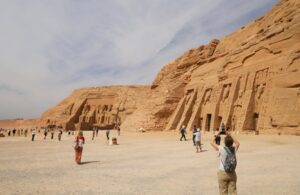
The Abu Simbel temples tell three stories at once. The first is the story Ramses II wanted the ancient world to hear: Egypt was strong, its king was favored by the gods, and its authority reached deep into Nubia. The second is more personal: beside his own Great Temple, Ramses created a second sanctuary honoring the goddess Hathor and his Great Royal Wife, Queen Nefertari. The third belongs to the modern age, when rising water threatened to erase both temples and an international team cut an entire sacred mountain into blocks, moved it uphill and rebuilt it.
Abu Simbel is therefore not simply a monument that survived time. It is a monument saved twice—first from the desert sand that buried it, and later from the lake that would have drowned it.
Abu Simbel at a Glance
| Question | Quick answer |
|---|---|
| Where is Abu Simbel? | In southern Egypt, on the western shore of Lake Nasser, near the Sudanese border |
| Who built Abu Simbel? | Pharaoh Ramses II of the Nineteenth Dynasty |
| When was Abu Simbel built? | The Great Temple was cut into the rock around 1264 BCE, during Ramses II’s reign |
| How many temples are there? | Two: the Great Temple of Ramses II and the Small Temple of Hathor and Nefertari |
| Why was Abu Simbel built? | To honor the gods and the royal family, proclaim Ramses II’s divinity and power, and project Egyptian authority in Nubia |
| Was Abu Simbel moved? | Yes. The temples were dismantled and reconstructed on higher ground between 1963 and 1968 |
| Why was it moved? | Lake Nasser, created by the Aswan High Dam, would have submerged the original site |
| What is the solar alignment? | On February 22 and October 22, sunrise reaches the Great Temple’s inner sanctuary and illuminates three of its four seated figures |
| How far is it from Aswan? | Roughly 280 kilometers south; the road journey usually takes about three to three-and-a-half hours each way |
| Current opening hours | Daily, 6:00 AM–5:00 PM, according to Egypt’s Ministry of Tourism and Antiquities |
Before the Colossi, There Was a Frontier
Abu Simbel stands in Nubia, a region extending through southern Egypt and northern Sudan. For ancient Egypt, Nubia was never an empty southern edge. It was a land of communities, kingdoms, trade routes, gold resources and military importance. At different moments, Egypt fought in Nubia, governed parts of it, recruited Nubian soldiers and absorbed Nubian religious and artistic influences.
Ramses II inherited this complicated relationship when he became king in the thirteenth century BCE. He ruled during the New Kingdom, when Egypt sought to present itself as the dominant power of the eastern Mediterranean and northeast Africa. Monumental architecture was one of the languages through which pharaohs expressed that ambition.
The location of the temple of Abu Simbel was therefore strategic as well as sacred. Travelers approaching Egypt from the south would encounter a cliff transformed into the image of Ramses. The four colossal statues did not merely decorate a religious building. They made the landscape itself announce who ruled.
The message was carefully layered. Ramses appears as king, as guardian and eventually as a divine figure seated among major gods in the innermost sanctuary. Military scenes celebrate his victories. Images of his family turn the façade into a royal genealogy. Solar light penetrates the mountain to reach his deified image.
Abu Simbel was not propaganda in the modern, narrow sense of a poster making a single claim. It was a complete sacred environment in which politics, worship, memory and landscape reinforced one another.
Ramses II Builds for Eternity
Ramses II ruled for more than six decades and left his name across Egypt. He enlarged temples, raised obelisks, commissioned colossal statues and built the Ramesseum as his memorial temple at Thebes. Few rulers understood the power of scale as clearly as he did.
At Abu Simbel, scale begins before the visitor enters.
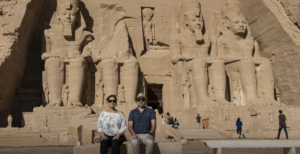
The façade of the Great Temple rises approximately 30 meters and is dominated by four seated images of Ramses II. Smaller members of the royal family stand near the king’s legs, including his mother, Queen Tuya; his principal wife, Nefertari; and royal children. Above the entrance, a figure of the falcon-headed sun god Ra-Horakhty occupies a niche, connecting the king’s monument to the rising sun.
Across the top of the façade, a row of baboons raises its hands toward dawn. Ancient Egyptians associated baboons with the sun’s arrival because their morning calls appeared to greet the day. At sunrise, the stone animals, the divine image and the royal colossi become part of the same visual performance.
The four Ramses figures look nearly identical, and that repetition is the point. A human ruler ages; a monumental image does not. The façade replaces the vulnerable body of one man with four permanent versions of the ideal king.
Except permanence is never absolute.
An earthquake in antiquity caused the upper part of the second colossus from the left to collapse. Its head and torso remain on the ground. When the temples were relocated in the twentieth century, the fragments were deliberately placed as they had been found rather than restored to the seated body. The decision preserves both Ramses II’s ambition and the monument’s long life after him.
Inside Abu Simbel Temple: The King Walks Toward the Gods
Passing between the colossi changes the scale of the visit. Outside, Ramses towers above you. Inside, his presence follows you into the mountain.
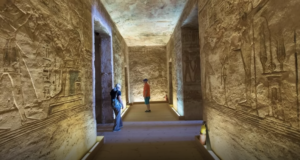
The first great hall is lined with eight pillars fronted by standing figures of Ramses in the form of Osiris. Arms crossed over their chests, the statues connect the living king with the god of death, regeneration and the afterlife. The hall feels ceremonial and controlled, its central axis pulling the eye toward the darker rooms beyond.
The walls tell a more violent story. Reliefs show military campaigns, captives and the famous Battle of Kadesh, fought between the forces of Ramses II and the Hittite Empire. Egyptian accounts present the king as a heroic warrior who confronted danger and rescued his army through personal courage and divine support.
Modern historians read the battle more cautiously. Kadesh was not the simple, total victory the temple scenes suggest. Its outcome was complex, and Egypt and the Hittites later formalized peace through a treaty. But the walls of Abu Simbel were not carved to preserve an impartial military report. They were designed to create the ideal image of a king who defeats chaos and restores order.
As you continue inward, the chambers become smaller and the light diminishes. This narrowing progression is common in Egyptian temple architecture. The public monumentality of the façade gives way to increasingly restricted sacred space.
Side rooms probably served storage and ritual functions. A second pillared hall leads toward the vestibule and the sanctuary. Every doorway frames the next, making the journey feel inevitable: from the sunlit face of Ramses outside to his divine presence in the deepest room.
At the back of the Great Temple sit four figures carved directly from the rock: Ptah, Amun-Ra, the deified Ramses II and Ra-Horakhty. Here the king no longer approaches the gods as an ordinary worshipper. He sits among them.
This is the dramatic conclusion of the Abu Simbel temple inside: a mortal ruler has used architecture, ritual and image to cross into the divine world.
The Solar Alignment: When Dawn Enters the Mountain
Twice each year, sunrise travels through the entrance and along the temple’s central axis. The rays penetrate the deep interior and reach the four seated figures in the sanctuary. Amun-Ra, the deified Ramses II and Ra-Horakhty receive the light. Ptah, a god closely associated with the hidden and underworld realms, remains in shadow.
The phenomenon is now observed on February 22 and October 22, attracting visitors before dawn for what is often called the Abu Simbel Sun Festival or Sun Feast. Egypt’s Ministry of Tourism and Antiquities confirms these dates and applies special admission prices on both days.
The alignment demonstrates extraordinary planning, but popular explanations often go beyond the evidence. Many travel pages repeat that February 22 marked Ramses II’s coronation and October 22 his birthday—or reverse the two dates. These claims are appealing, but the precise dates of the king’s birth and accession are not securely established in a way that proves this interpretation.
What can be said with confidence is that the temple was oriented so sunlight reached its innermost sacred images at two significant points in the annual cycle. The effect connected the king, the gods and the renewing sun in a carefully engineered ritual moment.
The twentieth-century rescue preserved the orientation with impressive accuracy. Engineers rebuilt the temple so the solar event would continue after the move, even though the sacred mountain surrounding it was now artificial.
Nefertari’s Temple: A Queen Stands at the King’s Height
A short walk north of the Great Temple brings you to a second rock-cut façade. It is smaller, but it tells a story that the four giant Ramses figures cannot.
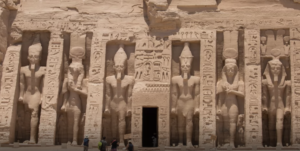
Six standing colossi flank the entrance: four represent Ramses II and two represent Queen Nefertari. Most Egyptian royal monuments show queens much smaller than kings, often no higher than the ruler’s knee. At Abu Simbel, Nefertari’s statues rise to approximately the same height as her husband’s.
The equality is unusual and visually unmistakable.
The temple was dedicated to Hathor, goddess of music, love, joy, motherhood and the celestial realm, and to Nefertari as the queen associated with her. On the façade, Nefertari wears crowns connected to Hathor, including cow horns holding the solar disk. Inside, Hathor-headed columns support the main hall, and reliefs show the royal couple making offerings to the gods.
Nefertari was Ramses II’s Great Royal Wife during the earlier part of his reign and appears prominently in royal diplomacy and temple art. Her celebrated tomb in the Valley of the Queens reveals another version of her image: not simply the king’s companion, but a queen moving through the divine landscape of the afterlife.
At the temples of Abu Simbel, her status is written at monumental scale. Ramses still appears four times on the Small Temple’s façade, but he allowed Nefertari to stand beside him at the same height. The building honors a queen while simultaneously connecting the royal marriage to divine order.
The effect is gentler than the Great Temple but no less political. Outside one sanctuary, Ramses presents himself as Egypt’s invincible king. Outside the other, the royal couple embodies sacred harmony.
Sand Covers the King
No pharaoh can control what happens after his reign.
Over the centuries, the temples fell out of active use. Wind carried sand against the cliff and across the façades. Gradually, Ramses II disappeared. By the early nineteenth century, much of the Great Temple was buried, with the upper sections of the colossal figures still visible above the accumulated sand.
In 1813, the Swiss traveler Johann Ludwig Burckhardt brought the site to wider European attention. Four years later, Giovanni Battista Belzoni reached and entered the Great Temple after clearing enough sand from the doorway.
The conventional “rediscovery” story should be understood carefully. Local Nubian people knew the landscape, and European travelers did not reveal an unknown place to an empty world. They documented the temple for a growing European audience and accelerated the period of excavation, collection and tourism that followed.
A popular story claims the name Abu Simbel came from a local boy who guided Burckhardt to the ruins. The story is often repeated, but its details are difficult to verify. It belongs to the site’s modern folklore rather than firmly established archaeological history.
By the twentieth century, sand had been cleared and the temples had become icons of ancient Egyptian art. Then a threat far greater than burial appeared.
The Water Begins to Rise
Egypt’s plan to construct the Aswan High Dam promised major benefits: expanded electricity generation, better control of the Nile and support for agriculture. It would also create an enormous reservoir—Lake Nasser—across a landscape filled with Nubian communities and ancient monuments.
Abu Simbel stood directly in the future flood zone.
The problem seemed impossible. These were not buildings assembled from manageable blocks on flat ground. They had been carved into living rock. To save them, engineers would need to move parts of a mountain without destroying the art inside it.
Egypt and Sudan appealed for international help. On March 8, 1960, UNESCO launched the International Campaign to Save the Monuments of Nubia. Archaeologists, architects, engineers, hydrologists and governments from around the world joined a race against the rising water.
Abu Simbel became the campaign’s most famous challenge.
How Did They Move Abu Simbel?
In November 1963, workers began cutting the temples with wire saws. The façades, chambers and colossal figures were divided into more than a thousand numbered blocks, many weighing around 30 tons.
This was not demolition followed by imitation. The operation was a controlled disassembly. Teams documented the position of every section, stabilized fragile surfaces and stored the blocks until they could be rebuilt.
The new location was approximately 64 meters higher and 180 meters inland from the original site. There, engineers constructed enormous reinforced-concrete domes. The ancient temple pieces were reassembled around these structures, and an artificial hill was shaped above them to recreate the appearance of rock-cut sanctuaries.
The details had to work at several scales at once.
From a distance, the relocated site needed to feel like a natural cliff beside the water. Up close, the carved scenes had to align across cut lines. Inside, the sequence of halls and chambers had to retain its ancient proportions. Most remarkably, the Great Temple needed to maintain its relationship with the rising sun.
On September 22, 1968, Abu Simbel was inaugurated in its new position. The temples had been moved before the waters of Lake Nasser covered their original location.
The broader UNESCO Nubia Campaign continued until 1980. It saved 22 monuments and complexes through 40 technical missions from five continents. UNESCO records the total cost at approximately US$80 million, with about half donated by some 50 countries. The effort helped inspire the international idea that extraordinary cultural places belong not only to one nation, but form part of humanity’s shared heritage.
In 1979, the Nubian Monuments from Abu Simbel to Philae were inscribed on the UNESCO World Heritage List.
The Abu Simbel relocation succeeded so convincingly that many visitors do not realize they are walking through an engineered mountain. That illusion is one of the project’s greatest achievements.
Abu Simbel Before and After Relocation
The temples are ancient; the hill around them is modern. Understanding this distinction makes the site more impressive, not less.
| Before relocation | After relocation |
|---|---|
| Temples carved into a natural sandstone cliff | Ancient temple blocks reassembled around reinforced-concrete domes |
| Original position close to the Nile | New position beside Lake Nasser, higher and farther inland |
| Site threatened by permanent submersion | Site protected above reservoir level |
| Ancient landscape and river relationship | Carefully recreated topography and preserved orientation |
| Original stone fabric | The same carved stone, cut into numbered sections and reassembled |
Look carefully inside and you may notice fine lines where the blocks meet. These seams are the quiet evidence of the rescue. They show where modern engineering entered the body of an ancient monument.
Why Is Abu Simbel Important?
Abu Simbel matters for more than size.
It preserves the political imagination of Ramses II, a ruler who used sacred art to project authority across Egypt’s southern frontier. It contains one of the strongest surviving visual statements of royal divinity. Its reliefs preserve the official Egyptian memory of the Battle of Kadesh. The Small Temple gives Nefertari a monumental presence rare for an Egyptian queen.
The site also tells a Nubian story. It stands in a region shaped by cultural exchange, imperial ambition and communities whose own modern displacement accompanied the creation of Lake Nasser. The rescue of temples deserves admiration, but it should not cause visitors to forget that many Nubian families were also relocated as their villages disappeared beneath the reservoir.
Finally, Abu Simbel changed the modern history of conservation. Its rescue demonstrated that international cooperation could protect heritage on a scale once thought impossible. The campaign helped create momentum for the 1972 World Heritage Convention.
At Abu Simbel, the ancient and modern meanings cannot be separated. Ramses created a monument to permanence. The twentieth century proved that permanence sometimes requires action.
Where Is Abu Simbel Located?
Abu Simbel is in southern Egypt’s Aswan Governorate, on the western shore of Lake Nasser and close to the border with Sudan. It lies roughly 280 kilometers south of Aswan.
The remote location is part of the experience, but it requires planning. Most travelers visit from Aswan by private vehicle, organized coach or domestic flight. A smaller number arrive as part of a Lake Nasser cruise or stay overnight in Abu Simbel village.
Because departure times, flight schedules and road procedures can change, confirm the latest arrangements shortly before travel. A well-organized visit should account for the long transfer, ticketing, walking time, heat and the possibility that many Aswan day tours arrive within the same morning window.
How to Visit Abu Simbel From Aswan
By Road
The road journey generally takes three to three-and-a-half hours each way. Many tours leave Aswan around 4:00 or 5:00 AM so visitors reach the temples in the cooler morning. The standard day trip returns to Aswan around early afternoon.
This is usually the most economical option and works well for families or small groups using a private air-conditioned vehicle. The drawback is six or more hours on the road for a visit of roughly two hours.
By Air
Flights between Aswan and Abu Simbel significantly reduce road time, although the complete journey includes airport procedures and ground transfers. Schedules vary, and seat availability can be limited during busy periods and solar-alignment events.
Flying is useful for travelers who prioritize comfort or have limited time, but the total cost is higher than a road excursion.
By Lake Nasser Cruise
Selected Lake Nasser cruises include Abu Simbel, sometimes allowing travelers to view the temples at quieter hours or see the illuminated façades in the evening. This is different from the standard Nile cruises operating between Luxor and Aswan; ordinary Nile itineraries often offer Abu Simbel as a road or flight excursion from Aswan.
By Overnight Stay
Staying in Abu Simbel is the best strategy for travelers who want a slower experience. You can visit later in the day after most road groups have departed, attend the sound-and-light show when operating and return at opening time the next morning.
It also turns Abu Simbel from a rushed excursion into a destination and creates more opportunity to appreciate the Nubian setting around the temples.
Abu Simbel Tickets and Opening Hours in 2026
As of September 22, 2026, Egypt’s Ministry of Tourism and Antiquities lists the archaeological site as open daily from 6:00 AM to 5:00 PM.
Standard admission
| Visitor category | Ticket price |
|---|---|
| Foreign adult | EGP 750 |
| Foreign student | EGP 375 |
| Egyptian adult | EGP 30 |
| Egyptian student | EGP 10 |
Solar-alignment admission on February 22 and October 22
| Visitor category | Ticket price |
|---|---|
| Foreign adult | EGP 1,200 |
| Foreign student | EGP 600 |
| Egyptian adult | EGP 60 |
| Egyptian student | EGP 20 |
Ticket prices, photography rules and opening hours may change. Check the official Abu Simbel page immediately before travel. Student tickets normally require valid identification. Transport, guiding and the evening sound-and-light show are separate unless explicitly included in a tour package.
Best Time to Visit Abu Simbel
October through April offers more comfortable temperatures than summer. Even in winter, the open approach can become warm after the early morning.
Most road groups arrive between roughly 7:30 and 10:00 AM. To experience fewer crowds, consider staying overnight and entering at 6:00 AM or visiting later in the afternoon before closing. Always leave enough time to see both interiors without rushing.
February 22 and October 22 are special but extremely busy. Attend for the shared energy and the solar phenomenon, not for solitude. Arrive well before sunrise, expect queues and arrange transport and accommodation far in advance.
Rules for photography inside the temples can change. Follow the signs and instructions on the day rather than relying on older travel articles that mention camera tickets or complete bans.
Common Myths and Confirmed Facts
“The solar dates were Ramses II’s birthday and coronation.”
Not proven. The temple’s solar design is real, but there is no secure evidence establishing the modern dates as the king’s exact birthday and accession anniversary.
“Abu Simbel is a reconstructed copy.”
False. The temples consist of the original ancient rock, divided into numbered sections and reassembled. The supporting domes and surrounding hill are modern.
“Nefertari’s statues are exactly equal to Ramses everywhere.”
Too broad. On the Small Temple façade, the queen’s colossi are approximately the same height as the king’s, which is exceptionally rare. Elsewhere, artistic scale varies by scene and purpose.
“The Battle of Kadesh reliefs prove a decisive Egyptian victory.”
They prove the official royal message. The historical result was more complicated than the heroic temple narrative.
“European explorers discovered an unknown temple.”
Misleading. They publicized and entered the sand-buried monument for European audiences, but local Nubian knowledge of the site and landscape should not be erased.
Frequently Asked Questions About Abu Simbel
What is Abu Simbel?
Abu Simbel is an archaeological site in southern Egypt containing two rock-cut temples commissioned by Ramses II. The Great Temple honors major gods and the deified king; the Small Temple honors Hathor and Queen Nefertari.
Where is Abu Simbel located?
It is on the western shore of Lake Nasser in Aswan Governorate, near Egypt’s border with Sudan and approximately 280 kilometers south of Aswan city.
Who built the Abu Simbel temples?
Ramses II, a Nineteenth Dynasty pharaoh, commissioned both temples during the thirteenth century BCE.
When was Abu Simbel built?
Egypt’s Ministry of Tourism and Antiquities dates the Great Temple to around 1264 BCE. Construction and decoration continued during Ramses II’s reign.
Why did Ramses II build Abu Simbel?
The temples honored the gods, Ramses II and Nefertari while projecting royal power in Nubia. The Great Temple also celebrated the king’s military image and presented him as a divine ruler.
Can you go inside Abu Simbel temple?
Yes. Standard archaeological-site admission normally includes entry to the interiors of both the Great and Small Temples, subject to current site regulations.
Was Abu Simbel moved?
Yes. More than a thousand numbered blocks were cut, transported and reassembled on higher ground to save the temples from Lake Nasser.
When was Abu Simbel moved?
Cutting began in late 1963, the main rescue work took place from 1964 to 1968, and the temples were inaugurated at their new location on September 22, 1968.
How far was Abu Simbel moved?
UNESCO states that the temples were rebuilt approximately 64 meters higher and 180 meters inland from their original site.
How long is the trip from Aswan to Abu Simbel?
The road journey usually takes about three to three-and-a-half hours each way. A typical excursion therefore occupies most of the morning and part of the afternoon.
Can you fly from Aswan to Abu Simbel?
Yes, domestic flights may operate between Aswan and Abu Simbel. Schedules change, so confirm availability for your travel date.
When does the Abu Simbel solar alignment happen?
The modern event is observed around sunrise on February 22 and October 22. Three sanctuary figures receive sunlight while Ptah remains in shadow.
Is Abu Simbel worth the long journey?
Yes. Few places combine colossal New Kingdom architecture, vivid temple interiors, the story of Ramses II and Nefertari, solar design and a world-changing modern rescue project. The distance is substantial, but the experience is unlike any other site in Egypt.
The King Who Moved a Mountain—and the World That Moved It Again
When Ramses II ordered his temple cut into the Nubian cliff, he was making a claim against time. His face would greet the sun. His victories would cover the walls. His divine image would sit in the mountain long after the man himself was gone.
For more than three thousand years, the monument endured earthquakes, abandonment, sand and rediscovery. Then the modern world changed the Nile, and the permanence Ramses had designed was suddenly at risk.
The answer was as bold as the temple itself. Workers sliced through the mountain, numbered its pieces and rebuilt the ancient vision above the rising water. Ramses II had once transformed a cliff into a monument. In the twentieth century, people from many nations transformed the monument into a symbol of shared responsibility.
That is why the Abu Simbel temples stay in the memory. The colossi are astonishing, but size is only the beginning. Behind their calm stone faces lies a human story about power, love, ambition, loss, engineering and the decision that some achievements should not be allowed to disappear.