Citadel of Qaitbay: Built on the Lighthouse of Alexandria Site
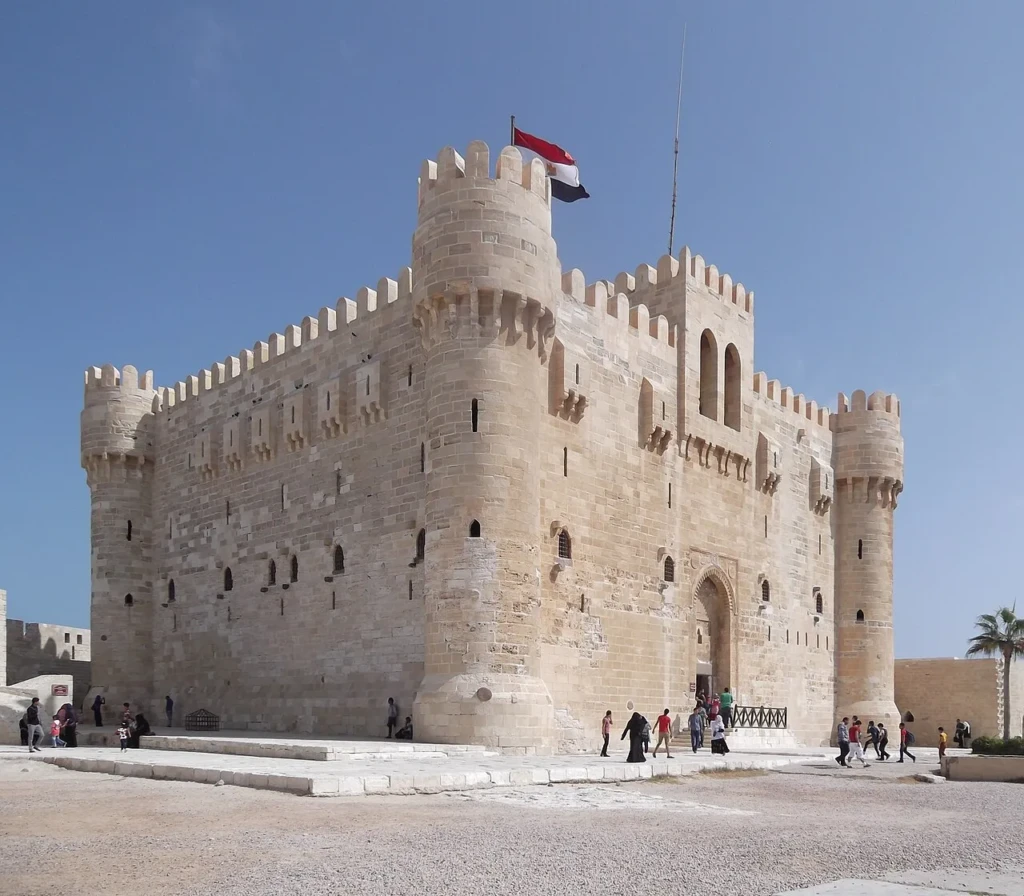
Sultan al-Ashraf Qaitbay built the Citadel of Qaitbay between 1477 and 1479 on the ruins of the Lighthouse of Alexandria, one of the Seven Wonders of the Ancient World. The limestone fort stands at the eastern tip of the old Pharos peninsula, guarding the mouth of Alexandria’s Eastern Harbour. Most visitors spend about an hour here, often as the last stop on a day trip from Cairo.
This guide covers the link between the fort and the lost lighthouse, what you will walk through inside, opening hours and tickets, and how to fit Qaitbay into a day in Alexandria.
Citadel of Qaitbay: Quick Facts
| Fact | Details |
|---|---|
| Location | Eastern tip of the Pharos peninsula, at the entrance to the Eastern Harbour, Alexandria |
| Built | 1477 to 1479 CE (882 to 884 AH), Mamluk period |
| Built by | Mamluk sultan al-Ashraf Abu al-Nasr Qaitbay |
| Built on | The site of the ancient Lighthouse of Alexandria (the Pharos) |
| Material and size | Limestone; the complex covers about 17,550 square meters |
| Opening hours | 9:00 AM to 8:00 PM daily |
| Foreigner ticket | EGP 200 adult, EGP 100 student |
| Time needed | Our planning suggestion: 1 to 1.5 hours |
| From Cairo | Our Alexandria day trip plans for about three hours’ drive each way, depending on traffic |
Hours and prices are as listed on the official Ministry of Tourism and Antiquities site in October 2026; check before you go.
Why Was the Citadel Built on the Site of the Lighthouse?
The short answer is location. The tip of Pharos is the natural lookout point over both of Alexandria’s ancient harbors. Whoever controlled it could watch every ship that came in from the sea. The Ptolemies chose it for their lighthouse, and Qaitbay chose it for his fort some 1,700 years later for the same reason.
The Lighthouse of Alexandria
The lighthouse was planned under Ptolemy I and completed under his son Ptolemy II, between about 284 and 246 BC. Ancient writers credit the design to Sostratus of Cnidus, although modern scholars debate that. Estimates of its height range from about 103 to 118 meters (338 to 387 feet), which made it one of the tallest structures of the ancient world.
It stood for well over a thousand years. Earthquakes cracked it in 796 and 951, and a quake in 956 brought down its top section. A powerful earthquake in 1303 left it in ruins, and a further quake in 1323 finished much of what remained.
The name of the island lives on in everyday language. The Greek word pharos came to mean “lighthouse,” and it survives in words such as the Italian and Spanish faro and the French phare.
From ruin to fortress
Sultan Qaitbay ordered a fort on the lighthouse site to defend Alexandria against attack by sea. Work started in 1477 and the fort was complete by 1479. Chroniclers of the period record that the sultan spent more than 100,000 gold dinars on the project.
The builders reused fallen stone from the lighthouse ruins. So while nothing of the Pharos stands today, parts of it are probably in the walls around you. More of it lies just offshore on the seabed, as you will read below.
A Short History of the Citadel After Qaitbay
The fort stayed in military use for most of the next 500 years. Its story tracks the major turning points of Egyptian history.
- Early 1500s: Sultan Qansuh al-Ghuri, one of the last Mamluk rulers, strengthened its garrison and added a prison.
- Ottoman period (from 1517): The Ottomans kept the fort manned with soldiers, artillery and craftsmen and maintained it.
- 1798: French forces under Napoleon’s invasion took the citadel, helped by its weak garrison at the time.
- Early 1800s: Muhammad Ali Pasha repaired the outer ramparts and installed modern coastal cannons.
- 11 July 1882: The British fleet bombarded Alexandria during the Urabi revolt. The north and west faces of the fort were badly damaged.
- 1904 onward: The upper floors were restored, and King Farouk later had parts renovated as a royal rest house.
- After 1952: The Egyptian navy turned the building into a maritime museum.
- 1984 and 2003: Egypt’s antiquities authorities carried out major restoration and conservation work.
What to See Inside the Citadel of Qaitbay
The layout is simple, which makes the fort easy to visit without a long briefing. Here is the order most visits follow.
1. The outer walls and towers
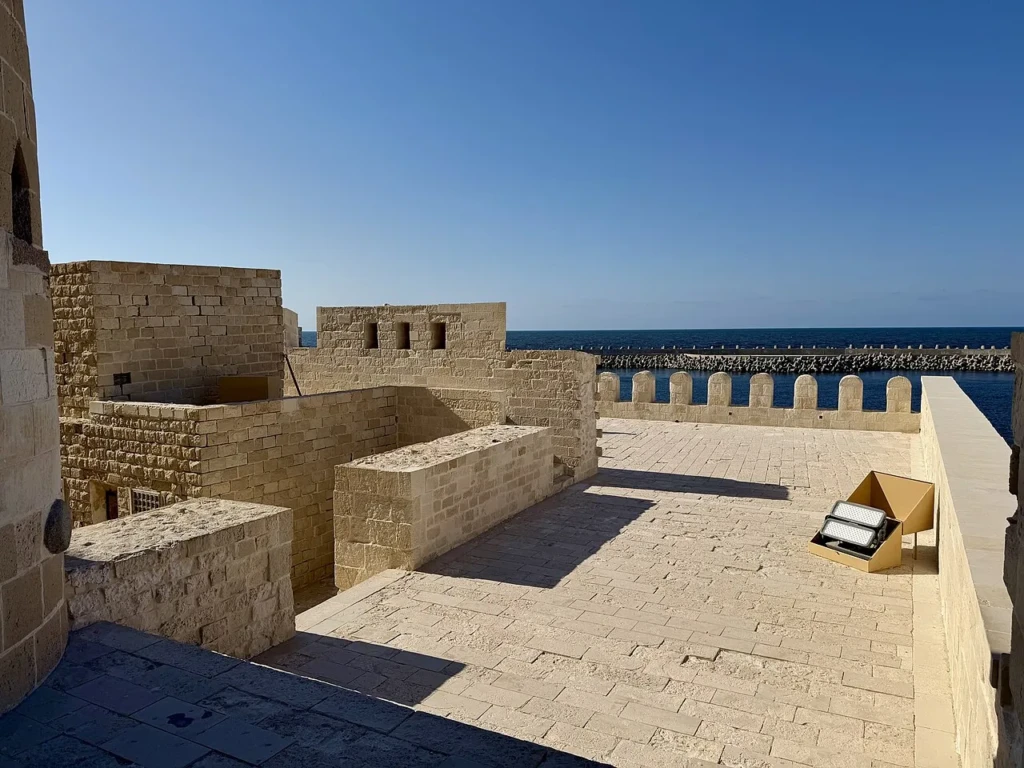
An outer wall studded with defensive towers encloses the whole complex. Walk along the inside of this wall first. It gives you a sense of scale and the first sea views toward the open Mediterranean. Look for the arrow slits and the thickness of the masonry, built to take the impact of a naval attack.
2. The inner wall and barracks
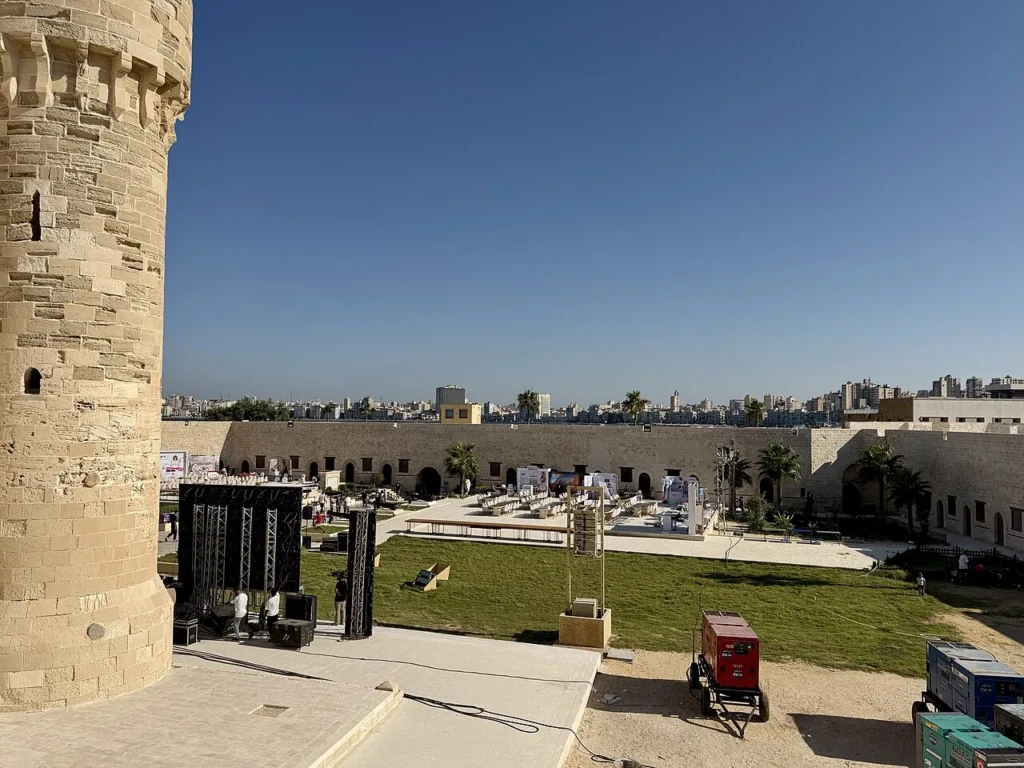
A second, inner wall surrounds the central courtyard. Rooms are built into it, and the Ministry describes some as soldiers’ barracks and others as storerooms. Walking through them shows how a garrison lived, slept and kept supplies on this exposed headland.
3. The courtyard and water tank
The main entrance opens into the courtyard. Near the main tower is a water tank that once supplied the soldiers and their horses. On a promontory surrounded by salt water, a secure fresh-water supply was as important as the walls.
4. The main tower (the keep)
The heart of the citadel is the main tower in the northwest of the courtyard. It is a massive square block on three floors. Half-round towers sit on its four corners, each with projecting balconies that let defenders fire down on attackers. Qaitbay also placed a small mosque within the fortress.
Climbing through the floors is the highlight for most visitors. The upper levels give the widest views over the Eastern Harbour and the city’s seafront.
5. The Qaitbay Citadel Visitor Center
The Ministry of Tourism and Antiquities has opened a visitor center in one of the halls of the main tower, created with the French Centre for Alexandrian Studies. It has nine bilingual Arabic and English panels with maps and diagrams. They explain the ancient Royal Port, nearby submerged sites and how Alexandria’s defenses developed, including later forts built under Muhammad Ali.
A screen shows a film about the lighthouse site. If you only have time for one indoor stop, make it this one, because it explains what you cannot see from the walls.
What Lies Underwater Next to the Citadel?
The Ministry lists the waters beside the fort as an official underwater archaeological site. It begins right at the edge of the citadel, runs for about 150 meters and lies 6 to 8 meters deep. Systematic work there began in 1994.
More than 3,000 architectural pieces have been recorded on the seabed, including columns, statues, bases and capitals. Some of the heaviest blocks weigh over 20 tons and lie in a line heading north from the citadel, consistent with a fall from a tall structure. The site also holds the remains of three ancient shipwrecks, with dates ranging from the 3rd century BC to the 7th century AD.
Back in 1962, divers working with the Egyptian navy raised a colossal statue known as the “Isis of Pharia” from this area, broken into three pieces. You cannot see the seabed from the fort, but you can see some of the recovered pieces on land. The Ministry notes that 36 large blocks from the site are displayed along a corridor at the Roman Theater of Kom el-Dikka in central Alexandria.
Opening Hours and Ticket Prices
As listed on the official Ministry of Tourism and Antiquities site in October 2026, the Citadel of Qaitbay is open every day from 9:00 AM to 8:00 PM. Check before you go, because hours can change on public holidays and during Ramadan.
| Ticket type | Price (October 2026) |
|---|---|
| Foreign adult | EGP 200 |
| Foreign student (with valid student card) | EGP 100 |
You can confirm the current figures on the official Qaitbay Fort page of the Ministry of Tourism and Antiquities.
How to Get to the Citadel of Qaitbay
The citadel sits at the end of the peninsula that closes the Eastern Harbour, so you reach it along Alexandria’s seafront. Within the city, a taxi or private car is the simplest option. Your driver or guide will confirm timing, because traffic along the waterfront can be slow at busy times.
From Cairo, most visitors come on a full-day trip. On our private Alexandria day trip from Cairo, we plan for about three hours’ drive each way, depending on traffic, with an early start and an evening return. If you would rather not do the round trip in one day, an overnight stay makes the visit much more relaxed.
Best Time to Visit
The late afternoon is a good choice. Long opening hours mean you can arrive after other sightseeing and stay for the light over the harbor. Mornings are usually quieter if you want the towers with fewer people around.
Alexandria has a Mediterranean climate and is milder in summer than Cairo or Luxor. In winter, the wind off the sea can be strong and cold on the upper levels, so bring a light jacket. For a month-by-month view of weather across Egypt, see our guide to the best time to visit Egypt.
Practical Tips for Your Visit
- Wear flat, grippy shoes. Stairs inside the keep are stone, uneven and worn smooth in places.
- Dress modestly if you plan to enter the mosque area. Shoulders and knees covered is a sensible standard across Egypt’s religious spaces.
- Bring cash in Egyptian pounds for small purchases on the waterfront, and confirm with your guide how tickets will be paid on the day.
- Allow time for the Visitor Center. It turns a walk around old walls into a clear story about the lighthouse and the harbor.
- Watch the edges. Parapets and sea walls are old, and spray can make surfaces slippery on windy days.
For packing and clothing advice for the whole trip, read what to pack and wear in Egypt.
What Else to See Nearby
Qaitbay is rarely a visit on its own. Alexandria’s Greek and Roman sites pair naturally with it, and the city is compact enough to see several in one day.
- Pompey’s Pillar and the Catacombs of Kom el-Shoqafa: Our day trip from Cairo visits both before ending at Qaitbay.
- The Roman Theater at Kom el-Dikka: See the large blocks recovered from the seabed beside the citadel.
- The Eastern Harbour seafront: The curve of the harbor links the citadel with the city center.
Our Alexandria travel guide covers the city’s museums, neighborhoods and food in more depth. If you are planning Alexandria as part of a longer trip, browse our Egypt tour packages that include Alexandria or the sample 7, 10 and 14-day Egypt itineraries.
Visit with Delta Tours Egypt
The easiest way to see the Citadel of Qaitbay from Cairo is our Alexandria Over Day private tour, from $130 per person. It visits Pompey’s Pillar, the Catacombs of Kom el-Shoqafa and the Citadel of Qaitbay with your own guide and returns you to your Cairo hotel in the evening.
To spend more time in the city, consider the 4 Day Cairo and Alexandria Tour, from $390 per person. Longer journeys that combine Alexandria with a Nile cruise include the Cleopatra 10-Day Cairo, Nile Cruise and Alexandria Tour, from $1190 per person, the Alexander the Great 10-day tour, from $1310 per person, and the luxury Ptolemy 10-day journey, from $3210 per person.
For other single-day options around Cairo, see our private Cairo day tours.
Frequently Asked Questions
Is the Citadel of Qaitbay the same place as the Lighthouse of Alexandria?
It stands on the same spot, but it is a different building. The lighthouse was destroyed by earthquakes in the 14th century, and Sultan Qaitbay built his fort on the site between 1477 and 1479, reusing fallen stone from the ruins.
How much is the ticket for the Citadel of Qaitbay?
As listed on the official Ministry of Tourism and Antiquities site in October 2026, foreign adults pay EGP 200 and foreign students EGP 100. Check the official page before you go, as prices are revised from time to time.
What are the opening hours of the Citadel of Qaitbay?
The official listing in October 2026 gives 9:00 AM to 8:00 PM every day. Hours can differ on holidays and during Ramadan, so confirm on the day.
How long do you need at the Citadel of Qaitbay?
Our planning suggestion is one to one and a half hours. That covers the walls, the main tower and the Visitor Center without rushing.
Can you see the remains of the lighthouse?
Not from the fort itself, because the remains lie underwater beside the citadel. Some recovered blocks are displayed at the Roman Theater of Kom el-Dikka, and the Visitor Center inside the main tower explains the underwater site with maps and a film.
Can I visit Alexandria and the citadel as a day trip from Cairo?
Yes. It is a long day, with about three hours’ drive each way depending on traffic. Our private day trip combines Qaitbay with Pompey’s Pillar and the Catacombs of Kom el-Shoqafa.
Alexandria shows a side of Egypt that the pyramids and temples do not, and the Citadel of Qaitbay is where its ancient and medieval stories meet. Tell us your dates and we will shape the day around you, or explore our tailor-made Egypt tours to build Alexandria into a longer trip.
Featured image: Citadel of Qaitbay. Photo: لا روسا / Wikimedia Commons, CC BY-SA 3.0