Deir el-Medina: The Village of the Tomb Builders

Deir el-Medina is the ruined village on Luxor’s West Bank where the craftsmen who cut and painted the royal tombs in the Valley of the Kings lived with their families. It was occupied for most of the New Kingdom, roughly 1550 to 1080 BC. Visitors today walk through the stone footings of the houses, enter small painted tombs the workmen made for themselves, and see a Ptolemaic temple to Hathor at the north end of the site.
Most West Bank sites tell you how pharaohs wished to be remembered. Deir el-Medina tells you how the people who built those monuments actually lived: what they ate, how they were paid, what they argued about, and which gods they prayed to. This guide covers the history, what to see in a sensible order, tickets and hours, and how to fit the village into a day in Luxor.
Deir el-Medina Quick Facts
| Fact | Details |
|---|---|
| Location | West Bank of the Nile opposite Luxor, in a small desert valley within walking distance of the Valley of the Kings |
| Period | New Kingdom, 18th to 20th Dynasties (about 1550 to 1080 BC); Hathor temple from the Ptolemaic era |
| Founded | Earliest datable remains belong to the reign of Thutmose I |
| Ancient name | Set Maat, “the Place of Truth” |
| Who lived here | The royal tomb workforce and their families, titled “Servants in the Place of Truth” |
| World Heritage | Part of the UNESCO site Ancient Thebes with its Necropolis (inscribed 1979) |
| Opening hours | 6:00 AM to 5:00 PM (Ministry ticket list; see the tickets section) |
| Foreign adult ticket | EGP 220 (student EGP 110); Tomb of Pashedu on a separate EGP 120 ticket |
| Time on site | Our planning suggestion: 1 to 1.5 hours |
What Was Deir el-Medina?
When a New Kingdom pharaoh came to the throne, work began on his tomb in the Valley of the Kings. The quarrymen, plasterers, draftsmen, sculptors and painters who did that work were a permanent, salaried state workforce. They and their families lived together in one walled settlement in a narrow valley behind the hill of Qurnet Murai. That settlement is Deir el-Medina.

The earliest remains that can be dated come from the reign of Thutmose I, early in the 18th Dynasty. The village reached its final shape in the Ramesside period. At its height it held around 68 houses packed along a single narrow street. It was abandoned at the end of the 20th Dynasty, in the reign of Ramesses XI, as tomb robbery, raids and civil instability made the work and the place unsafe.
The Egyptians called the settlement Set Maat, the Place of Truth. Its workmen carried the title “Servant in the Place of Truth,” and the jobs were prized and often passed from father to son. The modern Arabic name means “Monastery of the Town.” It comes from the Christian era, when the old Hathor temple at the site became a monastery dedicated to Saint Isidorus the Martyr.
Why the Village Matters to Historians
Deir el-Medina is one of the best-documented communities anywhere in the ancient world. The reason is paper, or rather its cheaper substitute. The villagers wrote constantly on ostraca, flakes of limestone and broken pottery. Thousands survived. A single well near the village produced around five thousand of them.
These texts record ordinary life: work registers, sales, loans, letters, wills, prayers, court cases, love songs, laundry lists and medical remedies. Through them, scholars know individual villagers by name, along with their families and their quarrels. No other Egyptian site lets you study a working community in this much detail across almost four centuries.
Life in the Place of Truth
The workforce was split into two crews, the “left” and the “right” gangs, each under its own foreman. They worked opposite sides of a tomb, a little like the port and starboard crews of a ship. During a working stint the men slept in a camp on the ridge above Hatshepsut’s temple rather than walking home each night.
Pay came in rations of grain and other goods, at up to three times the rate of a farm laborer. Many workmen also took unofficial second jobs to earn more. Absence records survive, with reasons that range from illness and family events to brewing beer and, in a few famous entries, a hangover or an argument with a wife.
Literacy was unusually high. Many villagers could read, and some women probably could as well. The community also had its own local court, made up of a foreman, deputies, craftsmen and a scribe, to settle disputes over unpaid goods and similar matters.
The First Recorded Strike
Around year 25 of Ramesses III, about 1170 BC, the grain rations stopped arriving on time. The tomb workers put down their tools and walked off the job, complaining that they were hungry and that eighteen days of the month had passed without supplies. The authorities responded, rations resumed, and work restarted. This is often described as the first recorded strike in history, and further protests followed in later reigns.
What to See at Deir el-Medina
The site is compact. Paths link the village, the western cemetery and the temple, and most visitors move through them in the order below. Expect uneven ground and some steep steps down into the tombs.

1. The Village Street and Houses
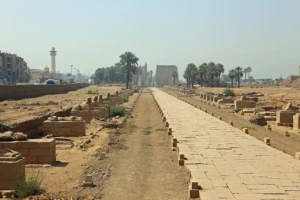
Start with the village itself, laid out in a long rectangle along the valley floor. Only the lower walls survive, but the plan is easy to read. You can follow the central street and step into the outlines of individual homes.
A typical house had four or five rooms in a row: an entrance room, a main room, two smaller rooms, and a kitchen at the back with a cellar and stairs to the roof. Walls were mud brick on stone footings, plastered and whitewashed. Average floor space was around 70 square meters. Look for the raised brick platforms in the front rooms and the wall niches that held household shrines and statues of protective gods.
2. The Workmen’s Tombs
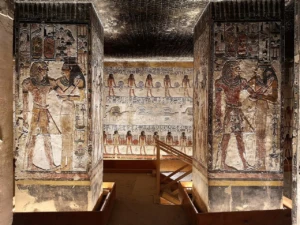
The cemetery climbs the slope on the western side of the village. Because the residents were Egypt’s best tomb craftsmen, their own burials are among the most finely painted on the West Bank. Many paired a small rock-cut chapel with a little pyramid built above it. The burial chambers are small and often reached by steep stairs. The colors inside are bright and the scenes are intimate in scale.
Tomb of Sennedjem (TT1). Sennedjem served in the Place of Truth under Seti I and Ramesses II. His burial chamber was found intact in January 1886, holding about 165 objects and more than 20 burials of family members. Its decorated burial chamber shows Sennedjem and his wife Iyneferti working the fields of the afterlife, along with scenes from the Book of the Dead. The coffins and grave goods were removed long ago, and some are now in museums abroad, including the Metropolitan Museum of Art in New York.
Tomb of Inherkhau (TT359). Inherkhau was a foreman of the tomb workers under Ramesses III and Ramesses IV. His tomb has scenes from the Book of Gates and the Book of the Dead, a harpist, and the sun god in the form of a cat killing the serpent Apophis. One wall shows two rows of earlier kings and queens, led by the village’s divine patrons, Amenhotep I and his mother Ahmose-Nefertari.
Tomb of Pashedu (TT3). Pashedu was another Servant in the Place of Truth. His tomb needs its own ticket. Inside, the god Osiris sits enthroned while Pashedu kneels in prayer, with rows of deities on the walls around them.
3. The Temple of Hathor
At the north end of the site stands a small stone temple inside a mud-brick enclosure. It was built in the Ptolemaic period, on a spot where the villagers had worshipped Hathor long before. Ptolemy IV, who ruled from 221 to 204 BC, is recorded among its builders, and reliefs show him with his queen, Arsinoe III. The temple honored Hathor together with Maat, the goddess of truth and order, a fitting pairing for the Place of Truth. Its later conversion into a monastery gave the whole site its modern name.
Opening Hours and Ticket Prices
The Ministry of Tourism and Antiquities ticket list, published on the official mota.gov.eg site and still posted there in October 2026, gives these figures for foreign visitors:
- Deir el-Medina: EGP 220 per adult, EGP 110 per student, open 6:00 AM to 5:00 PM.
- Tomb of Pashedu: EGP 120 per adult, EGP 60 per student, on a separate ticket.
That list is dated November 2024. Prices at several other sites have changed since then, and Deir el-Medina has no visitor page of its own on egymonuments.gov.eg. Treat these numbers as a guide and check the current price before you go. Ask at the ticket office which tombs the main ticket covers on the day of your visit.
Tickets for West Bank sites are sold separately for each monument, so a visit here is an add-on to your Valley of the Kings ticket, not part of it. Your guide can buy them for you as part of a private day.
How to Get to Deir el-Medina
The village sits on the West Bank, across the Nile from Luxor’s hotels and its East Bank temples. It lies within walking distance of the Valley of the Kings to the north and the Valley of the Queens to the west, with the royal mortuary temples to the east.
Most travelers reach it by private car with a driver as part of a West Bank day. Travel time depends on where you are staying and how you cross the river, so your driver or guide will confirm timing on the day.
How Long to Spend and the Best Time to Visit
Our planning suggestion is 1 to 1.5 hours. That covers a slow walk through the village, two or three tombs and the Hathor temple. Allow more if you want time with the inscriptions or if you are adding the Tomb of Pashedu.
Go early. The site opens at 6:00 AM on the Ministry list, and the valley traps heat by late morning. October to April is the most comfortable season. Between May and September, plan to be finished before midday. For more on weather by month, see our guide to the best season to visit Egypt.
Practical Tips for Your Visit
- Wear shoes with grip. Tomb stairways are steep, and the paths between the village and cemetery are gravel and rock.
- Expect tight spaces. Burial chambers are small and can be warm and crowded. If you dislike confined spaces, the village and temple are fully open-air.
- Carry water and sun protection. There is little shade on the village floor.
- Ask about photography. Rules for cameras and phones inside tombs can change, so check at the ticket office before you take pictures.
- Bring small Egyptian pounds. They are useful for tips to tomb guardians and for restrooms.
- Read before you go. The ruins look modest at first glance. Knowing the stories behind them, from the strike to the absence lists, makes them far more rewarding.
How to Combine Deir el-Medina With Nearby Sites
Deir el-Medina fits into almost any West Bank itinerary because it lies between the main royal sites. A useful approach is to see the royal tombs first, then visit the village to meet the people who made them.
- Valley of the Kings: the royal tombs the villagers cut and decorated. Seeing them first gives context for everything at Deir el-Medina.
- Valley of the Queens: burial ground of royal wives and children, including Nefertari, and another major work site for the same crews.
- Medinet Habu: the mortuary temple of Ramesses III, the king whose reign saw the famous strike.
- Hatshepsut Temple: the terraced temple at Deir el-Bahari, below the ridge where the workmen kept their overnight camp.
A common pattern is the Valley of the Kings early in the morning, Deir el-Medina mid-morning, and Medinet Habu or Hatshepsut’s temple before lunch. Our Luxor travel guide covers how to split the East and West Banks across your days. If you want an early start, our Luxor hot air balloon guide explains how a sunrise flight over the West Bank fits into the same day.
Visit Deir el-Medina With Delta Tours Egypt
Delta Tours Egypt does not sell a fixed Deir el-Medina tour. We can arrange a private visit on request through our tailor-made tours, with your own Egyptologist guide and driver, and fit it around the other West Bank sites you want to see.
If you would like a ready-made day to build on, these existing Luxor products cover the main West Bank and East Bank sites, and we can discuss adding the village when you book:
- West Bank of the Nile private tour, 1 day, from $150 per person
- Luxor East and West Banks private full day, 1 day, from $128 per person
- Luxor hot air balloon ride, 1 day, from $120 per person
- 4 Day Cairo and Luxor Tour, 4 days / 3 nights, from $570 per person
You can also browse all our private Luxor day tours.
Frequently Asked Questions
What is Deir el-Medina famous for?
It is famous as the home of the artisans who built and decorated the royal tombs in the Valley of the Kings. Thousands of written records from the village reveal daily life in unusual detail. Visitors come for the house ruins, the painted workmen’s tombs and the Ptolemaic Hathor temple.
Is Deir el-Medina worth visiting?
Yes, especially if you have already seen the royal tombs. The workmen’s tombs are small but richly colored, and the site is usually far quieter than the Valley of the Kings. It adds a human side to a day otherwise spent with pharaohs.
How much is the Deir el-Medina ticket?
The Ministry of Tourism and Antiquities ticket list on mota.gov.eg shows EGP 220 for foreign adults and EGP 110 for students. The Tomb of Pashedu costs an extra EGP 120. The list dates from November 2024, so confirm the price before you go.
How far is Deir el-Medina from the Valley of the Kings?
The village is within walking distance of the Valley of the Kings, which lies to its north. In practice, most visitors move between the two by car with their driver, which saves time and energy in the heat.
Which tombs can you visit at Deir el-Medina?
The best-known tombs are those of Sennedjem, Inherkhau and Pashedu. Pashedu’s tomb has its own ticket. Ask at the ticket office which tombs the main ticket covers on the day you visit.
Were the Deir el-Medina workers slaves?
No. They were free, salaried state employees paid in grain and other goods. Records show they had legal rights, their own local court and enough standing to go on strike when their rations were late.
Deir el-Medina rewards travelers who want more than a checklist of temples. Tell us how many days you have in Luxor, and we will plan a West Bank route that includes the village, at your pace, through our tailor-made Egypt tours.
Featured image: Temple of Deir el-Medina. Photo: Olaf Tausch / Wikimedia Commons, CC BY 3.0