Egyptian Museum Cairo (Tahrir): Is It Worth Visiting After GEM?

Yes, the Egyptian Museum in Tahrir Square is still worth visiting, even though Tutankhamun’s treasures now sit in the Grand Egyptian Museum (GEM) at Giza. The 1902 building still holds the Narmer Palette, the complete burial of Yuya and Thuya, the royal gold of Tanis and statues of the pyramid-building kings. Plan two to three hours, and treat it as a companion to the GEM rather than a replacement.
This guide explains what moved, what stayed, how to walk the two floors, what tickets cost in October 2026, and how the old museum compares with the new one.
Is the Egyptian Museum in Tahrir Still Open?
Yes. The museum has stayed open throughout the transfer of objects to Giza. When the last Tutankhamun pieces were packed in autumn 2025, only the Tutankhamun hall closed, on October 20, 2025, according to Egypt Today. The rest of the building carried on as normal.
The official name is the Egyptian Museum, though many travelers call it the Cairo Museum, the Tahrir Museum or the Museum of Egyptian Antiquities. All of these refer to the same neoclassical building on Tahrir Square in downtown Cairo.
Opening hours and ticket prices (October 2026)
As listed on the Ministry of Tourism and Antiquities site, egymonuments.gov.eg, in October 2026; check before you go:
- Hours: daily, 9:00 am to 5:00 pm. The ticket window closes at 4:00 pm.
- Ramadan hours: 9:00 am to 4:00 pm, with the ticket window closing at 3:00 pm.
- Foreign adult: EGP 550.
- Foreign student: EGP 275, with a valid student card.
- Audio guide: EGP 75 for foreign visitors.
- Phone photography: free.
The museum’s own ticket and hours page adds that children under six enter free and that a personal-use video permit costs EGP 300, as listed in October 2026. Egyptian and Arab visitors pay much lower local rates. Ticket prices at Egyptian sites change often, so confirm them a few days before your visit.
What Moved to the Grand Egyptian Museum?
Two big transfers changed the Tahrir museum in the past five years.
The royal mummies (2021)
On April 3, 2021, 22 royal mummies, 18 kings and 4 queens, left Tahrir in the Pharaohs’ Golden Parade. They went to the National Museum of Egyptian Civilization (NMEC) in Fustat, Old Cairo, not to the GEM. Ramesses II and Hatshepsut are among them. Our article on where the royal mummies are now covers the parade and the new galleries.
Tutankhamun’s treasures (2025)
For almost a century, Tutankhamun’s gold mask and coffins were the reason most visitors came to Tahrir. That ended in 2025. The final pieces of the collection were moved to Giza that autumn, and the GEM showed almost the whole tomb group together for the public from November 4, 2025, two days after the official opening ceremony. Reports at the time counted more than 4,500 objects on display there.
So if your main goal is the gold mask, the golden shrines or the chariots, go to the GEM. Our Grand Egyptian Museum guide covers tickets, highlights and the Tutankhamun galleries.
Many other objects have also moved. Arab News reported in June 2025 that around 32,000 artifacts had already been transferred, while the Tahrir museum still held around 170,000.
What Can You Still See at the Egyptian Museum?
A lot. The list below sticks to pieces that the Ministry of Tourism and Antiquities or recent reporting confirms are part of the current Tahrir displays. Galleries are being rearranged, so a piece may sit in a different room than older guidebooks show.
The Narmer Palette
This carved slate slab marks the unification of Upper and Lower Egypt under one king, around the start of the pharaonic era. It is small, so many people walk straight past it. Look for the king wearing the white crown on one side and the red crown on the other.
The burial of Yuya and Thuya
Yuya and Thuya were the parents of Queen Tiye, wife of Amenhotep III, and so ancestors of Tutankhamun. Their tomb in the Valley of the Kings was found almost intact in 1905. The museum displays their complete burial upstairs, with coffins, funerary masks and grave goods. For many visitors, this room now does the job the Tutankhamun hall used to do. It shows what a well-stocked New Kingdom burial looked like, at a more human scale.
The treasures of Tanis
Kings of the 21st and 22nd Dynasties were buried at Tanis in the Nile Delta, and their tombs were found intact in 1939 and 1940. The gold and silver from these burials remain at Tahrir. Highlights include the burial goods of Psusennes I and the gold funerary mask of King Amenemope. Because the discovery happened during the Second World War, these pieces are far less famous than Tutankhamun’s, and the gallery is usually quieter.
Statues of the pyramid builders
The ministry lists statues of Khufu, Khafre and Menkaure, the three kings behind the Giza pyramids. Seeing them makes a good bridge if you visit the Giza pyramids on the same trip.
Other pieces worth finding
The museum’s own floor plan lists these among the current ground-floor highlights:
- The colossal seated group of Amenhotep III with Queen Tiye.
- Colossal statues and a bust of Akhenaten from the Amarna period.
- A head of Queen Hatshepsut and relief fragments from her expedition to Punt.
- The coffin of Petosiris and other Late Period and Greco-Roman sarcophagi.
Upstairs, the same plan points to Fayum mummy portraits, a satirical papyrus of a rat served by cats, the Book of the Dead of a priest of Bastet, and a seated statuette of Imhotep. These are small objects with big stories, and they reward slow looking.
How Long Do You Need, and What Route Should You Take?
Two to three hours is enough for the highlights at a steady pace. A serious history reader could spend a full morning. With a guide who knows the rooms, two hours covers the main pieces without rushing.
Ground floor: walk the timeline
The ground floor holds the heavy stone pieces: statues, reliefs and sarcophagi. It is laid out in time order as a clockwise loop, starting with the earliest periods and ending with Greco-Roman Egypt. A simple plan works well:
- Enter and start with the Early Dynastic and Old Kingdom rooms, where the Narmer Palette and the pyramid-age statues belong.
- Continue clockwise through the Middle and New Kingdom galleries.
- Find the colossal seated group of Amenhotep III and Tiye.
- Look for the Amarna-period displays and Akhenaten’s unusual statues.
- Finish the loop with the Late Period and Greco-Roman pieces.
Upper floor: themes and treasures
The upper floor holds smaller objects arranged more by theme: jewelry, papyri, coffins, statuettes and funerary goods. Head first to Yuya and Thuya and the Tanis gold, then use the remaining time for papyri, Fayum portraits and the animal and divine statuettes.
The museum says its exhibits and floor plans are being updated, so treat this route as a guide. Ask a guard or your guide where a specific piece is today.
Tips for an easier visit
- Start early, so you have time for both floors well before the ticket window closes at 4:00 pm.
- Cairo is hot from late spring to early fall, so a morning visit is the most comfortable.
- A guide or the audio tour adds context that short labels cannot.
- Bring your passport or student card if you need a reduced ticket.
Egyptian Museum vs Grand Egyptian Museum: Which Should You Visit?
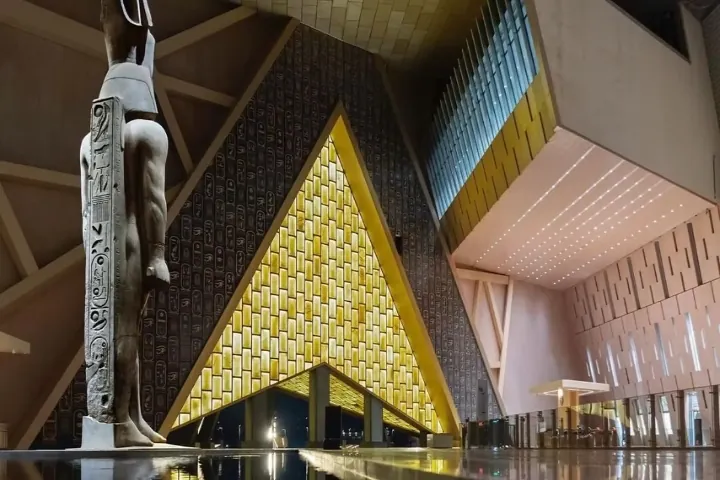
If you only have time for one museum, choose the GEM for Tutankhamun and modern galleries. If you have time for two, add Tahrir for the Narmer Palette, Yuya and Thuya, Tanis and the feel of a historic museum.
| Egyptian Museum (Tahrir) | Grand Egyptian Museum (Giza) | |
|---|---|---|
| Location | Tahrir Square, downtown Cairo | Near the Giza pyramids |
| Opened | November 15, 1902 | Full opening November 2025 |
| Building | Neoclassical, designed by Marcel Dourgnon | Modern, with a Grand Staircase and pyramid views |
| Tutankhamun | No longer on display | Almost the full tomb collection, including the gold mask |
| Main reasons to go | Narmer Palette, Yuya and Thuya, Tanis gold, Old Kingdom statues | Tutankhamun galleries, colossal statues, chronological galleries |
| Royal mummies | No; they moved to NMEC in 2021 | No; see NMEC in Old Cairo |
| Feel | Crowded cases, old labels, historic atmosphere | Spacious, modern display design |
| Time needed | 2 to 3 hours | Half a day or more |
| Foreign adult ticket | EGP 550 (egymonuments.gov.eg, October 2026) | See our GEM guide |
| Best paired with | Downtown, the Nile Corniche, Islamic Cairo | Giza pyramids and the Sphinx |
Who should still go to Tahrir
- Travelers with three or more days in Cairo.
- Repeat visitors who saw Tutankhamun here years ago and want to see the rest properly.
- Anyone interested in the earliest kings, the Old Kingdom or the Third Intermediate Period.
- People who enjoy historic museum buildings as much as the objects.
Who can skip it
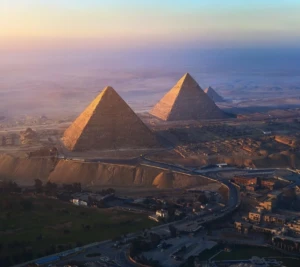
If you have only one day in Cairo, spend it at Giza: the pyramids, the Sphinx and the GEM sit close together. Come back for Tahrir on a later trip, or add a second Cairo day.
How to Combine the Egyptian Museum With Other Cairo Sights
Tahrir sits in the middle of the city, so it pairs well with sights on the east bank of the Nile. Cairo traffic is heavy, though, so avoid crossing the city twice in one day. Group your sights by area instead.
A half day downtown
Start at the museum at 9:00 am. After two or three hours, walk toward the Nile Corniche for lunch. In the late afternoon, take a two-hour Cairo felucca sail (from $45 per person) for a quiet break on the river.
A full day of Cairo history
Pair the museum in the morning with Islamic and Coptic Cairo in the afternoon. Our Old Cairo and Citadel private tour (from $100 per person) covers the Citadel, the bazaar and Coptic Cairo. The NMEC and its royal mummies are also in Old Cairo, so they fit the same side of town.
Giza on a separate day
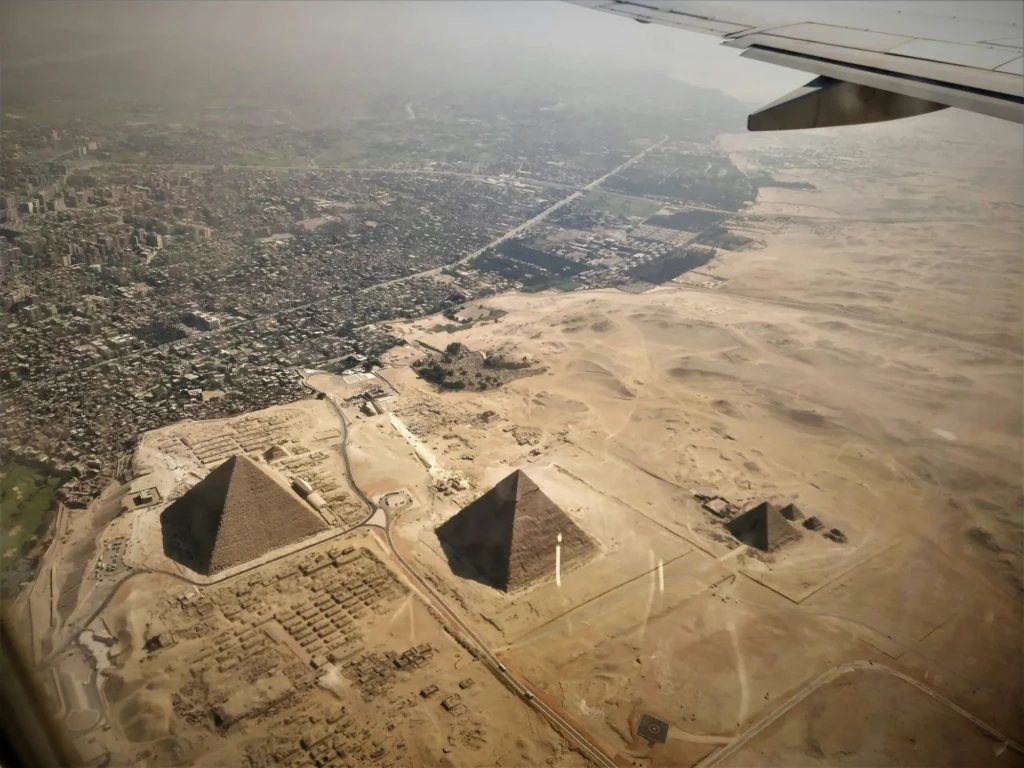
Keep the pyramids and the GEM for their own day. Our Grand Egyptian Museum and pyramids tour (from $95 per person) or the shorter private Giza pyramids tour (from $55 per person) cover that side of the city.
A short Cairo stay
The Taste of Egypt 4-day Cairo tour (from $535 per person) gives you time in the city without rushing. Ask us if you want the Tahrir museum added to your days. Our Cairo travel guide explains neighborhoods and where to stay, and the private Cairo day tours page lists every excursion we run in the city.
A Short History of the Building
Egypt’s first state antiquities collection dates to 1835. Auguste Mariette opened a museum at Boulaq, on the Nile, in 1858. After a flood in 1878 and years of crowding, the collection moved to a palace in Giza in 1889.
The French architect Marcel Dourgnon designed the present building. Its foundation stone was laid in 1897, and it opened on November 15, 1902. The museum describes itself as the first national museum in the Middle East.
The museum came through a hard moment in January 2011, when looters broke in during the revolution and 54 objects were reported stolen. Twenty-five of them were found soon after on the museum grounds, and a “Damaged and Restored” exhibition opened in 2013. Since then, the focus has turned to the transfer to the GEM and to updating the historic galleries.
Frequently Asked Questions
Is the Egyptian Museum worth visiting now that Tutankhamun has moved?
Yes, if you have more than one day in Cairo. The Narmer Palette, Yuya and Thuya’s burial and the Tanis treasures are still there. If you have only one day, choose the GEM.
Is the Egyptian Museum the same as the Grand Egyptian Museum?
No. The Egyptian Museum is the 1902 building in Tahrir Square, downtown. The Grand Egyptian Museum is the new museum beside the Giza pyramids, where the Tutankhamun collection is now shown.
Is King Tut’s mask still in the Egyptian Museum in Tahrir?
No. The gold mask and the rest of the Tutankhamun collection moved to the GEM in 2025. The Tutankhamun hall at Tahrir closed on October 20, 2025, for the final transfer.
How much is the Egyptian Museum ticket for foreigners?
EGP 550 for an adult and EGP 275 for a student, as listed on egymonuments.gov.eg in October 2026. Prices change, so check before you go.
Where are the royal mummies now?
They are at the National Museum of Egyptian Civilization in Fustat, Old Cairo. They moved there from Tahrir in the Pharaohs’ Golden Parade on April 3, 2021.
Can you visit the Egyptian Museum and the GEM on the same day?
It is possible, but it makes for a long day with heavy traffic between downtown and Giza. Two separate days are more comfortable, and each museum deserves fresh eyes.
If you would like both museums, the pyramids and Old Cairo arranged at an easy pace with your own Egyptologist, browse our private Cairo tours or ask us to shape them into a tailor-made itinerary.