Sultan Hassan and Al-Rifai Mosques: Cairo’s Twin Monuments
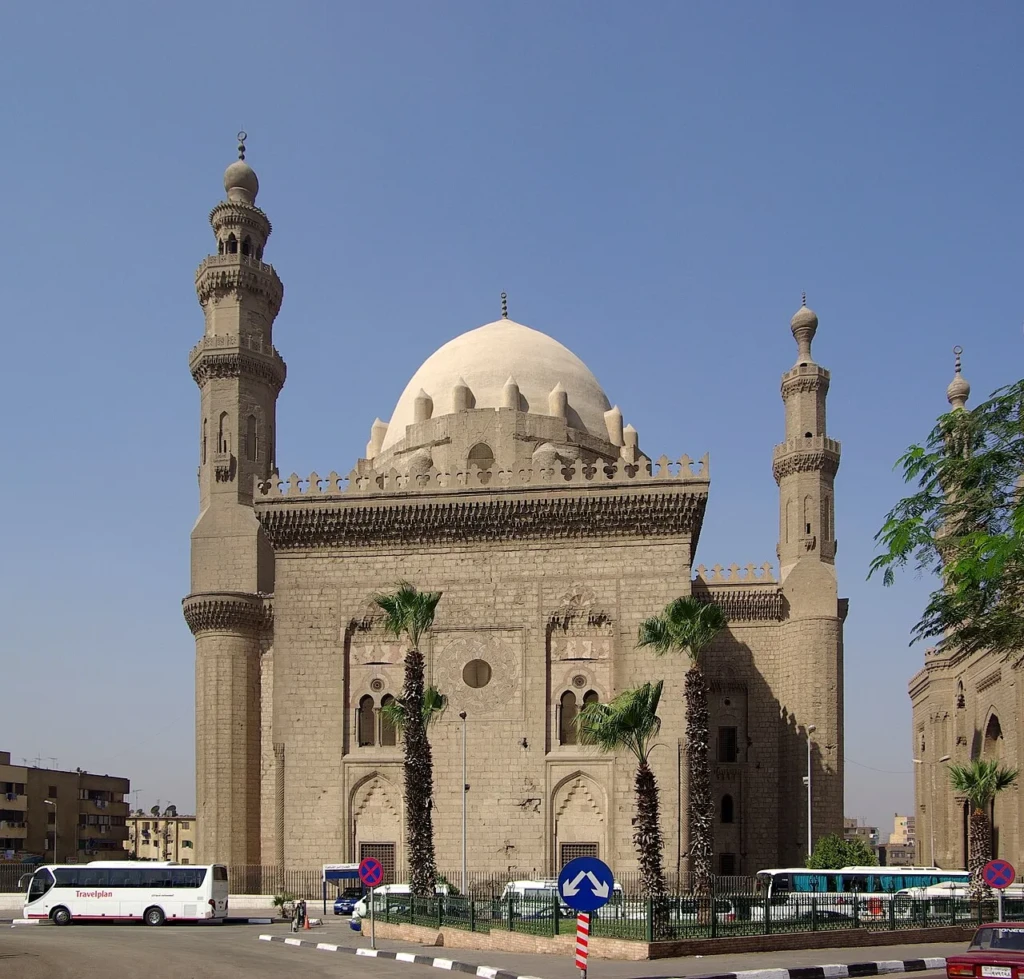
Two giant mosques face each other across a narrow lane below the Cairo Citadel. The Sultan Hassan Mosque is a 14th-century Mamluk mosque and religious school, and the Al-Rifai Mosque beside it was finished in 1912 as a royal burial mosque for Egypt’s last ruling dynasty. One foreign adult ticket of EGP 220 covers both, and they open daily from 9:00 am to 5:00 pm, as listed on the official Ministry of Tourism and Antiquities site in October 2026. Check before you go.
This guide explains why the pair matters, what to look for inside each building, how to fit them into a Cairo day, and how to visit them comfortably as a non-Muslim traveler.
Sultan Hassan and Al-Rifai at a Glance
| Fact | Sultan Hassan Mosque | Al-Rifai Mosque |
|---|---|---|
| Location | Salah al-Din Square (also called Citadel Square), historic Cairo, directly below the Citadel | |
| Built | From 1356 into the early 1360s (Bahri Mamluk period) | 1869 to 1912, in two phases |
| Built by | Sultan an-Nasir Hasan ibn Muhammad ibn Qalawun | Commissioned by Hoshiyar Qadin, mother of Khedive Ismail; completed under Khedive Abbas Hilmi II |
| Purpose | Congregational mosque, four law schools (madrasas) and the founder’s mausoleum | Mosque, Sufi shrine and royal mausoleum of the Muhammad Ali dynasty |
| Opening hours | Daily, 9:00 am to 5:00 pm (official site, October 2026) | |
| Foreigner ticket | Adult EGP 220, student EGP 110; one inclusive ticket for both mosques (official site, October 2026) | |
| Time needed | Our planning suggestion: 1.5 to 2 hours for both, more if you want to sketch or photograph details | |
Why the Sultan Hassan Mosque Matters
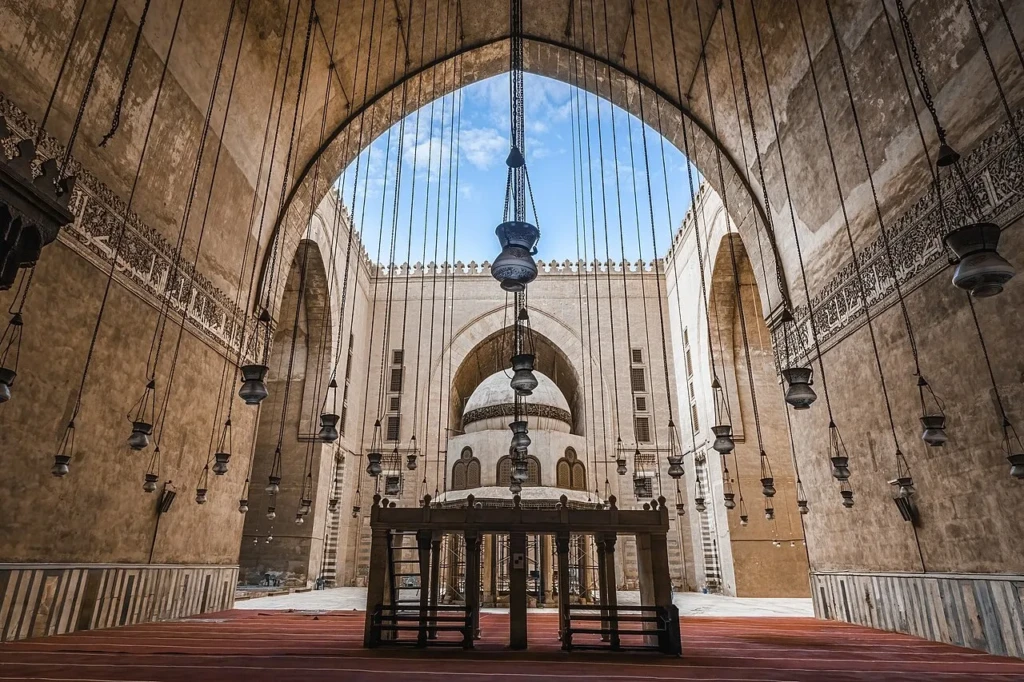
The Sultan Hassan Mosque is one of the largest historic mosques in Cairo and one of the most ambitious buildings of the Mamluk era. It was meant to be a single complex that combined a Friday mosque, schools for the four Sunni schools of Islamic law, student housing and a royal tomb.
A sultan who never lay in his own tomb
Sultan Hasan came to the throne as a boy in 1347. He was deposed, jailed for about three years and later restored. In 1361, while his mosque was still being built, he was assassinated by one of his own commanders. His body was never found, so the grand mausoleum he planned for himself never received him. Two of his young sons are buried there instead.
Built during the plague years
Construction began in 1356, when the Black Death was still returning to Cairo in waves. The medieval historian al-Maqrizi, writing about 60 years later with access to state records, said the work cost 30,000 dirhams a day. Its total cost made it the most expensive mosque of medieval Cairo. Much of the money came from the estates of wealthy emirs who had died in the epidemics. Some historians also believe stone from the Giza pyramids was reused in its walls.
A fortress by accident
The mosque stands so close to the Citadel, and is built so solidly, that rebels used its roof to fire on the fortress more than once. In 1391 Sultan Barquq had its entrance stairs destroyed and the doorway blocked. In 1517 the last Mamluk sultan, Tumanbay, sheltered inside while the Ottomans took Cairo, and Ottoman cannon fired on it from the Citadel. You are looking at a building that survived siege, neglect and partial collapse, and that was restored many times up to the 20th century.
The numbers behind the scale
The building covers almost 8,000 square meters. It is about 150 meters long, 68 meters wide and 36 meters high. The surviving southern minaret is the tallest of Mamluk Cairo; its top stood about 84 meters above the street level of the time. Two more minarets were planned over the entrance, but one fell during construction in 1361 and killed around 300 people, including children at a school below. The builders gave up on the pair after that.
Why Al-Rifai Was Built Next Door
Al-Rifai looks medieval, but it is a late 19th and early 20th-century building in the Neo-Mamluk style. Its designers set out to match Sultan Hassan in height and grandeur, so the two read as a pair from the Citadel above.
The site first held a small Fatimid-era mosque, later turned into a shrine for Ali Abu Shubbak, a grandson of the Sufi founder Ahmad al-Rifai. The mosque takes its name from that family line. In 1869 Hoshiyar Qadin, mother of Khedive Ismail, ordered a much larger mosque that would also hold the tombs of her family. Her architect, Hussein Fahmi Pasha, died during the first phase, and work stopped after Ismail was removed from power. It resumed in 1905 under Khedive Abbas Hilmi II, with the Hungarian architect Max Herz supervising, and the mosque was completed in 1912.
The Ministry of Tourism and Antiquities notes two details worth knowing before you walk in. Builders imported materials such as Italian marble from Europe, and Al-Rifai was the first Islamic monument in Egypt to use cement, a small sign of the move into the modern era.
What to See, in Visiting Order
Most visitors enter Sultan Hassan first, since it is the older building and sets the scale for everything that follows. Then they cross the lane to Al-Rifai. Your ticket is checked at the entrance; keep it handy for the second building.
1. The great portal of Sultan Hassan
The entrance portal rises about 38 meters and is angled outward so it could be seen from the Citadel. Look closely and you will notice that much of its carving was never finished. Some patterns are only outlined in the stone, waiting for a carver who never came. One medallion near the base is carved on one side and blank on the other. It is a rare chance to see how Mamluk stonework was laid out before it was cut.
The original bronze-covered doors are not here. Sultan al-Mu’ayyad bought them at a low price in the early 15th century for his own mosque, where they can still be seen.
2. The domed vestibule and bent passage
Inside the doorway is a small, ornate entrance hall under a central dome with carved stalactite vaults. From there a dark, bending corridor leads you toward the light of the courtyard. The change from shadow to open sky is part of the design, so walk it slowly.
3. The central courtyard and its four iwans
The courtyard is a vast open square framed by four tall vaulted halls called iwans, each open on one side. In the center stands a domed fountain for washing before prayer. Doorways in the four corners lead to the separate madrasa wings, each with its own small courtyard and several floors of student rooms.
4. The qibla iwan and mihrab
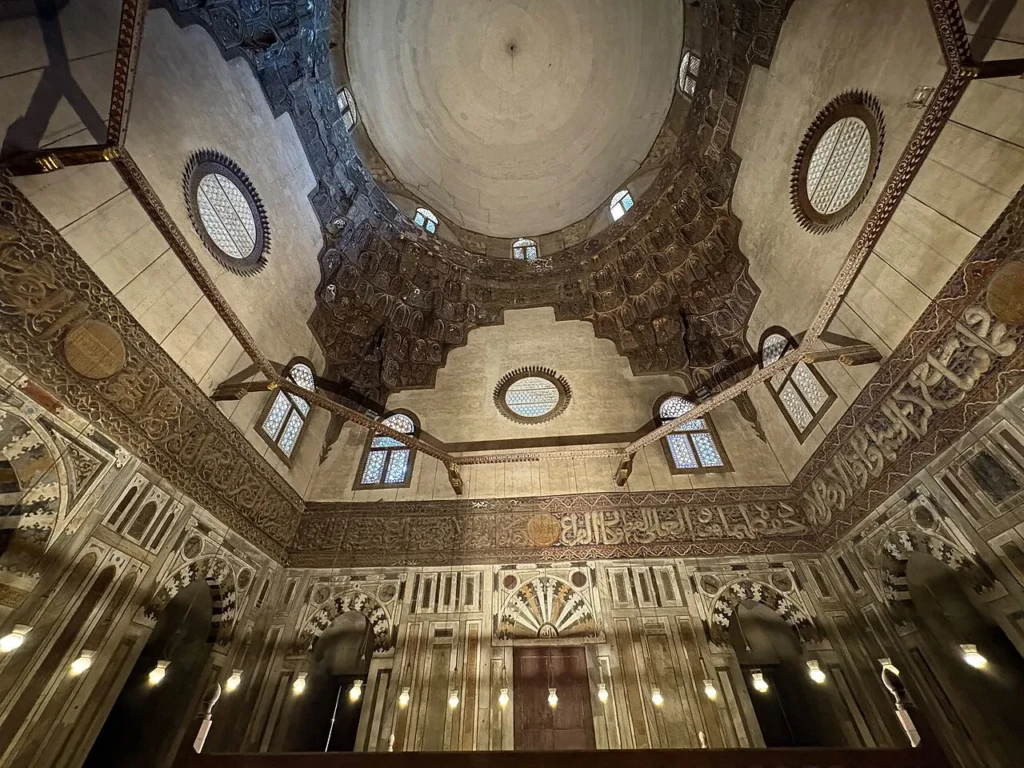
The largest iwan faces Mecca and holds the prayer niche (mihrab) and the stone pulpit (minbar). A long band of Kufic script carved over a background of swirling plant forms runs across the whole hall, quoting the Qur’an’s Sura of Victory. Below it, colored marble panels frame the mihrab. The raised stone platform in the middle of the space was used by Qur’an reciters during prayers.
5. The mausoleum behind the prayer wall
A door to the left of the mihrab opens into the domed tomb chamber. Placing a mausoleum directly behind the prayer wall is unusual; no other Mamluk religious building does it. Inside you will see marble paneling, a carved wooden band of the Throne Verse around the room, painted and gilded wooden corners under a dome about 12 meters across, and a wooden lectern inlaid with ivory. The current dome dates from 1671 and replaced an earlier, bulb-shaped one.
6. Al-Rifai’s entrance and prayer hall
Crossing to Al-Rifai, notice how its entrances are lined with stone and marble columns and gilded arches. The interior covers about 6,500 square meters, of which roughly 1,767 square meters is set aside for prayer. The rest holds the shrine and the royal tombs, so you will spend most of your time in the side chambers rather than the prayer hall.
7. The royal tombs
Al-Rifai is the burial place of Khedive Ismail and his mother Hoshiyar Qadin, Sultan Hussein Kamel, King Fuad I and King Farouk, the last king of Egypt. The tomb of Mohammad Reza Pahlavi, the last Shah of Iran, who died in Cairo in 1980, is also here. Many visitors find this the most surprising part of the visit: a single room tells the story of a century of Egyptian and regional politics.
8. The Sufi shrines
Smaller domed rooms hold the tombs of Ali Abu Shubbak al-Rifai and Yahya al-Ansari. These remain places of devotion, and you may see people praying. Keep your voice low and give them space.
How to Get There and How Long It Takes
The mosques stand on Salah al-Din Square, at the foot of the Citadel hill in historic Cairo. Travel time from hotels in downtown Cairo, Zamalek or Giza depends heavily on traffic, so your driver or guide will confirm timing on the day. If you are staying in Giza, allow extra margin and avoid weekday rush hours where you can.
Taxis and ride-hailing apps can drop you on the square. If you plan to continue to the Citadel afterward, ask your driver to wait rather than walking uphill in the heat.
Opening Hours and Ticket Prices
Both mosques are listed as open every day from 9:00 am to 5:00 pm. The foreign adult ticket is EGP 220 and the foreign student ticket is EGP 110. The official pages state that this is an inclusive ticket that gives entry to both Sultan Hassan and Al-Rifai. All figures are as listed on the official Ministry of Tourism and Antiquities site in October 2026; check before you go, as prices and hours change.
The official listings do not give separate visiting rules for Friday prayers. Because both buildings are working mosques, we suggest avoiding the midday Friday prayer and the call to prayer generally, and following any instruction from the attendants.
What to Wear and How to Behave
These are active places of worship, and respectful dress makes the visit easier for everyone. The following is our standard advice for mosque visits in Cairo rather than an official dress code:
- Cover shoulders and knees. Loose long trousers or a long skirt work well.
- Women should bring a scarf to cover their hair.
- You will remove your shoes before stepping onto prayer areas. Socks help on hot stone in summer.
- Do not walk in front of people who are praying, and keep conversations quiet.
- Ask before photographing people. Photographing the architecture is a normal part of a visit, but follow any signs or attendant instructions on the day.
For wider advice on clothing, money and etiquette, see our guide to what to know before your trip to Egypt.
Best Time to Visit
Arrive soon after opening at 9:00 am. The courtyard of Sultan Hassan is open to the sky, and mornings are usually cooler and calmer.
For the season, the cooler months suit long walks in historic Cairo best. Our guide to the best season to visit Egypt covers the weather month by month. In summer, start early, carry water and plan an indoor stop for the hottest hours.
How to Combine Sultan Hassan with Nearby Sites
The two mosques sit at the heart of one of Cairo’s richest historic areas, which UNESCO added to the World Heritage List in 1979 as Historic Cairo. Several major monuments are close by:
- The Cairo Citadel sits directly above the square, with the Muhammad Ali Mosque on its summit. Seeing the two mosques from the Citadel walls, and then the Citadel from the square, shows why the builders angled their facades as they did.
- The Mosque of Ibn Tulun, from the 9th century, lies in the same district and makes a strong contrast in age and style.
- Khan el-Khalili and al-Muizz Street are a short drive north and work well for a late afternoon in the old city.
A full Islamic Cairo day often pairs the Citadel and these two mosques in the morning with the bazaar later on. Many travelers spend another day at Giza and the museums. Our Cairo travel guide helps you split the city into realistic days, and our Grand Egyptian Museum guide covers the ancient side of most Cairo stays.
Visit with Delta Tours Egypt
We do not sell a fixed tour built around Sultan Hassan and Al-Rifai, but we can arrange a private visit with a licensed guide and driver on request through our tailor-made Egypt tours. It fits easily into a custom Cairo day alongside the Citadel or the bazaar.
If you prefer a ready-made itinerary, our Old Cairo and Citadel private tour starts from $100 per person, and the Taste of Egypt 4-day Cairo tour starts from $535 per person. For Giza, the private Pyramids day tour starts from $55 per person. Ask us if you would like the two mosques added to a private day, and we will confirm what is possible. You can compare all our options on the Cairo day tours page.
Frequently Asked Questions
Is one ticket valid for both Sultan Hassan and Al-Rifai?
Yes. The official Ministry of Tourism and Antiquities listings describe the EGP 220 foreign adult ticket as inclusive, covering both mosques. Students pay EGP 110 with a valid card, as listed in October 2026.
Can non-Muslims enter the Sultan Hassan Mosque?
Yes, both mosques sell tickets to foreign visitors during opening hours. Dress modestly, remove your shoes where asked, and avoid walking in front of anyone who is praying.
How old is the Sultan Hassan Mosque?
Work began in 1356 and continued into the early 1360s, during the Bahri Mamluk period. That makes the building more than 660 years old. Its neighbor, Al-Rifai, is far younger and was completed in 1912.
Who is buried in the Al-Rifai Mosque?
Members of Egypt’s former royal family rest here, including Khedive Ismail, King Fuad I and King Farouk. The last Shah of Iran, Mohammad Reza Pahlavi, is also buried in the mosque. Sufi shrines of Ali Abu Shubbak and Yahya al-Ansari occupy separate chambers.
How long should I spend at the two mosques?
We suggest 1.5 to 2 hours for both. That allows time for the portal, the courtyard, the mausoleum and the royal tombs without rushing. Photographers and architecture fans may want longer.
Is Sultan Hassan worth it if I have already seen the Citadel?
Yes. The Citadel shows Cairo’s rulers and their fortress, while Sultan Hassan shows the scale of Mamluk religious building up close. Seeing both gives you the view from above and from below of the same historic square.
Planning Cairo around more than the pyramids? Tell us which monuments matter most to you, and we will build a private itinerary around them through our tailor-made tours.
Featured image: Mosque-Madrasa of Sultan Hassan, Cairo. Photo: Berthold Werner / Wikimedia Commons, CC BY 3.0