Pyramid of Menkaure: The Smallest Giza Pyramid
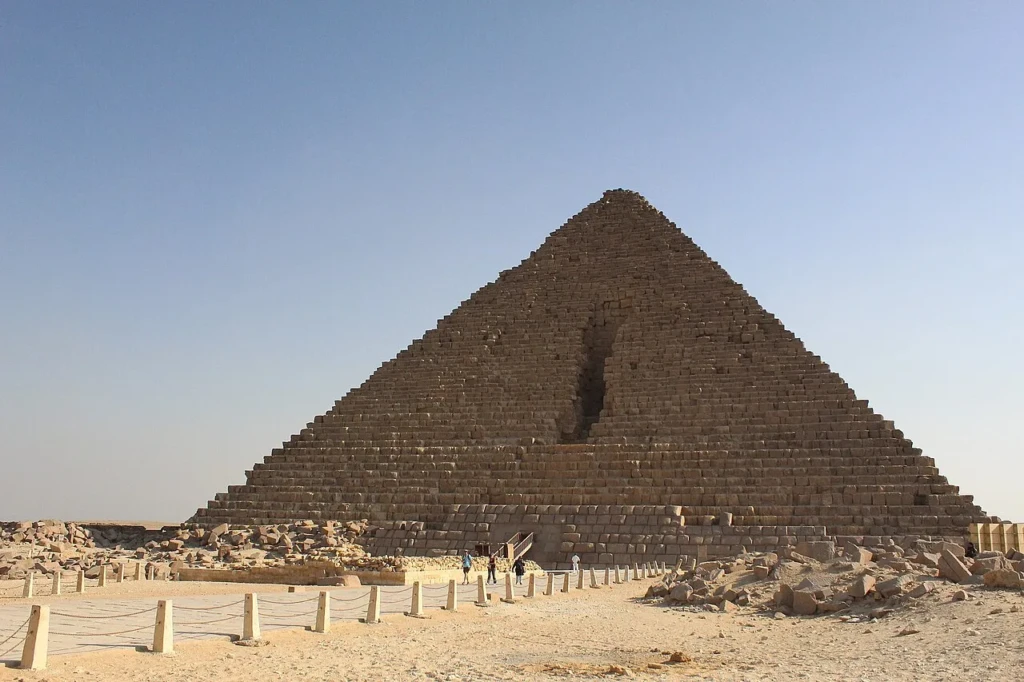
Standing about 65 m (213 ft) tall when finished, the Pyramid of Menkaure is the smallest of the three main pyramids at Giza. It was built for King Menkaure (c. 2532–2503 BC), most likely Khafre’s son and Khufu’s grandson. What it lacks in size it makes up for in material: its lower casing was red granite brought from Aswan, more than 800 km (500 miles) to the south.
Below you will find why it is so much smaller, what makes it unusual, what lies inside, the official ticket and hours information, and how to include it in a Giza visit.
Pyramid of Menkaure at a Glance
| Fact | Details |
|---|---|
| Location | Southwestern end of the main row of pyramids on the Giza Plateau |
| Period | Old Kingdom, 4th Dynasty; reign of Menkaure, c. 2532–2503 BC |
| Built for | King Menkaure (Mykerinos or Mycerinus to the Greeks) |
| Original height | About 65 m (213 ft); about 61 m (200 ft) today |
| Casing | Aswan granite on the lower part, limestone above |
| Companions | Three small queens’ pyramids on its south side |
| Interior ticket (foreign adult) | EGP 280, plus Giza area entry (official site, October 2026) |
| Time needed | About 45 minutes outside; 30–45 minutes more inside (our planning suggestion) |
| Delta tour | Giza, Saqqara and Dahshur pyramids day tour, from $105 per person |
Who Was Menkaure?
Menkaure was the third and last of the great pyramid builders at Giza. The Ministry of Tourism and Antiquities dates his reign to about 2532–2503 BC and describes him as most likely the son of Khafre and the grandson of Khufu. The Greeks knew him as Mykerinos.
Greek writers were still telling stories about him two thousand years later. Herodotus, writing in the 5th century BC, described the pyramid of Mycerinus as built of “Ethiopian stone” up to half its height, a nod to its granite casing. He also recorded, and rejected, a Greek tale that it belonged to a courtesan named Rhodopis.
His temples also produced some of the best-known sculpture of the Old Kingdom. The so-called triads, found in his valley temple, show him as a young, athletic king beside the goddess Hathor and a regional deity.
Why Is the Pyramid of Menkaure So Small?
The difference in size is dramatic. The Ministry notes that Menkaure’s pyramid covers less than a quarter of the base area of the other two. By volume, it is roughly a tenth of the Great Pyramid.
The Ministry gives two main reasons. First, space on the Giza Plateau was running out after Khufu and Khafre had claimed the best ground. Second, Menkaure chose a far more demanding material for the outside of his tomb.
A granite skin from Aswan
Khufu and Khafre cased their pyramids in white limestone. Menkaure chose granite for the lower part. The stone was quarried in Aswan and shipped down the Nile. Granite is much harder than limestone, so every block took longer to cut, move and dress.
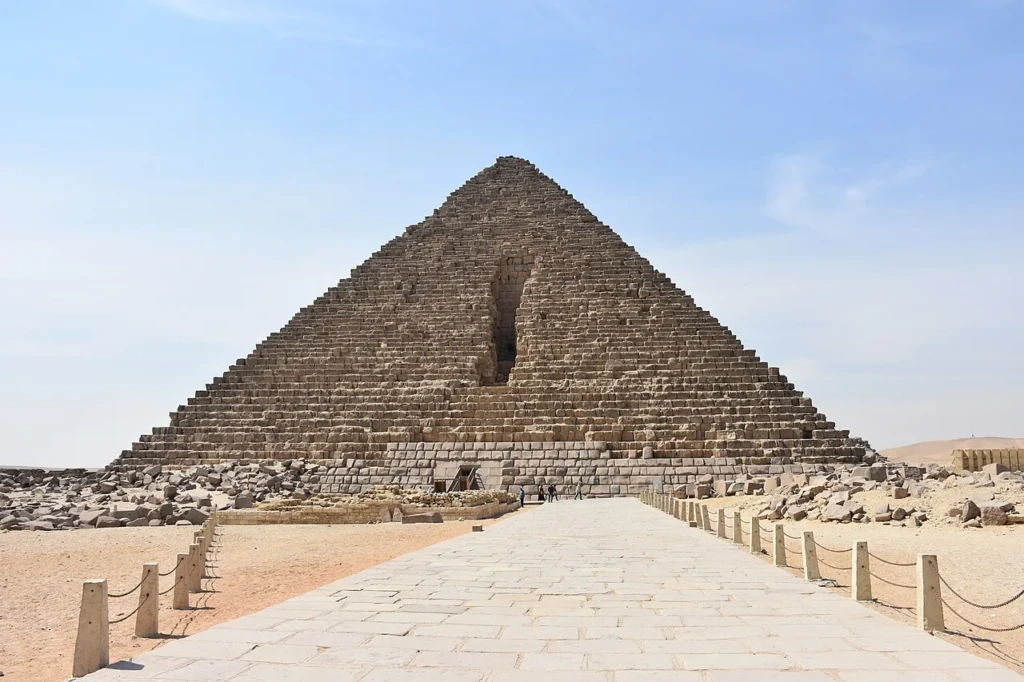
Only the bottom part of the casing was granite. The courses above it were limestone, which has since disappeared. Some of the granite blocks are still in place around the base today, and you can see that many of them were never smoothed. That rough finish is a sign that work stopped before the pyramid was complete.
A king who died before the work was done
According to the Ministry, Menkaure died before his complex was finished. His mortuary and valley temples were planned in huge limestone blocks faced with granite, but they were completed in whitewashed mud brick instead. His successor, Shepseskaf, finished the job more quickly and cheaply.
Even so, Menkaure’s cult did not fade. The Ministry notes that priests kept up his worship for about 300 years after his death.
What to Look for on the Outside
Many visitors give Menkaure’s pyramid a quick photo stop and move on. It rewards a slower look, because the unfinished details tell a story the larger pyramids cannot.
The rough granite casing
Walk along the lower courses and look closely at the granite. Much of it was left in the rough. On the east face, around the spot where the mortuary temple met the pyramid, part of the casing was dressed smooth, which shows how the finished surface was meant to look. It is one of the best places in Egypt to see ancient stone dressing at an incomplete stage.
The great gash on the north face
A deep vertical scar runs down the north face. It dates to 1196, when Sultan al-Aziz Uthman, a son of Saladin, ordered workers to begin dismantling the pyramids, starting with this one. After months of slow work, the project was abandoned. The damage remains, and it exposes some of the pyramid’s internal structure.
The three queens’ pyramids
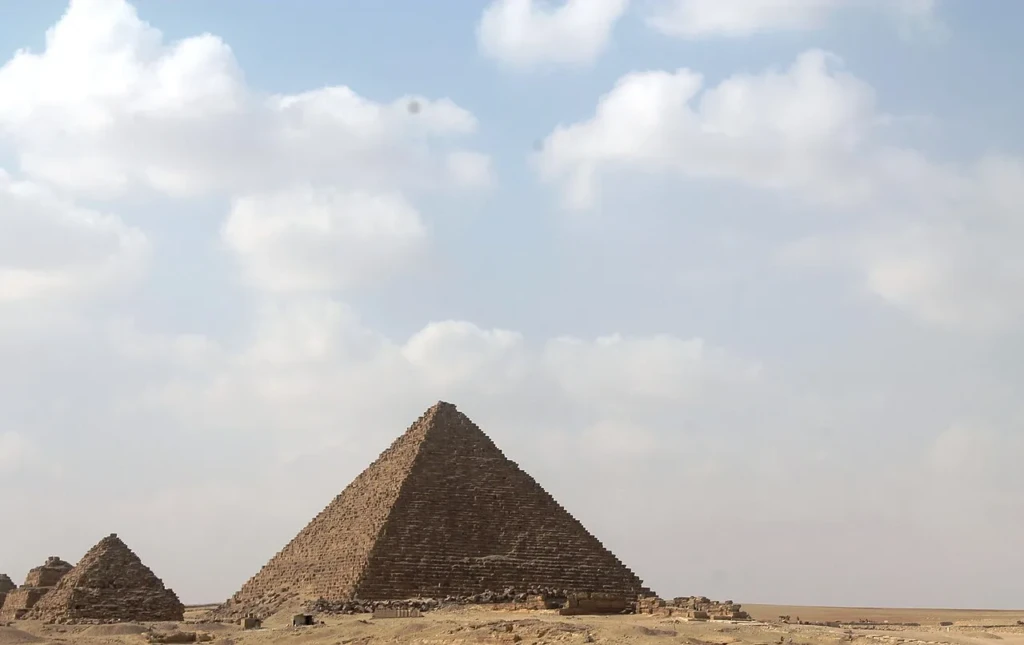
On the south side stand three small pyramids, usually linked to Menkaure’s queens. The easternmost is the largest and the only true pyramid in shape. The other two are stepped. The Ministry notes that no separate satellite pyramid has been found for Menkaure, and that the largest of the three may first have been planned as one.
The scattered casing blocks
You will see many granite blocks lying around the base. In early 2024, a plan to put some of them back on the pyramid caused wide debate. The Ministry later reported that a scientific review committee had unanimously objected to reinstalling the blocks, because their exact original positions cannot be known. The committee backed study, survey and site cleaning instead, so the pyramid keeps its current appearance.
What Is Inside the Pyramid of Menkaure?
The interior is more complex than its size suggests, and it was the first royal pyramid at Giza to include decorated walls in an underground room. The layout below follows published surveys of the pyramid. Your guide will confirm which parts are open on the day.
The descending passage
The entrance is on the north face, a few meters above the base. A passage lined with granite where it crosses the masonry slopes down into the bedrock. Expect a steady downhill walk in a confined space.
The paneled antechamber
The passage opens into a room whose walls are carved with niches that imitate the facade of a royal palace. It is simple decoration, but it is the first in the inner rooms of any Giza pyramid. Neither Khufu’s nor Khafre’s burial chambers have anything like it.
The portcullis and the upper chamber
Beyond the antechamber, a passage once held three granite portcullis slabs that blocked access to the rest of the tomb. It then leads to a large rectangular room. Scholars think this room was part of an earlier plan and later served as working space during construction.
The granite burial chamber
A further passage descends from the floor of that room to the burial chamber. It is lined with red Aswan granite, and its ceiling of paired granite beams was cut into a curve, giving it a softly vaulted look. Nearby, a short stair leads to a room with six small cells, possibly for storage of burial goods.
The Lost Sarcophagus of Menkaure
In 1837, the British explorer Howard Vyse located the true entrance and reached the burial chamber. Inside he found a basalt sarcophagus carved with palace-facade panels, a rare and beautiful piece for its time.
Vyse arranged to ship it to England. In 1838, the ship carrying it, the Beatrice, sank in a storm with all its cargo. The sarcophagus has never been recovered. Today it is known only from drawings published by Vyse and a watercolor by a French Egyptologist.
Vyse also found the lid of a wooden coffin bearing Menkaure’s name. Later radiocarbon dating showed it was made centuries after his death, probably when the tomb was restored in later times. The lid is now in the British Museum.
Opening Hours and Tickets
These figures are as listed on the official Ministry of Tourism and Antiquities site in October 2026; check before you go.
| Ticket | Foreign adult | Foreign student |
|---|---|---|
| Giza Plateau area entry | EGP 700 | EGP 350 |
| Pyramid of Menkaure interior (area ticket required) | EGP 280 | EGP 140 |
The official Menkaure page lists opening hours of 7:00 AM to 5:00 PM daily. The official Giza Plateau page lists 8:00 AM to 4:00 PM for the plateau and confirms that the area ticket does not include entry to any of the three pyramids. Because the two official listings differ, use the shorter window for planning and confirm on the day.
Among the interior tickets published for Giza, Menkaure’s is far cheaper than the Great Pyramid’s, which the Ministry lists at EGP 1,000 for a foreign adult. If you want to go inside a Giza pyramid without paying the top price, Menkaure is worth considering.
How to Get There
Menkaure’s pyramid stands a few hundred meters southwest of the pyramid of Khafre, inside the same Giza Plateau site. You reach it after entering one of the plateau’s main gates with an area ticket. There is no separate entrance.
Travel time from your hotel depends on where you stay and the traffic on the day; your driver or guide will confirm timing. Inside the site, the walk from the Great Pyramid to Menkaure is long and exposed to the sun, so moving between the pyramids by car saves a lot of energy.
Best Time to Visit and Practical Tips
Visit early in the day, when temperatures are lower and the light on the granite casing is softer. Our guide to the best time to visit Egypt explains how conditions change through the year.
- Choose shoes with good grip. The ground around the base is uneven, and the descent inside is steep.
- Skip the interior if you are uncomfortable in narrow spaces or have trouble with stairs and slopes.
- Bring water and sun protection. There is very little shade near the pyramid.
- Ask your guide to point out the smoothed granite panels and the queens’ pyramids before you go inside.
Combining Menkaure’s Pyramid With Nearby Sites
Menkaure’s pyramid is one stop in a full Giza visit. Depending on the route your guide chooses, you can continue to the Sphinx and Khafre’s valley temple at the eastern edge of the plateau. Our Giza Pyramids Complex guide lays out the whole site, and our Great Sphinx of Giza guide covers the next stop.
If Menkaure’s unfinished state makes you curious about how pyramids developed, the earlier sites to the south show the full story. See our Step Pyramid of Djoser guide and our Dahshur Bent and Red Pyramid guide.
Visit With Delta Tours Egypt
Our Giza, Saqqara and Dahshur pyramids day tour, from $105 per person, places Menkaure’s pyramid in the wider story of pyramid building, from Djoser’s steps to the Red Pyramid. For a shorter visit focused on Giza, the private Giza pyramids tour starts from $55 per person. You can also pair the plateau with the museum on the Grand Egyptian Museum and pyramids tour, from $95 per person. Travelers with a long layover can look at the Cairo airport stopover tour, from $180 per person.
Frequently Asked Questions
How tall is the Pyramid of Menkaure?
The Ministry of Tourism and Antiquities gives its original height as 65 m. It now stands at about 61 m because its top and much of its casing are gone. That makes it far smaller than the Great Pyramid and the Pyramid of Khafre.
Why is the Pyramid of Menkaure partly red?
The lower part of its casing was made of red granite from Aswan. The limestone that covered the upper part has been removed over the centuries. Many of the granite blocks were never smoothed because the king died before the work was finished.
Can you go inside the Pyramid of Menkaure?
The official site lists an interior ticket at EGP 280 for foreign adults, on top of Giza area entry, as of October 2026. Access can change, so confirm with your guide or at the ticket office on your date.
Who damaged the Pyramid of Menkaure?
The large gash on the north face dates to 1196, when Sultan al-Aziz Uthman tried to demolish the pyramids. Workers gave up after months of slow progress. Stone robbing over many centuries also removed most of the upper casing.
Are the granite casing blocks being put back?
No. A review committee reported in 2024 that it objected to reinstalling the scattered blocks, since their original positions cannot be known. The Ministry published the committee’s findings, which favor study and site cleaning over reconstruction.
Is the Pyramid of Menkaure worth visiting?
Yes, especially if you enjoy detail. Its unfinished granite casing, queens’ pyramids and decorated antechamber show stages of construction that the larger pyramids hide. Its interior ticket is also cheaper than the Great Pyramid’s.
Menkaure’s pyramid is small only by Giza standards, and it tells you more about how the work was done than its neighbors do. To add it to a guided day on the plateau, browse our Egypt day tours and private excursions.
Featured image: Pyramid of Menkaure at Giza. Photo: Vincent Brown / Wikimedia Commons, CC BY 2.0